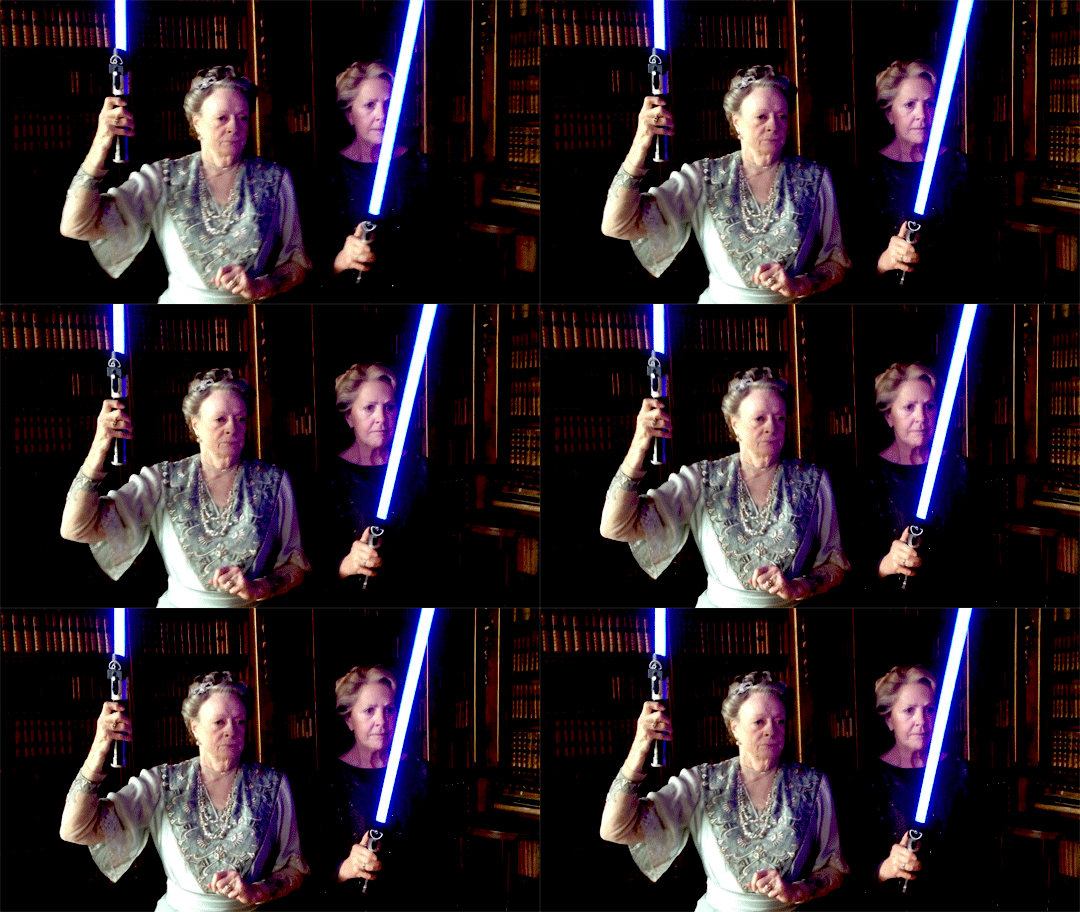
I’m most fond of her role as Dowager Countess Violet Crawley in Downton Abbey. It is one of the best in that franchise—most of the characters are interesting and all of the acting is fantastic, but hers topped it by far. Already two years ago, you could tell from the footage of the second movie, Downton Abbey: A New Era, that she was getting very old and fragile. I remember thinking at the time that I wouldn’t be surprised if that was to be her last performance. (It wasn’t, but almost.)
(Note: There’s no captioning, and it’s only in Finnish, but mostly the trailer is non-verbal. In the beginning, the text reads Experience the world’s best-known adventure. At the end, while raising his staff Gandal says You cannot pass!)
Tampere Theatre, Tampere Hall, and Tampere Philharmonic Orchestra, among others, have worked for four years to create the adaptation. I haven’t heard the reason why the play runs only about two months (Aug 22 to Sept 21, 2024 and Dec 18, 2024 to Jan 11, 2025); you’d think a slightly longer run might be warranted for such a large production. I do know it’s staged at Tampere Hall instead of Tampere Theatre’s own, beautiful historical building because the latter is under renovations. I also know that the production team had to make their own Finnish translation from scratch and that no songs were allowed due to limitations posed by The Tolkien Estate.
The sets and props look fantastic, as does the lighting and video projections. I’m not sure I agree with the Elven costuming, though; their profiles look a little too much like the female Hobbit / villager Hobbit profiles. Otherwise the wardrobe looks fabulous. You can’t tell about the soundscape on the basis of the trailer alone, but I have high hopes. I hope the Hall also works for the adaptation as a performance space.
We can’t wait to see it!
Out There highlights intriguing art, places, phenomena, flora, and fauna.
The beginning of autumn is upon us. Trees are putting on their fall colors as the days grow shorter and the night chill begins to bite. What’s a druid to do but put together an autumn-themed transmog? This includes a few of the beautiful woodsy leafy pieces from the Emerald Dream zone mixed with some other gear.
I have to say that I’m not wowed. It’s very pretty to look at, beautifully cinematic, even breathtaking at times. However, it really doesn’t seem to be a movie for me.
We’re not in the 80s or 90s anymore, when just about any SFFnal movie was sure to get my eyeballs simply by existing. Then, for a while during and after the aughts, handsome effects and CGI often got me to see a movie I wouldn’t necessarily have seen at the theater otherwise. Now we have reached a saturation point. For a good long while I have just not been able to be bothered about seeing a new release at the theater unless there’s something special about it, or a movie hits a very particular interest of mine.
(I will certainly not take the trouble, if trailers merely make a movie look like a whole bunch of men doing man-things and relegates women to the sidelines. It’s one thing to place your story in a society where minorities aren’t formally given recognition by the society, but there’s a huge difference between writing or filming those minorities in a dismissive way and a respectful way. I found Oppenheimer, for example, a wonderful example of the latter.)
Even reading that Megalopolis is loosely based on Roman history (the Catilinarian Conspiracy in 63 BCE involving an aristocrat attempting to overthrow the Republic) didn’t make it more interesting to me. Granted, the time stop gimmick is slightly interesting, but I confess that it, too, lost its appeal by the end of the trailer.
It is a shame I won’t see more of Nathalie Emmanuel, whose work in the Fast & Furious franchise and in Game of Thrones I’ve liked. Perhaps I’ll find Megalopolis in the library, if it’s ever imported to Finland. At this writing it doesn’t look like it, but we’ll see.
Megalopolis opens on September 27, 2024.
Hey, look! We found a thing on the internet! We thought it was cool, and wanted to share it with you.
Last month we saw an exhibit of fantasy art by John Howe in Tampere-talo, Tampere, Finland. Titled The Art of John Howe: Journeys through the worlds of J.R.R. Tolkien, the exhibit is the first time that Howe’s work has been comprehensively displayed in Finland.
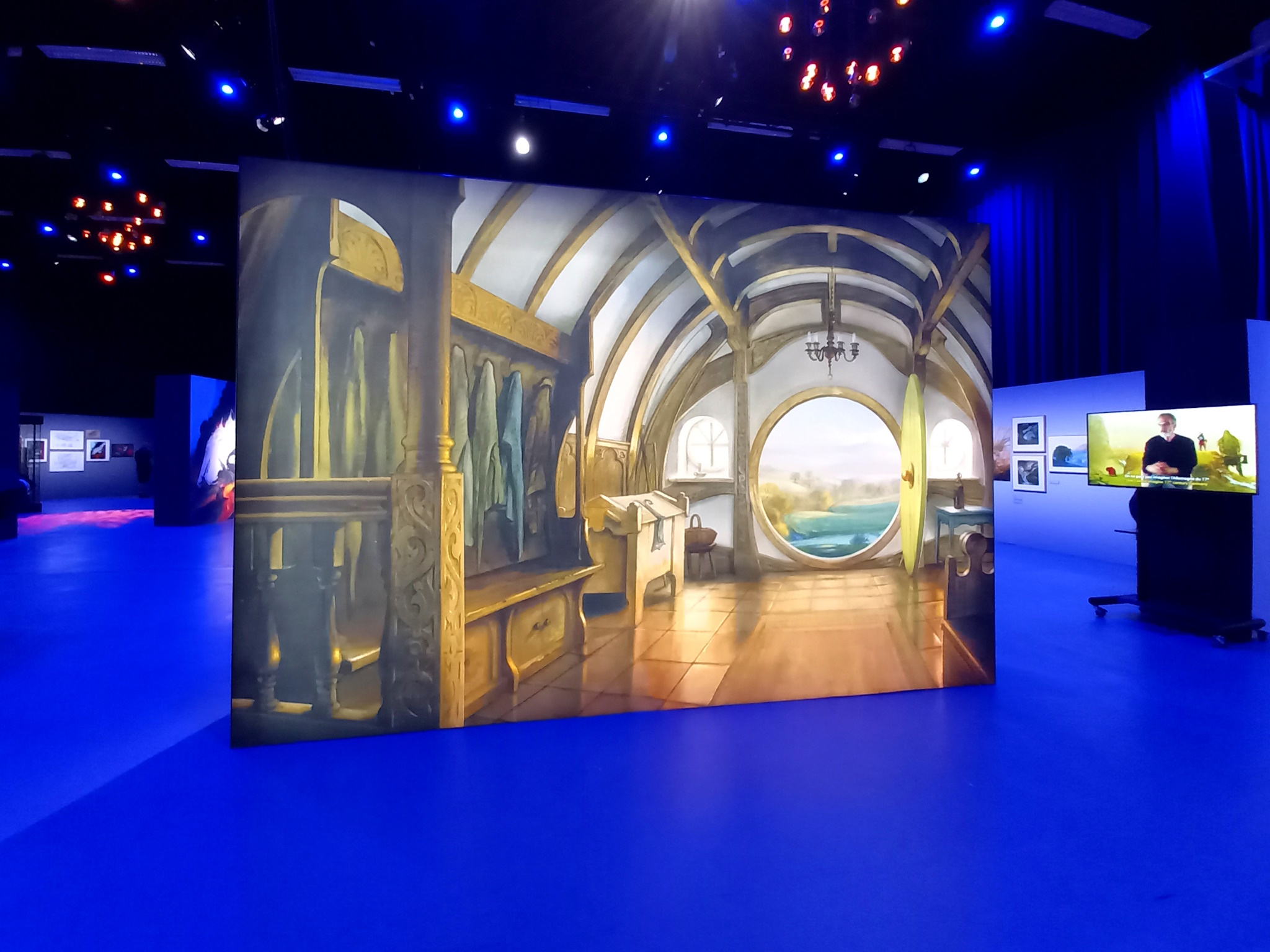
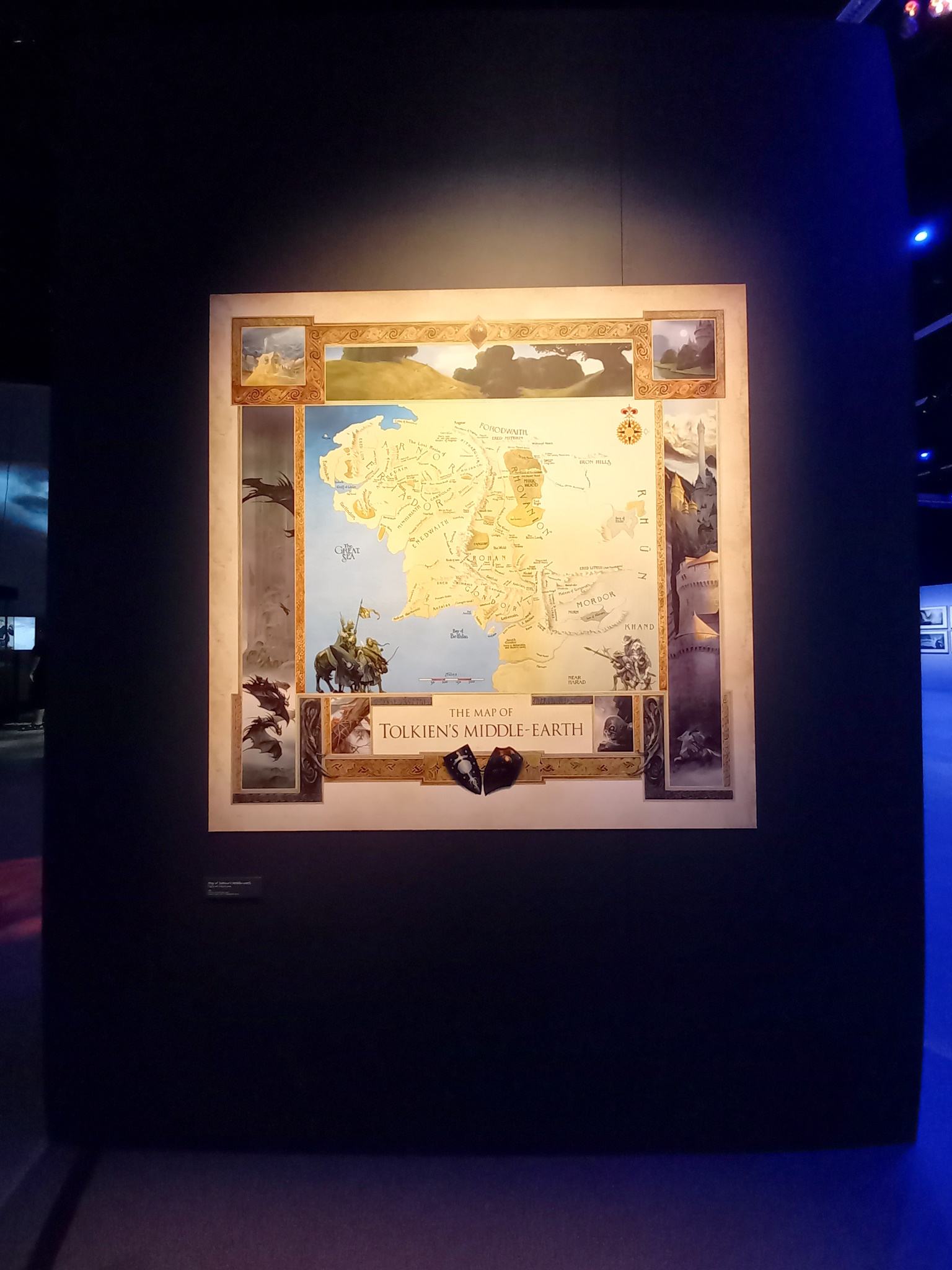
Over 250 original works were presented, from pencil drafts to finished color paintings and sculpture, along with sketchbooks and even some metal armor belonging to Howe. Some images were also enlarged into murals or banners, and a number of video screens scattered around the exhibit looped captioned interviews.
Apart from various illustrations of The Lord of the Rings and The Hobbit, on display were for example works on mythical topics or sagas, like Beowulf and Arthurian legends. Also various architectural or creature studies were included.
The exhibit space was partitioned into irregular areas. Walls framed your route in interesting ways, and the murals created striking views. In one corner there was even a video with flying dragons projected up on the wall high above the framed artworks so that the dragons were visible from a distance. The art pieces had enough room, and no area was too small—clearly accessibility was planned in.
There was no predetermined loop, merely a path suggested by the layout, which made it easy to pick your preferred viewing order and to avoid the occasional crowd. It was also easy to double back without first having to finish the whole route.
Color and lighting were used in a fascinating way. Most spot lights were warm orangey-brown or in the blue-purple range. Otherwise the hall was surprisingly dark, but not unsafely so. It was very interesting from a mood point of view.
Visitors were encouraged to take photos. Unfortunately, the ceiling lights reflected on the glass, which made photographing individual framed artworks difficult.
It was great seeing the complexity, detail, and vividness of Howe’s art in person, not to mention the variety of his work. We were absolutely delighted to be able to visit!
Images by Eppu Jensen
In Making Stuff we share fun arts and crafts done by us and our fellow geeks and nerds.
There’s an old law of probability often phrased that if an infinite number of monkeys sat at an infinite number of typewriters pressing random keys for an infinite amount of time, they would at some point type out Shakespeare’s Hamlet. The point is that, given a large enough scope of opportunity, things that are very unlikely but not impossible can and do happen.
One of the earliest known expressions of this idea comes from the Roman statesman and philosopher Cicero, although Cicero takes the negative view. He poses the idea as a thought experiment to reject materialist philosophies, like Epicureanism, which held that the world was not created by the gods but was the product of random collisions of matter:
How can anyone look on these things yet convince themselves that certain solid and discrete bodies are carried by force and gravity, and the beautiful and exquisite world is made by the fortuitous arrangement of these bodies? If someone thinks this is possible, I don’t see why they shouldn’t also think that innumerable shapes of the twenty-one letters, made out of gold or whatever material, could be tossed down on the ground so that one could read the words of Ennius’ Annals in them. For myself, I doubt that chance could make a single verse out of them.
Cicero, On the Nature of the Gods 2.93
(My translation)
As unlikely as it is that just tossing letters down on the ground once will yield any comprehensible lines from Ennius’ early Roman historical epic, the infinite monkey theory tells us that if we threw an infinite number of letters an infinite number of times, some verses of Ennius would eventually emerge, not to mention lines from Cicero himself, or any other text that could be written in the Latin alphabet.
One might say that Cicero’s mistake was an insufficiency of monkeys.
Serving exactly what it sounds like, the Quotes feature excerpts other people’s thoughts.
The Map of the World, Late Babylonian (found Abu Habba (Sippar), currently British Museum; c. 6th c. BCE; clay)
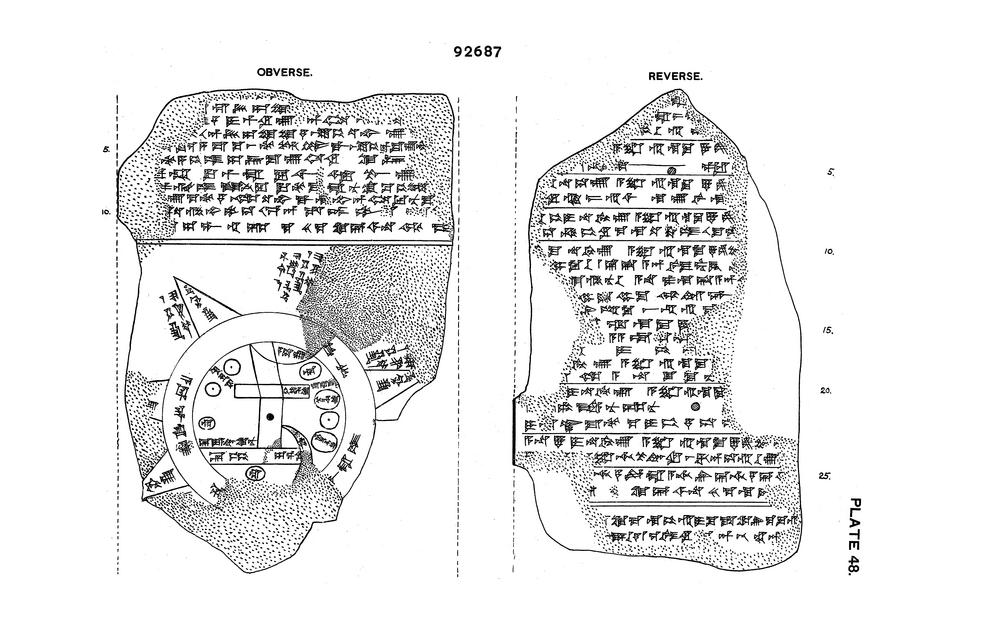
The map shows the world as a disc surrounded by the circular “Bitter River”. Babylon is marked as a rectangle, the river Euphrates flows south in the middle, and small circles show cities or districts.
The curator’s comment in the BM catalog says that according to the tablet it was copied from an earlier one. Clearly there was an established practice by 6th c. BCE—this object is quite recent in Mesopotamian terms, after all.
Obviously, the map was meant to be more conceptual than realistic. However, there are many notes (and even some time / linear measurements) which make it more usable. (Please visit BM and read the item description; it’s quite fascinating.)
The Map of the World, Late Babylonian (found Abu Habba (Sippar), currently British Museum; c. 6th c. BCE; drawing of clay tablet)
What an intriguing map, isn’t it?
As the fragment is approximately 12 by 8 cm (approx. 3″ x 5″), it’s believable that it could’ve easily been transported if desired. Which makes it quite plausible that intrepid adventurers in a story or role-playing campaign in a similar setting could carry around maps made in the same style. There could quite well be professional mapmakers and a developed cartography for your world, even if writing doesn’t happen on sheets of paper as we know it.
The Visual Inspiration occasional feature pulls the unusual from our world to inspire design, story-telling, and worldbuilding. If stuff like this already exists, what else could we imagine?
So much of what survives of ancient art has lost the colors it originally held—statues have lost their paint, pigments have faded, textiles have weathered. One of the few materials that holds its color well over time is glass. Just look at this ancient Greek glass perfume bottle and see!
This type of bottle, called an alabastron, was used to store small quantities of valuable liquids like perfumed oil. Like this one, they typically had pointed or rounded bottoms and were kept in wooden or metal stands or hung from loops. The bright colors of this bottle are made from layers of colored glass and gold, bent around one another and blown into shape.
The swirling colors of this bottle almost make me think of 1960s psychedelia. It can be startling to find an ancient object that has kept its color and be reminded that it was created and used in a world that was equally colorful.
Image: Alabastron via Metropolitan Museum of Art (found Greece, currently Metropolitan Museum, New York; 1st c. BCE; glass)
Out There highlights intriguing art, places, phenomena, flora, and fauna.
The Glasgow Worldcon—known as A Worldcon for Our Futures—has been done and dusted for a couple of weeks now. Some buddies of mine went, but I didn’t. Instead, I’ve enjoyed reading various reports and stories, and looking at photos, of course.
A chef, steampunk-style. Aaaah! So inventive and different! 😀
There are the requisite rivets, of course, and valves, dials, gauges, and piping, but also burner coils, a pan, a spatula, and plates (in another photo). What really stopped me in my tracks are the burner coils, though—so, it’s not just any generic steampunk gadget you strap onto your back, it’s a portable stove!
It looks like the stove might have been built from a cardboard box, but I haven’t been able to find the story behind this outfit to confirm. (If anyone knows, please share or link!) It would be interesting to hear details, for instance whether it’s feasible to carry anything inside the oven. So clever, though!
“I’m talking that massive, never-ending Discord chat with your bestie? The one that makes you giggle through the day? It’s not a ‘waste of time,’ it’s what time was made for“
– atlinmerrick on Tumblr
Hear, hear!
As much as it might frighten us some days, change is permanent and the only absolutely realiable thing in life. (Apart from the sheer impossibility of taking anything with you when it’s time to go.) Why not find happiness while you can? Why not allow yourself to feel the joy you feel? Lots of adults would be happier, I think, if they allowed more of the delight they used to feel in their childhood to remain in their lives. (Mostly talking to my Protestant forebears here…!)










 Co-Geeking
You must be logged in to post a comment.