I was checking something about the cozy fantasy genre the other day when I suddenly fell into a deeeep rabbit hole.
(And, by the way, long post warning. This post is not far from the dreaded “Let me tell you about my character” trope, so read or skip accordingly… TL;DR: Playing around with cozy gnomecore-themed photographs to make moodboards for my latest D&D character.)
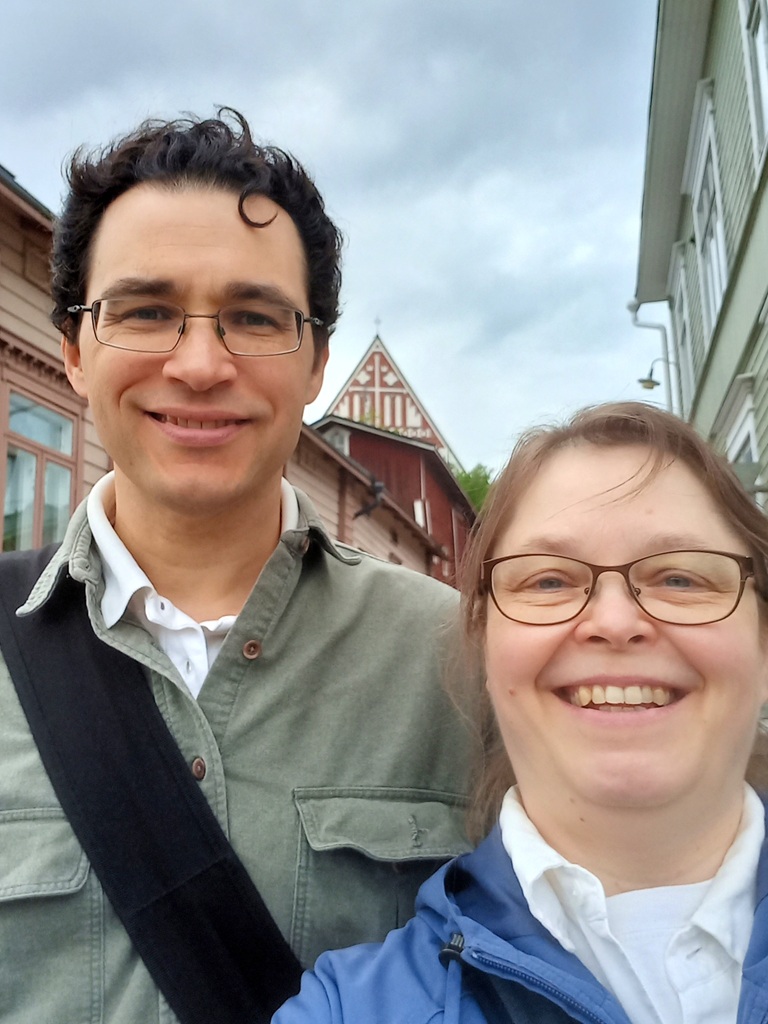
We started this blog together back in June 2015 with no grand ideas or plans, just wanting a place where each of us could post about the things we geek about and where we could post jointly about the things we geek about together. We had no idea what the next decade would bring us, but it’s been a fun ten years, and we’re still at it!
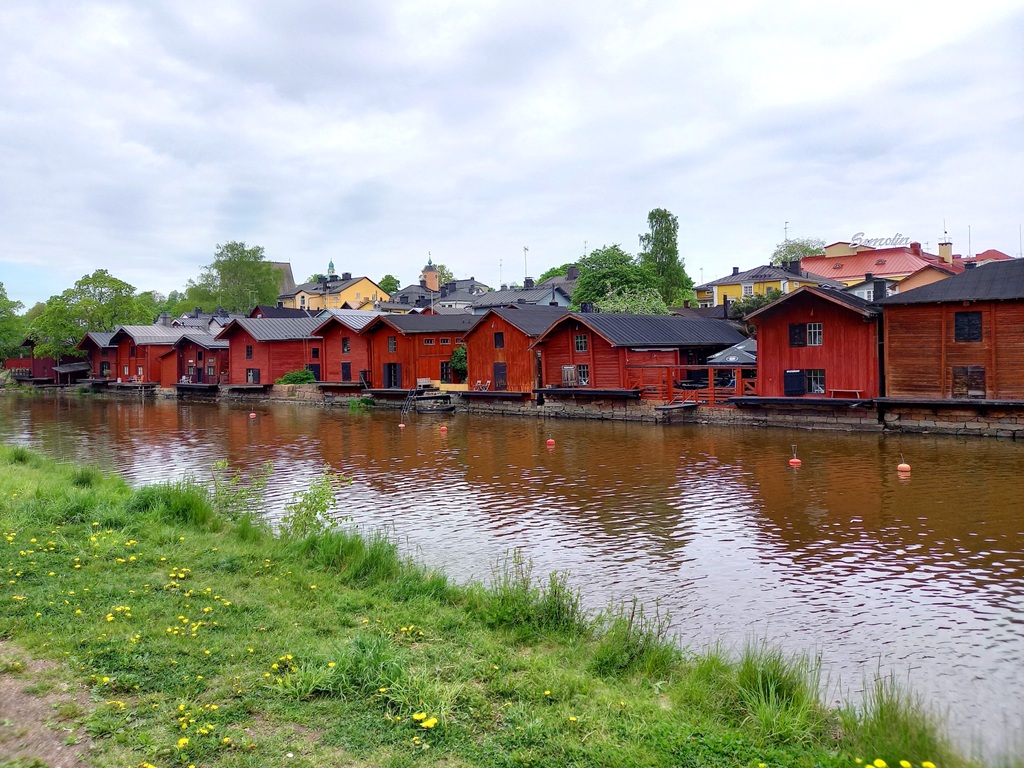
For a little celebration, we decided to take a short trip to a place we’ve both been interested in visiting for a while: the old town of Porvoo. Porvoo is a small city on the Finnish southern coast a little to the east of Helsinki. It’s like most Finnish cities except for its remarkable old town.
A large portion of the northern half of the city is made up of well-preserved colorful old wooden houses along cobblestone streets, all surrounding a medieval church.
While many of the house exteriors are legally protected, it’s not a museum or living history exhibit, just a part of town where ordinary folks and families live. Walking around there, though, is a little bit like stepping back in time.
Whatever brought you to Co-Geeking, we hope you’ve enjoyed our work. We look forward to another ten years, and who knows how many more!
The sculpture of the death Laocoon and his sons is one of the mot famous works of ancient art. Carved from several pieces of marble that were fitted together with metal pins, it represents a dramatic moment from the legends of the Trojan War. When the Greeks carried out their ruse, pretending to withdraw from Troy but leaving behind a giant wooden horse, the Trojans were skeptical. While some Trojans wanted to bring the horse within their walls, the priest Laocoon warned the Trojans not to trust the Greeks. The god Poseidon, who favored the Greeks, sent a serpent from the sea to kill Laocoon and his sons, which convinced the Trojans to reject Laocoon’s advice and bring the horse behind their walls, unwittingly sealing their city’s doom.
This marble statue, depicting that dramatic mythological moment, has a dramatic history of its own. It was found in pieces in the soil of an Italian vineyard in 1506 and quickly gained attention. One of the first people to see it was the artist Michelangelo. Classical scholars noted that the Roman author Pliny had described with admiration a similar statue of Laocoon, and believed that this work was the very one that had impressed Pliny. The fragments were acquired by Pope Julius II for display in the Vatican palace. Several of the major artistic names of the Italian Renaissance worked on restoring the fragments and carving replacements for parts that were missing, among them not only Michelangelo but Raphael and Bramante.
In some ways, the Laocoon was the perfect sculpture for time in which it was discovered. Interest in relics of Greco-Roman art was growing, and the rich and powerful were starting to regard the acquisition and display of antiquities as a useful mark of status. Among those antiquities, large-scale marble sculpture was the most highly prized. The belief that the Laocoon statue was the very same one that Pliny had praised conferred upon it a special aura of authenticity. It was not just any ancient statue, but an ancient statue with a known origin and history, whose quality was vouched for by one of the great names of Roman literature.
At the same time, while the authentic antiquity of the sculpture was crucial to its value as a collector’s prize, it was also particularly suited to contemporary tastes. The fine delineation of the figures’ musculature in a pose of high emotional drama was perfectly adapted to the interests of artists of the Italian Renaissance. Even though it was a product of pagan Rome, the subject and its execution had resonances for a Christian audience. The agony of Laocoon’s body in a moment of divine intervention made a parallel to the agony of Jesus on the cross. The slithering serpent attending on a moment of fateful choice echoed the tale of Adam and Eve. For a Christian pontiff who was also a powerful political figure and a connoisseur of Classical art, it is hard to imagine a more perfect sculpture.
(The sculpture was so perfect for Julius, in fact, that one scholar has suggested that it was not an actual ancient sculpture but a forgery by Michelangelo himself. The evidence for this idea is weak, however, and it has not found wide acceptance among scholars.)
Yet, as perfectly adapted as the Laocoon sculpture was to the time in which it was discovered, times change, and the sculpture has changed with them. Since the Pope’s artists first reassembled the sculpture pieces and created their own replacements for the missing parts, the Laocoon has not remained the same. Over the past five centuries, artists and restorers have repeatedly gone back to the sculpture and changed it, readjusting the positions and postures of the figures, creating new replacements, and treating the surface. The position and postures of the two smaller figures has been changed. The angle of the main figure’s arm has been revised. Traces of paint were cleaned away to make the marble gleaming white. The Laocoon that we can see today in the Vatican Museums is, in important ways, not the same sculpture that came out of the vineyard soil in 1506.
Whenever we look at an artifact from the past, we must bear in mind that what we are seeing is usually not what the object originally looked like. The Laocoon statue is perhaps an extreme case, given how much attention it has garnered since it was first excavated, but we always remake relics of history to better fit what we in the present think the past should look like. Julius and his artists wanted a complete and glorious masterpiece of Classical art, so they made one out of the pieces from the vineyard. Today we want an instructive and historically accurate piece of sculpture, so we have removed many of the replacement pieces carved by the pope’s artists and rearranged the original pieces in ways that we think are more authentic. Yet since long before 1506, no one has seen what the Laocoon sculpture originally looked like, and no one in the future ever will.
Thoughts for writers
Just as Michelangelo and his fellow sculptors reimagined a relic of the past, whenever we look to the past to inspire our writing, we are always creating our own version of it for our own needs. However much we may seek and value historical accuracy, we are telling stories in and for our own times; they will always reflect what we believe and value about ourselves. This is a strength of fiction and fantasy, not a weakness. The important thing is to be thoughtful and purposeful about how we use and reimagine history when we look to it for inspiration and not let our unexamined, unthinking biases shape how we understand it.
Image: Laocoon and his sons, photograph by Wilfredo Rafael Rodriguez Hernandez via Wikimedia (found at Rome, currently Pio Clementino Museum, Vatican; 1st c. BCE-1st c. CE; marble; believed to be by Agesander, Athenodorus, and Polydorus of Rhodes)
History for Writers looks at how history can be a fiction writer’s most useful tool, from worldbuilding to dialogue.
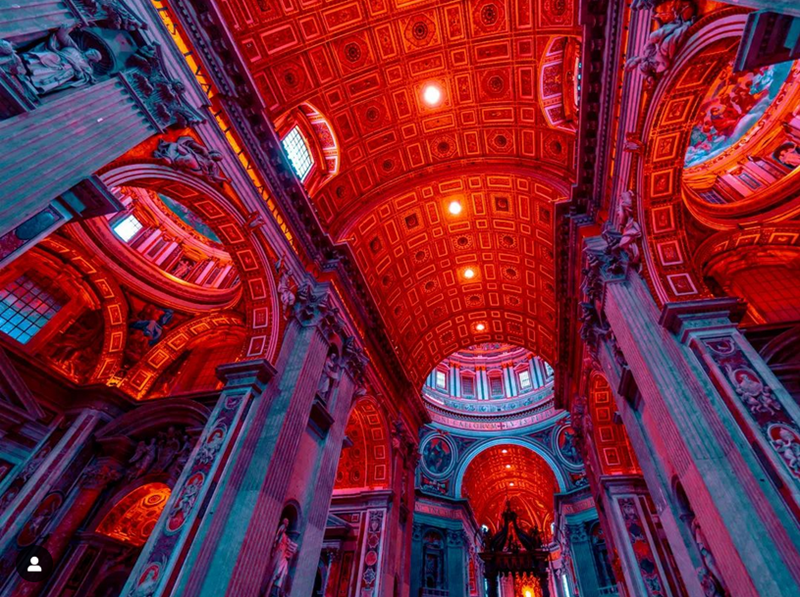
In his work, video director, photographer, and art director Aishy plays with color and light. One of his most striking projects is the Red Lights: Vatican series. Interior views from St. Peter’s Basilica in Vatican City become striking and very different from their everyday state.
Aishy’s work is often described as having a sci-fi or cyberpunk flair. However, what his Vatican photos remind me of is how ancient Mediterranean statues and buildings in their original state were not the bland off-white or grey we currently know, but vibrantly painted.
And to get back to the cyberpunk idea: wouldn’t it be more interesting—or at the very least less ubiquitous—if your next dystopia were not visually mostly black or grey, but eyeball-bustingly garish in color? Surely that could also be quite dystopic, right?
There are some specific examples I can think of. The throne room in Star Wars: Episode VIII – The Last Jedi, for starters, looks magnificently arresting. I’m just a little tired of red (or the combination of red and black). Sure, it’s a strong color often linked to strong emotions, but it tends to be overused. How about orange instead, like the Las Vegas of Blade Runner 2049? Or in Jupiter Ascending? Perhaps purple, turquoise, or chartreuse?
Just tone down the use of those ever-present blacks and greys, thanks.
(As a sidenote, the ancestry festival in Star Wars: Episode IX – The Rise of Skywalker delighted me for its happy colors, even if the planet itself was another desert.)
The Visual Inspiration occasional feature pulls the unusual from our world to inspire design, story-telling, and worldbuilding. If stuff like this already exists, what else could we imagine?
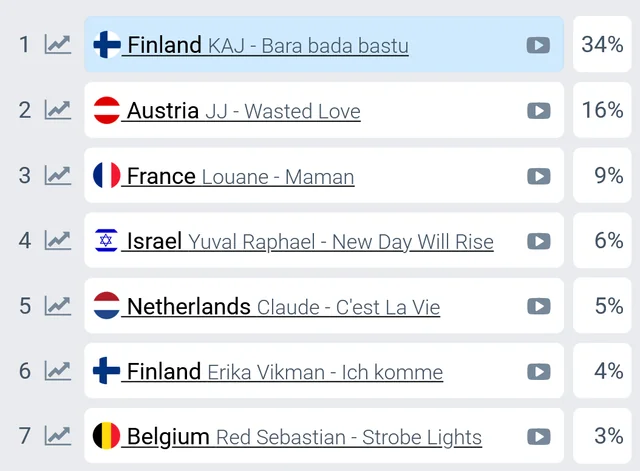
In addition to the two acts, I was surprised to find that Finns have had their fingers in other countries’ Eurovision pies, too: besides Erika Vikman’s stage show, designer Ari Levelä has participated in creating the visuals for Austria and Cyprus, and Estonia’s song Espresso Macchiato is co-written and produced by Finnish songwriter Johannes Naukkarinen. It is indeed a very exciting Eurovision year for Finland!
The grand finale takes place late tonight, 22.00 / 10 p.m. our time, and it’s going to run at least four hours. (Gosh, I almost have a headache from the mere thought of staying up that late!)
I’m really torn. I really hope KAJ wins, because Bara bada bastu is so joyful, cozy, and sweet, exactly what the world needs right now. But only if KAJ guys get to keep their quirkiness, happiness, and wholesomeness, because it’s part of their charm, and you can’t do that if you’re sleep deprived and exhausted and harangued by media and fans alike. Plus, it would give Sweden their 8th Eurovision win, pushing them ahead of Ireland (both have seven wins ATM), which as a Nordic person I would LOVE.
At the same time, though, Erika Vikman’s win would be stupendous—it would be the second time Finland wins, the first win for a female solo artist from Finland, and a win for female empowerment. It’s a catchy song with a great beat at the end, and a challenging tune (i.e., meant for a skilled singer). Apparently, after Thursday’s second semifinal there’s been a surge of interest; some have even wondered whether she might really turn out to be this year’s dark horse.
Moreover, Erika’s is an act where a grown-up woman dresses and sings how she wants, instead of a serving of bare female flesh centered around stereotypical male sexual desire (i.e., a slip of a girl decked up in barely-there sparkly cover-ups furiously gyrating and tossing her hair). (*cough* Cyprus 2018, Cyprus 2019, Cyprus 2021 *cough*) Acts are acts, sure, but like KAJ’s, Erika’s seems to contain a certain amount of authenticity that people respond to.
Ohwell. In the end, I suspect I’ll just be overjoyed that Finland has two such strong contenders this year. Following Käärijä’s second place in 2023, recent years have been exceedingly good from the point of view of Finnish Eurovision fans, and that’s not something to sneeze at. 🙂
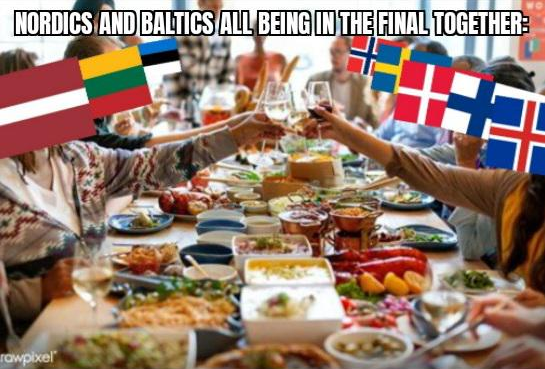
As a cherry on top, all of the Nordic countries (Finland, Sweden, Norway, Denmark, and Iceland) AND all of the Baltic countries (Estonia, Latvia, and Lithuania) qualified for the grand final. All at the same time, for the first time. Yay for us smaller countries in the north! 🙂
Alexander Skarsgård and cast of Murderbot TEASE what to expect from All Systems Red adaptation by Radio Times on YouTube
I haven’t yet seen the latter; I’m saving it for just the right time. (It’s Eurovision week, and as Finland entirely and utterly unofficially has two representatives this year, I have more incentive to stay up wayyy past my usual bedtime three nights this week. I’m almost too old for this shit, but not yet!)
Despite digging, I haven’t been able to find exactly when the episodes become available. keydekyie on Tumblr very kindly reminded the world that Apple lists the next day as the air date to avoid confusion due to different time zones, so the first episodes actually dropped on Thursday at 9 p.m. EST.
Woot! Although in Finnish time, that’s 4 a.m., which is definitely not the easiest of viewing times. (It’s been a long while since being 7 hours ahead of EST felt this hard.) OTOH, it means we could see each new episode over breakfast… That’s an intriguing thought…! Anyway, we *still* need to decide whether we want to see one episode a week, or whether we’ll wait till the end to binge it all at once.
Hey, look! We found a thing on the internet! We thought it was cool, and wanted to share it with you.
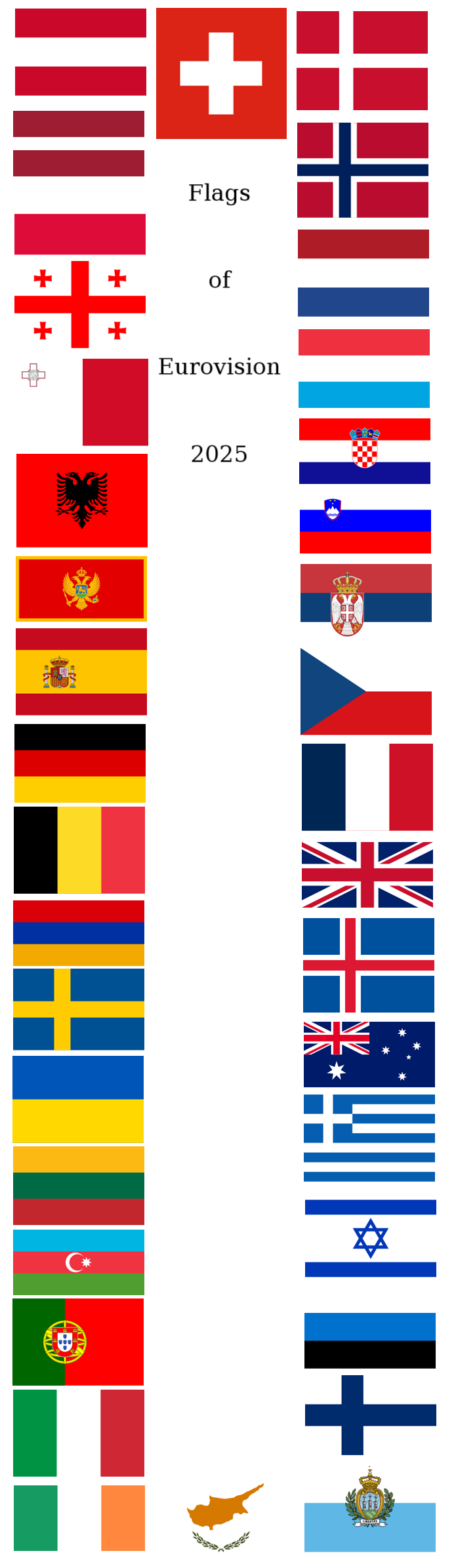
Every year when we watch the Eurovision Song Contest, I find myself distracted from the music and stage shows by all the European flags. I enjoy seeing all the different combinations of colors and designs, and every year I find myself thinking: “I wonder if I could organize the Eurovision flags in such a way that they flow from one to the next with similar colors and patterns?” Well, this year I finally decided to try it, so here it is! My Eurovision 2025 flag carousel, starting with this year’s host, Switzerland, and circling through the flags of all the other participating countries!
Why did I make this? No good reason. Just because I wanted to.
Should you care? I really can’t think of any reason why you would.
But if you’re a fellow fan of flags, I hope you enjoy it!
Ooh! A new version of Jane Austen’s Pride and Prejudice is in the works!
Netflix is producing the 6-episode adaptation. Author Dolly Alderton will adapt and Euros Lyn direct. Of the cast so far announced are Olivia Colman as Mrs. Bennet—which will be a fantastic performance, I’m sure—plus Emma Corrin as Elizabeth Bennet and Jack Lowden as Mr. Darcy.
At this writing the new P&P series is only in preproduction, so lots of unknowns remain, including release date. According to Netflix, production is slated to start in the UK this year, but that’s all so far.
Wow, I’ve been wanting another Jane Austen adaptation for a while, so this is great! Not necessarily P&P, though, it’s been done so many times, but I’ll take it. 🙂
As I said, I firmly believe Colman will be great, and I seem to remember good things about Corrin (Princess Diana in The Crown and Cassandra Nova in Deadpool & Wolverine). Lowden, however, is completely new to me; I have no idea what kind of an actor he might be.
Another complete unknown to me is writer Dolly Alderton. However, I’ve seen the work of director Euros Lyn in Doctor Who and Torchwood as well as Broadchurch and Sherlock (the latter with Martin Freeman and Benedict Cumberbatch). Broadchurch, especially, was fantastic, and he and Colman worked together in that.
Very promising! Looking forward to hearing more about this adaptation.
Every now and then you read snippets where an overused truism is poked and prodded in a way that nudges something loose.
“His features, his gestures, his long black braid: All these had become as familiar to me as if I had known them my entire life long, yet I had first encountered him only a few days ago. I did not understand it. Was this what kinship meant? A sense, deep in your bones, that the person next to you is part of you? Inextricable from what you are? That you could not be who you are without their existence as part of the architecture of your very self?
“We are none of us one thing alone and unchanging. We are not static, or at rest. Just as a city or a prince’s court or a lineage is many people in one, so is a person many people within one, always unfinished and always like a river’s current flowing onward ever changing toward the ocean that is greater than all things combined. You cannot step into the same river twice.”
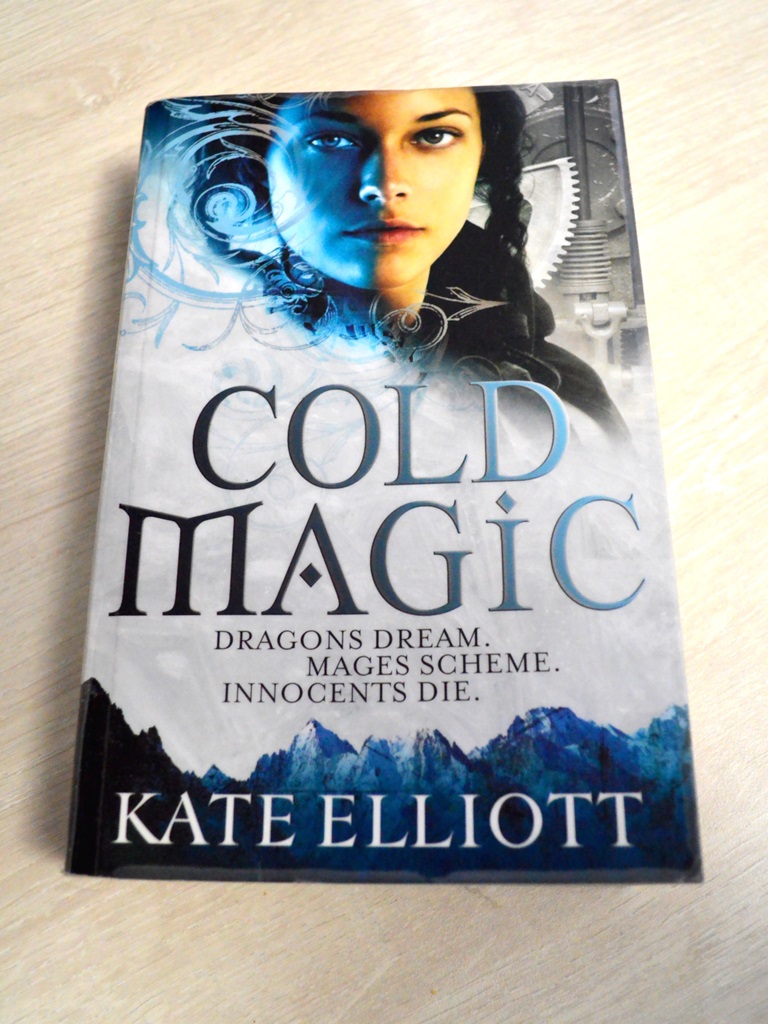
– Catherine in Cold Magic by Kate Elliott
I remember being kinda stunned one time, years ago now, when talking to a coworker and she said she never re-reads books. I find that unfathomable, to be honest. It’s a bit like never eating the same food twice.
Strictly speaking, of course, the two examples are different, since repeatedly cooking the same dishes makes the kind of pragmatic sense that re-reading does not and cannot offer. But if you eat your favorite foods more than once, why wouldn’t you read your favorite books more than once? It’s so exhilarating to gain a deeper or a wider understanding of a work or phenomenon you think you thoroughly know already, because you have changed.
Elliott, Kate. Cold Magic. London: Orbit, 2010, p. 384-385.
Image by Eppu Jensen
Serving exactly what it sounds like, the Quotes feature excerpts other people’s thoughts.
Do not be too sad, Sam. You cannot always be torn in two. You will have to be one and whole, for many years. You have so much to enjoy and to be, and to do.
– Frodo, in The Return of the King
I recently reread The Lord of the Rings for the first time in over a decade. It is also the first time I’ve read the book since we moved from the US to Finland. This line, from Frodo to Sam before his departure from the Grey Havens at the end of the novel, was always a beautiful line, but it hit me harder now.
Eppu and I have always lived a life torn in two. Coming from two different countries on different continents, we always knew that to be together, one of us would have to be far away from the people, places, and things we have grown up with and loved. For many years, she was the one who was far from home, as we lived in the US for my studies and work. Since we moved to Finland a few years ago, now I am the one whose familiar places and people are far away.
You might think that the romance between the human Aragorn and the Elf Arwen would speak to me the most, but their love story plays out on the scope of high mythology, beautiful but too remote to relate to. The simple words of a Hobbit, wishing healing and hope to a beloved friend, struck my heart.
We cannot always be torn in two. Love makes us one and whole.
Tolkien, J. R. R. The Lord of the Rings. Harper Collins edition, 1994, p. 1006.
Serving exactly what it sounds like, the Quotes feature excerpts other people’s thoughts.