No Time for Conditioner When You’ve Got Rebels to Fight

The Greek military writer Polyaenus recounts this story about the Parthian princess Rhodogune:160901Shirin

Rhodogune was bathing and beginning to wash her hair. A messenger came to report that a subject nation was in revolt. Without washing out her hair but just tying it up as it was, she mounted her horse, led out the army, and swore an oath that she would not wash her hair until she had put down the rebellion, and indeed, after long fighting, she triumphed. After her victory, she bathed and washed out her hair.

– Polyaenus, Stratgems 8.27

So, the next time you’re having a bad hair day or just can’t be bothered to do anything but tie it back, you can tell the world you’ve got rebels to fight and the hair can wait.

Image: Shirin bathing (not Rhodogune, sorry) via Wikimedia (c 1480; ink on parchment)

Serving exactly what it sounds like, the Quotes feature excerpts other people’s thoughts.

Down with Dull Dystopias

The other day, Erik and I were at the library borrowing some light evening viewing. On my way to the circ desk my eye fell on the Just Returned cart and on a relatively recent SFF novel that I’ve heard good things about. (I always stop to check the cart. It’s often the best spot to pick up the popular new acquisitions.)

I picked it up and flipped over to the book description to remind myself what it was about. The novel is set in an apocalyptic or dystopic world with major environmental issues. And that made me promptly put it back down. I didn’t even finish reading the book description.

What my reaction made me realize is that, for now, I’ve reached my tolerance for dark storylines with brooding characters in dire situations.

Supermoon Lunar Eclipse Starting Sm

My little episode at the library collided with two random online pieces.

I was reading Tor.com’s coverage on the 2016 Arthur C. Clarke Award. In his acceptance speech, winner Adrian Tchaikovsky praised the other five shortlisted nominees for a recurring theme:

“One of the things that struck me about the shortlist for this year is empathy as a theme that runs through a lot of these books. Empathy across races, across borders… One of the things [my] book is about is the ability of humanity to seize value in things that are different, and the danger when that doesn’t happen.”

Tchaikovsky’s comment made me conscious of not just how done I am with dystopia, but also how much I’ve been missing stories where the nicer aspects of humanity are clearly present. That doesn’t mean all feel-good stories all the time. It does mean that lifting the darker side of humanity up into the limelight is not enough if, at most, the positive universals get slapped on like a thin coat of paint on a dilapidated theater.

The next day, I ran into an article at Literary Hub by Brandon Taylor. “There is No Secret to Writing About People Who Do Not Look Like You” focuses on the importance of empathy as an aspect of the writing craft:

“Stories have many functions: entertainment, healing, education, illustration, explanation, misdirection, persuasion. Stories have the power to shape worlds and to change lives, and so there is a lot at stake when an author sits down to write. Many people fold stories like delicate paper ships and launch them from obscure corners of the world, hoping that their ships land on distant shores and spread some of the truth of their lives to strangers. It is an act of communion, an act of humanity, the sharing of your story with another person. We each contain within us a private cosmos, and when we write of ourselves, we make visible the constellations that constitute our experience and identity.

[…]

“There can be no story without empathy. Our stories begin because we are able to enter the lives of other people. We are able to imagine how a person might move through the world, how their family might operate, what their favorite foods might be, how their nation works, how their town works, and the smallest, most inconsequential aspects of their lives rise up to meet us at our desks. You can’t write if you can’t empathize. Solipsism is anathema to good writing.”

Taylor’s piece crystallized in my mind why dystopias drag me down. It’s because many dystopic stories ignore or trivialize humane acts or traits like cooperative labor or generosity, and in doing so, they omit crucial aspects of humanity. And that—unless extremely, extremely skillfully executed—makes dystopias unsatisfying for me, exactly as I tend to think many utopian stories boring.

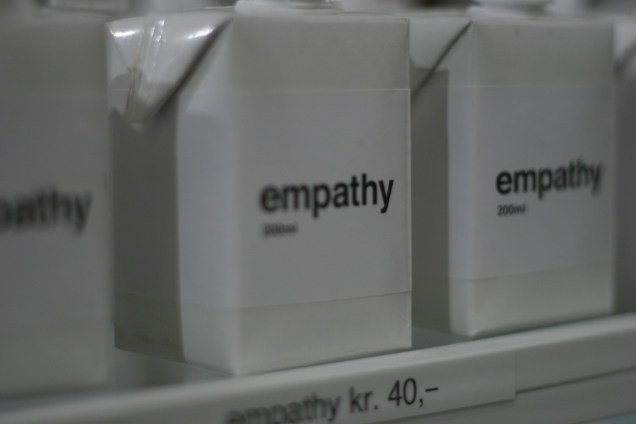
Empathy

Just like darker traits, selfless characteristics exist today because in the past they helped us survive. They still do. We need them, and we’re better for it.

So much of my reading lately has included dystopic worldbuilding. I didn’t realize quite how much that’s been subconsciously bothering me. I’m full, thank you. No wonder books like The Long Way to a Small Angry Planet by Becky Chambers—one of the Clarke nominees, by the by—make such joyful reading experiences.

Images: Supermoon Lunar Eclipse Starting by Eppu Jensen; Empathy by Pierre Phaneuf (pphaneuf) on Flickr (CC BY-NC-SA 2.0)

This post has been edited for clarity.

Story Time is an occasional feature all about stories and story-telling. Whether it’s on the page or on the screen, this is about how stories work and what makes us love the ones we love.

Catch!

War can be a nasty business. It’s no wonder soldiers sometimes enjoy a bit of cheeky humor. This ancient Greek sling bullet was cast with the word DEXAI on it, meaning “Catch!” or “Take that!”

Sling bullet, photograph © Trustees of the British Museum via The British Museum (Athens; 4th c. BCE; lead)

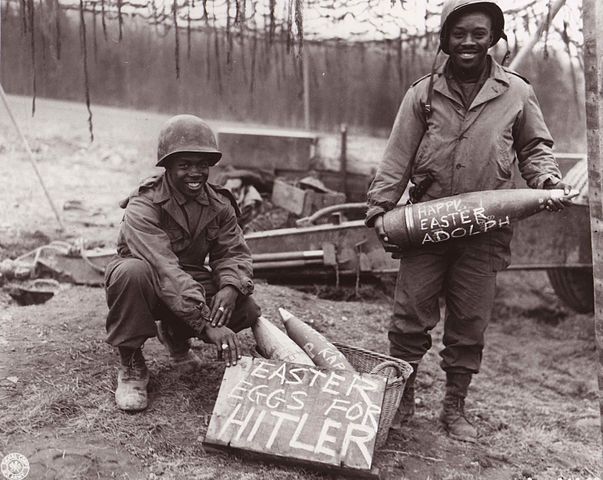
It’s in much the same spirit as these American soldiers in World War II offering “Easter eggs” for Adolf Hitler.

Easter eggs for Hitler, US National Archives via Wikimedia

Some things just don’t change.

History for Writers is a weekly feature which looks at how history can be a fiction writer’s most useful tool. From worldbuilding to dialogue, history helps you write. Check out the introduction to History for Writers here.

New Research Resource: Gigantic Online Picture Map of London

The London Picture Archive is a gigantic, free online photo map of the city’s past. The project has been nicknamed Collage.

Collage The London Picture Archive

Managed by London Metropolitan Archives (LMA), the map is made with over 250,000 photos, prints, maps, and drawings from the collections of LMA and Guildhall Art Gallery. Visitors can search by street name, or browse featured galleries and subjects. From the description of Collage:

“The images provide an extraordinary record of London and its people from the fifteenth century to the present day. The whole of Greater London is covered, as are the adjoining counties. Some of the many highlights include photographs of Victorian London; the sixteenth century ‘Agas’ map of London; Hollar’s stunning panorama from 1647; beautifully designed twentieth century posters for London’s tramways; the Cross and Tibbs photographs of Second World War damage to the City of London and the collections formerly held at the Guildhall Print Room. We regularly add new content from the LMA collections and, in particular, continue to develop descriptions and subject tags for the very large London County Council Photograph Library.”

I’ve only poked around for a short time, but for general purposes Collage looks like an endless source of images. For more specific searches it may not do quite so well. It certainly appears to be a worthwhile source for historical or historically inspired worldbuilding.

Image: screencap of Collage home page by Eppu Jensen

Out There is an occasional feature highlighting intriguing art, spaces, places, phenomena, flora, and fauna

Impressions on Arrival Trailer #1

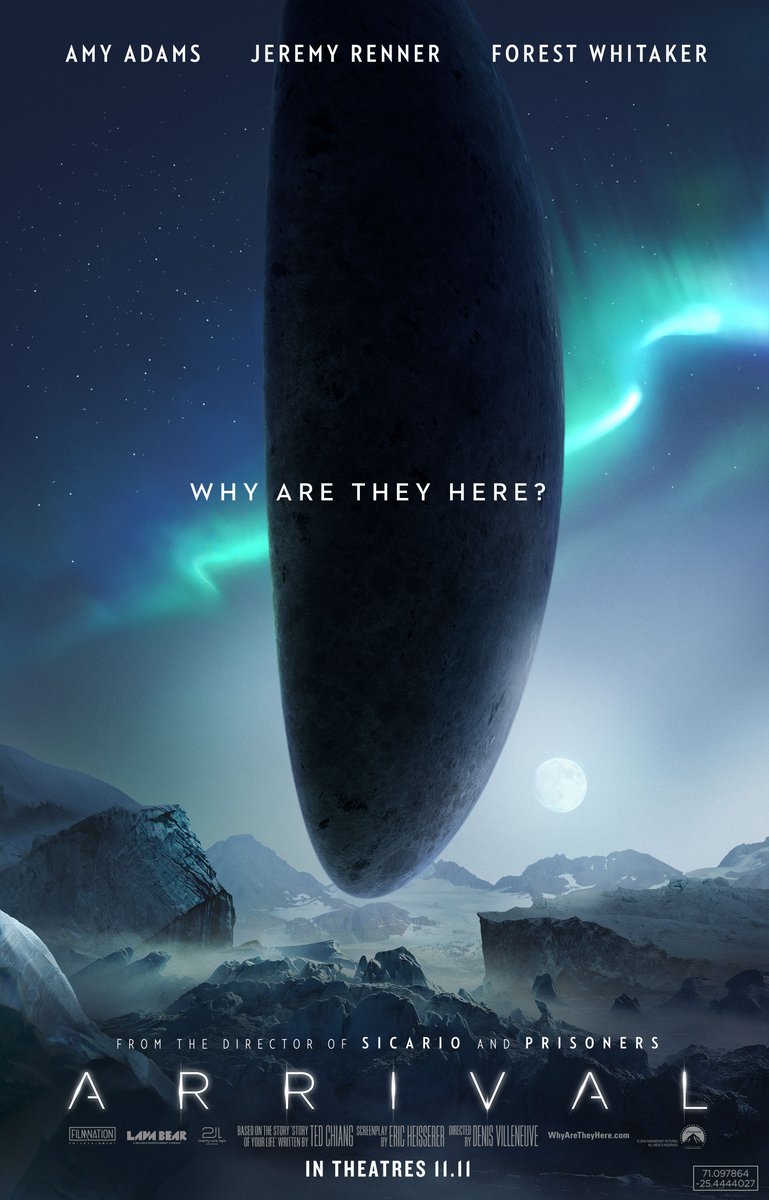
Have you heard of Arrival? It’s a forthcoming science fiction movie about a first contact situation on earth, and the more I read about it the more curious I get.

Twitter Arrival Movie Poster Aug 16 2016

The story is based on Ted Chiang’s 1998 novella “Story of Your Life,” adapted to screen by Eric Heisserer and directed by Denis Villeneuve. Chiang won both the Nebula and Sturgeon Awards with it.

The main interest for me is that Dr. Louise Banks, the character played by Amy Adams, is a linguist. Since we don’t generally get much screen time, it’s exciting, as is having languages / linguistics as a story focus. There’s also a little bit of Nordic involvement: the score is by Icelandic composer Jóhann Jóhannsson.

The first official trailer is looking great:

Arrival Trailer #1 (2016) – Paramount Pictures by Paramount Pictures

I love the fact that for a change the UFO that lands in the U.S. touches down in Montana, not New Frigging York City. That horse is thoroughly, properly dead, ladies and gentlemen of Hollywood. Thank you for not going there.

Judging by the trailer, the movie also avoids one of my pet peeves. It looks like finding a way to communicate with the aliens is going to take a lot of effort and a good, long while. We get glimpses of various graphics on computer screens, but it’s clear that the bulk of the work consists of human effort assisted by computers. In other words, people are doing the actual analyzing while computers number-crunch. Compare it, for instance, with the mothership scene in Close Encounters of the Third Kind (a clip of the scene here). As fascinating as the tonal-color language is, I’m so disappointed with the perfunctory and hand-wavy treatment the linguistic mystery got. I do hope that the Arrival trailer is accurate in acknowledging the effort that not only communication but of all kinds of intellectual work require.

And it may indeed be: The USA Today sneak peek quotes the male lead Jeremy Renner: “It’s big and there are thriller elements and tension, but it’s going to lean much more into a thinking person’s film.” There are also hints that Adams’ character will begin dreaming in the aliens’ language, which is a phenomenon I find fascinating. (I sometimes dream in multiple languages. The highest count I can remember is four.)

I discovered one interesting factoid. In the U.S. trailer, Dr. Banks can be heard commenting on the emerging common language like this: “We need to make sure that they [aliens] understand the difference between a weapon and a tool. Language is messy, and sometimes one can be both.”

The international trailer suggests a different story angle, however. Have a look:

ARRIVAL – International Trailer (HD) via Sony Pictures Entertainment

In it, instead of “[w]e need to make sure that they understand,” Dr. Banks says: “We don’t know if they understand the difference between a weapon and a tool [my emphasis].”

I don’t know what to make of the decision, and I can’t wait to see which one the movie actually goes with. Fortunately I don’t have that long to wait: the U.S. release date is November 11, 2016.

Image via Arrival Movie on Twitter

On, of, and about languages.

Autogenerating Fantasy World Maps with Uncharted Atlas

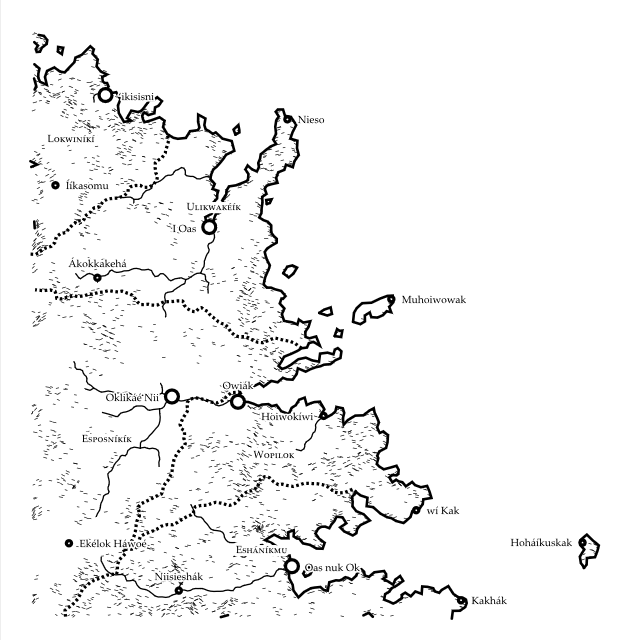
Autogenerating fantasy world maps is now possible with an incredible online tool coded by Martin O’Leary.

Uncharted Atlas Map
An autogenerated map for a fantasy world, including slopes, borders, coastlines, rivers, cities, and territories, created with Uncharted Atlas. Coding by Martin O’Leary

Currently mainly existing to feed material to the Uncharted Atlas twitterbot, the tool and its code are available for others as well.

Says O’Leary:

“I wanted to make maps that look like something you’d find at the back of one of the cheap paperback fantasy novels of my youth. I always had a fascination with these imagined worlds, which were often much more interesting than whatever luke-warm sub-Tolkien tale they were attached to.

“At the same time, I wanted to play with terrain generation with a physical basis. There are loads of articles on the internet which describe terrain generation, and they almost all use some variation on a fractal noise approach, either directly (by adding layers of noise functions), or indirectly (e.g. through midpoint displacement). These methods produce lots of fine detail, but the large-scale structure always looks a bit off. Features are attached in random ways, with no thought to the processes which form landscapes. I wanted to try something a little bit different.”

Uncharted Atlas also generates names for cities, towns, and regions with a separate bit of code, following a set of consistent rules. For an explanation of how it works and to try your own hand at it, see the terrain notes and language notes.

As a user, I’d like to see a way to connect several of these individual maps into a larger unity, but that’s getting ahead of things—just having a free tool like this is fantastic. 🙂 Kudos!

In Making Stuff occasional feature, we share fun arts and crafts done by us and our fellow geeks and nerds.

Book Trailer for Ann Leckie’s Ancillary Series by bironic

Assembled from a number of different sources, none of which have any sort of connection to author Ann Leckie’s writing, we now have an amazing book trailer for her Imperial Radch trilogy:

Ancillary Justice book trailer by bironic

It was made by bironic, the creator of the goosebump-inducingly glorious video Starships! On the creation process, bironic has this to say:

“A labor of love, nine months in the making. I watched or scanned through about 50 movies and TV shows (plus endless YouTube videos) in the hunt for clips that looked like my headcanon of critical moments, places and characters from the books, while trying not to use hugely recognizable actors and actresses. Not that you’d know it from the final source list, but the research process involved reading and learning a lot about the history of black characters in Western science fiction film and television as well as a crash course in modern African SF/F independent filmmaking, both of which were fascinating.”

Make sure to read the notes for the book trailer in full.

Hey, look! We found a thing on the internet! We thought it was cool, and wanted to share it with you.

History, Disability, Inclusion

160822CaludiusThe Roman emperor Claudius walked with a limp, spoke a with a stutter, and sometimes experienced sudden and uncontrollable movements of his body. These effects were moderate when he was calm but became more pronounced when he was agitated. Claudius’ symptoms are well documented and modern scholars have suggested various diagnoses. Polio was at one time the preferred explanation but has fallen out of favor. More recent suggestions are cerebral palsy and Tourette syndrome.

If he lived today, Claudius could be diagnosed and receive appropriate treatment or accommodation. The systems we have now to describe various disabilities helps us to recognize an individual’s particular set of symptoms as part of an identifiable condition or disease. Knowing what to call things, where they come from, and how to treat or accommodate them makes a difference to how we handle individual cases. In antiquity, all anyone knew was that Claudius behaved strangely in ways that no one could explain.

Lack of labels and explanations does not mean that people did not live with all the same things we live with today. Some are obvious. Romans may not have been able to explain why Claudius’ distant relative, the censor Appius Claudius Caecus, went blind, but there was no doubt about the state of his vision. Other conditions are less obvious, but no less real.

We have only very recently learned to recognize the chronic traumatic encephalopathy experienced by sports players who receive repeated trauma to the head, for example, but brains are not more vulnerable now than they were in past centuries. For most of the past several thousand years, war has meant large numbers of people repeatedly hitting each other in the head, with or without helmets. CTE and the changes in behavior that go with it must have been part of the experience of pre-modern warriors, whether they knew how to identify it or not.

Post-traumatic stress disorder is also a modern diagnosis, but people have always experienced traumatic stresses, not just in warfare but from violence within families and between individuals, sexual assault, and life-threatening accidents. In any population that has experienced such stress, some individuals will experience aftereffects, whether they have a name for them or not.

Similarly, we have only recently (in historical terms) learned to diagnose autism and related conditions, but people have lived with them throughout human history. The same can be said of Alzheimer’s disease. Many people who are described in historical sources as “simple-minded,” “senile,” etc. may have been living with one of these conditions.

Even when people couldn’t name or explain the disabilities and conditions they lived with, their experiences of life could be profoundly shaped by them. Claudius’ family considered him an embarrassment and kept him out of public view. He himself reportedly exaggerated his symptoms and avoided the public sphere when he was a young man to keep himself from seeming like a threat to the rest of the dynasty, which may have helped him survive the murderous palace intrigues of the early empire. When he unexpectedly became emperor after the assassination of Caligula, though, his lack of experience in public business made his claim to the title precarious. To improve his reputation, he initiated the Roman conquest of Britain. Claudius’ condition, whatever it was, ended up affecting the lives of thousands of people.

Thoughts for writers

Historians and writers of speculative fiction are in a similar position: we spend our time thinking about a world in terms that the people living in it would not, perhaps even could not, think of themselves. No historian can suppose that Romans simply didn’t experience post-traumatic stress disorder because they didn’t have a word for it. Writers have a similar responsibility.

Of course, in speculative fiction, anything is possible. We can imagine worlds with magic, or warp drive, or both. We can imagine worlds without gender, without water, without music. All of these are valid artistic choices, but we have to recognize them as choices and take seriously the causes and consequences of those choices.

It’s entirely plausible to construct a fictional world in which people don’t have a word for autism or don’t recognize cerebral palsy as a physical condition, but those conditions exist and affect people whether their culture acknowledges them or not. An ancient Roman could not have explained the laws of gravity, but things still fell down. To create a fictional world in which such conditions simply do not exist is a choice. If we make that choice as writers, we owe it as much serious thought as if we created a world without gravity. Creating a world in which people do not understand disabilities is no excuse for creating a world in which no one experiences a disability.

(Author’s note: I have tried, to the best of my understanding, to use the current accepted terminology to refer to the various symptoms, conditions, and disabilities I have mentioned in this post, but if I have made any mistakes, I welcome corrections in the comments and will update the post accordingly.)

Image: Portrait head of Claudius, photograph by Cnyborg via Wikimedia (currently Ny Carlsberg Glyptotek, Copenhagen; 1st c. CE; marble)

History for Writers is a weekly feature which looks at how history can be a fiction writer’s most useful tool. From worldbuilding to dialogue, history helps you write. Check out the introduction to History for Writers here.
Making Rangers’ Rations

Here’s a look at how we made yesterday’s Rangers’ Rations.

The menu

  • Ham
  • Fruit sauce
  • Cucumber salad
  • Bread
  • Butter
  • Cheese
  • White wine

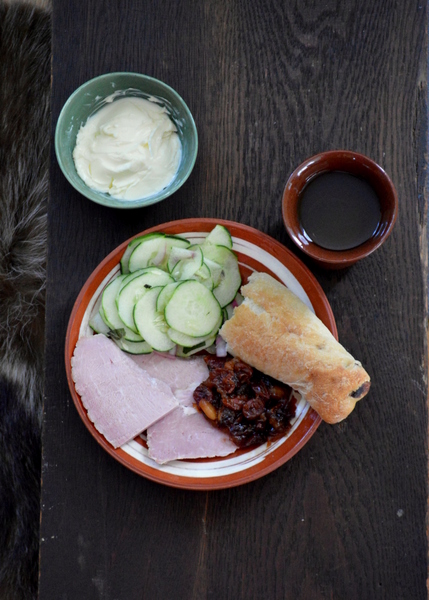
erikchef1Like the Hobbits’ dinner at the Prancing Pony in Bree, we get a pretty clear description of what the rangers of Gondor eat at their camp in Ithilien and it all makes a lot of sense for people who are stuck out in the wild away from supply lines living off rations. Ham, dried fruit, butter, and cheese are all preserved foods that keep well long-term. (4.5) Not all breads keep well, but there are many kinds that do. I’ve stuck to this description with a couple of adjustments.

First, I added a cucumber salad for the sake of some more vegetables. This particular salad uses vinegar and salt, not unlike a pickling brine. While this salad wouldn’t last as long as a proper pickle, the brine does help it keep a little longer.

Second, I made a softer bread rather than the hardtack Faramir’s troops would probably have had for their regular rations. Since Ithilien has olive trees and other characteristically Mediterranean vegetation, I’ve used a basic Mediterranean-style dough that can be baked in many different ways. (4.4)

Dinner8 Ithilien Pared Down

The thinking behind these adjustments (other than I wanted a vegetable and didn’t feel like making hardtack again) is that Faramir broke out the good stuff for his honored guests. (Remember we’re going by the novel here, not the Peter Jackson movies—which were mostly great but turned Faramir into a total jerk.) Cucumbers and soft fresh bread may not be much of a luxury to most of us, but for weary travelers they could be a welcome change from waybread and forage.

Continue reading

Dining in Middle Earth: Rangers’ Rations

“After so long journeying and camping, and days spent in the lonely wild, the evening meal seemed a feast to the hobbits; to drink pale yellow wine, cool and fragrant, and eat bread and butter, and salted meats, and dried fruits, and good red cheese, with clean hands and clean knives and plates. Neither Frodo nor Sam refused anything that was offered, nor a second, nor indeed a third helping. The wine coursed in the veins and tired limbs, and they felt glad and easy of heart as they had not done since they left the land of Lórien.”

LotR Dinner8

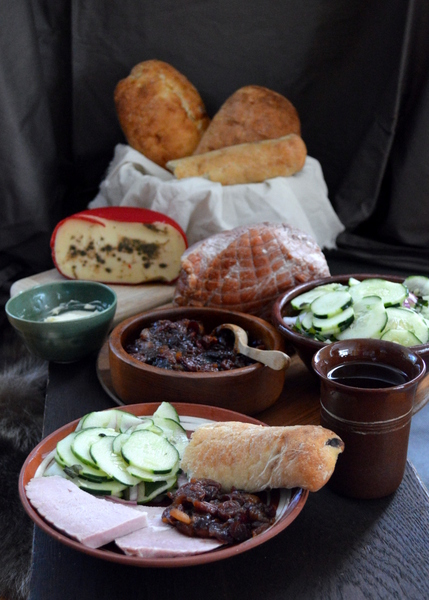
The rangers of Gondor in Ithilien offer a simple but satisfying dinner for two hungry Hobbits. For this month’s meal, we have a version following Tolkien’s description (with the addition of a salad, just to have a vegetable on the table). We served up ham with dried fruit sauce, a cucumber salad, bread, butter, and cheese, and a cup of wine to go with it.

LotR Dinner8 Main

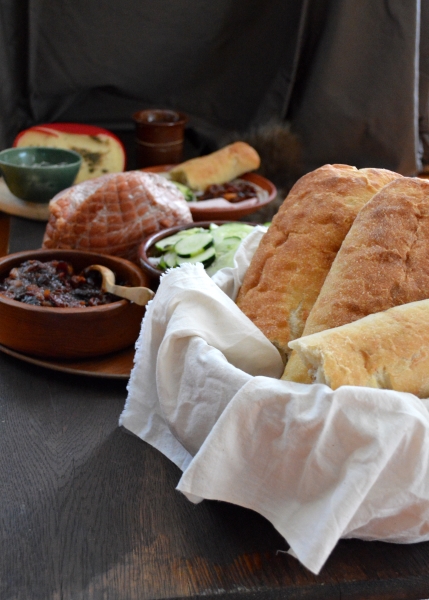
A makeshift narrow trestle table holds brown glazed pottery as well as plain wooden bowls and serving plates, closely resembling the rangers’ base. Butter is served from its own little green ceramic bowl and bread is accessible from a fabric-covered basket. Hunks of cheese can be cut on the same small wooden cutting board that it’s served on.

LotR Dinner8 Alt Setup

Check out what’s it about in the introduction, or read the how-to!

Images by Eppu Jensen

Geeks eat, too! Second Breakfast is an occasional feature in which we talk about food with geeky connections and maybe make some of our own. Yum!