“I don’t need characters to be likable. I do, however, need them to be livable — meaning, I need to find some reason to want to live with that individual for 300+ pages. Some things are dealbreakers, though, and a character who is too vile or somehow unredeemable by my own metric… then I just can’t stay in the story.”
– Chuck Wendig
Hear, hear. Well-written characters can save an awkward plot or shoddy pacing, or make an otherwise outdated novel from the 1800s enjoyable. But even a detailed and rich world suffers if there are only unpalatable or cardboard-thin individuals inhabiting it.
Fiction—or non-fiction, for that matter—is at its best when readers form an empathic connection with one or more characters. Depend upon it, readers will notice if authors treat their cast merely as a walking, talking plot delivery system.
Serving exactly what it sounds like, the Quotes feature excerpts other people’s thoughts.
Monday is when I write, from a historian’s perspective, about some interesting or useful tidbit for writers, especially writers of genre fiction. I’m doing that again today, but from a different angle. Today I want to talk about representation, specifically the representation of people who are not straight white cis men in books, television, movies, games, and other media.
First things first: I’m a straight white cis man with no significant mental or physical challenges. I am a native-born citizen of the country in which I live and a native speaker of its majority language. I am financially secure and socially comfortable. I am not, as far as I know, heir to any titles of nobility, but other than that, if a privilege exists in the world, I’ve probably got it.
Yeah. I’m about to talk about representation. If anyone wants to get off this ride, now’s the time.
When creators and fans talk about adding representation to popular media, the refrain from people who look like me is often: “Why do we have to have X in this story? What do you mean you can’t identify with the characters? Why can’t all you Xes identify with people who aren’t exactly like yourselves?”
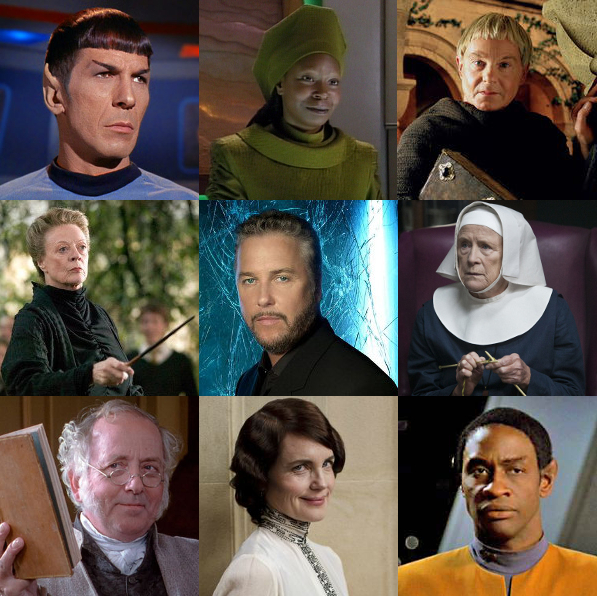
I understand where this response comes from. There are white guys all over the place in popular media, but I’ve never identified with a character just because he was a white guy. There are so many of them that I couldn’t identify with them all if I wanted to. When I look at a character and think Hey! That’s me! it comes from traits other than outward identities. Here are some of the characters I’ve felt connected to over the years:
Spock (Star Trek), Guinan (Star Trek: The Next Generation), Brother Cadfael (Cadfael novels and tv series), Minerva MacGonagall (Harry Potter novels and films), Gil Grissom (CSI), Sister Monica Joan (Call the Midwife), Mr. Bennet (Pride and Prejudice), Cora Crawley (Downton Abbey), Tuvok (Star Trek: Voyager)
They’re not all the same gender, race, age, or even species as I am. Two of them are members of a religious order, and I’m not religious at all. Most of them don’t even (fictionally) live in this century.
What can we learn from this collection? (Other than that I have a thing for Vulcans and a rather inflated sense of my ability to dole out wise advice to young ‘uns.) That representation is an aspect of privilege even when you’re not being represented. Having white guys all over the place frees me to look at the characters in my media and identify with them not based on the outward categories they fall into but because they’re thoughtful, introverted, curious, even-tempered, and passionate about knowledge.
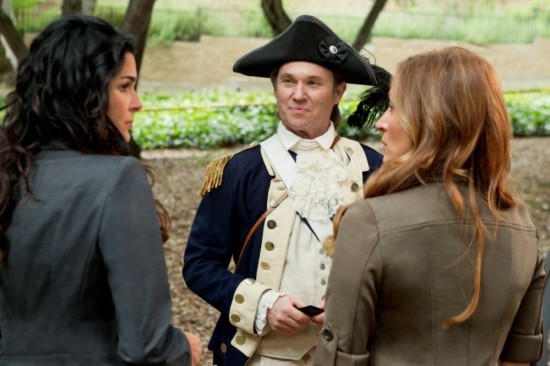
On the other hand, I am a member of a very small minority who is rarely represented in media, and then usually in a dismissive, stereotyped, even offensive way: history professors. According to most books, movies, and tv shows, we are boring, joyless pedants in tweed jackets with elbow patches who obsess over minutiae and care only about names and dates.
“Easily the most boring class was History of Magic, which was the only one taught by a ghost. Professor Binns had been very old indeed when he fell asleep in front of the staff room fire and got up the next morning to teach, and left his body behind him. Binns droned on and on while they scribbled down names and dates, and got Emeric the Evil and Uric the Oddball mixed up.”
– J. K. Rowling, Harry Potter and the Philosopher’s / Sorcerer’s Stone Ch. 8
We always wear period clothes and are at best dimly aware of what century we actually live in, if not actively in denial about it.
Professor Dwayne Cravitz from Rizzoli and Isles s. 2 ep. 6 “Rebel Without a Pause”
(Not to mention that we make our (black) graduate students do unpaid labor so that they can have the “authentic slave experience.”)
Oh, and if we’re medieval historians, we’re indistinguishable from renfaire performers. (I can’t find a link to it now, but the memory is seared in my mind of an NPR interview with a scholar attending the annual medieval studies conference in Kalamazoo which made it clear the interviewer thought it was basically a fantasy convention.)
Come on by my history class sometime. I won’t be wearing a costume or droning on about names and dates. I’ll be deep in conversation with my students about social structures, economic forces, multicultrual interactions, source analysis, and all the other interesting parts of history.
Now, history professors are not, by any stretch of the imagination, a historically oppressed or marginalized group. I know how aggravating it can be to be badly represented even as a comfortably privileged middle class white man, but I can’t really imagine what it must be like to be, say, a Native American woman, or a gay man who uses a wheelchair, or a Muslim teenager with Asperger’s, and have to deal with not only the weight of the social disadvantages that come with that and seeing people like myself so rarely and poorly portrayed in media.
Of course we can all identify with people who aren’t like us. That’s not the point. The point is that, no matter who we are, we all deserve to see enough people outwardly like ourselves in books, television, movies, and other media that we don’t have to identify with them just to feel like we’re there.
History for Writers is a weekly feature which looks at how history can be a fiction writer’s most useful tool. From worldbuilding to dialogue, history helps you write. Check out the introduction to History for Writers here.
Ladies and gentlemen, this is why machine translation isn’t going to replace human translators in a hurry:
Apparently Heh heh heh was too much for the Facebook language algorithm. No, thanks, I don’t need it translated. Granted, I use FB with three languages (Finnish, English, Swedish) with any regularity. All of my settings are in English, however.
And the real irony? The above screenshot comes from an English-language conversation.
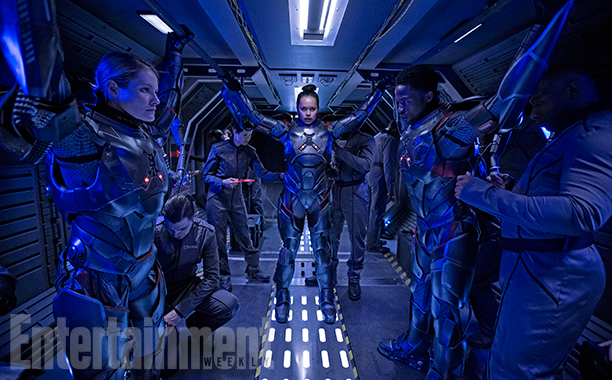
Browsing Tumblr the other day, I ran into what looked like stills from a scifi series. My immediate reaction was “What is this? Who’s she? I wanna see it!!”
Turns out they were indeed scifi show stills. The pictures come from an article by Dalton Ross on Entertainment Weekly. He talked with The Expanse showrunner Naren Shankar about a new character introduced in season 2, and shared these photos.
The commanding presence that drew my eye is marine Roberta “Bobbie” Draper from Mars, played by New Zealand actress, model, and boxer Frankie Adams.
Mr. Shankar talked about casting Ms. Adams for the role:
“When you ask a casting director to find a 6-foot half-Polynesian, the response is usually one of stunned silence, like, ‘Really?’ And we were like, ‘Yeah, really.’ We’ve been very conscious about maintaining the ethnic identity of the characters in the book as much as humanly possible. And we were really intent on doing that with Bobbie.
“We actually looked in the U.K., Los Angeles, New York, Toronto, Hawaii, and New Zealand. And when [co-author] Ty Franck saw the first casting tape on her, he said, ‘That’s her, that’s her,’ right away. She’s a professional boxer, as well as being a model and so she had the physicality and a very interesting, unusual kind of face you rarely see on television. She’s awesome and we couldn’t be more delighted to have her on the show.”
I have to say that the third shot (above) reminds me a lot of the 2004 Galactica reboot. I’ve only seen the pilot for The Expanse, though, and that streamed over a very hiccupy connection. It looked interesting, but for some reason or another I never got back to it.
I seriously hope that Bobbie won’t just be another case of Strong Female Character syndrome. Kick-ass female characters can be awesome, and they are definitely an improvement over women as mothers or love interests. But I’m done with women written as one-dimensional beings, be it demure damsels in distress or forceful fighters.
I want the people in my entertainment to be complex and three-dimensional regardless of their gender. Whether The Expanse delivers or not will remain to be seen, though. (Haven’t read the books that it’s based on, so I’ve nothing to go on there.) Apparently I now must check out season 1 in order to see season 2 when it comes out. 🙂
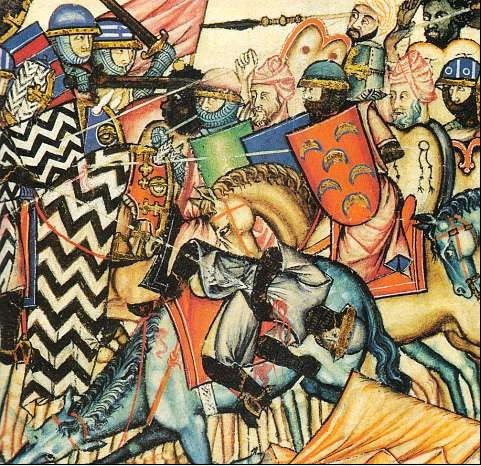
Religion often becomes involved when people are in conflict. Many religious traditions provide points of identity around which people can rally when they feel threatened or can offer reassurance and justification to those about to enter combat. Extreme circumstances, like war, have often led people to embrace their own religious traditions (or new ones) more firmly. All of this is undeniably true. Popular history, however, often makes a further claim: that religious differences cause violent conflicts. A careful look at history shows us a different picture. Religious differences have rarely, if ever, caused wars on their own, and where they have been involved in starting hostilities, they have played only a partial role alongside many other forces.
When we look at history, it is easy to find conflicts between people of different faiths, but these are unusual interruptions in a world history that is mostly about people of different faiths getting along reasonably well. Religious differences on their own don’t drive people into conflict. Protestant and Catholic Christians, for example, have been engaged in a bitter conflict in Northern Ireland for most of the past century, but during that time Northern Ireland has been pretty much the only place in the world where Protestants and Catholics have fought a sustained violent conflict. Nor is religion the only thing that separates the sides in Northern Ireland: differences in religion, language, political inclinations, popular culture, and social life are all wrapped up in the thousand-year history of English colonialism in Ireland. Catholic and Protestant denominations in Northern Ireland have provided a structure in which people can organize to pursue their causes and have been markers of identity around which people rally in difficult times, but if all the people of the territory were of the same religion, the conflict there would still have happened. Blaming religious differences for the Northern Irish Troubles is like blaming the US Civil War on a disagreement over what color Army uniforms should be.
If all people came together, each one offering their own private troubles in exchange for someone else’s, everybody, having gotten a good look at their neighbors’ burdens, would happily go home with the same ones they had brought with them.
– Herodotus, Histories 7.152, translated by Erik Jensen
Herodotus, reminding us all not too judge others too harshly. Everyone has their own troubles that you may not see. We can all use a little compassion in our lives.
Serving exactly what it sounds like, the Quotes feature excerpts other people’s thoughts.
MARVEL || Glitter & Gold (collab w/ djcprod) by Grable424
They’ve skillfully intercut clips from Iron Man and Captain America movies, Guardians of the Galaxy, and Ant-Man, among others; the Doctor Strange trailer also features, even if the movie wasn’t out yet. The song is “Glitter & Gold” by new-to-me artist Barns Courtney, and very catchy. Love it!
Hey, look! We found a thing on the internet! We thought it was cool, and wanted to share it with you.
While there were solid choices on the list, what struck me was that out of 15 named creators only 2 were women. That’s 13%. Since women make up half of the world’s population, an eighth is an unacceptably low proportion in my eyes, so I made a list of my own.
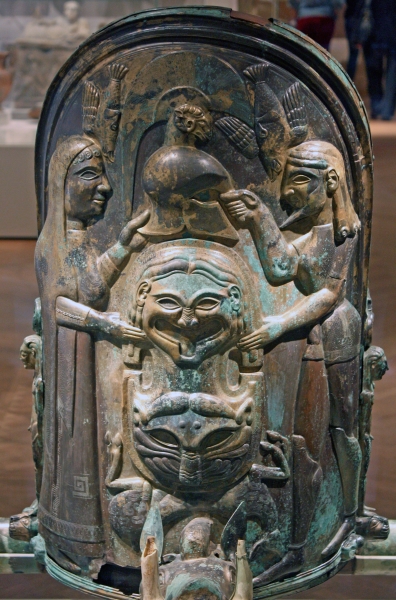
Even Achilles knows that women are an integral part of the world.
Notes on my list: 1) it’s novels only (no anthologies), 2) in a random order, 3) with no double entries (otherwise I’d include also Jemisin’s The Inheritance Trilogy), 4) and I include not only a variety of flavors within the fantasy genre but also historical fiction. Moreover, 5) I’ve included old and newer favorites as well as new-to-me authors whose works sound intriguing. Finally, 6) the common denominator is (like in the Game of Thrones) the presence of power struggles of various sorts, negotiation of identities, and survival.
1. Ursula K. Le Guin. The Earthsea cycle (A Wizard of Earthsea; The Tombs of Atuan; The Farthest Shore; Tehanu; Tales from Earthsea; The Other Wind)
Aspects of identity examined in an island-based early medievalesque world with magic and lots of sailing.
2. Kai Ashante Wilson. Sorcerer of the Wildeeps
Sword and sorcery, gods and mortals, with a band of mercenaries working as caravan guard in focus. (Linguist’s note: Fascinating mix of vernacular and more formal language.)
3. N.K. Jemisin: The Dreamblood duology (The Killing Moon; The Shadowed Sun)
Ancient-Egyptian-flavored fantasy on a moon orbiting a Jupiter-like gas giant.
4. Samuel R. Delany. Nevèrÿon series (Tales of Nevèrÿon; Neveryóna; Flight from Nevèrÿon;The Return to Nevèrÿon)
Sword and sorcery in a world before the dawn of history, with strong elements of power, economic development and breaking barriers.
A blend of a coming-of-age story with high-stakes intrigue and danger on an island with water-based tech.
Enjoy! I know I will get back to this list after finishing my current reading project.
Image: Monteleone chariot with Thetis and Achilles, detail of image by Peter Roan on Flickr CC BY-NC 2.0 (Etruscan, currently Greek and Roman galleries, The Metropolitan Museum of Art; 2nd quarter of the 6th century BCE; bronze inlaid with ivory)




 Co-Geeking

.jpg)


