The Oldest Active Library in the World

The library attached to al-Qarawiyyin mosque and university (alternate western spellings include Al Karaouin and Al Quaraouiyine, among others) in Fez, Morocco, is not just the oldest active library in the world, it’s also exceptionally beautiful.
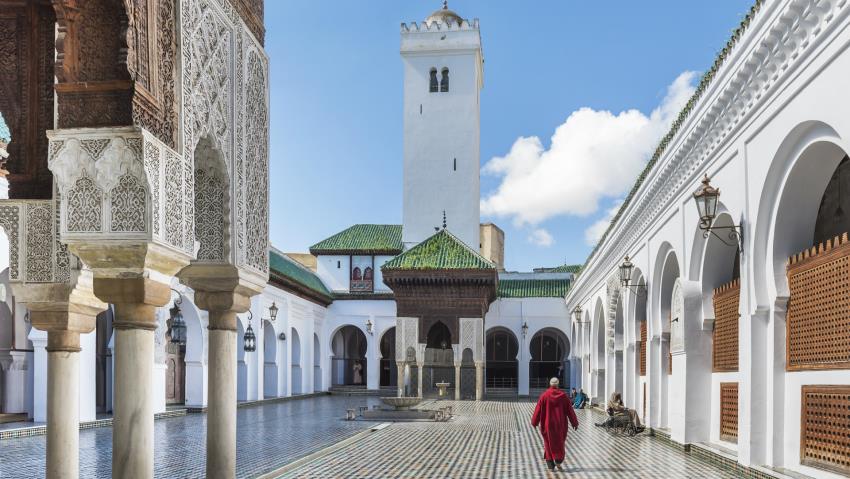
TheNewArab al-Qarawiyyin Library Courtyard 479

Al-Qarawiyyin was founded in 859 by Fatima Al Fihri. The architecture of the university reflects various past styles and ruling dynasties. The decorated interiors include calligraphic designs on the walls, ceramic patterns on the floors, and wooden carvings on the ceilings.

TEDcom al-Qarawiyyin Main Reading Room aziza_chaouni_img_2096

From 2012 to 2016, the library was completely renovated. The restoration was lead by architect Aziza Chaouni. She describes the starting point for her project at TED.com:

“When I first visited, I was shocked at the state of the place.

“In rooms containing precious manuscripts dating back to the 7th century, the temperature and moisture were uncontrolled, and there were cracks in the ceiling. […]

“Throughout the years, the library underwent many rehabilitations, but it still suffered from major structural problems, a lack of insulation, and infrastructural deficiencies like a blocked drainage system, broken tiles, cracked wood beams, exposed electric wires, and so on.”
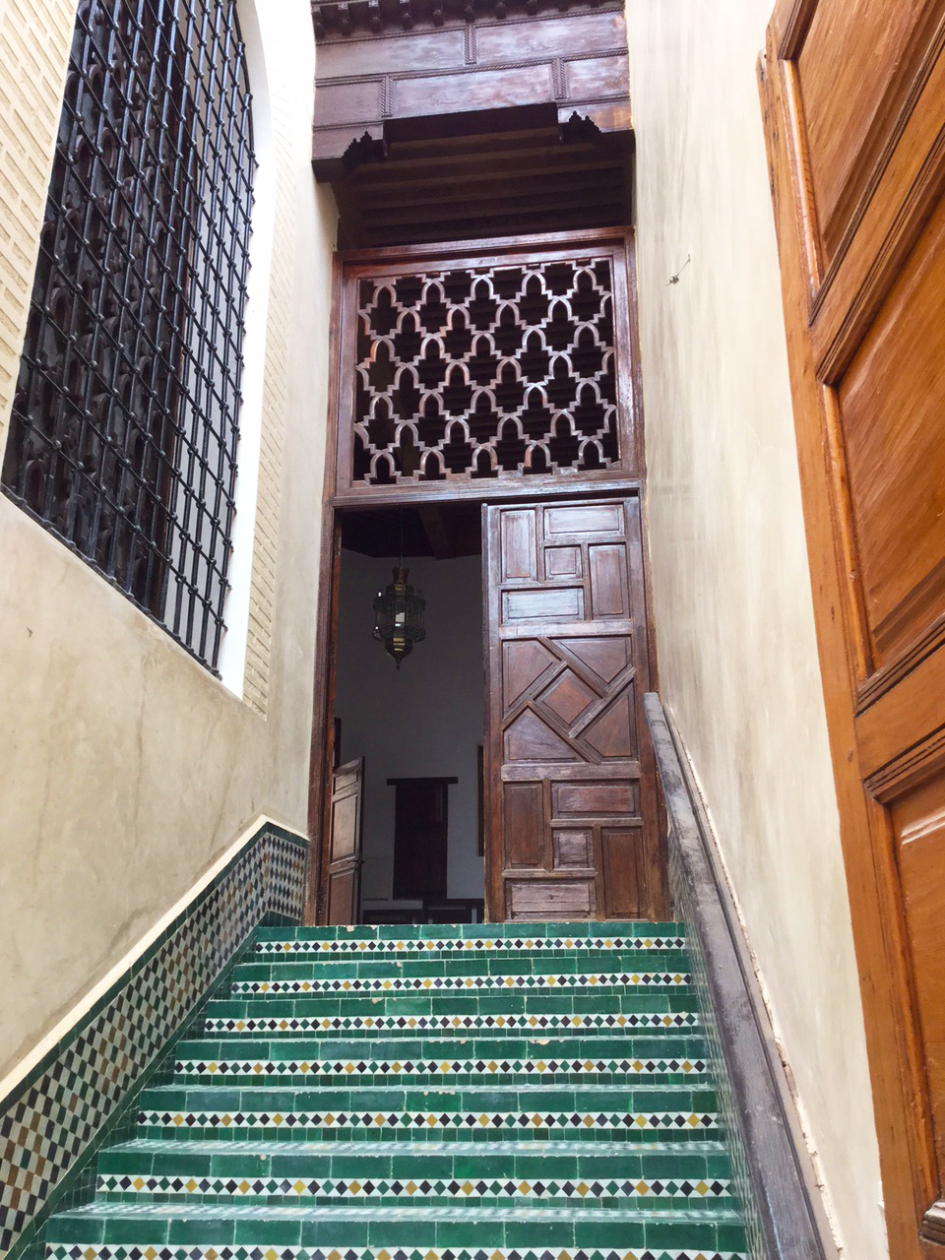
TEDcom al-Qarawiyyin Entrance Main Reading Room aziza_chaouni_img_2100

One of Chaouni’s leading principles was respect to its authenticity. Her restoration team preserved and salvaged what they could, but when it wasn’t possible, features and details were created from scratch. This included using local materials and construction systems, like furniture by local craftsmen who used native wood. Says Chaouni:

“There has to be a fine balance between keeping the original spaces, addressing the needs of current users, including students, researchers and visitors, and integrating new sustainable technologies — solar panels, water collection for garden irrigation, and so on.”
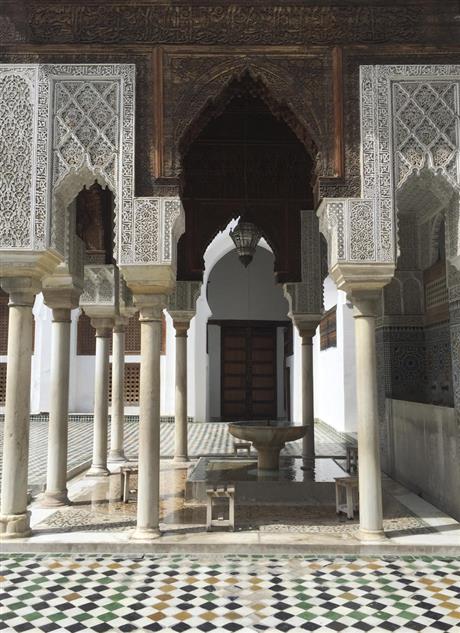
TheBigStory al-Qarawiyyin Fountain Samia Ezzarrouki 460x

Currently a part of Morocco’s state university system, the library is now open to the public in addition to historians and students.

(Incidentally, the university’s famous alumni include the 16th-century Andalusian adventurer known as Leo Africanus, whose book Description of Africa was considered the most authoritative source for northern Africa until the beginning of European exploration and expansion in the African continent.)

More photos at The New Arab, TED.com, The Big Story, Tor.com and BookRiot.

Images: Courtyard via TheNewArab; main reading room and entrance to main reading room by Aziza Chaouni via TED.com; fountain by Samia Errazzouki via The Big Story.

The Visual Inspiration occasional feature pulls the unusual from our world to inspire design, story-telling, and worldbuilding. If stuff like this already exists, what else could we imagine?

Text as Art

Language can be beautiful. We all know this as readers and writers. But language can also be beautiful as a visual, even physical work of art. In pre-modern societies where literacy rates were low, most people who looked at written text experienced it as a work of art, not as a work of language.

Here, for example, is the beginning of the Gospel of John in the Book of Kells.

Book of Kells, folio 292r via Wikimedia (Ireland; c. 800; ink on vellum)

It may be hard at first to tell that there is even a text in the midst of this work of art, but if you know where to look you can find the Latin text: IN PRINCIPIO ERAT VERBUM (In the beginning was the word).

Book of Kells via Wikimedia, text highlighted by Erik Jensen

Continue reading

Quotes: Our Ability to Come Together

“Because it’s those things we celebrate as ‘other’ that make us truly human. It’s what we label ‘soft’ or ‘feminine’ that makes civilization possible. It’s our empathy, our ability to care and nurture and connect. It’s our ability to come together. To build. To remake. Asking men to cut away their ‘feminine’ traits asks them to cut away half their humanity, just as asking women to suppress their ‘masculine’ traits asks them to deny their full autonomy.

“What makes us human is not one or the other–the fist or the open palm–it’s our ability to embrace both, and choose the appropriate action for the suitable situation we’re in. Because to deny one half […] is to deny our humanity and become something less than human.”

– Kameron Hurley: The Geek Feminist Revolution

Because people are not stereotypes. Stereotypes aren’t just lazy, they’re outright dangerous if carelessly applied.

Hurley, Kameron. The Geek Feminist Revolution. New York, NY: Tor, 2016. Chapter “Women and Gentlemen: On Unmasking the Sobering Reality of Hyper-Masculine Characters.”

Serving exactly what it sounds like, the Quotes feature excerpts other people’s thoughts.

Metal Cover of Star Trek: Voyager Theme

YouTuber Captain Meatshield arranged a heavy metal cover of the Star Trek: Voyager theme, and it’s fantastic:

Star Trek: Voyager Theme – Metal Cover by Captain_Meatshield

How do I know it’s great? Like the original, Captain Meatshield’s arrangement passed the goosebump test. Good job, sir!

Hey, look! We found a thing on the internet! We thought it was cool, and wanted to share it with you.

Ancient Models for Writing About Language Barriers

160718graffitoThe ancient Mediterranean was a multilingual place. Although a few languages were in common usage—Phoenician, Greek, Aramaic, Punic, and Latin, in different times and places—many other languages were spoken, including Iberian, Gaulish, Etruscan, Oscan, Hittite, Hebrew, Egyptian, and Numidian. Many people, especially in the great port cities like Carthage, Rhodes, and Alexandria, would have encountered numerous different languages in their daily lives. It is no surprise that this experience of a polyglot world was reflected in classical literature. The ways in which ancient writers represented multilingualism and language barriers offer some useful models for us as speculative fiction writers today.

Continue reading

Leena Krohn Is a 2016 World Fantasy Awards Finalist

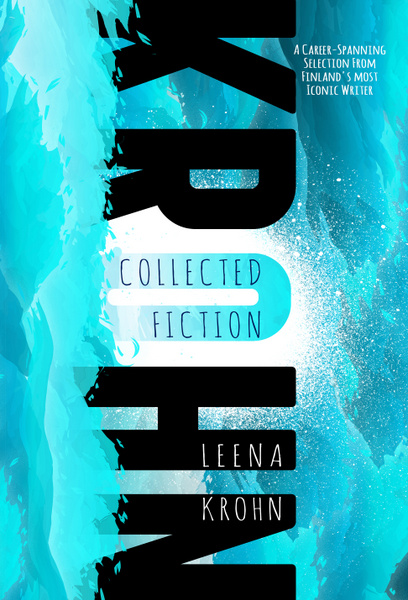
Finnish author Leena Krohn’s English-language anthology Collected Fiction (Cheeky Frawg Books, 2015) is a finalist for the World Fantasy Awards in the Collection category.

Cheeky Frawg krohn-cover-large

Collected Fiction appeared on The New Yorker‘s and The A.V. Club‘s best-of lists last year (see previous posts here and here). It was also recommended by the New York Public Library.

The awards will be presented during the World Fantasy Convention, held October 27-30, 2016 in Columbus, Ohio. Congratulations for the nomination!

Found via Locus Online.

Image via Cheeky Frawg Books.

Making Of Herbs and Stewed Rabbit

Here’s a look at how we made yesterday’s Of Herbs and Stewed Rabbit.

Dinner7 All

The menu

  • Rabbit stew
  • Hardtack leaves (lembas)
  • Blackberries

erikchef1Tolkien is very clear about not only what goes into Sam’s rabbit stew but how Sam cooks it. I’ve stuck as close as I can to that recipe.

Lembas presents more of a problem, since magical Elvish bakeries are in short supply these days, but we are helped by Gimli’s observation that lembas is like a delicious version of the Dale-men’s cram. (2.8) Cram is also mentioned in The Hobbit, which tells us: “it is biscuitish, keeps good indefinitely, is supposed to be sustaining, and is certainly not entertaining, being in fact very uninteresting except as a chewing exercise. It was made by the Lake-men for long journeys.” (H13) All of which suggests one thing: hardtack.

Hardtack has been made for centuries as a way of making grain into rations that are dense with nutrition and resistant to spoilage, both qualities that are desirable in food that must sustain travelers on long journeys.

Continue reading

Dining in Middle Earth: Of Herbs and Stewed Rabbit

“’I’ve got a bit of a stew for you, and some broth, Mr. Frodo. Do you good. You’ll have to sup it in your mug; or straight from the pan, when it’s cooled a bit. I haven’t brought no bowls, nor nothing proper.’

“Sam and his master sat just within the fern-brake and ate their stew from the pans, sharing the old fork and spoon. They allowed themselves half a piece of the Elvish waybread each.”


LotR Dinner7

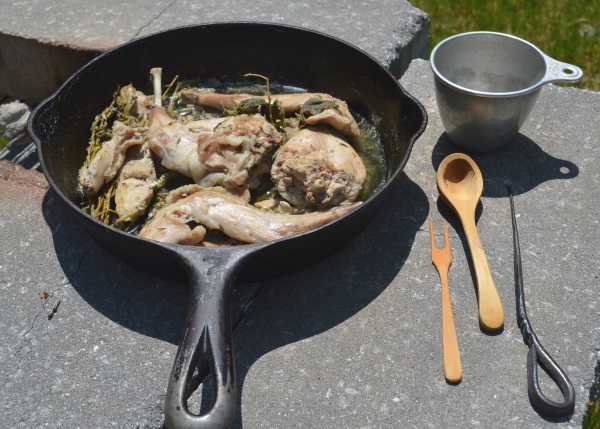
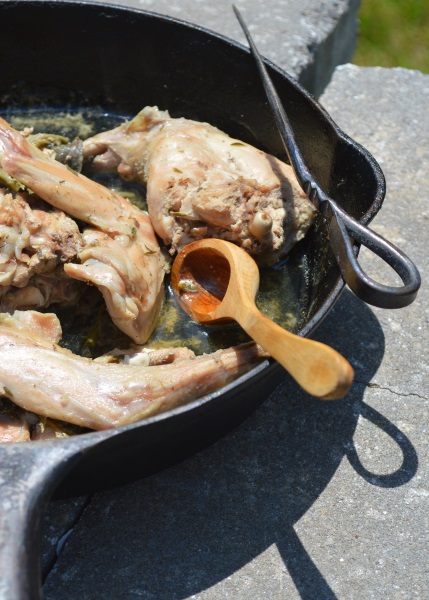
The simplest and most famous of all meals in The Lord of the Rings is without doubt the rabbit stew cooked in the wilds of Ithilien by Sam Gamgee. This is the closest Tolkien comes to giving us a recipe and we have done our best to honor both Tolkien’s words and the simplicity of the scene he evokes. This month we have a simple rabbit stew cooked on a fire outdoors and accompanied by our version of lembas bread.

LotR Dinner7 Stew

Like in The Lord of the Rings, our stew is served from the pan. Hobbit implements from previous dinners (Long-Expected Party and Farewell Feast in Bag End) make a reappearance. There’s also a skewer-like metal poker for cooking, and an old metal measuring cup has pretensions of mughood. Lembas wrapped in strawberry leaves and blackberries inside a piece of cloth add a hint of comfort to the austerity.

LotR Dinner7 Munchies

Check out what’s it about in the introduction, or read the how-to!

Images by Eppu Jensen

Geeks eat, too! Second Breakfast is an occasional feature in which we talk about food with geeky connections and maybe make some of our own. Yum!

The Great Walls of China

The Great Wall is perhaps the most iconic piece of Chinese architecture and the best known outside of China. It is also widely misunderstood. Border walls like the Great Wall in China, Hadrian’s Wall in Britain, and the Great Wall of Gorgan in Persia do not function the same way as the walls of a city or fortress. These walls are less about keeping people out than they are about managing, observing, and sending a message to the people entering the country or already within it.

A view of the wall from near the eastern terminus, photograph by Jack Upland via Wikimedia

Continue reading