Legal Brief Partly in Klingon to Counter a Big Movie Studio

The copyright infringement case filed by Paramount Pictures Corporation against the Star Trek fan production Axanar has been in the news a bit this spring. I have a mild interest in it, but I don’t spend much time following the reports—with one marvellous, excellent, and hilarious exception.

Attorney Marc Randazza wrote an amicus curiae brief for Language Creation Society (i.e., for the defendant’s benefit) to counter a copyright claim by Paramount “over the entire Klingon language, not any particular words or portions of dialogue from any episodes of Star Trek, but in the entire vocabulary, graphemes, and grammar rules of Klingon.”

His friend and co-blogger Ken White at Popehat shared the story and the brief itself (as a .pdf file). (The full docket for the case is also available via the U.S. Courts Archive.)

Mr. Randazza not only argues that one cannot copyright an entire language, invented or not; he also briefly summarizes the history and some current uses of Klingon. (Did you know, for example, that the Klingon Language Institute has overseen Klingon wordplay contests? I didn’t. Check them out; the palindromes are especially awesome.)

The best thing about the brief, however, is how Mr. Randazza uses Klingon—complete with the Klingon font, transliterations to the Latin alphabet, and translations—to illustrate his arguments.

I’ve copied three examples below without the Klingon font, using the Latin transliterations instead and adding the English translations Mr. Randazza provides. It’s worthwhile to visit the .pdf brief available online (here or here) for the full effect, though.

“Plaintiff Paramount Pictures Corporation (“Paramount”) has claimed this copyright interest for many years, but has not actually asserted it in court before now – most likely because the notion of it is [meq Hutlh / it lacks reasons].”

[p. 9 of 26]

“Just as poker jargon is unprotectable, so is Klingon. To grant such protection would be to attempt to leash that which Plaintiffs have no right to control. Plaintiffs will learn that [Suvlu’taHvIS yapbe’ HoS neH / brute strength is not the most important asset in a fight].”

[pp. 16-17 of 26]

“Plaintiffs attempt to downplay the significance of their claim of ownership over the Klingon language by arguing that ‘a language is only useful if it can be used to communication [sic] with people, and there are no Klingons with whom to communicate.’ […]

“A language is not constrained to a given ethnic or racial group. By their logic, Ancient Greek is not ‘useful’ because the Ancient Greeks are no longer with us, and the language has no native speakers, despite it being the original language of some of the seminal literary and philosophical works of the western world. Plaintiffs’ logic would seem to dictate that French is not ‘useful’ if spoken by a native German. [qoH vuvbe’ SuS / The wind does not respect a fool.]”

[pp. 23-24 of 26]

At the very least, do yourself a favor and check out how the first line of the Sesame Street theme song translates into Klingon (pp. 23-24). Ha!

Randazza Amicus Curiae Paramount v Axanar

Mr. Randazza’s straightforward and humorous writing not only counters stereotypes about legal language, but it’s also very informative. (And he did it pro bono!) Qapla’, sir!

Image: Screencap from Brief of Amicus Curiae by Marc J. Randazza for Paramount v. Axanar (case no. 2:15-cv-09938-RGK-E) filed April 26, 2016

Out There is an occasional feature highlighting intriguing art, spaces, places, phenomena, flora, and fauna.

Top Five Greek and Latin Poems that Read Like Teenage Facebook Updates

Woot! We made it! Hidden Youth has gotten funded! Thank you so much to everyone who contributed, spread the word, or expressed support over the past few weeks. I am so thrilled to be part of this anthology.

And now, as promised, I give you: The Top Five Greek and Latin Poems that Read Like Teenage Facebook Updates

5. #CRUSHINGSOHARDYOUCANTEVEN (Sappho, frag. 31)

He’s lucky as the gods,

any man who sits by you,

listening close to your

sweet voice

and lovely laugh. It just

makes my heart tremble in my chest.

When I glance at you, words

won’t come,

my tongue shatters, a thin

flame runs under my skin,

I can’t see,

my ears ring.

Sweat pours, I break out

trembling, I’m paler than a

flower. I could almost die.

But I can take it all…


4. #THATONEGUY (Horace, Satires 1.3.1-3)

The trouble with all these musical types is when you’re out with friends

and you beg them to sing, nothing will open their lips,

but when you don’t want them to sing they won’t shut up.


3. #DTMFA (Catullus, Poems 85)

I hate and I love. Maybe you wonder why I do this?

I don’t know, but I feel it happening and it’s torture.


2. #YOLO (Archilochus. Elegies frag. 232.8)

Aisimides, no one who listens to other people’s

criticisms ever gets to have a good time.


1. #BESTFRENEMIES (Martial, Epigrams 1.32)

I don’t like you, Sabidius, and I don’t know why.

All I know is: I don’t like you.


Announcements from your hosts.

Why Hidden Youth Matters to Me

There are just five days to go in the Kickstarter for Hidden Youth, the anthology of speculative fiction about marginalized young people in history. As I posted before, my story, “How I Saved Athens from the Stone Monsters,” is one of the stories in this awesome collection. I wanted to post again to thank everyone who has contributed to making Hidden Youth happen and also to say something about why this collection is so important to me, and would be even if I didn’t have a story in it.

160701frescoI teach ancient Mediterranean history at a state university. Ancient Mediterranean history is the dead-white-guy-est of all dead-white-guy history. It’s filled with the sorts of dead white guys that people make white marble statues of and that living white guys like to point to as the pinnacles of western literary, artistic, and philosophical achievement. We’ve basically had two thousand years of white guys burnishing their white-guy cred by laying exclusive claim to the legacy of the great dead white guys of the ancient Mediterranean. So successfully have they done this that a lot of people have a hard time imagining an ancient Mediterranean world that isn’t all white guys.

Now, I’m a white guy. I’ve always had the comfort of seeing myself in history. Even as a professional historian, doing my best to be objective and fully conscious of how complicated, contingent, and constructed such identities are, I can never really know what it is like to look at history and not see people who look like me. That’s a barrier I can’t cross, but I have a lot of friends who live on the other side, especially my students.

Half my students are women and a lot of them are black, Hispanic, and southeast Asian kids from working-class towns. They’ve lived their lives in the shadow of other people’s histories. They have been shown the dead-white-guy-marble-statue version of history and told—sometimes subtly, sometimes not so subtly—“This is ours. You don’t belong here.” I consider it my job to say: “Yes, you do. You were always part of this history.”

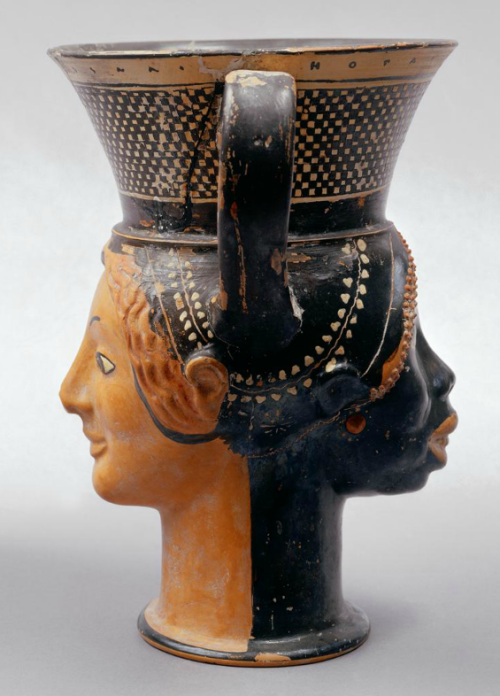
160701kantharosThe ancient Mediterranean world was multicultural, multi-ethnic, multilingual, and full of connections both within itself and to the larger world beyond. Like in my story, there were Egyptians in late classical Athens with their own Isis temple. A Sri Lankan king sent ambassadors to open diplomatic relations with Rome. And it wasn’t all a bunch of men, either. The queen of Halicarnassus was a military adviser to the Persian king. A wealthy woman of African ancestry was buried in style in late Roman York. The evidence is everywhere once you start to look for it.

The power of dead-white-guy-marble-statue history is strong and it needs to be challenged. I confront it in the classroom and my scholarly work, but we also need books like Hidden Youth out there to send the message: history is for everyone, not just people who look like me.

If you’ve already supported Hidden Youth, thank you so much. If you haven’t, please consider it. You can give as little as a dollar, and if you can’t do that, please spread the word.

On a less serious note, let me offer an added incentive to give: if Hidden Youth meets its funding goal, in honor of the collection’s theme I promise to translate and post my picks for The Top Five Greek and Latin Poems that Read Like Teenage Facebook Updates.

UPDATE: Hidden Youth got funded! Hooray! So, as promised, here you go: The Top Five Greek and Latin Poems that Read Like Teenage Facebook Updates.

Images: Bull leaping fresco (restored), photograph by Nikater, via Wikimedia (Knossos; 1550-1450 BCE; fresco). Janifrom kantharos, via People of Color in European Art History (Etruria, currently Villa Giulia; 6th c. BCE; ceramic)

Announcements from your hosts.

Paleolithic Siberian Unicorn

Besides being an awesome name for a band, paleolithic Siberian unicorn is an apt description of an animal otherwise known as Elasmotherium.

160630elasmotheriumElasmotherium was a prehistoric relative of the rhinoceros that ranged across central Asia and eastern Europe. It stood over 2 meters tall at the shoulder and its body was as long as 4.5 meters. Its distinguishing feature was an enormous horn on its face. The exact size and shape of the horn have never been determined, since no horn remains have been found, but the bony basis for the horn can be clearly seen on preserved skulls.

Elasmotherium was long thought to have gone extinct over 350,000 years ago, but recent work on a skull found in Kazakhstan has shown that the animal survived until at least 29,000 years ago. That puts living Elasmotheria in the middle of the upper (more recent) paleolithic (40,000-10,000 years ago). Humans certainly lived alongside them and may have depicted them in cave art.

Some have speculated that Elasmotheria survived even longer and may have been the inspiration for fantastical animals including unicorns, as described by eastern European legends, and the Chinese qilin. It’s impossible to verify such ideas, but they’re fun to think about.

Image: Elasmotherium via Wikimedia (c. 1920; painting; by Heinrich Harder)

Hey, look! We found a thing on the internet! We thought it was cool, and wanted to share it with you.

Possible Prehistoric Twig Toy

In an article at SAPIENS, archaeologist Stephen E. Nash discusses the difficulty of interpreting prehistoric life due to the fact that artifacts made of perishable materials are so rarely preserved to be found. It’s a quick, fascinating read, but what jumped at me was this image of a split-twig figurine that Dr. Nash shared:

Denver Museum of Nature & Science
Figurine of a deer or bighorn sheep, accession number DMNS/A1291.1, by Denver Museum of Nature & Science via SAPIENS (Dolores Cave near Gunnison, Colorado; c. 2,500 BCE; split twigs)

Found in Dolores Cave near Gunnison, Colorado, and at 4,500 years old it’s apparently the oldest and easternmost example of an artifact style found in dry cave environments across the American West. It’s unknown whether the figurine had ritualistic (or magical) uses or whether it was a child’s toy.

Regardless of what its function was, the figurine is an intriguing example of Stone Age material culture. Like Dr. Nash points out, much of the coverage of prehistoric cultures concentrates on artifacts made of nonperishable materials—stone, bone, shells, metal, or the like. It’s exhilarating to see something that could basically have been the equivalent of a twig toy horse.

The Visual Inspiration occasional feature pulls the unusual from our world to inspire design, story-telling, and worldbuilding. If stuff like this already exists, what else could we imagine?

Galaxy Donuts Almost Better than the Real Thing

Sam (who goes by sobeautifullyraw on Instagram) shared her recipe for vegan donuts with most impressive galaxy glazing. Take a look at the results:

Instagram sobeautifullyraw Vegan Galaxy Donuts

I would imagine it’s easy to adapt the instructions for making the frosting with cow’s milk should you prefer that, or just use the icing to top regular store-bought donuts for a quicker project.

Sam really pulled no punches: topping the donuts, there’s vegan edible food glitter for individual stars. You can truly feast your eyes on these beauties!

Image by Sam (sobeautifullyraw) on Instagram

Geeks eat, too! Second Breakfast is an occasional feature in which we talk about food with geeky connections and maybe make some of our own. Yum!

This Is Not the Food

When characters in fantasy fiction sit down to a meal, we have a pretty god idea of what to expect. If the setting is Europe-ish, you can count on hearty bowls of stew, roasted meats dripping with savory juices, ripe wheels of cheese, and maybe a little bread to dab up the sauce with. If the setting is Asia-ish, expect sizzling pans of vegetables and fish, skewers of meat steaming with spices both hot and sweet, and maybe a little rice to dab up the sauce with. (And I’m sure some of you out there who have read books I haven’t can tell us what food to expect in Africa-ish, Americas-ish, or other-ish settings.) The trouble with this picture of food is, historically speaking, it’s backwards. The sizzling meats, steaming vegetables, and spicy sauces are not the food. The bread, rice, and other grains are the food.

160627banquet Continue reading

ActionMovieKid’s Awesome Adventures

ActionMovieKid is a terrific YouTube channel that I just discovered. It’s run by ActionMovieDad (also known as Hashi), who does the videos mostly with Adobe After Effects. He writes of how the channel came to be:

“My 4-year-old kid is awesome. He gets into some epic situations which remind me that life is an adventure. Now his sister’s getting into the action too. Buckle up.”

Below are my current favorites. They’re all really short, but there are many neat longer compilations, too.

Toy Lightsaber by ActionMovieKid

Get in the Boat! by Action Movie Kid

Scary Bridge by Action Movie Kid

3-Year-Old with a Real Portal Gun by Action Movie Kid

It’s so great when adults take kids seriously enough to immerse themselves into their adventures. And I especially love how well Hashi incorporates his kid’s expressions into the videos.

P.S. ActionMovieKid is also on Facebook and on Twitter.

Hey, look! We found a thing on the internet! We thought it was cool, and wanted to share it with you.

Fantasy Religions: Religious Experts

If you’re inventing a fantasy religion for a story or game, you’ll probably want more than just buildings and rituals. Who uses those buildings? Who performs those rituals? Not just the everyday believers but the people whose job it is to carry out the functions of the faith. For many of the stories we tell that involve imagined religions, knowing something about the people who have expertise in that religion is important.

There are many different kinds of religious experts, even within most religious traditions, and their roles and lives can vary enormously, from the highest priest of a central temple to the attendant who sweeps the dirt off a rural roadside shrine. Some cultures have complex hierarchies of religious people or divide them into many different roles, while in others all people who follow a religious life are the same. Some religious traditions have no special personnel at all.

To try to list all the possible variations of religious people would be overwhelming and unhelpful. Instead, I’d like to offer a way of thinking about different kinds of religious experts that is flexible and practical, especially for worldbuilding. To that end, consider this question: what is it about a person with a special religious role that makes them special? Here are a few possible answers, and bear in mind that more than one of these can apply to the same person.

Special powers

160620priestSome religious experts are believed by the adherents of their faith to be endowed with a special ability to invoke divine aid, at least under certain conditions. Historically, it is common to refer to religious experts with such special powers as priests, but different traditions have their own terms.

A familiar example in the modern west is the priests of Catholic Christianity who have the power to, among other things, invoke the miracle of transubstantiation. Many other religions practiced today also have priests who perform important rites, such as Hinduism, Zoroastrianism, Shinto, and Ifa. The priests of most historical religions with an organized structure also fall into this category, including those of ancient Greece, Rome, Egypt, Persia, the Aztecs and the Maya. Many traditions require specific circumstances, locations, and rituals in order for the invocation of divine aid to be effective, but others hold that every act of a holy individual is imbued with divine force.

Continue reading

Hidden Youth Kickstarter

Life is tough as a flute girl working the streets of Athens—and that’s before the monsters attacked. When the city’s guardian statues suddenly come to life and start rampaging through the city, Mnestra, an Egyptian girl, and her Thracian friend Lampedo get separated in the chaos. Can Mnestra find the courage to rescue her friend and confront not only the monsters tearing up the city but also the most powerful man in Athens?

My short story “How I Saved Athens from the Stone Monsters” will be published this fall in the anthology Hidden Youth, a collection of 22 short fantasy and science fiction stories about young people from marginalized groups throughout history. This anthology follows the previous collection Long Hidden which told the stories of people who are often left out of speculative fiction.

I am honored to have my work chosen for Hidden Youth, but this anthology needs our help to make it out into the world. Check out the Kickstarter for Hidden Youth and consider supporting this work.

Announcements from your hosts.