New Research Resource: Gigantic Online Picture Map of London

The London Picture Archive is a gigantic, free online photo map of the city’s past. The project has been nicknamed Collage.

Collage The London Picture Archive

Managed by London Metropolitan Archives (LMA), the map is made with over 250,000 photos, prints, maps, and drawings from the collections of LMA and Guildhall Art Gallery. Visitors can search by street name, or browse featured galleries and subjects. From the description of Collage:

“The images provide an extraordinary record of London and its people from the fifteenth century to the present day. The whole of Greater London is covered, as are the adjoining counties. Some of the many highlights include photographs of Victorian London; the sixteenth century ‘Agas’ map of London; Hollar’s stunning panorama from 1647; beautifully designed twentieth century posters for London’s tramways; the Cross and Tibbs photographs of Second World War damage to the City of London and the collections formerly held at the Guildhall Print Room. We regularly add new content from the LMA collections and, in particular, continue to develop descriptions and subject tags for the very large London County Council Photograph Library.”

I’ve only poked around for a short time, but for general purposes Collage looks like an endless source of images. For more specific searches it may not do quite so well. It certainly appears to be a worthwhile source for historical or historically inspired worldbuilding.

Image: screencap of Collage home page by Eppu Jensen

Out There is an occasional feature highlighting intriguing art, spaces, places, phenomena, flora, and fauna

Legal Brief Partly in Klingon to Counter a Big Movie Studio

The copyright infringement case filed by Paramount Pictures Corporation against the Star Trek fan production Axanar has been in the news a bit this spring. I have a mild interest in it, but I don’t spend much time following the reports—with one marvellous, excellent, and hilarious exception.

Attorney Marc Randazza wrote an amicus curiae brief for Language Creation Society (i.e., for the defendant’s benefit) to counter a copyright claim by Paramount “over the entire Klingon language, not any particular words or portions of dialogue from any episodes of Star Trek, but in the entire vocabulary, graphemes, and grammar rules of Klingon.”

His friend and co-blogger Ken White at Popehat shared the story and the brief itself (as a .pdf file). (The full docket for the case is also available via the U.S. Courts Archive.)

Mr. Randazza not only argues that one cannot copyright an entire language, invented or not; he also briefly summarizes the history and some current uses of Klingon. (Did you know, for example, that the Klingon Language Institute has overseen Klingon wordplay contests? I didn’t. Check them out; the palindromes are especially awesome.)

The best thing about the brief, however, is how Mr. Randazza uses Klingon—complete with the Klingon font, transliterations to the Latin alphabet, and translations—to illustrate his arguments.

I’ve copied three examples below without the Klingon font, using the Latin transliterations instead and adding the English translations Mr. Randazza provides. It’s worthwhile to visit the .pdf brief available online (here or here) for the full effect, though.

“Plaintiff Paramount Pictures Corporation (“Paramount”) has claimed this copyright interest for many years, but has not actually asserted it in court before now – most likely because the notion of it is [meq Hutlh / it lacks reasons].”

[p. 9 of 26]

“Just as poker jargon is unprotectable, so is Klingon. To grant such protection would be to attempt to leash that which Plaintiffs have no right to control. Plaintiffs will learn that [Suvlu’taHvIS yapbe’ HoS neH / brute strength is not the most important asset in a fight].”

[pp. 16-17 of 26]

“Plaintiffs attempt to downplay the significance of their claim of ownership over the Klingon language by arguing that ‘a language is only useful if it can be used to communication [sic] with people, and there are no Klingons with whom to communicate.’ […]

“A language is not constrained to a given ethnic or racial group. By their logic, Ancient Greek is not ‘useful’ because the Ancient Greeks are no longer with us, and the language has no native speakers, despite it being the original language of some of the seminal literary and philosophical works of the western world. Plaintiffs’ logic would seem to dictate that French is not ‘useful’ if spoken by a native German. [qoH vuvbe’ SuS / The wind does not respect a fool.]”

[pp. 23-24 of 26]

At the very least, do yourself a favor and check out how the first line of the Sesame Street theme song translates into Klingon (pp. 23-24). Ha!

Randazza Amicus Curiae Paramount v Axanar

Mr. Randazza’s straightforward and humorous writing not only counters stereotypes about legal language, but it’s also very informative. (And he did it pro bono!) Qapla’, sir!

Image: Screencap from Brief of Amicus Curiae by Marc J. Randazza for Paramount v. Axanar (case no. 2:15-cv-09938-RGK-E) filed April 26, 2016

Out There is an occasional feature highlighting intriguing art, spaces, places, phenomena, flora, and fauna.

NASA Goes off to Outer Space for Star Wars Day

This May the Fourth, NASA rules. Check out what they posted on the NASA Tumblr account:

NASA Tumblr Saturns Moon Mimas

“Worlds That Will Make You Believe Star Wars is Real

“The fantastical planets in Star Wars preceded our discovery of real planets outside our solar system… but fiction isn’t too far from the facts. When we send our spacecraft into the solar system and point our telescopes beyond, we often see things that seem taken right out of the Star Wars universe.

“Is there a more perfect time than May the 4th to compare real worlds to the ones depicted in Star Wars?

“Probably not… so here are a few:

What follows is pictures (mostly artists’ renderings) and short descriptions of eight planetary bodies that could serve as models for various locations in the Star Wars universe. And don’t let the photo of Saturn’s moon Mimas above fool you; it’s the most scruffy-looking of the bunch.

NASA’s post isn’t earth-shattering or deep or anything. But it does show a sense of humor, and combines pop culture geekery with science geekery in a very satisfying way. (YMMV, of course.)

I’m gonna go take you to Jabba now follow NASA on Tumblr right now.

Image: Saturn’s moon Mimas (the so-called Death Star moon) via NASA on Tumblr.

Out There is an occasional feature highlighting intriguing art, spaces, places, phenomena, flora, and fauna.

Quality Research Resources by Private Individuals

I wrote last week about what a fantastic thing it is to have a wealth of primary sources stored in libraries and museums, nowadays increasingly being made available online. For completeness’s sake, it needs to be mentioned that it’s not only library and museum professionals that share quality research or materials online.

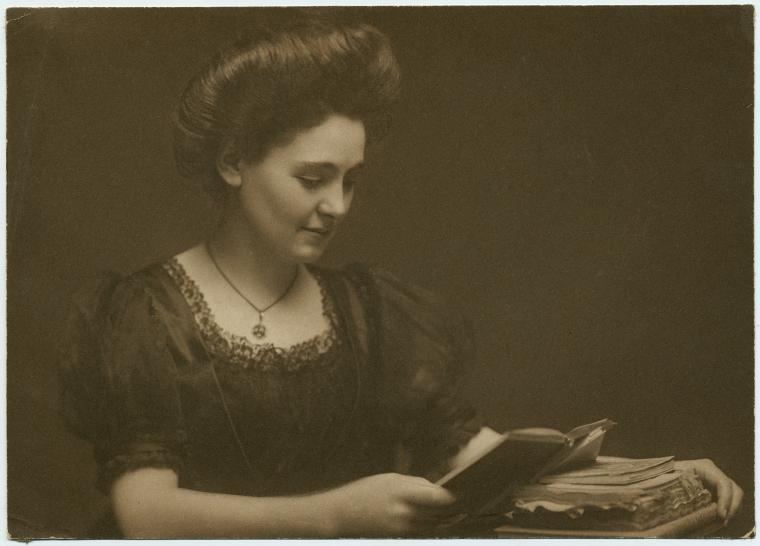
nypl-unidentified-woman-reading-a-book
Unidentified woman reading a book via NYPL, Manuscripts and Archives Division (1913; photograph)

Below I list a (very) few linguistic and historical resources put together by dedicated private individuals. They’re all diligent in documenting their steps and sources, and providing info and links for those interested in finding more. Thorough documentation is, again, not a surefire way to avoid mistakes, but it does allow tracking sources and re-creating the research.

A short list, to be sure, but what better than that to add to. 🙂

Out There is an occasional feature highlighting intriguing art, spaces, places, phenomena, flora, and fauna.

The Glory of Library and Museum Materials

I really love the Internet for research. It connects us to materials and people around the world. As a visual person, I find the availability of photographs and other visualizations on just about any subject especially gratifying. You can visit places and eras that you physically may not be able to.

NYPL Digital The Drawbridge

One of the invaluable services libraries and museums provide, especially now that more of their collections are being digitized, is access to historical periods and obscure topics. (Like the Peter Parker collection of 80 paintings of Chinese patients with large tumors or other major deformities – that’s not a joke!)

And that’s only the beginning – using library and museum websites and digital collections to find primary sources for research has other benefits as well:

  • Copious metadata: the provenance (origins and history) of documents or items, including details like dates, original creators, owners, and chain of custody, are clearly marked when known, and when unknown, that is clearly stated, too.
  • Materials that physical items were made of are also given, often with information on the techniques involved or links to further reading in connection with museum exhibits.
  • Many libraries and museums group items in their digital collections into more easily browsable subgroups, for example by era, style, type, or topic.
  • Copyright information is easily available: any limitations to re-using the materials are clearly given. There are also collections that concentrate on items that are in public domain.
  • If digital materials are made available for re-using, often there are multiple formats, sizes, or resolutions. That’s great service!
  • Sets of search results are often smaller than online in general. Finding an answer is faster!
  • Digital collections are created by professionals. While this doesn’t completely eliminate the possibility of errors, online materials at libraries and museums are researched, curated, and checked, which increases the reliability of the information provided.
  • If additional information or clarification is needed, it’s the job of museums and libraries to at least try to help. That’s literally why they’re there!

Below are just some amazing digital collections from museums and libraries around the world:

Must. Resist. Internet. Rabbit. Holes!

Image: The Drawbridge via NYPL (The Miriam and Ira D. Wallach Division of Art, Prints and Photographs: Print Collection, The New York Public Library, New York Public Library Digital Collections; 1748-1751; etching; by Giovanni Battista Piranesi)

Out There is an occasional feature highlighting intriguing art, spaces, places, phenomena, flora, and fauna.

Travel Destination Video: Dwarf Planet Ceres

There’s a new animation of the dwarf planet Ceres. It was made on the basis of images sent by NASA’s spacecraft Dawn, and resembles a travel destination video.

Flight Over Dwarf Planet Ceres by NASA Jet Propulsion Laboratory

More photos, info, and spiffy infographics on Ceres at NASA’s Solar System Exploration site. I’d definitely go visit! How about you?

Out There is an occasional feature highlighting intriguing art, spaces, places, phenomena, flora, and fauna.

NYPL Releases Thousands of High-Res Public Domain Images

The New York Public Library released a treasure trove of 180,000 high-resolution scans of public domain images. They include photographs, etchings, watercolors, sheet music, maps, illuminated manuscript images and other pages from books, stereoscopic views, and more. The oldest materials date back as far as the 11th century. With their visual search you can browse by century, genre, collection, and even color.

NYPL Public Domain Img Collection
Visual browse tool’s color view via NYPL Manuscripts and Archives Division

According to the NYPL:

“Did you know that more than 180,000 of the items in our Digital Collections are in the public domain?

“That means everyone has the freedom to enjoy and reuse these materials in almost limitless ways. The Library now makes it possible to download such items in the highest resolution available directly from the Digital Collections website.

“No permission required. No restrictions on use.

“Below you’ll find tools, projects, and explorations designed to inspire your own creations—go forth and reuse!”

I know I’m going to be using the collection a lot!

Out There is an occasional feature highlighting intriguing art, spaces, places, phenomena, flora, and fauna.

Headcanon: Underground Hydroponics in The Hunger Games World

From time to time, I get sucked into thinking about the pragmatics of fictional worlds. By that I mean all the mundane details of how people lead their everyday lives, starting from the very basic human (or creature) needs like food, clothing, waste management, and social interaction. Not just who takes care of, say, the laundry and when, but where do they go to do it, how do they get there, what kinds of implements are they expected to bring in themselves and what is shared, how long does it take, what physical motions do they go through, is it a solo activity or a joint effort, and the like.

For me as a visual person, often thinking about everyday activities and movement through spaces tumbles into thinking about what exactly do these various spaces look like. It’s a way to add depth and realism into a story – we are physical beings who love tactile experiences and accumulate all sorts of personal possessions, and if a fictional world ignores that, it makes that world fall flat for me. (Hello, Star Trek!)

The Hunger Games is one of the current ones in my mind because of the approaching Mockingjay – Part 2 premiere and because of an article on Colossal I saw about a World War II era bomb shelter in London that has been turned into an underground farm.

Growing Underground Forgotten Heritage Photo Shoot
Growing Underground on Instagram.

The company running the operation, Growing Underground, produces leafy greens like watercress, basil, coriander, and radish in hydroponic beds lit by LED lamps.

Growing Underground Beds Homepage
Growing Underground.

In the The Hunger Games world, the population of District 13 lives in underground bunkers; the above-ground structures were destroyed by the Capitol. In the Mockingjay novel, Collins mentions various spaces like the armory, the laundry, labs, testing ranges, and farms in passing. She describes these spaces mostly just in very generic terms; e.g., the color of the living compartments is white, and we hear of furniture like dressers and conference tables with individual screens, but that’s about the extent of the detail.

Scenes in the movie Mockingjay – Part 1 show the special weapons lab with a shooting range, the hangar, the bunker, and some hospital and apartment rooms, among others, but I don’t think we’ve seen any underground farms of any kind, nor the poultry farm, for example, that was destroyed in the book version of the bombing of 13 by the Capitol.

Mockingjay1 D13 Collage
Clockwise from top: living quarters, cafeteria, and infirmary at District 13. Images via Jabberjays.net.

The Growing Underground photos of their growing beds fit quite well with Collins’s carefully frugal description and the established Hunger Games visual style. So, in my headcanon, even if we haven’t seen them on screen, District 13’s underground hydroponics now look very much like those of Growing Underground.

Out There is an occasional feature highlighting intriguing art, spaces, places, phenomena, flora, and fauna.

Art for Early Editions of Dune

Have you read Dune? If so, you might enjoy this early art by John Schoenherr:

Schoenherr Dune Dawn at the Palace of Arrakeen
John Schoenherr: Dawn at the Palace of Arrakeen.
Schoenherr Dune Stilgar and His Men
John Schoenherr: Stilgar and His Men.


Schoenherr Dune Defeating the Sardaukar
John Schoenherr: Defeating the Sardaukar.

Apparently, Frank Herbert said Schoenherr (1935-2010) was “the only man who has ever visited Dune.” Schoenherr’s paintings of Herbert’s Dune were published first in the Analog magazine and later in a fully illustrated version.

For me, along with John Christopher’s The Tripods, Dune is one of the SFF books I read in my (much) younger days and have kept re-reading over the years. Seeing this early art was certainly a treat!

Found via Dangerous Minds – go visit for more info & pics.

Out There is an occasional feature highlighting intriguing art, spaces, places, phenomena, flora, and fauna.

Statue of Lenin Turned to the Dark Side

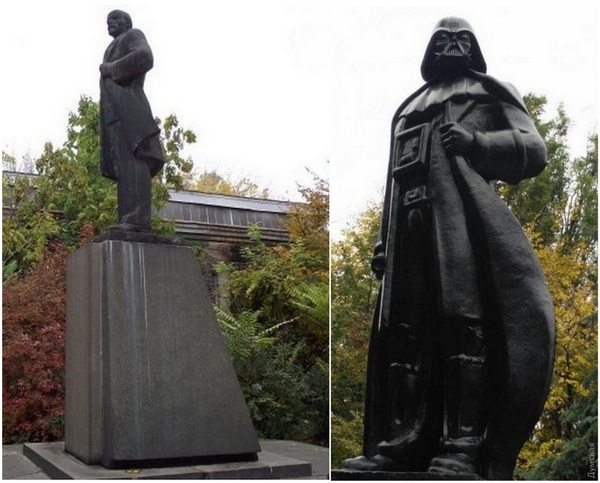
In Odessa, Ukraine, a statue of Lenin fated for demolition instead got a new life – as Darth Vader.

Dumskaya Lenin Vader
Images: Dumskaya.net via Meduza.

The destruction of the statue was called for by a new law that requires the elimination of all landmarks and geographic names dedicated to communist figures. Artist Alexander Milov repurposed the statue and turned Lenin into the dark side. There’s more under Vader’s cloak than a covered-up Lenin’s coat, though: the statue’s head conceals a router delivering Wi-Fi to the immediate area.

Who woulda thunk that Lenin’s pose would be spot on for Vader!

Found via Meduza.

Out There is an occasional feature highlighting intriguing art, spaces, places, phenomena, flora, and fauna.