Travel Destination Video: Dwarf Planet Ceres

There’s a new animation of the dwarf planet Ceres. It was made on the basis of images sent by NASA’s spacecraft Dawn, and resembles a travel destination video.

Flight Over Dwarf Planet Ceres by NASA Jet Propulsion Laboratory

More photos, info, and spiffy infographics on Ceres at NASA’s Solar System Exploration site. I’d definitely go visit! How about you?

Out There is an occasional feature highlighting intriguing art, spaces, places, phenomena, flora, and fauna.

NYPL Releases Thousands of High-Res Public Domain Images

The New York Public Library released a treasure trove of 180,000 high-resolution scans of public domain images. They include photographs, etchings, watercolors, sheet music, maps, illuminated manuscript images and other pages from books, stereoscopic views, and more. The oldest materials date back as far as the 11th century. With their visual search you can browse by century, genre, collection, and even color.

NYPL Public Domain Img Collection
Visual browse tool’s color view via NYPL Manuscripts and Archives Division

According to the NYPL:

“Did you know that more than 180,000 of the items in our Digital Collections are in the public domain?

“That means everyone has the freedom to enjoy and reuse these materials in almost limitless ways. The Library now makes it possible to download such items in the highest resolution available directly from the Digital Collections website.

“No permission required. No restrictions on use.

“Below you’ll find tools, projects, and explorations designed to inspire your own creations—go forth and reuse!”

I know I’m going to be using the collection a lot!

Out There is an occasional feature highlighting intriguing art, spaces, places, phenomena, flora, and fauna.

Headcanon: Underground Hydroponics in The Hunger Games World

From time to time, I get sucked into thinking about the pragmatics of fictional worlds. By that I mean all the mundane details of how people lead their everyday lives, starting from the very basic human (or creature) needs like food, clothing, waste management, and social interaction. Not just who takes care of, say, the laundry and when, but where do they go to do it, how do they get there, what kinds of implements are they expected to bring in themselves and what is shared, how long does it take, what physical motions do they go through, is it a solo activity or a joint effort, and the like.

For me as a visual person, often thinking about everyday activities and movement through spaces tumbles into thinking about what exactly do these various spaces look like. It’s a way to add depth and realism into a story – we are physical beings who love tactile experiences and accumulate all sorts of personal possessions, and if a fictional world ignores that, it makes that world fall flat for me. (Hello, Star Trek!)

The Hunger Games is one of the current ones in my mind because of the approaching Mockingjay – Part 2 premiere and because of an article on Colossal I saw about a World War II era bomb shelter in London that has been turned into an underground farm.

Growing Underground Forgotten Heritage Photo Shoot
Growing Underground on Instagram.

The company running the operation, Growing Underground, produces leafy greens like watercress, basil, coriander, and radish in hydroponic beds lit by LED lamps.

Growing Underground Beds Homepage
Growing Underground.

In the The Hunger Games world, the population of District 13 lives in underground bunkers; the above-ground structures were destroyed by the Capitol. In the Mockingjay novel, Collins mentions various spaces like the armory, the laundry, labs, testing ranges, and farms in passing. She describes these spaces mostly just in very generic terms; e.g., the color of the living compartments is white, and we hear of furniture like dressers and conference tables with individual screens, but that’s about the extent of the detail.

Scenes in the movie Mockingjay – Part 1 show the special weapons lab with a shooting range, the hangar, the bunker, and some hospital and apartment rooms, among others, but I don’t think we’ve seen any underground farms of any kind, nor the poultry farm, for example, that was destroyed in the book version of the bombing of 13 by the Capitol.

Mockingjay1 D13 Collage
Clockwise from top: living quarters, cafeteria, and infirmary at District 13. Images via Jabberjays.net.

The Growing Underground photos of their growing beds fit quite well with Collins’s carefully frugal description and the established Hunger Games visual style. So, in my headcanon, even if we haven’t seen them on screen, District 13’s underground hydroponics now look very much like those of Growing Underground.

Out There is an occasional feature highlighting intriguing art, spaces, places, phenomena, flora, and fauna.

Art for Early Editions of Dune

Have you read Dune? If so, you might enjoy this early art by John Schoenherr:

Schoenherr Dune Dawn at the Palace of Arrakeen
John Schoenherr: Dawn at the Palace of Arrakeen.
Schoenherr Dune Stilgar and His Men
John Schoenherr: Stilgar and His Men.


Schoenherr Dune Defeating the Sardaukar
John Schoenherr: Defeating the Sardaukar.

Apparently, Frank Herbert said Schoenherr (1935-2010) was “the only man who has ever visited Dune.” Schoenherr’s paintings of Herbert’s Dune were published first in the Analog magazine and later in a fully illustrated version.

For me, along with John Christopher’s The Tripods, Dune is one of the SFF books I read in my (much) younger days and have kept re-reading over the years. Seeing this early art was certainly a treat!

Found via Dangerous Minds – go visit for more info & pics.

Out There is an occasional feature highlighting intriguing art, spaces, places, phenomena, flora, and fauna.

Statue of Lenin Turned to the Dark Side

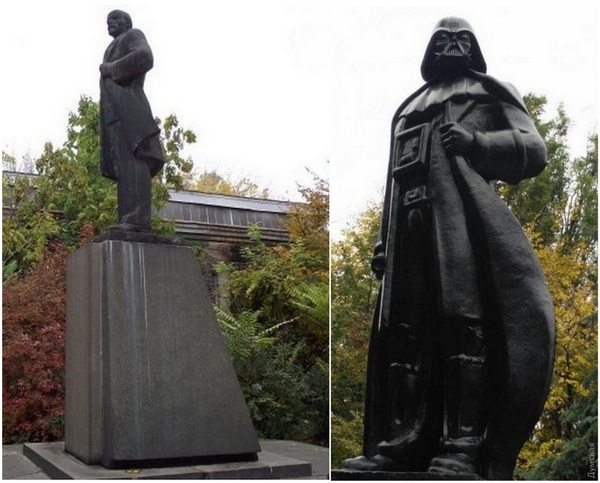
In Odessa, Ukraine, a statue of Lenin fated for demolition instead got a new life – as Darth Vader.

Dumskaya Lenin Vader
Images: Dumskaya.net via Meduza.

The destruction of the statue was called for by a new law that requires the elimination of all landmarks and geographic names dedicated to communist figures. Artist Alexander Milov repurposed the statue and turned Lenin into the dark side. There’s more under Vader’s cloak than a covered-up Lenin’s coat, though: the statue’s head conceals a router delivering Wi-Fi to the immediate area.

Who woulda thunk that Lenin’s pose would be spot on for Vader!

Found via Meduza.

Out There is an occasional feature highlighting intriguing art, spaces, places, phenomena, flora, and fauna.

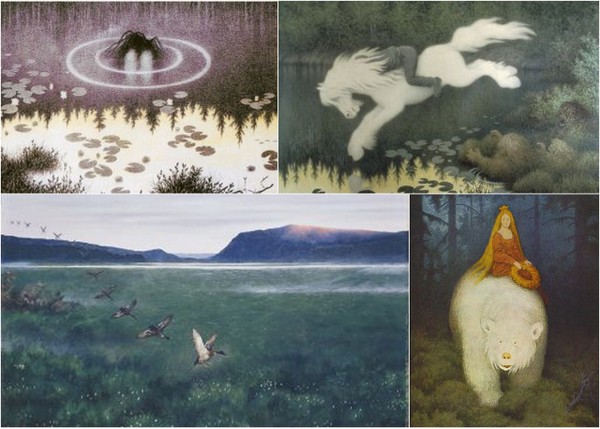
Theodor Kittelsen’s Naturalistic Fantastical Art

Norwegian Theodor Kittelsen (1857-1914) developed into one of Scandinavia’s most popular artists. He’s especially well known for his nature paintings and illustrations of fairy tales, legends, and trolls.

Trollet_som_grunner_pa_hvor_gammelt_det_er
Theodor Kittelsen: Trollet som grunner på hvor gammelt det er [troll wonders how old it is], 1911. Via Wikimedia Commons.
His art clearly shows how strongly the Norwegian nature inspired him. Kittelsen’s style is said to include aspects naturalism, mysticism, and Art Nouveau.

Kittelsen Collage
Theodor Kittelsen, clockwise from top left: Nøkken [water spirit], 1887–92; Gutt på hvit hest [boy on white horse]; Kvitebjørn Kong Valemon [white bear King Valemon], 1912; 12 villender [12 wild ducks], 1897. Via emmeffe6 on Flickr (one, two, three, four).
The element of a boy on a white horse is connected with water spirit tales. Apparently some näkki water spirits (to use my native Finnish term) can turn into horses to capture humans to pull underwater. I don’t remember that aspect of the näkki stories from my childhood; perhaps there’s a difference between the Scandinavian and Finnish tales.

The landscapes in Kittelsen’s paintings remind me of the Finnish wildernesses a lot. There’s also something solemn and contemplative in the mood of his imagery that makes me connect it with Tolkien’s art and writing, on one hand, and, on the other, with the illustrations of Tove Jansson (see examples of her work on Alice in Wonderland and The Hobbit provided by The Official Moomin site).

Out There is an occasional feature highlighting intriguing art, spaces, places, phenomena, flora, and fauna.

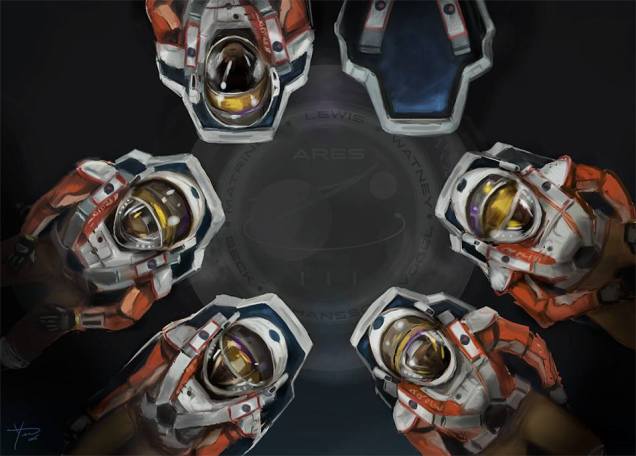
Digital Painting Inspired by The Martian

Painter and photographer d. yee was inspired to re-interpret a scene from The Martian as a digital painting:

d. yee.
d. yee.

Says artist:

“Was thinking to use this as a reference for a large format painting (in acrylic). After working on this digital painting over a couple of days I’m starting to rethink the feat. My right hand is not happy.”

Beautiful. Reminds me stylistically of some SF book covers I like. I hope a large format acrylic is coming (and published on their website)!

Out There is an occasional feature highlighting intriguing art, spaces, places, phenomena, flora, and fauna.
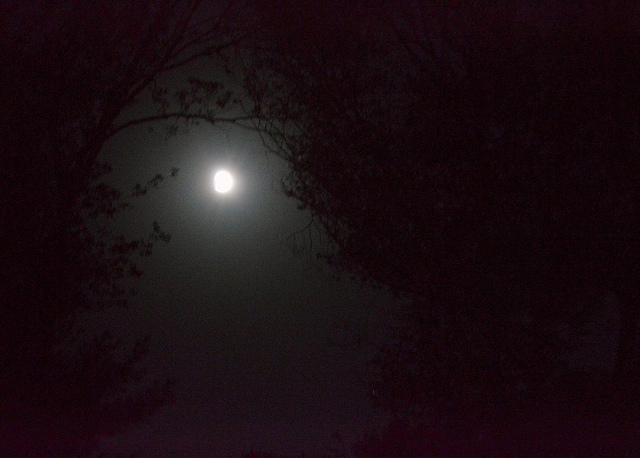
Supermoon Lunar Eclipse

We happened to have excellent conditions for the 2015 supermoon lunar eclipse: clear skies, warm weather, and a dark backyard for early night viewing. The best shot I got is from the beginning of the eclipse (with a little computer enhancement).

Very neat. And, although celestial photography won’t become a part of my skills in a hurry, it was nice to try.

Image by Eppu Jensen

 This post has been edited.

Out There is an occasional feature highlighting intriguing art, spaces, places, phenomena, flora, and fauna.

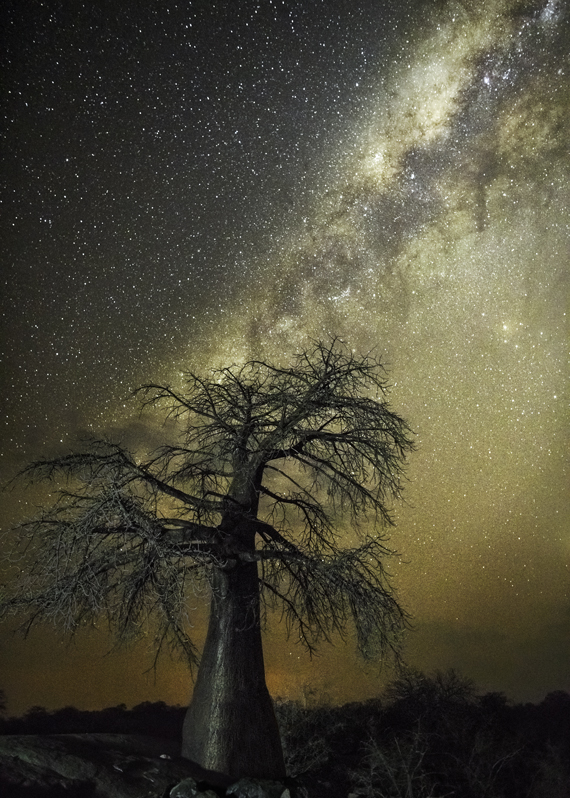
Ancient African Trees Look Alien at Night

Photographer Beth Moon‘s new series Diamond Nights documents baobabs and quiver trees against moonless, starry night skies with breathtaking results. For a Nordic city dweller like me, the images might as well be from a different planet.

Beth Moon: Aquila, 2015.

Beth Moon: Serpens, 2015.

In her artist’s statement, Moon writes of the technical aspects of shooting:

“The majority of these photographs were created during moonless nights, shot with a wide angle lens and ISO of 3200 – 6400. […] Exposures up to 30 seconds allowed enough light to enter the lens without noticeable star movement. Each location required a lot of experimenting. and different lighting techniques. Sometimes a short burst of diffused light from a flashlight was sufficient, or bounced light from multiple flashlights was used for a softer more natural glow.”

Beth Moon: Ara, 2015.

Photos like these remind me of the incredible diversity of our planet, and how much more of the world we can see and share through the power of Internet than even our parents. Love it!

Found via Colossal.

Out There is an occasional feature highlighting intriguing art, spaces, places, phenomena, flora, and fauna.