Fantastic Worlds Exhibit at The Smithsonian

The Smithsonian’s new exhibit Fantastic Worlds: Science and Fiction, 1780-1910 opened on July 01, 2015. In addition to the physical exhibit, the Smithsonian Libraries provide an online version.

The Smithsonian Libraries online exhibit Fantastic Worlds.

From the online exhibit description:

“Travel with us to the surface of the moon, the center of the earth, and the depths of the ocean β€” to the fantastic worlds of fiction inspired by 19th-century discovery and invention.

“New frontiers of science were emerging. We took to the air, charted remote corners of the earth, and harnessed the power of steam and electricity. We began unlocking the secrets of the natural world. The growing literate middle class gave science a new and avid public audience. Writers explored the farther reaches of the new scientific landscape to craft novels, hoaxes, and satires.”

The online exhibit reveals a new thematic component (or chapter) each Tuesday. So far we’ve seen “Terra Incognita” and The Age of the Aeronaut”. The chapters include images, maps, and videos, plus intriguing curator’s notes. Sounds great for early science fiction and fantasy enthusiasts, as well as people interested in the history of exploration or late 1700s to 1800s.

Found via Smithsonian Libraries on Tumblr.

Out There is an occasional feature highlighting intriguing art, spaces, places, phenomena, flora, and fauna.

Painted Mechanized Fauna

Among other projects, Swiss artist, graphic designer, and illustrator Remo Lienhard (aka Wes21) produces large-scale public art and designs that combine natural elements with science fiction.

Remo Lienhard: Journey, 2014.
Remo Lienhard: Kolosskalmar, 2014.

His style resembles 1980s sci-fi illustrations, but the joining of mechanical parts and buildings with humongous bugs and sea animals, for example, is new. (New to me, at least.)

The piece below gives quite a literal meaning to the old Finnish joke about our national air force consisting of mosquitoes:

Remo Lienhard: Mosquitoes Down, 2014.

I got a good chuckle out of that one. πŸ™‚

I recommend having a look at Lienhard’s website. Apart from the works with sci-fi elements, there is so much to admire.

Found via Colossal.

Out There is an occasional feature highlighting intriguing art, spaces, places, phenomena, flora, and fauna.

Forest Photos Made Otherworldly

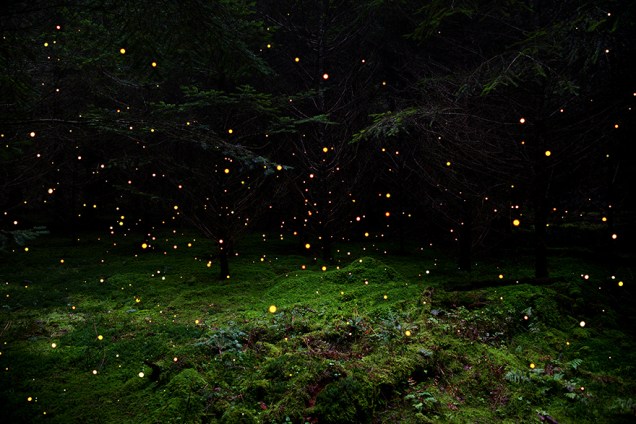
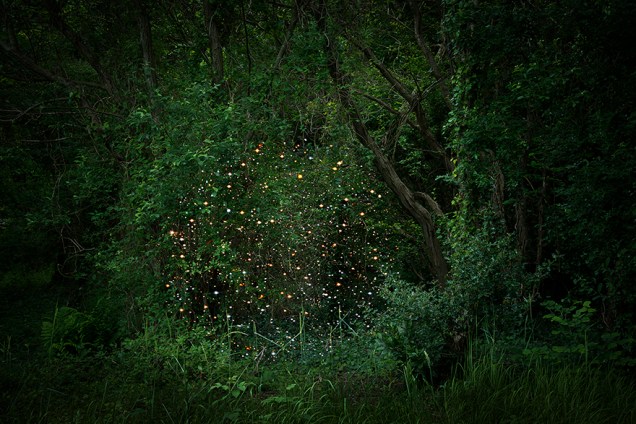
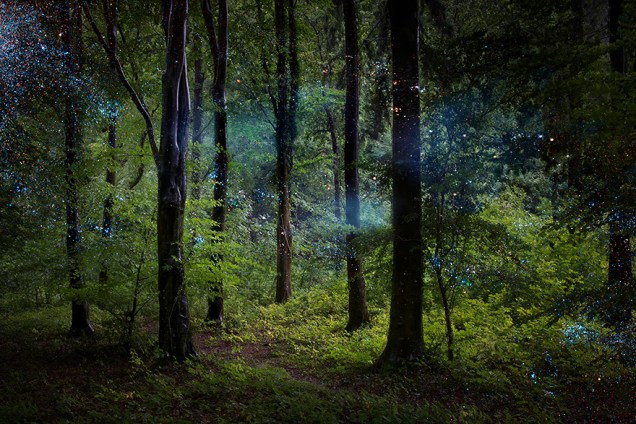
I just ran into a collection of photos of woods and other natural areas by photographer Ellie Davies. I thought many of the forest photos in particular looked magical or fairylike. Take a look:

Ellie Davies Stars-5
Ellie Davies: Stars, 2014-2015. Images: Ellie Davies and STScI/Hubble & NASA.
Ellie Davies Stars-2
Ellie Davies: Stars, 2014-2015. Images: Ellie Davies and STScI/Hubble & NASA.
Ellie Davies Stars-9-2014
Ellie Davies: Stars, 2014-2015. Images: Ellie Davies and STScI/Hubble & NASA.

The photos above come from her series Stars from 2014-2015. I couldn’t figure out how Davies made them. Turns out that they are composites of forest photos and Hubble images of the Milky Way, Omega Centauri, the Norma Galaxy, and embryonic stars in the Nebula NGC 346, provided by Space Telescope Science Institute (STScI) and NASA. Very neat!

Some of Davies’s past projects incorporate photoshopped elements, small-scale construction, or objects into the landscapes she photographs.

Ellie-DaviesSmoke-and-Mirrors-9
Ellie Davies: Smoke and Mirrors, 2010.
Between-the-Trees-11-Bayeux-Crop
Ellie Davies: Between the Trees, 2014.

Despite the man-made additions, the photos stay in an apparitional realm, playing with the otherwordly. And it’s intentional. In her artist’s statement, Davies writes:

β€œUK forests have been shaped by human processes over thousands of years and include ancient woodlands, timber forestry, wildlife reserves and protected Areas of Outstanding Natural [Beauty]. As such, the forest represents the confluence of nature, culture, and human activity. Forests are potent symbols in folklore, fairy tale and myth, places of enchantment and magic as well as of danger and mystery. In more recent history they have come to be associated with psychological states relating to the unconscious.

β€œAgainst this backdrop [my work] explores the ways in which identity is formed by the landscapes we live and grow up in. Making a variety of temporary and non-invasive interventions in the forest, my work places the viewer in the gap between reality and fantasy, creating spaces which encourage the viewer to re-evaluate the way in which their own relationship with the landscape is formed, the extent to which it is a product of cultural heritage or personal experience, and how this has been instrumental in their own identity.”

Found via Colossal.

Out There is an occasional feature highlighting intriguing art, spaces, places, phenomena, flora, and fauna.