Due to a post-winterstorm blackout a week more than two weeks ago, I’m still catching up on my Internet reading, so I only saw these awesome, nerdy motivational postersnow after the International Women’s Day. It was worth the wait, though:
Risa Rodil on Tumblr.
“Just because something works doesn’t mean it can’t be improved.”
Referring of course to Shuri from the movie Black Panther. As another tinkerer, I wholeheartedly agree! 😀
Risa Rodil on Tumblr.
“Behind every successful woman is herself.”
The posters are by letterer, illustrator and designerd Risa Rodil. She posted them on Tumblr in honor of the International Women’s Day (March 08).
I’m not a fan of the Victorian age per se, but watching Murdoch Mysteries has piqued my interest somewhat. Here are some intriguing photographs from the later 1800s to early 1900s.
From a set of unscripted photos taken in the streets of 1890s Norway by Carl Størmer, a young woman with books:
Young woman with books, photograph by Carl Størmer via Imgur (Oslo, Norway, 1890s)
All of the subjects in this set are remarkably relaxed. Love the contrast to the stiff studio portraits of the era!
(I’ve had trouble finding a more detailed source, unfortunately. Possibly Størmer’s photos are gleaned from the 2008 book 80 millioner bilder: Norsk kulturhistorisk fotografi 1855-2005 [’80 Million Pictures: Norwegian Culture-Historical Photography 1855-2005′], edited by Jonas Ekeberg and Harald Østgaard Lund.)
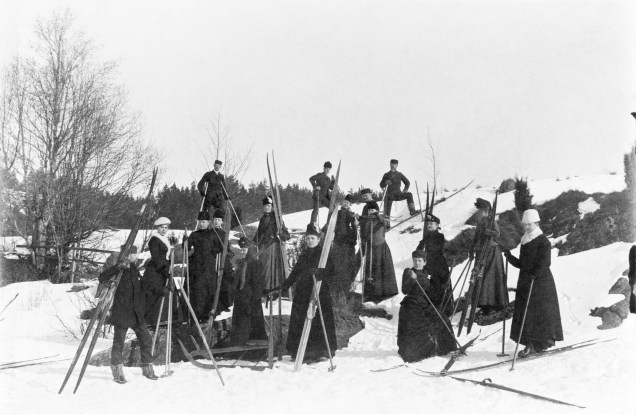
Finnish ladies and gentlemen on a ski trip in the 1890s:
Hiihtoretkeläiset ryhmäkuvassa (‘ski trip participants in a portrait’), photograph via Helsinki City Museum (Helsinki, Finland, 1890s, image number N252030, CC BY 4.0)
Judging by their attire, they are indeed ladies and gentlemen. What struck me is that, apparently, it wasn’t at all odd for the upper class to go skiing in their regular daywear.
Speaking of sports and Victorians, from 1891, here is high school dressage equestrian Selika Lazevski by Félix Nadar:
Selika Lazevski, photograph by Félix Nadar courtesy of Ministère de la Culture, France, via Black Female Equestrians (Paris, France, 1891)
What an arresting portait!
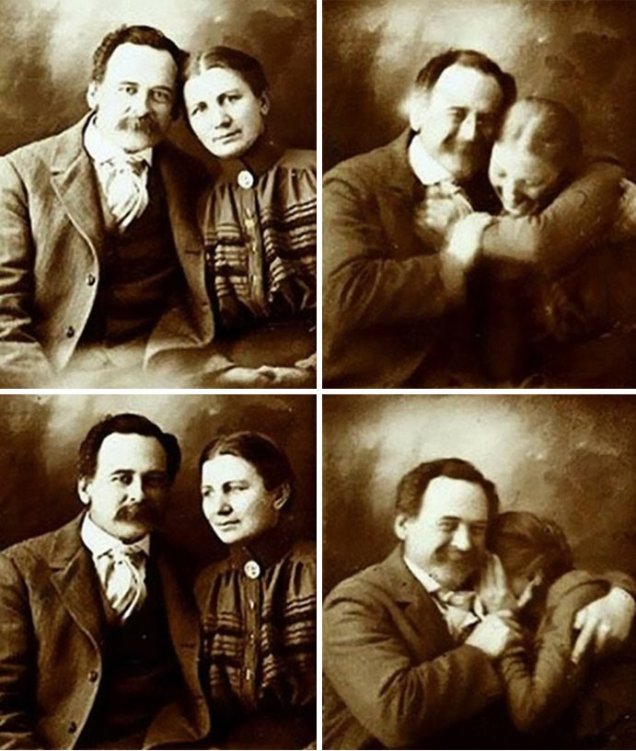
A Victorian couple from Leeds trying not to laugh while getting their portraits done in the 1890s:
Victorians certainly loved their wheels! I wonder exactly how one would’ve operated this chair—there’s clearly a handle bar connected to the front wheel, but if grabbing it with both hands, where does the propelling force come from?
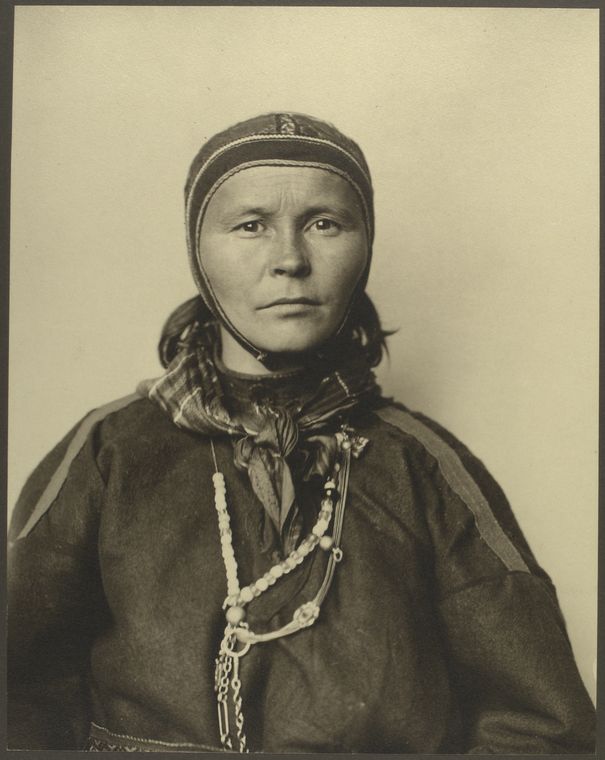
A Sami woman from Finland photographed at Ellis Island in the U.S., so presumably immigrating, around 1905-1914:
Laplander / Sami woman from Finland, photograph by Augustus F. Sherman via New York Public Library digital collections (Ellis Island, New York, NY, c. 1905-1914, image ID 418041, public domain)
I wish the portrait hadn’t cut off at the waist; I would’ve liked to see the rest of the details of her dress (the belt looks especially interesting). I know that nowadays Sami outfits (gákti) are unique. Each is made for its wearer to reflect the personal / family history and area (and possibly the people as a whole?). I don’t know, however, how far back in time that practice goes.
Anyway. These old photos give fascinating glimpses of western life only about 100 years ago. So similar and yet so, so different.
Out There is an occasional feature highlighting intriguing art, spaces, places, phenomena, flora, and fauna.
Yareta or llareta (Azorella compacta) is a low evergreen that grows in the Andes mountains in Peru, Bolivia, northern Chile, and Argentina.
Looking at the landscape where it’s found, it seems that the yareta latches onto ground or rock and grows up and out into the rounded shape over the years.
The rounded, cotton-ball-like shape reminds me of how some mosses grow. Unlike them, though, the yareta can grow in dry conditions and nutrient-poor soil, if slowly. (According to Wikipedia, their growth rate is approximately 1.5 cm / 0.6 inches per year; however, an article in Pharmacognosy Magazine cites 1 cm in 20 years.)
Apparently the Andean people used yareta since Pre-Columbian times for the treatment of colds, pains, diabetes, asthma, bronchitis, womb complaints, gastric disorders, backache, wounds, and altitude sickness (Pharmacognosy Magazine Aug 2014).
Yareta looks like a great option for speculative writers and artists looking to break out of the Eurocentric worldbuilding mold.
Images: Yareta at Ollague Volcano lookout by Miguel Vieira via Flickr (CC BY 2.0). Yareta – Bolivian Altiplano by Knut-Erik Helle via Flickr (CC BY-NC-ND 2.0)
Out There is an occasional feature highlighting intriguing art, spaces, places, phenomena, flora, and fauna.
Apart from various aspects of the story and the movie series, the exhibition covers for example illustrations, the history of real-world magic, and early sketches and notes by J.K. Rowling. In addition, on display are a number of items from the Museum of Witchcraft and Magic.
My favorite feature is perhaps the section covering the real-world history of various Hogwarts classes, closely followed by the animals and fantastical beasts section.
Alku (‘Beginning’), a piece by the Finnish vocal folk hop ensemble Tuuletar, appears in a Game of Thrones commercial. The band’s website says,
“’Alku’, the opening track from Tuuletar’s debut album “tules maas vedes taivaal” has been sold for the use of one of the most popular tv-series in the whole world, HBO’s Game of Thrones. The song will be heard in the season 7 DVD and Blue-Ray [sic] commercial, which will be broadcasted worldwide. The deal was made together with Finnish record label Bafe’s Factory and ThinkSync Music from London.”
The ThinkSync news page on the sale links to a German-language DVD / Blu-Ray trailer for GoT season 7 on YouTube with Alku in the background:
GAME OF THRONES Staffel 7 – Trailer #2 Deutsch HD German (2017) by Warner Bros. DE
Tuuletar mashes up a cappella, beatboxing and Finnish folk music and poetry into a unique combination. Their debut album, Tules maas vedes taivaal (‘On Fire and Earth, in Water and Sky‘), won the prestigious Emma Award (the Finnish version of a Grammy) for the best ethno album of the year in 2016.
Vocalists Venla Ilona Blom, Sini Koskelainen, Johanna Kyykoski and Piia Säilynoja make up Tuuletar. More videos at YouTube or Tuuletar website.
Congrats, Tuuletar! I first found the band two years ago just before they released their debut record, and am absolutely delighted to see them doing so well. And Alku is so amazing it gives me chills—always a sign of greatness!
The Snow Village hotel in Kittilä in Lapland, Finland, has gone all-out Game of Thrones for their 2017-2018 season. The snow and ice sculptures of various characters and scenes embellishing the resort were created in collaboration with HBO Nordic.
According to an Yle article (NB. in Finnish only), the hotel’s current look was finished at the beginning of December. While Finns built the structural parts of the snow village, the carving was done by an international team of artists with members from Ukraine, Poland, Latvia, and Russia.
It looks absolutely amazing! Just out of curiosity, I also had a look at the restaurant menus, and it sounds. So. Delicious! (Sadly, now I miss home!)
The downside is that the pricing is, erm, quite high, to stick with a polite understatement. Then again, what else is to be expected when you have to rebuild a significant part of your infrastructure every winter?
A false-color image of Saturn’s rings made from uncalibrated ultraviolet data, created and selected by Joshua Colwell, UVIS co-investigator:
The colors are incredible—the red is a real stand-out.
Titan and Epimetheus, selected by Morgan Cable, Project Science and system engineering assistant:
The size differences of Saturn’s moons are amazing. Moreover, this photo almost looks like it’s framed by a professional photographer when, in fact, it’s from outer space. Love it.
Enceladus’s plumes, selected by Molly Bittner, systems engineer, Cassini Spacecraft Operations:
Jets of water bursting from a subsurface ocean. On an icy moon. In Saturn’s orbit. And NASA got photos of it!
Stanford University’s Global Medieval Sourcebook (GMS) now brings English versions of previously untranslated Middle Ages literature to everyone’s fingertips for free.
The open access, open source teaching and research tool offers manipulable scans of the manuscripts alongside transcribed texts in their original language and in new English translations. Also a brief introduction for each text is included, providing a commentary on the text’s cultural context and transmission history, its content, and the scholarly conversation around it.
The texts come from Europe, North Africa, the Middle East, and Asia between the years 600 and 1600. The current selection of languages is impressive: Old and Middle High German, Middle Low German, Medieval Dutch, Old and Middle French, Old and Middle English, Medieval Italian, Medieval Latin, Old Spanish (including Aljamiado), Medieval Hungarian, Chinese, Arabic, and Persian.
Texts are searchable by genre, author, period, language, and keyword. The GMS also includes a few audio files of specialists reading the texts in their original language.
Sounds like a fascinating resource! I’m especially intrigued by the audio files, since that’s not a typical resource in medieval text databases. Stanford seems just to be getting started, however, since at this writing only some dozen or so texts are included in the sourcebook. I also encountered some glitches, hopefully to be fixed shortly.
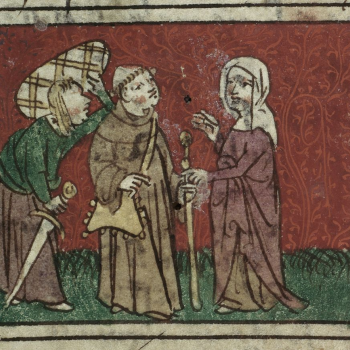
Image: The Gosling / daz genselin from British Library MS Harley 4399 f.37 via Global Medieval Sourcebook / Stanford University (Middle High German, c. 13th, illuminated manuscript)
Out There is an occasional feature highlighting intriguing art, spaces, places, phenomena, flora, and fauna
“You’ve probably heard of Disney’s Hercules… he’s kind of a big deal. This fun pottery montage design dress includes Hercules performing various feats of strength. The pottery banner reads ‘From Zero to Hero’ around the skirt.”
I don’t typically care for merchandise based on superheroes or animated characters. This dress is kinda neat, though, as far as the print design goes. The material, however, disappoints: 95% polyester and 5% spandex. Wearing what’s essentially a plastic bag has no appeal to me at all.
Subway riders in New York City are in for a treat this summer: e-books, e-shorts, and excerpts from full-length books are available in subway stations for free download.
This six-week Subway Library promotion comes from the cooperation of the New York Public Library, Brooklyn Public Library, and Queens Public Library with the Metropolitan Transit Authority and Transit Wireless.
The e-books and short stories come from the NYPL’s permanent collection, while excerpts have been made available by big-name publishers (including Hachette, HarperCollins, Penguin Random House, Plympton, and Simon & Schuster).
Along with the free reading, there is a social media competition, and a special Library Train will alternate running along the 6th and 8th Avenue lines (E and F trains). The latter has a car decorated to look like the Rose Main Reading Room inside the 42nd Street branch of the NYPL.
Read more about and browse the free selection at the Subway Library website!