You Belong Here

Co-Geeking is about the things we love: history, art, science fiction, fantasy, language, and so on. It is not about contemporary politics. We would rather just tend our geeky garden than get involved in the affairs of the big world outside.

But sometimes contemporary politics comes blundering through your garden gate and plomps itself down right on top of your petunia bed. And sometimes it proceeds to crap all over your tomatoes and puke on your antique roses. Then you gotta say something, so we’re saying it.

If you’re feeling threatened, worried, angry, or sad about the upsurge of hatred we’re seeing in current events, we’re with you. If you’re someone who loves the things we love but your history classes, SFF conventions, or geeky blogs made you feel like you didn’t belong, you belong here. If you’ve ever felt left out because of your race, religion, gender, orientation, or any other part of your identity, or if you’ve seen that kind of exclusion happen to someone you care about, we’re with you. If you don’t see yourself in the books, movies, tv shows you love, know that we want to see you there, too. If anyone has ever told you are wrong, bad, or dangerous just because of who you are, where you come from, or how you live your life, we stand with you.

Screw the fascists, racists, xenophobes, anti-Semites, Islamophobes, homophobes, sexists, transphobes, and all other flavors of bigot. Screw the people who believe that they are better than other people because of arbitrary details like race, religion, ancestry, sexuality, or gender. Screw the people are afraid of others just because of who they are. And double screw the ones who think that history supports their brand of hatred, or that they can drag it into the kind of stories we love, with a side of get stuffed.

We are in this together. Those who want to divide us will fail. Hatred and fear will fail. As we co-geeks carry on with our usual business of posting about interesting facets of history and squeeing over the latest movie trailers, know that we are here for you.

Babylon 5 s1 ep5 The Parliament of Dreams Selected Screencaps.
Selected screencaps from the Babylon 5 season 1 episode 5, “The Parliament of Dreams”, showcasing Earth’s dominant belief system: pluralism. (Delenn: What sort of demonstration does he have planned? Ivanova: He just said it’d showcase Earth’s dominant belief system. Sinclair: This is Mr. Harris. He’s an atheist. Mr Rosenthal, an Orthodox Jew. Sawa of the Jivaro tribe. Ms. Yamamoto, a Shinto. Ms. Naljo, a Maori…)

If want to get away from the problems of the big world for a little while, our garden is open. If you want to talk about what’s going on these days and how that relates to the art, stories, and history we love, we’re here for that, too. You belong here.

Image: Selected screencaps from the Babylon 5 season 1 episode 5, “The Parliament of Dreams”.

Announcements from your hosts.

Rating: Miss Fisher’s Murder Mysteries, Season 1

Our rewatching-and-rating project has moved on to Miss Fisher’s Murder Mysteries, a delightful Australian series about a flamboyant flapper detective from the roaring 1920s, based on the novels by Kerry Greenwood. We don’t get a lot of Australian tv on this side of the world, but Miss Fisher is a treat from beginning to end. The first season is the best-rating season of anything we’ve watched so far. (For an explanation of our rating system, see here.)

Here’s our ratings for the first season’s episodes:

  1. “Cocaine Blues” – 9
  2. “Murder on the Ballarat Train” – 8
  3. “The Green Mill Murder” – 8
  4. “Death at Victoria Dock” – 8
  5. “Raisins and Almonds” – 8.5
  6. “Ruddy Gor” – 7.5
  7. “Murder in Montparnasse” – 6
  8. “Away with the Fairies” – 7.5
  9. “Queen of the Flowers” – 7
  10. “Death by Miss Adventure” – 9
  11. “Blood and Circuses” – 5.5
  12. “Murder in the Dark” – 7
  13. “King Memses’ Curse” – 5

There are so many things to love about this series, from the wonderful characters to complicated mysteries. It explores both the Jazz-Age high life of the post-WWI bright young things and the workaday world of early-twentieth-century Melbournites. The main character, sparklingly played by Essie Davis, is always entertaining and she’s surrounded by an excellent supporting cast.

The average rating for this season is 7.4, which is a fantastic way to start. Most of this season’s episodes are good to excellent, with only a couple that come in a little underwhelming. The lowest of the season is the final episode, “King Memses’ Curse,” which is just a rather uninspired serial killer story. The entertainment industry loves its serial killers—especially, like this one, those that have an irrational obsession with the hero—but we’re just tired of the trope.

Fortunately, we have a couple of 9s tied for best episode to balance out the lackluster ones. The first episode, “Cocaine Blues,” starts things off with a bang, sending Miss Fisher into a murder investigation that leads to cocaine smuggling and a back-alley abortionist. Many of our favorite characters get introduced here: Miss Fisher’s timid but trusty companion Dot, the acerbic Doctor Mac, the sweet-natured Constable Collins, and Inspector Jack Robinson, who, though often aggravated by Miss Fisher’s insistence on thrusting herself into his investigations, also learns to value her input. The other 9 is “Death by Miss Adventure,” about a mysterious death in a factory which reveals many layers of intrigue and skullduggery. This episode gives Dot a chance to go undercover and also delves in Doctor Mac’s life in more detail.

You could hardly ask for a better first season!

Any Miss Fisher fans out there want to weigh in? Got a different pick for the best or worst episodes of the season? Let us know in the comments!

Image: Miss Fisher’s Murder Mysteries via IMDb

In the Seen on Screen occasional feature, we discuss movies and television shows of interest.

Artifacts and Transmogrification: Retribution Paladin and Arms Warrior

In my last post about transmogrifying with artifact weapons, I mentioned how, with my elemental shaman and arcane mage, I got lucky and the base artifact appearance fit very well with the looks I had already created for the characters. In other cases, the base appearance doesn’t suit my existing look, but one of the unlockable color variants does.

Here, for instance, is my retribution paladin. I had her in a blue and gold set that the red base weapon didn’t match, but the blue alternative suits perfectly.

My arms warrior, on the other hand, wanted the red alternative color to match his red and purple set.

Of Dice and Dragons is an occasional feature about games and gaming.

How to Helsinki: Last Call

Worldcon is in Helsinki this year. As a Finnish-American couple, we are very excited about this! In the coming months, we’d like to offer some practical advice about visiting Finland to our fellow fans who are considering going to the event but haven’t had experience with Finland and Finns before.

Worldcon 75 is just a week away now. In case you missed any of our previous posts, you might want to check them out, too:


Here are a few last-minute tidbits, odds and ends, and random pieces of advice that might be worth knowing if you’re getting ready to head to Helsinki:

Low-alcohol beverages, like beer and cider, are available at most grocery stores. For harder liquor (22+ % alcohol), you’ll need to go to one of the state-run Alko stores; you also must be 20 years old and have valid government I.D. Anyone who looks under 30 years of age may be carded when buying alcohol.

Apteekki = pharmacy

Apua! = Help!

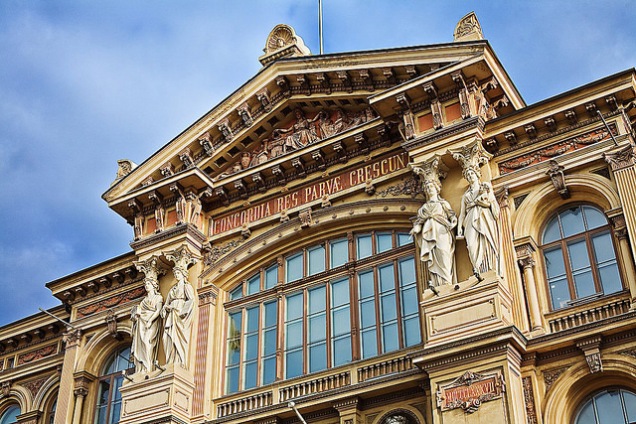
Ateneum Art Museum is one of the three museums forming the Finnish National Gallery and located conveniently on the south side of Rautatientori square close to Helsinki central railway station.

Flickr Alessandro Grussu Ateneum Art Museum

DO NOT FEED THE BIRDS. That creates problems for residents, outdoor sellers, and other visitors. The seagulls at Kaupptori, for example, are already quite adept at snatching food from people. (That means they will dive AT YOU and steal your food FROM YOUR HAND. I don’t know about you, but I find that intimidating and I don’t want it to happen to me! –Eppu)

Public drinking water fountains are rare in Finland, but tap water is clean and safe. Carrying a water bottle is a good idea.

Dual flush toilets are becoming very common, and they’re easy to operate: small button for small flush, big for large. Please do take part in our environmental efforts.

Electric sockets and plugs are Europlug type C or the grounded Schuko type F.

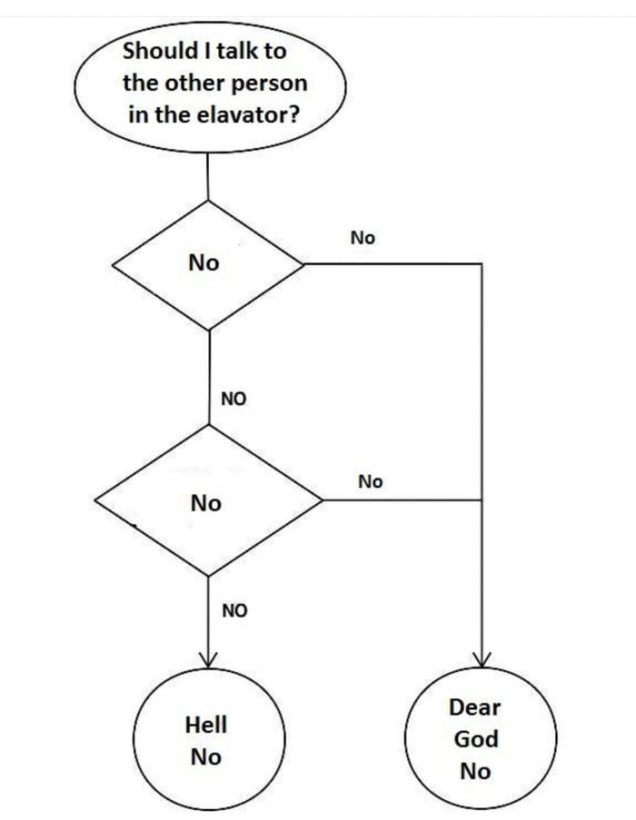
Elevator behavior humorously put: Keep your arms and legs inside the vehicle at all times, and for the sake of everything you hold dear, do not engage in small talk.

9gag Finland Elevator

More seriously: Elevator behavior shouldn’t be a problem; just be mindful that customs may be different than you’re used to and you’ll be fine.

The number for emergency services is 112. Also note that pay phones are almost non-existent in Finland because cell phones are so ubiquitous.

You may not be able to establish eye contact with strangers on the streets. This is perfectly normal in Finland; we love our personal space and want lots of it.

Gasoline is very expensive due to taxation—keep it in mind if planning to rent a car.

If you meet a Finn with whom you share a mutual acquaintance, you may be asked to take greetings to that person. It is vital that you follow through. Carrying greetings (the Finnish word is terveisiä, which covers the whole social scale from “Say hi to your buddies for me” to “Do give my sincerest regards to your honored great-grandmother”) is serious business in Finland.

Indoor spaces tend to be warm due to effective insulation. Dress in layers for the win!

With regard to the language issue, one of the most succinct answers is by author Elizabeth Bear: “[I’ve] heard some concern about the language issue. There is no language issue. If one of your languages is English […] you will have no issues at all navigating. (It’s sort of a running joke with my agent and I that while my books sell very well in the Nordic countries as imports, we can’t get a translation deal there. Because everyone speaks English […]”

Luggage storage is available e.g. at Helsinki central railway station and at the Kamppi long distance bus station.

Mosquitoes are the bane of the Finnish summer. (We actually joke about them being our air force. –Eppu) Current reports are that this has not been a bad mosquito year, but it’s still important to take precautions if you’re sensitive to bites and will be out and about in the late evening or early morning, which are the prime biting times.

The National Museum of Finland concentrates on Finnish history from the Stone Age to 19th century and has an extensive collection of objects. The building itself, of National Romantic style, may also be of interest. Free entry every Friday 4 p.m. to 6 p.m.; at other times, entry fees apply.

National Museum of Finland

Petrol is very expensive due to taxation—keep it in mind if planning to rent a car.

Pharmacy = apteekki

The word please (or the like) doesn’t exist in Finnish. Instead, the same function is embedded in the verb form of the sentence. This doesn’t mean that Finns are inherently rude; we may sound rude to native speakers of languages that use an explicit please word if we forget to use it in other languages, and we well might slip up since it’s not ingrained.

Finnish does not have gendered pronouns. The word hän means both ‘he’ and ‘she.’ It’s not unusual for Finns, even Finns who speak English very fluently and are highly aware of gender identity issues, to slip and use the wrong gendered pronoun when speaking English. (It’s a little like English speakers learning Spanish and having to remember that forks are masculine but spoons are feminine.)

Recycling is becoming very common. Your hotel room and Messukeskus might have containers for different types of trash. Please do take part in our environmental efforts.

If you bump into someone by accident, just saying “Sori” (comes from and sounds pretty much the same as English sorry) is usually sufficient. Finns don’t really do apologies for small accidents.

Towel hooks in bathrooms are only for storing the dry towels. Spread towels to dry elsewhere (rack, over the shower stall door / shower curtain bar) and hang to store.


Some additional reading & browsing

Images: Ateneum Art Museum by Alessandro Grussu on Flickr. Finland elevator behavior via 9gag. National Museum of Finland by Eppu Jensen

In Live and Active Cultures we talk about cultures and cultural differences.

The Secret of Roman Concrete

Trajan’s Market, Rome, with a vaulted concrete ceiling over brick walls, photo by Szilas via Wikimedia

Roman concrete is an architectural marvel. It made it possible for the Romans to build structures unlike any built with the techniques of stone masonry. It turns out Roman concrete is also a chemical marvel. The combination of volcanic ash and rock, lime, and seawater gradually becomes stronger over time as the interaction of the volcanic components and the seawater forms new minerals that fill up cracks and reinforce the structure.

An article from the Guardian explains the process:

Over time, seawater that seeped through the concrete dissolved the volcanic crystals and glasses, with aluminous tobermorite and phillipsite crystallising in their place. These minerals […] helped to reinforce the concrete, preventing cracks from growing, with structures becoming stronger over time as the minerals grew.

Given the limitations of Roman science, it’s doubtful that an ancient Roman concrete expert could have explained the chemical processes that happened in concrete, but that doesn’t mean that Romans just stumbled onto this formula by accident. Even with a limited theoretical understanding, smart people can acquire a lot of practical knowledge through experimentation and careful observation.

Thoughts for writers

Something to keep in mind when worldbuilding: practical knowledge doesn’t have to come from theoretical knowledge. In fact, it is often the opposite: theoretical knowledge develops from an attempt to explain what we already know practically to be true. If you want your fictional cultures to be able to make sturdy concrete, or airships, or vaccines, that doesn’t require them to have a modern understanding of chemistry, physics, or biology. Pre-modern peoples discovered lots of useful things by trial and error and paying close attention to the world around them, even if their attempts to explain why those things worked were sometimes wide of the mark, or they never attempted to explain them at all.

History for Writers is a weekly feature which looks at how history can be a fiction writer’s most useful tool. From worldbuilding to dialogue, history helps you write. Check out the introduction to History for Writers here.

Quotes: My dear admiral, that post!

Admiral and Mrs. Croft, out driving in their one-horse chaise have come across a group of their acquaintances walking and offered to give a ride to one of them. Anne Elliot joins them.

“Very good-humoured, unaffected girls, indeed,” said Mrs. Croft… “and a very respectable family. One could not be connected with better people.—My dear admiral, that post!—we shall certainly take that post!”

But by coolly giving the reins a better direction herself, they happily passed the danger; and by once after judiciously putting out her hand, they neither fell into a rut nor ran foul of a dung-cart; and Anne, with some amusement at their style of driving, which she imagined not a bad representation of the general guidance of their affairs, found herself safely deposited by them at the cottage.

– Jane Austen, Persuasion


One of the loveliest descriptions of marriage I have ever read: we make up for one another’s eccentricities and, however strange we may look to anyone else, we get where we’re going in the end.

Austen may be famous for her romantic pairings like Elizabeth Bennet and Mr. Darcy, or Marianne Dashwood and Colonel Brandon, but I think Admiral and Mrs. Croft are one of her best images of real marital happiness.

Serving exactly what it sounds like, the Quotes feature excerpts other people’s thoughts.

Greek Myth, Etruscan Tomb

We like to think of the modern world as one in which different cultures intertwine and overlap with one another, but there were complicated cross-cultural interactions in the ancient world as well. For example, look at this wall painting from an Etruscan tomb.

Sacrifice of Trojan captives, photograph by Battlelight via Wikimedia (François Tomb, Vulci; late 4th c.; fresco)

This scene depicts an incident from the Trojan War. After his friend Patroclus was killed in battle, the great Greek warrior Achilles went mad with grief. He piled up an enormous funeral pyre for Patroclus, on top of which he also killed twelve Trojan prisoners. At the center of this painting, Achilles slits the throat of a naked Trojan prisoner while a Greek soldier leads another prisoner to the slaughter from the right. To the left, the ghost of Patroclus, in a blue cloak with a bandage over the fatal wound in his chest, looks on in dismay.

This incident comes from the Greek legends of the Trojan War and is mentioned in the Iliad, but it is a rather obscure scene. It was rarely, if ever, referred to in later Greek literature or depicted in Greek art. The fact that an Etruscan artist could use this event as the basis for a tomb painting demonstrates a more than passing knowledge of Greek myth.

The Etruscans were a people of northern Italy who had extensive trade contacts with the Greeks and imported large quantities of fine pottery and other Greek luxury goods. They also imported Greek legends and stories, which they frequently depicted in their own artworks. Like the painting in the François Tomb, Etruscan art often picks up on obscure or unusual incidents that were not widely depicted in Greek art. This selectiveness tells us that Etruscans were not just copying the Greek art that they acquired but were making conscious artistic choices based on extensive knowledge of the Greek material.

This painting also adds some uniquely Etruscan elements to the scene. The winged woman directly behind Achilles is Vanth, an Etruscan goddess whose role seems to have been to decide the fate of the souls of the dead. The blue-skinned man to Achilles’ right is Charu, another Etruscan god who led the souls of the dead to wherever Vanth decided to send them. Vanth and Charu are purely Etruscan characters with no basis in the Iliad. Greek myth had figures who performed similar functions, but they looked nothing like Vanth and Charu.

These two figures are not simply added to the scene. The way that they frame the sacrificial act and share a knowing look over Achilles’ head changes the scene’s meaning. Rather than just seeing Achilles’ awful act, we see that his act happens in a context that transcends the mortal world. The Greek afterlife was pretty much universally bleak, except for a few select troublemakers who got ironically tortured. The Etruscan afterlife is poorly understood, but they seem to have believed that the deeds of the living affected the fate of the dead, which could be pleasant or terrifying. In this painting, Vanth and Charu seem to be saying to one another: “We see what’s happening here, and it won’t be forgotten. We’re here for the Trojans this time, but Achilles’ day is coming.”

This painting is one that a Greek artist would never have painted and that a Greek viewer wouldn’t have understood. It only made sense to an Etruscan, but to an Etruscan who knew their Iliad well enough to recognize the figures of Achilles and Patroclus and identify the moment in the story that was being depicted. Here in this image we have a moment of cross-cultural interaction on display.

History for Writers is a weekly feature which looks at how history can be a fiction writer’s most useful tool. From worldbuilding to dialogue, history helps you write. Check out the introduction to History for Writers here.

Rating: Leverage, Season 5

We’ve been rewatching and rating Leverage and we’ve gotten up through season 4. (For more on how our rating system works, see here, which also covers season 1 of Leverage.) Here’s what we thought.

  1. “The (Very) Big Bird Job” – 6
  2. “The Blue Line Job” – 4
  3. “The First Contact Job” – 10
  4. “The French Connection Job” – 8
  5. “The Gimme a K Street Job” – 4
  6. “The D. B. Cooper Job” – 1.5
  7. “The Real Fake Job” – 6
  8. “The Broken Wing Job” – 10
  9. “The Rundown Job” – 10
  10. “The Frame-Up Job” – 9
  11. “The Low Low Price Job” – 8
  12. “The White Rabbit Job” – 3
  13. “The Corkscrew Job” – 6
  14. “The Toy Job” – 5
  15. “The Long Good-bye Job” – 9

Leverage goes out on a high note with an average rating of 6.6 for its final season, a small step up from 6.4 for season 4 and the best of any season. There are a mix of better and worse episodes this season, including a couple of real duds, but there’s a slew of 9s and 10s that just sparkle. This season has a mix of traditional con procedurals and more ambitious episodes that break out of the formula. The best episodes include both perfectly executed traditional grift stories and some of the more unusual attempts. The effort to do something different doesn’t always pay off, though, and this season’s failures are some of the episodes that stray farthest from the formula.

The absolute worst of the season—and in the running for worst of the entire series—is “The D. B. Cooper Job,” at 1.5, which, like season 4’s “The Van Gogh Job” is mostly about other characters played by the main cast, this time reinventing the story of skyjacker D. B. Cooper. While “The Van Gogh Job” had the advantage of a charming, if sad, love story, “The D. B. Cooper Job” is just a whole lotta brooding white guys being emotionally unavailable and stuff, which is pretty much the last thing we need more of on tv. Dishonorable mention also goes to “The White Rabbit Job,” at 3, which tries to do an Inception and seriously fails to pull it off.

Happily, we have three standouts tied for best of the season at a full 10 points. “The First Contact Job” is a kooky X-Files riff with a faked alien contact and tons of tongue-in-cheek sci-fi geek humor. “The Broken Wing Job” is a solo adventure for Parker (our favorite character!) which challenges her to figure out how to do the work of the whole team while recovering from a broken leg. Watching Beth Riesgraf play the whole range of Parker’s emotions from climbing-the-walls stir-crazy to oh-no-you-don’t-hurt-my-friend badass is a sheer delight. Finally, “The Rundown Job” trades in the series’ usual quirky humor for an action-packed bioterror thriller in Washington D. C. with just Parker, Hardison and Eliot (our three favorite characters!).

And that’s Leverage! A lot of good episodes and great characters. Well worth a rewatch!

Any Leverage fans out there want to weigh in? Got a different pick for the best or worst episodes of the season? Let us know in the comments!

In the Seen on Screen occasional feature, we discuss movies and television shows of interest.

Know Your Barbarians

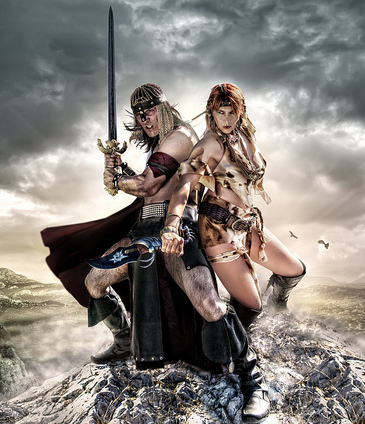
The word “barbarian” today conjures a fairly specific image: a large, muscular man or woman wearing leather or furs hefting an enormous weapon. They are ragged and dirty and if they have any kind of organization, it is as a rabble of warriors following whoever happens to be the strongest. This image has its roots in classical Greek and Roman literature, but Greco-Roman ideas about barbarians were broader and more complicated than this.

Greeks and Romans both had complicated relationships with the outside world. The economy of ancient Greece depended on foreign trade, especially with Egypt, but Greece was also on the northwestern frontier of the Persian empire, which often threatened Greek cities or interfered in their internal politics. Rome was an expansionist empire with ambitions of conquering the whole world, but the strength and stability of the empire depended on integrating conquered peoples into Roman culture.

Out of these historical experiences, Greek and Roman writers, artists, and philosophers developed a wide repertoire of narrative models for describing other peoples. These narratives ranged from the nuanced and admiring to the stereotyping and pejorative. “Barbarian” could mean many different things in different times and contexts. Among this repertoire, there were conventional archetypes that authors and artists could draw on and expect that their audience would recognize them.

These archetypes were nebulous conglomerations of tropes and stereotypes, not always consistent and liable to be manipulated, tweaked, and subverted in individual works of art or literature. They could be reduced to caricature or filled out with individual details. They functioned much like modern national and ethnic stereotypes. Imagine the caricature version of a British gentleman, replete with bowler hat and umbrella. We might expect such a character to have certain typical qualities, both positive (unflappable, chivalrous, witty) and negative (stodgy, proud, insensitive) and engage in typical behaviors (sipping tea, playing polo, driving a Jaguar). Of course, stereotypes don’t have to be followed. A Brit in a bowler hat with an umbrella may also turn out to be a tongue-tied chocoholic who raises miniature goats and likes to watch telenovelas, but the author who creates such a character and the audience that encounters them will recognize how the standard tropes have been played with.

Greeks and Romans had two principal archetypes for barbarians. One was based on small, materially poor, less well organized cultures mostly found to the west or north, such as Scythians, Thracians, Gauls, Germans, Iberians, Britons, and Dacians. The other was based on large, wealthy, sophisticated cultures mostly found to the east or south, such as Egyptians, Persians, Phoenicians, Lydians, Carthaginians, and Etruscans.

The northwestern barbarians are the ancestors of the modern “barbarian” image. They were portrayed as violent, ignorant, savage, and lacking in technology and social organization. They had no idea how to behave in a civilized society and were almost like wild animals. They lived in poverty and with barely any kind of government except the ability of the strong to impose their will on others. They could also be shown with good qualities, such as generosity and honesty. The were the original “noble savages,” ignorant of the benefits of civilization but also uncorrupted by its temptations.
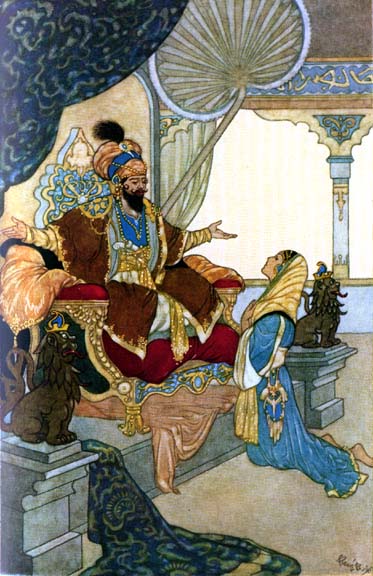
The southeastern barbarians were the opposite. They were portrayed as weak, decadent, devious, overwhelmed by luxury and tangled in arcane social hierarchies. They had given in to the corrupting effects of civilization and overindulged in every kind of physical pleasure. They lived like slaves under the rule of despotic tyrants, but they were so accustomed to the comforts of luxury that they lacked the will to resist. They could have positive qualities as well. Their cultures were ancient and sophisticated, rich in accumulated knowledge. We don’t have a good term for the opposite of “noble savages,” but we might call them “depraved sophisticates.”

Central to both of these archetypes is one of the key values of Greco-Roman society: self-control. The southeastern barbarians displayed too little of it, giving in every kind of indulgence and unable to resist the rule of a tyrant. The northwestern barbarians, by contrast, were too willful, unable to subordinate themselves to the structures of law and social order. By creating these archetypes, Greeks and Romans positioned themselves in the middle—sophisticated enough to enjoy the benefits of civilization, but strong enough to resist its corrupting effects.

Both of these archetypes have come down into modern literature. The northwestern barbarian has become the standard modern “barbarian,” but aspects of it can also be seen in modern Western stereotypes of Africans, African Americans, and Native Americans. “Darkest Africa” stories about wild cannibal tribes dumbfounded by modern technology and scientific knowledge play upon the same images of violence, savagery, and technological ignorance that Romans applied to the Gauls and Germans. The southeastern barbarian formed the basis for romanticized Western depictions of the Islamic world, China, and India. “Arabian Nights” fantasies of scandalous harems and treacherous palace politics, ancient secrets and fabulous treasures hidden in the twisting back streets behind markets filled with spices and gems evoke Greek tales about Egypt and Persia.

These archetypes have also found their way into fantasy and science fiction. Tolkien’s Elves reflect some of the more positive southeastern qualities of wisdom and sophistication while his Orcs display the violent, fractious, bestial traits of the northwest. Star Trek‘s Klingons and Romulans represent the tropes of warlike honor and treacherous sophistication. The people of Westeros in A Song of Ice and Fire and Game of Thrones face the rugged, wild, disorderly peoples of the north and the rich, old, devious kingdoms of the east.

Once you know your barbarians, you’ll recognize them everywhere.

Images: Hyboria, by Yan R. via Flickr. Sultan from the Arabian Nights, by Rene Bull via Wikimedia.

History for Writers is a weekly feature which looks at how history can be a fiction writer’s most useful tool. From worldbuilding to dialogue, history helps you write. Check out the introduction to History for Writers here.


Rating: Leverage, season 4

We’ve been rewatching and rating Leverage and we’ve gotten up through season 4. (For more on how our rating system works, see here, which also covers season 1 of Leverage.) Here’s what we thought.

Leverage, season 4

  1. “The Long Way Down Job” – 5
  2. “The 10 Li’l Grifters Job” – 3
  3. “The 15 Minutes Job” – 8
  4. “The Van Gogh Job” – 6
  5. “The Hot Potato Job” – 10
  6. “The Carnival Job” – 5.5
  7. “The Grave Danger Job” – 8
  8. “The Boiler Room Job” – 10
  9. “The Cross My Heart Job” – 8.5
  10. “The Queen’s Gambit Job” – 4
  11. “The Experimental Job” – 8
  12. “The Office Job” – 1.5
  13. “The Girls’ Night Out Job” – 8.5
  14. “The Boys’ Night Out Job” – 6
  15. “The Lonely Hearts Job” – 6.5
  16. “The Gold Job” – 7
  17. “The Radio Job” – 4
  18. “The Last Dam Job” – 6

Leverage makes a jump in this season from last season’s average of 5.6 to 6.4. Despite a few poorly-performing episodes dragging down the average, there are a lot of gems this season that show off the skill of the writing team and the versatility of the cast. This season’s episodes continue to experiment with the form, such as “The 10 Li’l Grifters Job,” a Christie-esque murder mystery, the parallel stories of “The Girls’ Night Out Job” and “The Boys’ Night Out Job,” and “The Office Job,” which is just The Office with our heroes blundering around in it. Some of these efforts pay off; others, not so much.

The worst episode of the season is “The Office Job” at just 1.5. Maybe if you’re a fan of The Office you’ll enjoy this, but we’re not, and it just doesn’t work as a Leverage episode. “The 10 Li’l Grifters Job,” “The Queen’s Gambit Job,” and “The Radio Job” don’t work very well as episodes, but they all have their moments. Like last season, season 4 also has another half-hearted attempt at an arc which really isn’t worth the trouble the writers went to in setting it up.

On the other hand, we get two brilliant 10s out of this season: “The Hot Potato Job,” in which the crew rescues a bio-engineered super potato from an evil agri-corp, and “The Boiler Room Job,” in which our heroes have to figure out how to scam a scammer who knows all the scams in the book. Both of these episodes pit the characters against formidably smart adversaries who keep them on their toes. Besides these two, there’s also a good selection of 8s and 8.5s

There’s also an oddity this season: “The Van Gogh Job,” which we rated a 6. The two of us usually give episodes pretty close to the same rating, so when an episode rates a 6, that usually means we both gave it a 3 on our scale of 1 to 5. For this episode, though, we were poles apart: one 5 (because it’s a powerful emotional story that lets the main cast show off their range by playing entirely new characters) and one 1 (because it’s just not a Leverage story and there’s no con to watch unfold).

Any Leverage fans out there want to weigh in? Got a different pick for the best or worst episodes of the season? Let us know in the comments!

Image: Leverage cast via IMDb

In the Seen on Screen occasional feature, we discuss movies and television shows of interest.