Rating: Murdoch Mysteries, Season 6

It’s another season of Murdoch for us to rewatch and rate. This one flies high at the beginning, then crashes and burns at the end. Here’s our take:

  1. “Murdoch Air” – 10
  2. “Winston’s Lost Night” – 6.5
  3. “Murdoch on the Corner” – 8
  4. “A Study in Sherlock” – 7
  5. “Murdoch au Naturel” – 7.5
  6. “Murdoch and the Cloud of Doom” – 6.5
  7. “The Ghost of Queen’s Park” – 6
  8. “Murdoch in Ladies’ Wear” – 2.5
  9. “Victoria Cross” – 5.5
  10. “Twisted Sisters” – 3.5
  11. “Lovers in a Murderous Time” – 3
  12. “Crime and Punishment” – 0
  13. “The Murdoch Trap” – 0

This is a remarkable season of Murdoch Mysteries, ranging from the very best the show has to offer to the very worst. The average for this season is only 5.1, which is the lowest yet for a season of Murdoch, but the average is deceptive since this season is half good-to-brilliant and half disappointing-at-best with not a lot falling in the middle range. It’s an odd roller coaster of a season, and, like all roller coasters, it eventually ends at the bottom.

That bottom is pretty darned low. “Crime and Punishment” and “The Murdoch Trap,” both rating a solid 0, make up a two-parter in which two of our least favorite things get combined: overly clever serial killers who get away with everything and artificial barriers thrown up by writers to squeeze more drama out of romantic angst. Darcy Garland, the multi-season speed bump to the blossoming relationship between Detective Murdoch and Doctor Ogden, suffers a character assassination this season as he goes from being reasonable and charming to being obstreperous and capricious, all for the writers’ increasingly desperate ploys to keep Murdoch and Ogden apart as long as possible. Rather than offer us something truly new and original on tv—reasonable adults dealing with complicated emotions with compassion, self-awareness, and generosity—the writers fall back on one of the most worn-out tropes of mystery fiction: have the offending interloper murdered by a genius serial killer who frames the detective. These are two episodes we will never be watching again.

But what a joy of an episode we get to start the season off with! “Murdoch Air” earns its full 10 rating with a thrilling opening, some great character moments, the return of the beloved James Pendrick, a dash of international intrigue courtesy of Myers and Clegg, and an exhilarating ending that has Murdoch soaring over Niagara Falls years before the Wright brothers got airborne. “Murdoch Air” has a little bit of everything that makes Murdoch so delightful.

There are a lot of other good episodes in the first half of the season, too, bringing us young Winston Churchill boozing around Toronto, a Sherlock Holmes impersonator with a mystery of his own to solve, an introduction to the turn-of-the-century nudist movement, and a poison-gas terrorist. On the other hand, you can skip the second half of the season and not miss much.

How did you like this season of Murdoch? Was the final two-parter right up your alley? Not thrilled by the airborne first episode? Let us know!

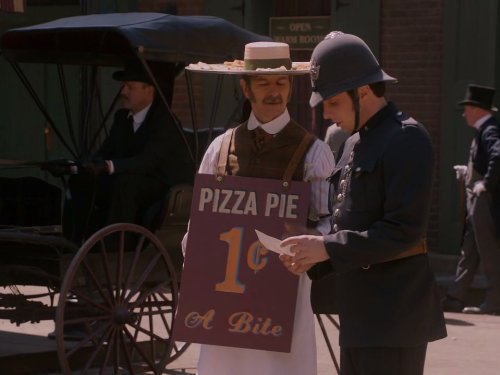
Image: Constable Crabtree trying pizza, from Murdoch Mysteries via IMDb.

In the Seen on Screen occasional feature, we discuss movies and television shows of interest.

I Miss Episodes

I turned 40 last year, and I think it’s starting to affect me: I’m beginning to feel the urge to rant about kids these days and how everything was better when I was young. So be warned, there is some curmudgeonliness ahead, but I do have a point here.

I’ve been thinking lately about why I find a lot of contemporary tv so unsatisfying. It’s not that tv shows are bad now. It’s been aptly said that we live in a golden age of television. Freed from the constraints of syndication and network time slots, modern shows have dared to tell bigger, more complicated stories. The proliferation of cable channels and online services producing their own original content has meant a chance for a wider range of productions, from big-budget crowd-winners to oddball side projects. All of this is to the good.

At the same time, we’ve lost something in the modern approach to tv-making: episodes. It used to be that a season of a tv show was one or two dozen short stories, each told over the course of an hour or half hour (or twenty to forty minutes, on commercial television). Nowadays, a season of television is a ten-hour movie with arbitrary breaks for theme music. Stories are not told in an episode but slosh over to the next hour or two before there’s any resolution; meanwhile, another story has started going at the same time and continues to slosh forward on its own. Every tv drama has now become a soap opera.

I miss shows that had actual episodes, each a story unto itself with a beginning, rising action, climax, and denouement all in one sitting. As much as that format could sometimes be limiting, it also had its artistic virtues. It forced the action to move along at a brisk pace. It created a sense of urgency that shaped the storytelling. There was a feeling of satisfaction that came with watching the problem of the episode be resolved. Modern shows tend to wallow in characters’ unresolved feelings, pad their running time with filler, and dive down narrative dead ends, much of which would have been cut short in properly episodic television.

Of course, lack of satisfaction is the point. Now that we can stream any show we want any time we want, the economic pressures have changed. Rather than keep us coming back every week to see more commercials, the business imperative of tv is now to keep us from clicking away to another streaming service. While new content models have freed tv from some artistic constraints, they have imposed new ones that are just as limiting. It is now tv’s job to never give us satisfying endings lest we wander off to do something else.

I do appreciate tv shows that have continuity and ongoing stories. I wouldn’t want to go back to the days when the end of an episode meant a complete reset back to status quo ante, but continuity can coexist with episodes. Shows of the 1990s like Star Trek: Deep Space Nine, Babylon 5, X-Files, and Stargate pulled it off. In these shows, episodes mostly told self-contained stories, but they also remembered what had happened in previous episodes. Characters grew and changed, major plot twists had ongoing consequences, and big multi-season arcs played out a piece at a time, and yet when the credits rolled at the end of an episode, you still had the satisfaction of a resolution.

I wish we had more shows like that these days.

Here there be opinions!

Aithiopia Forever

The Greek historian Herodotus tells us some interesting stories about the people he refers to as Ethiopians (or Aithiopes in Greek). The term Ethiopians/Aithiopes was widely used in ancient Greece for any dark-skinned people from the southern regions of Africa or India, but the people Herodotus means were those who lived in the northeastern African interior, south of Egypt along the Nile, in the region we know as Nubia.

Herodotus reports several remarkable things about these Ethiopians.While many of these stories are fanciful, or at least greatly exaggerated, they paint an interesting picture of what Herodotus and his fellow Greeks imagined the people of inner Africa to be like.

They were physically impressive and long-lived:

The Ethiopians are said to be the tallest and most beautiful of all peoples.

– Herodotus, Histories 3.20

Most of them live to 120 and some surpass this.

– Herodotus, Histories 3.23

They enjoyed a life of ease and good health, enabled by the special resources of their land:

There is a meadow outside the city filled with boiled meats from animals of all kinds. The lords of the city make it their custom to set these meats out at night, and during the day anyone who wants to may feast there. The locals say that the earth itself provides these things.

– Herodotus, Histories 3.18

[The Ethiopians possessed] a spring where they washed themselves and became sleeker, as if they had bathed in oil, even though it smelled of violets. … [T]he water of this spring was so light that nothing could float on it, neither wood nor anything lighter. Everything just sank to the bottom. If what they say is true, it seems likely that it is their regular use of this spring that makes them all so long-lived.

– Herodotus, Histories 3.23

They have an interesting way of choosing their leader:

Their customs are unlike those of any other people, and especially their kingship: they choose as king the one among them who is tallest and has the strength to match his height.

– Herodotus, Histories 3.20

And they preferred to be left alone and not be bothered by the rest of the world’s problems:

The Ethiopian king said [to the Persian king’s emissaries]: “The king of the Persians does not send you with these gifts because he desires my friendship, nor have you spoken the truth, for you have come here to spy on my kingdom. Nor is that man just, for if he were he would not desire the lands of others or enslave men who have done him no wrong. Now, give him this bow and say to him: ‘The king of the Ethiopians advises the king of the Persians that when a Persian can draw so strong a bow as easily as I do, then he may contemplate making war upon the long-lived Ethiopians. Until then, let him thank the gods for not putting the sons of the Ethiopians in a mood to conquer other lands.’”

– Herodotus, Histories 3.21

I think you can see where I’m going with this.

Herodotus’ Aithiopia is essentially Wakanda.

Happy anniversary, Black Panther!

Image: T’Challa and Shuri via Giphy

Serving exactly what it sounds like, the Quotes feature excerpts other people’s thoughts.

Mountains and Valleys

Landscape and geography shape the ways people live and the kinds of societies they build. While we cannot lay it down as a rule that a particular kind of landscape always produces a corresponding type of society, there are definite patterns that can be found in many parts of the world. One important set of such patterns revolves around the interaction between mountain societies and river valley societies.

River valleys have long been centers of population and growth. Rivers provide crucial resources including drinking water, irrigation water, and fish, which allow for a large population to grow in a small area. Rivers also provide easy transport for people and goods, encouraging travel and trade. As a result, river valleys support the development of large-scale, densely populated settlements. It is no surprise that most of the world’s earliest urbanized societies emerged in river valleys, including the Nile River in Egypt, the Tirgis and Euphrates Rivers in Mesopotamia, the Indus River in India, and the Yellow River in China.

Because of the ways that river valleys encourage dense, concentrated populations, the people who live along rivers have to develop ways of managing social conflicts that aren’t necessary in more widely scattered settlements. Early valley cultures were faced with the problem of working out competing claims to resources like irrigation water and access to navigable streams. They also confronted situations in which one person’s actions, such as discharging waste into a common waterway, could affect many other people. Different cultures found different ways of dealing with these problems. Some arrived at relatively peaceful and stable solutions while others frequently fell into conflicts over rights and resources. In the end, though, many river valley cultures ended up with complex, socially-stratified societies ruled over by centralized, bureaucratic governments.

Mountain societies, by contrast, tend to be small-scale, economically simple, and egalitarian. In the mountains, crucial resources such as fertile land and fresh water tend to be scattered in small pockets rather than concentrated in large quantities. Travel is difficult and time-consuming. These facts of geography lead to people living in very small communities, individual farmsteads, or movable camps. Self-sufficiency is at a premium when you can’t easily reach out to a larger community to help solve your problems. Mountain cultures therefore tend to remain small and highly local, and to rely more on personal relationships than organized institutions. Large-scale, organized mountain empires do exist in history, such as the Inca Empire in the Andes, but they are rare.

In some mountain cultures, the very sparseness of the population helps to maintain peace—you don’t fight your neighbors if you never see your neighbors—but the same factors that shape mountain cultures also often encourage violent conflict. When resources are limited, population growth can lead to spikes of competition, sometimes escalating into violence. Without well-developed institutions for managing interpersonal or inter-family conflict, fights over land and other vital resources can spiral out of control or drag on for generations. Many mountain societies have historically been subject to frequent violent conflicts, and those who live in them develop fighting skills as a matter of course.

These basic patterns have tended to shape how mountain cultures and river valley cultures have developed in history, but neither valleys nor mountains exist on their own. When valley societies and mountain societies interacted with one another, a whole new set of dynamics came into play.

Valley societies and mountain societies have often found themselves in conflict, but it is has historically been difficult for one to decisively overcome the other. River valley societies have the resources and surplus population to field large, well-organized armies and to provide those armies with a reliable source of supplies for long campaigns. Valley armies, however, have often struggled to assert control over mountainous regions. The fragmented nature of mountains makes it difficult to move large numbers of troops and supplies around. At the same time, mountains provide plenty of hiding places for local fighters who know the terrain well. Mountainous terrain favors the kind of small, mobile, skirmishing bands and guerrilla tactics that small, feuding, fragmented mountain cultures develop. Sometimes in history, valley empires have been able to assert control over the mountains at their edges, but it requires a concerted effort. The Assyrian Empire of Mesopotamia, for instance, kept up steady pressure against the mountain tribes to the north and east, but never had much direct control over them. The Roman Empire had secure control of the lowlands on both sides of the Alps generations before it could claim success in the mountains themselves.

On the other hand, mountain people rarely have much success at invading well-developed valley cultures. While mountain warriors tend to be good at hit-and-run raiding and harassing tactics that can effectively limit a valley culture’s reach, conquering a valley takes a more coordinated effort and larger numbers of troops than most mountain societies can muster. Without a well-established centralized government, mountain armies are more dependent on ties of family loyalty and negotiated compromises that are hard to maintain far from home under the rigors of a campaign. While there are often hostilities in the hinterlands where organized, expansive river valley powers run up against the scattered but tenacious resistance of mountain-dwellers, it is rare that one side manages to decisively defeat the other.

Decisive defeats can happen, however. Sometimes, as with the Roman conquest of the Alps, Spain, Illyria, and other mountainous parts of the greater Mediterranean, river valley cultures can gather the resources and effort for a concerted push that overwhelms the locals’ ability to resist. Other times, moments of weakness in the valley can create an opening for aggressive mountain neighbors to sweep down and take control. The Zhou Dynasty in China was founded when a people from the mountainous uplands of the west seized power from the Shang Dynasty that had ruled the lowlands of the Yellow River valley. The Persians came from the mountains of the Iranian Plateau to build an empire that took in two of the great ancient river valley civilizations, Mesopotamia and Egypt. The legends of the Mexica, whom we often refer to as Aztecs, say that they came from a mountainous home called Aztlán before migrating into the Valley of Mexico and dominating it with their warriors. There may well be some historical truth behind this myth.

Not all mountain-valley interactions are hostile, however. Sometimes mountain and valley societies can coexist peacefully and profitably. River valleys produce agricultural surplus, which is often in demand in the mountains where farming is harder and less predictable. Mountains can produce useful commodities such as metals, timber, and stone that are harder to come by in the lowlands. Mountains can also be good recruiting grounds for mercenaries to build up valley armies. The rugged mountains of Greece provided trade goods and experienced warriors to Egypt and Egypt in return furnished surplus food to Greece in a relationship that was stable and mutually beneficial.

There are no hard rules in history. The study of the past is as much the study of exceptions and unexpected results as it is of familiar patterns. Still, the patterns are there. History is full of mountain people and river valley people, and the problems and opportunities that arise when they come into contact with one another.

Thoughts for writers

As always, my advice for worldbuilding is: start with the land. The ways that societies shape themselves, cope with problems, and interact with one another are always influenced by the landscape in which they were created.

The dynamics of mountain and valley societies are also applicable to other landscapes. Wherever large numbers of people settle around a shared resource—a mystical Elven city on a nexus of magic-bearing ley lines, say, or a space station guarding a hyperspace portal—similar conflicts are likely to arise, leading to a similar range of possible solutions. Wherever people live in small, scattered communities with limited resources—whether it’s desert nomads traveling from oasis to oasis or hardscrabble asteroid miners—their cultures will likely reflect many of the same influences as mountain societies. When these disparate groups of people interact, they will show the effects of many of the same forces at work between mountain and valley peoples.

The interactions of mountain people and valley people have shaped history. They can shape imagined worlds as well.

Image: Nanga Parbat, Pakistan, photograph by Imrankhakwami via Wikimedia

History for Writers is a weekly feature which looks at how history can be a fiction writer’s most useful tool. From worldbuilding to dialogue, history helps you write. Check out the introduction to History for Writers here.

Rating: Murdoch Mysteries, Season 5

Season 5 of Murdoch Mysteries sees a new addition to the cast, ongoing relationship drama, and the return of some of our favorite and least favorite recurring characters. Here’s how we rated the season’s episodes:

  1. “Murdoch of the Klondike” – 7
  2. “Back and to the Left” – 8
  3. “Evil Eye of Egypt” – 6
  4. “War on Terror” – 6
  5. “Murdoch at the Opera” – 4
  6. “Who Killed the Electric Carriage” – 7
  7. “Stroll on the Wild Side, Part 1” – 5.5
  8. “Stroll on the Wild Side, Part 2” – 4
  9. “Invention Convention” – 8.5
  10. “Staircase to Heaven” – 4
  11. “Murdoch in Toyland” – 2
  12. “Murdoch Night in Canada” – 4.5
  13. “Twentieth Century Murdoch” – 5

The average rating this season is 5.5, a little weak but still decent. This season has a lot going for it, but at the same time has some problems that weigh it down. The season starts off strong with “Murdoch of the Klondike” in which a disillusioned Murdoch turned prospector decides to take up the badge once again, and “Back and to the Left,” an ingenious case of political intrigue which plays with the tropes of Kennedy assassination conspiracy theories. The latter half of the season drags a bit under the weight of a few too many recurring characters whose stories get in the way of Murdoch doing what Murdoch does best.

Our least favorite episode of the season is “Murdoch in Toyland,” which we gave a 2. James Gillies, from season 2‘s “Big Murderer on Campus” returns with an overdone and rather absurd plot to annoy Murdoch. We have absolutely had our fill of clever serial killers who follow detectives around like puppies pooping on the furniture for attention. No more.

At the top, we rated “Invention Convention” an 8.5. In this episode, an ingenious device used to murder a competitive inventor seems to have been a collaborative effort by his rivals, but turns out to have been even more insidious. This episode features Alexander Graham Bell and lets Murdoch geek out over some before-their-time inventions ranging from the Lazy Susan to e-mail.

One of the best features of this season is the introduction of Dr. Emily Grace as Dr. Ogden’s assistant-on-the-way-to-replacement in the morgue. We enjoy Dr. Grace’s fresh and sometimes shockingly modern (for 1899) perspective, and she has great onscreen chemistry with the established characters. For a series that in the past has struggled to even nominally pass the Bechdel test, adding a second regular female character is also very welcome (although quite a few of this season’s episodes still fail the test, or squeak by on technicalities).

Many familiar guest stars return for another go this season, some more welcome than others. James Gillies we have already mentioned—he worked well for one episode, but he should have ended there. Canadian secret agent Terrence Myers makes a return appearance, as does his American counterpart Allen Clegg. Both actors are always wonderful to watch, but their episode falls a bit flat. Anna Fulford, who helped Murdoch when he was on the run in England and suffering from amnesia back in season 3, makes a welcome return, but her double episode doesn’t use the character nearly as well. On the other hand, James Pendrick is back Pendricking things up with a solar-powered electric car and a gentleman’s feud with Henry Ford that makes for an entertaining episode.

How about the rest of you? What did you love (or not) from this season?

Image: Murdoch Mysteries ladies doing science via IMDb

In the Seen on Screen occasional feature, we discuss movies and television shows of interest.

Cap’n Crackers

Pour, O pour the pirates’ sherry, fill, O fill the pirates’ glass!

As a thank-you for participating in her positive WoW-ing experiment, Alunaria has very generously given us new pets! Here’s my rogue with Cap’n Crackers, a shoulder-sitting parrot, living the pirate life.

Thank you, Alunaria! It was fun, and the new friend is a lovely bonus!

Of Dice and Dragons is an occasional feature about games and gaming.

Bread and Cheese

A sturdy adventurer in a fantasy novel pauses to take a break from their journey to the Land of Quest Completion. They open their knapsack looking for something to eat and what do they find? Bread and cheese.

Always bread and cheese.

It’s a well enough known trope to make an easy, low-hanging joke. It’s the sort of thing you expect in fantasy media whose worldbuilding can be charitably described as “medieval Europe but with magic and dragons and also I’ve never actually read a book on medieval Europe.”

But bread and cheese is not a joke. It is, in fact, a very good and sensible choice for an adventurer to pack for a long and difficult journey.

The human body needs nourishment. For long term health, there are a lot of things you need: a proper balance of amino acids, vitamins, minerals, fiber, and so on. Doing without any of these essentials for prolonged periods means risking malnutrition, disease, and other serious health problems. For getting through several days or weeks of hard physical work, like traveling in rough terrain or fighting monsters, though, three things are crucial: water, calories, and protein.

An average adult human requires a minimum of about 2 liters of water, 3,000 calories, and 70 grams of protein each day in order to remain fit for physically demanding labor. More is better, but these will get you through if you don’t keep it up for too long. These are the requirements a meal must meet to be suitable for basic adventuring rations.

Water can be found in most parts of the world where people live. It may not be available in large quantities and it may not be safe or pleasant to drink straight from the source, but chances are your standard adventurer can find enough to survive on in most terrains. That leaves calories and protein.

There are lots of different ways of getting both. Your adventurer might eat meat, fish, eggs, milk, beans, vegetables, mushrooms, fruit, nuts, seeds, honey, insects, or plenty of other things. When a variety of food options is available, people like to indulge themselves (as we moderns and our waistlines know all too well). But not all these food items travel well. Fresh vegetables and fruit will wilt and rot. Meat and fish go bad and may attract dangerous animals. Eggs won’t hold up well to being jostled around in a traveler’s knapsack. Some of these products can be dried, salted, pickled, or otherwise preserved to last longer, but processing adds to cost. Depending on growing seasons and local farming practices, these foods may not be available when your adventurer needs them.

Hence the advantages of bread and cheese. In agricultural regions, staple crops like grain are almost always available. Unprocessed grain, if kept dry and safe from vermin, can be kept for a long time. Bread kept similarly dry and safe may become unappealing and tough to chew, but will preserve its nutritional value even after many days of jostling around in a hero’s handy haversack. Cheese can be made wherever there are milk-giving animals (often reared on marginal or fallow land in agrarian communities), and will last a long time without deterioration if well taken care of. In farming societies throughout large parts of the world, bread and cheese are both readily available, inexpensive, and easy to make portable.

Bread provides a good dose of calories and protein; cheese even more. Combined, they provide the complete set of amino acids that the body needs. (It turns out that combining different protein sources is nowhere near as complicated as conventional wisdom says it is. As long as you have a variety of different foods in your diet and you’re not trying to subsist on on a single non-animal source of calories, you’re pretty much covered. Still, for an adventurer braving the wilderness without a lot of variety easily available, it doesn’t hurt to make sure you’ve got everything your body needs in one meal.)

Bread and cheese. Don’t leave on an adventure without it.

Thoughts for writers

Bread and cheese make good sense for adventurers’ traveling rations in a lot of settings, but that doesn’t mean that if you’re writing an adventure you should just fall back on bread and cheese for all your heroes’ dietary needs.

Food is a fundamental part of life. As such, it is an indispensable element in worldbuilding. People eat the things they eat for good reasons, and societies are often structured, in very basic ways, around the production and distribution of foodstuffs. The availability of a single plant can have far-reaching effects on the culture that grows it. The consequences for worldbuilding don’t end with the food itself but carry on into how it is produced and consumed. Descriptions of food in fantasy literature often feature just as local color, but food can in fact inform major parts of your worldbuilding.

Bread and cheese may seem like an overused cliché, but it has been used so much for a reason. It is an entirely sensible and realistic choice of provisions for travelers in the hinterlands of any fantasy world that broadly resembles the living conditions across most of the premodern world. Don’t be afraid to fall back on bread and cheese if it is the right choice for your story, as long as you are choosing it for a reason and not just because it’s what fantasy adventurers always eat.

Image: Bread and cheese wheel, photograph by Andrew Malone via Flickr

History for Writers is a weekly feature which looks at how history can be a fiction writer’s most useful tool. From worldbuilding to dialogue, history helps you write. Check out the introduction to History for Writers here.

Quotes: Gentlemen

Miss Marple made a contribution to the conversation. “Gentlemen,” she said with her old maid’s way of referring to the opposite sex as if it were a species of wild animal, “are frequently not so levelheaded as they seem.”

– Agatha Christie, The Body in the Library

Speaking as a member of that peculiar species, I do not object in the least to Miss Marple’s observation.

Christie, Agatha. The Body in the Library. New York, NY: Black Dog & Leventhal, 1941, p. 103.

Serving exactly what it sounds like, the Quotes feature excerpts other people’s thoughts.

Race in Antiquity: Short Answers

Over the past year, I’ve been posting on the topic of race in ancient Greek and Roman society. The subject is a much more complicated one than it may at first appear and there is a lot to say about it. Today, to bring things to a conclusion, I’d like to offer some short, simple answers to some basic questions. Like most things in history, the full answers are always more complicated, but these are a start.

Did ancient Greeks and Romans have a concept of race?

Not as we understand it today. They primarily thought of human populations as defined by language, culture, family, and legal status. While they were aware of the kinds of natural variations in skin tone, face shapes, hair types, and other physical features we typically use to categorize race today, they did not generally regard these variations as markers of identity.

Did skin color matter in Greek and Roman society?

Yes, but not as an indicator of race. Across much of the ancient Mediterranean world there was a cultural ideal (at least among the elite levels of society who have left us written evidence) that men should work outdoors, preferably as farmers or soldiers, and women should work indoors, especially at textile production. As a result, dark skin was valued in men—a sign that they had spent plenty of time working in the sun—and light skin was valued in women. Light-skinned men and dark-skinned women were often looked down on for failing to meet this social standard. Judgments about skin color stemmed from prejudices relating to gender and class, not race.

Were there any black people in ancient Greece or Rome?

Yes. Blackness is a modern identity grounded not just in physical features but in historical experience and which we cannot simply apply onto people in the past; however, in simple biological terms, people whose features we would today associate with blackness have been identified in Greek and Roman contexts from as early as the thirteenth century BCE to as as late as the fourth century CE. As genetic evidence becomes more available in archaeological research, the number of known examples will surely grow, but literary and artistic evidence is already abundant.

Were there any East Asian people in ancient Greece or Rome?

Yes. Contacts of trade and diplomacy across Eurasia are well documented and people from East and Southeast Asia have been identified in Greek and Roman contexts as far north and west as Roman London.

Were there any Indigenous American, Australian, or Oceanian people in ancient Greece or Rome?

Not as far as I know, but the development of genetic research may yet surprise us on this score. As far as the present evidence will take us, we can say that Greece and Rome were connected to networks of trade, travel, and migration that spanned Eurasia and Africa, but that appears to be their limit.

Were the black and East Asian people who lived in Greece and Rome seen as different?

It’s hard to say. Ancient authors didn’t spend much time writing about the issue, which in itself may suggest that these sorts of differences didn’t matter, but arguments from silence are hard to rely on. Since Greek and Roman culture did not have a concept of race, though, it seems unlikely that these sorts of variations mattered very much. Just as we notice peoples’ hair and eye color today but don’t generally attach much meaning to it, Greeks and Romans may well have noticed if someone had a different skin tone or facial shape, but they didn’t necessarily think it mattered very much.

Were the black and East Asian people who lived in Greece and Rome also Greeks and Romans?

Most of them probably were. The definition of who could be counted as a Greek or a Roman was flexible and depended on circumstance. In some times and places, lines of identity were tightly policed and newcomers were not welcomed in; in other times and places, the definitions were expansive and new people were easily incorporated. A lot of people who came to the Mediterranean from other parts of the world settled down and had families. Even if the original immigrants were not accepted as Greeks and Romans, there is a good chance that their children and grandchildren thought of themselves and were thought of by their neighbors as being just as Greek or Roman as anyone else.

Were ancient Greece and Rome white civilizations?

No. The majority of people who identified as Greeks and Romans in any given time and place were probably, in modern terms, white, but that does not mean that Greek and Roman culture were themselves “white” or had any necessary connection with whiteness. The category of “white” did not exist in Greek or Roman culture, nor did Greeks and Romans believe that their culture was inherently linked to their ancestry. Indeed, they were generally quite happy to point out where they had taken cultural ideas and influences from other peoples. The idea of a “white civilization” would have sounded very strange to Greek and Roman ears.

For more information and further discussion, check out other entries in this series:

History for Writers is a weekly feature which looks at how history can be a fiction writer’s most useful tool. From worldbuilding to dialogue, history helps you write. Check out the introduction to History for Writers here.
Reconstructing an Ancient Andean Structure Block by Block

The basin of Lake Titicaca, on the border between Bolivia and Peru, is one of the few places in the world where large-scale, complex societies have developed independently, out of contact with other, earlier large-scale societies. Between about 500 and 1000 CE, the people who lived at the site of Tiwanaku, on the modern-day Bolivian shore, built a number of megalithic structures using highly accurate stonecutting to fit together enormous blocks of intricately carved stone.

Remains at Pumapunku, a site associated with Tiwanaku. Photograph by Brattarb via Wikimedia


In the past millennium and a half, these structures have been the victims of neglect, colonial looting, and reconstruction efforts driven more by the impetus to create suitably impressive national monuments than by archaeological evidence. As a result of these pressures, the various Tiwanaku structures are now in a very poor state and it is difficult to know how they were originally put together, what they looked like, or how they were used.

Now a team of archaeologists has brought a new approach to the problem. Working with the site known as Pumapunku, or the Gate of the Puma, they used data from earlier efforts to measure and reconstruct the surviving stones at the site to create small 3D printed blocks with a high degree of precision. These small blocks could be quickly and easily reassembled to test various ways of reconstructing the site and find a reconstruction that fit the original pieces together. Theories that are impossible to test on the ground, given the enormous size of the stone blocks and the fragile condition of the site, were easy to try out with the scale model blocks.

Working with printed blocks to reconstruct Pumapunku. Photograph from Alexei Vranich “Reconstructing Ancient Architecture at Tiwanaku, Bolivia: The Potential and Promise of 3D Printing,” Heritage Science 6 (2018), accessible here under Creative Commons


This experiment yielded some important new results. Where earlier archaeologists had reconstructed sections of what they believed to be a single long wall, the team discovered that those sections actually fit together better to create a rectangular enclosure, similar to some other, earlier sites in the region which can now be looked to as a basis for better understanding Pumapunku.

As a historian, I’m excited by the potential this new approach offers to archaeologists for reconstructing damaged or poorly preserved structures. As someone who used to spend hours playing with Legos, I’m thrilled to see such interesting applications for plastic bricks!

Updated for proofreading errors

How It Happens is an occasional feature looking at the inner workings of various creative efforts.