Representation Chart: Star Wars, Sequel Trilogy

We all know that the representation of people of different genders and races is imbalanced in popular media, but sometimes putting it into visual form can help make the imbalance clear. Here’s a chart of the Star Wars sequel trilogy movies (Episode VII: The Force Awakens, Episode VIII: The Last Jedi, Episode IX: The Rise of Skywalker).

Characters included

(Characters are listed in the first movie in which they qualify for inclusion under the rules given below.)

  • Episode VII: The Force Awakens: Poe Dameron, Kylo Ren, Han Solo, General Hux, Snap Wexley, Rey, Captain Phasma, General Leia Organa, Finn
  • Episode VIII: The Last Jedi: Luke Skywalker, Vice Admiral Holdo, Rose Tico
  • Episode IX: The Rise of Skywalker: Emperor Palpatine, Zorii, Lando Calrissian

Rules

In the interests of clarity, here’s the rules I’m following for who to include and where to place them:

  • I only count characters portrayed by an actor who appears in person on screen in more or less recognizable form (i.e. performances that are entirely CG, prosthetic, puppet, or voice do not count). Phasma and Zorii are edge cases on this rule, but since we do at least once see enough of their faces to identify the actors as white women, I have included them.
  • The judgment of which characters are significant enough to include is unavoidably subjective, but I generally include characters who have on-screen dialogue, who appear in more than one scene, and who are named on-screen (including nicknames, code names, titles, etc.)
  • For human characters that can be reasonably clearly identified, I use the race and gender of the character.
  • For non-human characters or characters whose identity cannot be clearly determined, I use the race and gender of the actor.
  • I use four simplified categories for race and two for gender. Because human variety is much more complicated and diverse than this, there will inevitably be examples that don’t fit. I put such cases where they seem least inappropriate. “White” and “Black” are as conventionally defined in modern Western society. “Asian” means East, Central, or South Asian. “Indigenous” encompasses Native Americans, Polynesians, Indigenous Australians, and other indigenous peoples from around the world.
  • There are many ethnic and gender categories that are relevant to questions of representation that are not covered here. There are also other kinds of diversity that are equally important for representation that are not covered here. A schematic view like this can never be perfect, but it is a place to start.

Corrections and suggestions welcome.

Chart by Erik Jensen

In the Seen on Screen occasional feature, we discuss movies and television shows of interest.

Toss a Coin to Your Mercenary

If you’ve played a role-playing game, whether tabletop or computer, you’ve probably seen your hero complete a quest and get rewarded with a handful of coins (be they copper, silver, gold, or something more exotic). It’s a perfectly familiar experience that makes sense from a modern point of view: do a job, get money. There’s a historical connection, though, between mercenaries (which, when you come right down to it, is what a lot of RPG characters are) and coins.

Various objects have been used for trade in cultures all around the world, from cowrie shells to cacao beans, but the earliest coins as we traditionally know them—lumps of precious metal in standardized weights stamped with symbols—were produced in the kingdom of Lydia, in the mountains of western Anatolia (modern-day Turkey), in the seventh century BCE. Lydia had two good reasons for producing coins. One: they had an abundance of precious metal wealth in the form of electrum (a natural alloy of gold and silver) collected from the rivers that ran through Lydia’s mountainous land. Two: they needed soldiers.

For a period in the seventh and sixth centuries, Lydia was one of four major states that dominated the region we know today as the Middle East. The others were Egypt, Babylon, and Media. These four states competed for dominance in the region and needed to maintain strong military forces. Many of them looked to the smaller, poorer, less well organized societies on their borders as recruiting grounds for mercenary soldiers.

There are certain advantages to hiring mercenaries rather than recruiting your own people to fight your wars. Hiring mercenaries lets you put troops on the front lines quickly while keeping your own peasants in the fields producing food. The loyalty of mercenaries is not constrained by local ties or obligations. They can be tasked with dangerous or onerous tasks like digging siege tunnels or standing guard duty that might prompt unrest if you asked a levy of your own people to do them. Finally, if you send a company of mercenaries into battle and a lot of them die, you don’t have to deal with their angry families back home.

Mercenaries are not integrated into the economies in which they serve. Pre-modern societies were held together by bonds of mutual obligation established over years and generations of living and working together. Landowners had an obligation to protect the tenant farmers who worked for them, and tenant farmers in return had an obligation to work the land. Small farmers living together in a village owed one another mutual support. Crafters and other specialists such as priests, doctors, entertainers, scribes, and others who offered services for pay still did so in the context of long-standing relationships. When people like these were called upon to form an army, they fought in defense of their homes and families, but also within existing relationships of obligation and patronage. Even if there was no formal compensation for militia service, a tenant farmer or a blacksmith who went off to war could expect that some of the benefits of victory would filter down to them through these relationships.

If you want mercenaries to fight for you, though, you have to pay them. You can offer food, clothing, and other goods like that, but a person only needs so many shirts, and extra food is hard to lug around from camp to camp. You can promise them land once their service is done, but that can cause conflicts with your own people who may not want a bunch of foreigners settling nearby. Also, having a lot of experienced fighters with nothing to do hanging around your kingdom can lead to trouble—once they’ve finished fighting your wars, you generally want them to go away again. For similar reasons, you don’t want your mercenaries to feel as though they’re being cheated or paid unequally, so whatever you pay them should be something whose value is easy to measure.

So the ideal characteristics of mercenary pay are:

  • Something that doesn’t excessively burden your own people to spend.
  • Something easily portable.
  • Something whose value is not dependent on being tied into your society or economy.
  • Something whose value is easy to measure.

For the kings of Lydia, the answer was easy: lumps of precious metal in standardized weights stamped with symbols. Or, as we know them now: coins.

Lydia had plenty of electrum to spare; handing it out to mercenaries put no extra burden on the Lydian people. (Electrum, containing variable proportions of silver and gold, was hard to make coins of standard value out of, so early electrum coins were soon replaced with coins made out of pure silver or gold processed out of raw electrum.) Coins were easy to carry. Although the exact value of a given weight of metal could vary depending on local circumstances, a full year’s pay for a mercenary might amount to no more than a kilo and a half of silver or a tenth of a kilo of gold. Precious metals were in demand everywhere. Mercenaries from Greece, Thrace, or Caria could easily take their coins home and exchange them for land or goods. The symbols stamped on coins served in part to guarantee that they were minted to a standard weight, which made it easy for soldiers to confirm that they were being paid what they had been promised and that pay was distributed fairly.

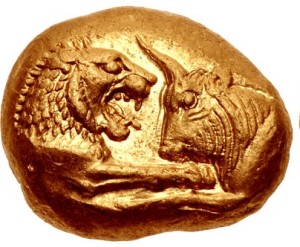
The symbols on coins had another function as well. Early Lydian coins were marked with the heads of a lion and a bull. These images suggested harmony on many levels, including cosmological (the lion representing the sun, the bull the moon), ecological (lion representing the wilderness, the bull cultivated land and civilization), and social (predator and prey together as one). It was an apt symbol for a rich and powerful state recruiting the services of its poor and underdeveloped neighbors. The coins that mercenaries carried around with them were meant to remind them of their role as the hungry lions who fought for the rich Lydian bull and were rewarded for it. Not long afterward, kings began to put their own images and personal symbols on their coins, an even more pointed reminder to the mercenaries who received them of who they owed their loyalty to.

Not long after Lydians began minting coins, many other peoples began to do the same—some directly inspired by the Lydians’ example, others independently but for much the same reasons. The usefulness of these coins for facilitating trade soon also made them appealing to merchants, crafters, wandering minstrels, and lots of other people not embedded in the agricultural economy, but paying mercenary soldiers continued to be an important reason for kings and empires to mint coins for many centuries to come.

So the next time your hero returns to town after clearing out another dungeon full of monsters and gets a handful of coins as a reward, know that you are part of a very long tradition.

Image: Lydian gold Croessid, obverse, photograph by Classical Numismatics Group via Wikimedia (minted Sardis; 564-539 BCE; gold)

History for Writers looks at how history can be a fiction writer’s most useful tool. From worldbuilding to dialogue, history helps you write.


The Strange Poetry of an Index

One of the tricks of the trade in academia is: when you pick up a new book, look at the index first. Seeing what terms appear there and which ones have large numbers of references tells you a lot about what the book is about.

I’ve been working on the index to my latest book, a collection of primary sources on the Greco-Persian Wars. Most of the entries are proper names for people, places, and institutions, and their specificity tells you pretty clearly the topic of the book. If you take those out, though, the terms that are left have a strange kind of poetry about them. You could let your imagination wander and dream up some very different books that had these terms in their indices. For your enjoyment:

animals, archers

beer, bees, bread, brick, bridges, bulls

canals, cannibalism, carnelian, cattle, cavalry, chariots, childbirth, clothing, colonies, crown, cuneiform

democracy, diplomacy, disease, dreams

earth and water, earthquakes, esparto, exiles

forgery, fowl, frankincense, frontiers

gifts, goats, gold, grain, guest-friendship

hair, helots, heralds, heroes, hoplites, horses, hostages

incense, ivory

labor, language, lapis lazuli, laws, linen, lions

medicine, mercenaries, merchants, moon, mules, multiculturalism, mummification

oil, ointment, oligarchy, oracles

palaces, papyrus, phalanx, pomegranates, poultry, propaganda

racing, rain, religion, roads

sacrifice, satraps, satrapies, sheep, shields, ships, shipwrecks, sieges, silver, storms, stone

temples, tolerance, tombs, trade, translation, tribute, triremes, turquoise, tyrants

walls, water, wind, wine, wood

How It Happens is an occasional feature looking at the inner workings of various creative efforts.

Rating: Castle, Season 6

It’s a return to form for the sixth season of Castle. Here’s our take on this season’s episodes:

  1. “Valkyire” – 7
  2. “Dreamworld” – 2
  3. “Need to Know” – 5.5
  4. “Number One Fan” – 8
  5. “Time Will Tell” – 8
  6. “Get a Clue” – 6
  7. “Like Father, Like Daughter” – 8.5
  8. “A Murder is Forever” – 6
  9. “Disciple” – 2
  10. “The Good, the Bad, and the Baby” – 9
  11. “Under Fire” – 8
  12. “Deep Cover” – 2
  13. “Limelight” – 6
  14. “Dressed to Kill” – 5.5
  15. “Smells Like Teen Spirit” – 2.5
  16. “Room 147” – 8.5
  17. “In the Belly of the Beast” – 3
  18. “The Way of the Ninja” – 7.5
  19. “The Greater Good” – 5
  20. “That 70’s Show” – 3
  21. “Law and Boarder” – 6
  22. “Veritas” – 2.5
  23. “For Better or Worse” – 3

The average rating for this season is 5.4, not the best that Castle has done, but a decent showing and better than the last couple of seasons. This season does well when it plays to its strengths: offbeat crimes and the interactions of its characters.

The three lowest episodes this season, coming in at 2, try to break the formula: “Dreamworld,” in which Beckett gets tied up in an international conspiracy; “Disciple,” in which Castle’s pet serial killer returns with a new friend; and “Deep Cover,” in which Castle gets tied up in an international conspiracy. None of these episodes works well or delivers the crime-solving comedy we expect from this series. I’m beginning to get the sense that someone in the Castle writers’ room really wanted to write spy thrillers but couldn’t hack it. Every time Castle tries to do international intrigue, it just bombs. At least this season mercifully more or less ties up the overdrawn story of Beckett’s mother’s death.

But this season more than makes up for its occasional missteps with a lot of average-to-good episodes that are enjoyable to watch. Our top pick this season, “The Good, the Bad, and the Baby,” at a 9, finds the team working backwards to uncover what led to a dying man staggering into a church holding a baby. One of the lovely things about this episode is how eagerly Castle jumps into the role of taking care of the baby, a refreshing reversal of the usual trope that men are useless with children. As runners-up at 8.5 we have “Like Father, Like Daughter,” in which Alexis enlists her father’s help for an Innocence-Project-like case, and “Room 147,” an intricate mystery in which multiple people inexplicably confess to the same crime.

Image: Beckett and Castle investigate, from “Room 147” via IMDb

In the Seen on Screen occasional feature, we discuss movies and television shows of interest.

Tolkien, Fantasy, and Race

Wizards of the Coast recently announced that they will be changing how the Dungeons & Dragons role-playing game system handles race. These changes include, among others, reimagining the traditionally evil Drow and Orcs as complex and nuanced cultures, revising how a player’s choice of race affects their character’s stats, and removing racially insensitive text from reissues of old content. You can read the company’s statement about these changes here.

Some of these changes are more obviously necessary than others. It’s not hard for most of us to see how having a race of dark-skinned Elves who are almost universally evil in your game is a poor design choice that needs to be rectified, but it’s less obvious to a lot of people why the game should be changed so that your Elf isn’t necessarily clever and dexterous or your Dwarf stout and tough. To understand why rules like these are problematic, it helps to look at how ideas about portraying non-human beings in fantasy have been shaped. Fantasy is as complex and varied as any other genre of literature and no single person is responsible for the development of its tropes and principles, but when we think about race in fantasy, there is one crucial place to start: Tolkien.

Tolkien’s Middle Earth legendarium profoundly shaped fantasy literature in the twentieth century and the other media drawing from it, such as role-playing games like Dungeons & Dragons. Tolkien’s versions of Elves and Dwarves, as well as his invention of Hobbits (made lawyer-friendly as “Halflings”), formed the basis for D&D’s early options for players who wanted an alternative to humans. Much of the popular fantasy archetypes for what non-human races are like (ethereal, wise, bow-wielding Elves; stubborn, pugnacious, axe-hefting Dwarves) were either created or codified by Tolkien.

Tolkien’s relationship to race is complicated. On one hand, he was vocally opposed to the antisemitism common in his time and to the Nazis’ attempts to claim his beloved Germanic mythology as a prop to their racist regime. His Middle Earth tales can be read as a counter-argument to white supremacist ideology, as the “lesser” folk of Middle Earth, like the Hobbits and the Wild Men, prove more resistant to the lies of evil than the “higher” races of Men. At the same time, there is no denying that Tolkien’s fiction is suffused with familiar racial assumptions, filled with white characters and portraying dark-skinned people only as strange or threatening others.

But it is Tolkien’s work as a scholar that is most important for understanding his effect on the depiction of race in fantasy. Tolkien’s academic training as an Oxford student in the early twentieth century was grounded in the traditions of the nineteenth century, which defined nations as coherent, natural entities existing across time and marked by inherent characteristics. This academic worldview was linked to the Romantic and nationalist movements at work in Europe in that century, as well as the ongoing imperialist projects of Britain, France, and other nations of Europe. At its core was the belief that culture and biology are equivalent, that people have fundamental national traits inherited from their ancestors which define their culture, character, even moral worth.

Every academic discipline concerned with the human past was engaged in some way with this project. Historians traced the ancestry of their own and other peoples as far back as written sources would allow, at which point archaeologists stepped in to carry the line further back. Scholars of literature and art looked to both nationally famous artists and rural folk traditions to delineate the defining characteristics of a culture. Scholars in different nations concocted their own versions of national culture and interpreted both ancient and recent history in terms of discreet nations wrangling with one another: while English writers explained their early history as the victory of the serious, diligent Anglo-Saxon over the moody, whimsical Celt, French historians conceived of the French Revolution as a primordial Gallic peasantry overthrowing the Germanic overlords who had dominated them since the fifth century CE. Even forgeries and hoaxes followed the same principle, like the collection of Gaelic poetry attributed to the bard Ossian or the fake primordial Englishman buried with a battered cricket bat at Piltdown. While the work of such historians, folklorists, artists, pranksters and others was in itself fairly benign, it was part of a larger politics that justified the exploitation and oppression of some ethnic groups for the benefit of others based on specious claims about national characters and destinies.

Tolkien’s subject, philology, was no exception. Scholars believed that language could be a key to those parts of the past that neither history nor archaeology could reach, perhaps even the most important parts, for what can be more fundamental to our identity than the words we use to describe our world? Linguistic research, starting in the eighteenth century with the realization that the ancient Indian language Sanskrit came from the same source as Greek and Latin, had demonstrated that it was possible to discover regular principles that governed shifts in sound as languages evolved and split into new languages. Applying these principles to the earliest documented fragments of existing languages made it possible to reconstruct, with a high degree of certainty, elements of vocabulary and grammar belonging to languages that had never been written down.

Tolkien, and other philologists of his generation, believed that it was possible to go a step further and apply the same principles to myths, legends, even history. Working backwards from the earliest recorded elements of a culture—its oldest literature and art, archaeological remains, and whatever fragments of ancient knowledge survived in folk tradition—they hoped to reconstruct the primordial beliefs, practices, and character of that culture. Tolkien carried this same spirit into his literary work and with his Middle Earth stories tried to reimagine a history that might have lain behind the scattered remnants of Germanic mythology that come down to us through English, Norse, German, and Icelandic sources.

The result of this labor was a fictional world that incorporates numerous traces of ancient tradition—Smaug, from The Hobbit, has shades of Fafnir from the Volsunga Saga, while the arrival of Aragorn, Gimli, Legolas, and Gandalf at Edoras in The Lord of the Rings recreates the Geatish heroes’ arrival at Heorot in Beowulf—but put together in a distinctly nineteenth-century way. The various races of Men in Tolkien’s work reflect contemporary belief in inherent national cultures to the extent that the Dunedain of the north retained their culture for many long generations cut off from Gondor in the south. Other peoples of Tolkien’s world are culturally defined by their ancestry, stretching over thousands of years.

Tolkien’s Elves and Dwarves are a similar combination of ancient Nordic lore and nineteenth-century nationalistic culture-construction. Tolkien took stories about Elves and Dwarves from different times, cultures, and genres, extracted the elements he believed were characteristic, and fused them together to create the kind of singular, coherent cultures that scholars of his day believed could be found among real peoples. The idea of Elves as archers comes from a Scottish tradition of referring to prehistoric arrow points as “Elf-shot.” The intermarriage of Elves and humans comes from Icelandic sagas. The bewildering power of an encounter with Elves derives from medieval German folklore. Tolkien believed that these various fragments were the remains of what had once been a clear, consistent belief in Elves as beings with defined characteristics, much as words in Sanskrit, Greek, and Old Norse were the remains of an older language, and that by putting them together he could reconstruct the nature of Elves in same way philologists reconstructed lost languages. The same applies to Tolkien’s Dwarves.

Tolkien’s assumptions about lost cultural knowledge only make sense in the context of the scholarship he worked in. Modern research has found that the image of Elves in northern European mythology is widely varied. Writers in different times and cultures had vastly different ideas about what Elves were, ranging from benevolent ancestor spirits to malicious swamp creatures that would steal your baby and eat it. There is no evidence that the original Elf Tolkien thought he could reconstruct was ever anything but a mirage. Indeed, it is not just that Elves did not have consistent characteristics in northern mythology, early northern writers don’t even seem to have viewed “Elf” as a stable category that could be defined. Many texts use the term fluidly for many different sorts of supernatural creature, overlapping with Dwarves, demons, angels, and others in ways that do not allow for any clear definition.

It is primarily to Tolkien that we owe the idea, not just that Elves, Dwarves, and other fantastical creatures have consistent characteristics, but that they exist as discreet groups that can be defined. This conception of fantasy folks is a product of a particular cultural and scholarly worldview, one that is increasingly out of date. Aloof archer Elves and beefy brawling Dwarves running around your game world may seem perfectly harmless, but the archetypes that define these as the standard types of Elves and Dwarves are rooted in a history of imperialism and racism.

It is time to leave behind this artifact of the nineteenth century and embrace a world in which Dwarves can be slender bookworms and Elves can be boisterous bruisers, or anything else you want them to be.

Post edited for grammar

Image: Elf and Dwarf cosplay, photograph by Tomasz Stasiuk via Flickr (CC BY-SA 2.0)

History for Writers looks at how history can be a fiction writer’s most useful tool. From worldbuilding to dialogue, history helps you write.

How We Lost the Library of Alexandria

There are a couple of persistent myths floating around about how the Library of Alexandria was destroyed. One says that it was burned down by Julius Caesar in the first century BCE, the other that it was destroyed by Christians in the fourth century CE. Both of these stories are wrong. That’s not what happened to the Library. The actual history is instructive, especially now.

The story begins with the foundation of the Library itself. After the death of Alexander the Great, his followers fell into a fifty-year struggle for control of his empire. When the dust settled, three major successor states founded by Alexander’s generals controlled most of the eastern Mediterranean and the old Persian Empire: the descendants of Antigonus in Macedonia, the descendants of Seleucus in Syria and Mesopotamia, and the descendants of Ptolemy in Egypt. Other, smaller, states, some of them also led by former officers of Alexander’s army, filled the edges and the gaps in between the Antigonid, Seleucid, and Ptolemaic kingdoms.

Ptolemy and his dynasty ruled from Alexandria, the new city founded at the westernmost mouth of the Nile by Alexander during his campaign. The Ptolemies and their court made up a small Greco-Macedonian elite ruling over a vast and ancient land whose people had a strong sense of cultural identity and a long history of resistance to foreign rule. The Ptolemies faced two major problems in ruling their kingdom: competing against the other successor states, and asserting control over the native population of Egypt.

A large part of the challenge in both cases came down to questions of culture. The Ptolemies needed to attract skilled administrators and mercenary soldiers to staff their bureaucracy and enforce their rule, but they were competing with all the other successor kingdoms who wanted the same people for the same reasons. One way of drawing desirable recruits to Alexandria was to demonstrate the richness and refinement of the Ptolemaic court. At the same time, maintaining order in Egypt meant reaching some degree of accommodation with members of the native elite who could keep the peasants in line. To Egyptian nobles who were proud of their own history and culture, the Ptolemies had to show that they were worthy partners who could live up to the standards of culture and sophistication Egyptians expected from their kings.

The Ptolemies’ propaganda approached these challenges in many different ways, but the Library was one important part of their cultural program. Under royal patronage, the Library amassed the largest collection of literary works in Greek assembled anywhere in the Mediterranean. In doing so, it projected the Ptolemies’ cultural sophistication in the common language of the eastern Mediterranean world. It was one of the institutions that made the city of Alexandria noteworthy and demonstrated the Ptolemaic kings’ power and wealth.

The Library of Alexandria was not created as a benevolent or altruistic center of knowledge. It was as much a part of power politics as the king’s mercenary army, and it could be as ruthless in its operations. Ships arriving in Alexandria were reportedly ransacked for any texts the Library might be lacking. The Library borrowed the official texts of winning dramas from the Athenian state archives, then kept the originals and returned cheap copies. The collection was only accessible by royal permission; it was not a place for the public.

Maintaining such a large collection required a dedicated staff of both specialist curators and laborers. Adding new texts to the collection took a lot of work to prepare the papyrus scrolls on which they were recorded and house them safely, but just maintaining the collection was a major job in itself. Papyrus scrolls are not permanent; they break down over time, even in the best conditions. Every text in the Library had to be periodically recopied as the old scrolls decayed. All of this work was funded by the Ptolemaic kings, for whom the Library was an important prop to their power.

In the mid-first century BCE, Julius Caesar fought a campaign in Alexandria against the reigning king Ptolemy XIV in support of his sister Cleopatra, who would go on to rule as the last Ptolemaic monarch. During the fighting, Caesar’s troops set fire to some of the ships in the port. The fire spread to some dockside buildings, including warehouses that held papyrus intended for the Library. The exact extent of the fire is unclear. While some ancient sources report that the Library itself suffered damage, it is clear that the most of the collection was unharmed, and the loss was largely of materials, not finished texts.

Decades later, after Cleopatra was killed and Egypt was annexed to the Roman Empire, however, the Library went into decline. The later Ptolemaic kings had been less enthusiastic in their support of the Library than the earlier kings had been, and by the first century BCE the Library was already a diminished institution. With no Ptolemaic dynasty to prop up, it no longer served a purpose. Some Roman emperors showed an interest in the Library, but most had no desire to keep supporting an institution that rivaled their own propaganda works in Rome. Without money to pay for upkeep and repairs, to pay the salaries of librarians and workers, the Library of Alexandria faded away. Support from the local elite kept some of the collection intact, some part of which remained active as a much smaller, provincial version of its former self through the third century CE.

Just how long this reduced version of the Library continued on is unclear. The third century was a time of widespread violence and unrest in the Roman world, and Alexandria had always been a rowdy city prone to riots. The growing community of Christians in Alexandria sometimes participated in these upheavals, but they were far from the only ones. In one famous incident, an attack by pagans sparked a Christian counterattack which wrecked a Neoplatonist school, but there is no record that any books were kept there. Whatever was left of the collection may well have suffered in the violence of the times, but by then the Library-with-a-capital-L was a thing of the distant past.

There is a lesson for us in the end of the Library of Alexandria, but it is not one about the brutishness of Caesar or the violence of early Christians. What doomed the Library was not some act of willful destruction but the slow decay that comes on when there is not enough money to keep basic operations going. In these days when we all find our budgets stretched tight, it is important to remember how much the cultural institutions we depend on also depend on us.

As many people have noted recently, the covid-19 pandemic isn’t the apocalypse we expected. We like to imagine that great things end in cataclysm, not in the slow grinding down of underfunded institutions. We prefer the bang to the whimper. But just like the Library of Alexandria, the establishments we rely on—be they local libraries, theater companies, independent bookstores, niche comics publishers, or anything else—will not be destroyed by invaders or violent mobs. They will wear away by inertia and neglect. Now is the time to show your support, in whatever ways you can manage, to the things that make your life brighter, richer, and fuller.

Image: A modern artist’s interpretation of the Library of Alexandria via Wikimedia (19th c.; engraving; by O. Von Corven)

History for Writers looks at how history can be a fiction writer’s most useful tool. From worldbuilding to dialogue, history helps you write.
Quote: Something that You Have Longed For Without Hope

If something happens that you have longed for and desired without
hope, it is a blessing to your soul.
So it is a blessing to us, more precious than gold,
that you long for me again, Lesbia.
You long for me without hope; you bring yourself back
to me. What a red-letter day!
Who leads a happier life than mine? Who can say
that life has given him a greater gift?

– Catullus, Poems 107

(My own translation)

I think a lot of us now know what it is like to long for something almost without hope, even if it is not for the return of a former lover. One thing I have longed for this past spring is the long days of summer when the sun lingers in the sky and we can enjoy warm evening breezes.

Whatever it is you are longing for now, I hope this summer brings it to you.

Serving exactly what it sounds like, the Quotes feature excerpts other people’s thoughts.

When Your Favorite Creator Has a Bad Take

It happens sometimes, especially in today’s social media world: the creator of something you love, be it a book, movie, tv show, comic book, or some other work of art, has a bad take. We’re not talking about your garden-variety difference of opinion. (Despite what the Internet would have you believe, people who like pineapple on their pizza and people who don’t can, in fact, live in peace together.) We’re talking about a serious bad take, one that denies the fundamental humanity of a whole group of people or supports acts of violence in the real world. What do you do then?

The first steps are obvious enough. You can speak out against them, whether online or off. You can affirm your support for the people they targeted, whether publicly to the world at large or privately to the people you care about.

You can watch how the creator responds, whether they learn and grow from the experience or double down on their bad ideas. A lot of us have had to learn to challenge the bad ideas we absorbed from the culture around us, and most of us didn’t do it in public with an audience of millions. It’s fair to say that if someone has reached an age where they are producing art for a mass audience, they should really have gotten past basic prejudices and misjudgments, but if somehow they haven’t, it’s better that they do it now than not at all. Whether you find their actions convincing or sufficient is up to you. You don’t owe anyone your forgiveness, no matter what they may say or do. You’re also not wrong if you choose to give it. You are the only one who gets to decide what is enough for you.

If someone’s bad ideas are egregious enough to merit it, you can stop giving them money. Don’t buy their latest book or a ticket to their new movie. This may get complicated if their work is tangled up with the work of other people whose good work you still want to support, but loss of revenue is one of the biggest pressures you can put on a company or organization to drop a problematic actor or cut ties with a writer who has spewed hate. You can stop giving them attention, too. Unfollow or even block them on social media. Don’t give clicks to articles or posts about them or their latest work.

What about the works you already have? Do you have to clear their books off your shelves or throw away the DVDs? You can, of course, if you feel it’s right for you. If your enjoyment of those pieces of art would forever be tainted by their creator’s asinine or prejudiced comments, then there is no need for you to keep them. Like forgiveness, it’s a personal decision you can only make for yourself.

But what if you want to keep them? What if there are still things you love about those works, despite their creator’s attack of foot-in-mouth disease? How do you continue to enjoy them?

I spend a fair amount of my time reading books that were written by people who were absolutely wrong about a lot of important things ranging from the intellectual capacity of women to the morality of slavery. Much of this I read simply for my work, not for pleasure, but there are ancient texts I enjoy, some I have read over and over again for sheer delight, like the masterfully-told stories of Herodotus, the heroic deeds of the Homeric epics, Sappho’s longing love poetry, Martial’s wickedly funny epigrams, and others. Even without having a social media feed from any of these authors, I am confident that most of them believed in things we would find abhorrent today. How can I continue to enjoy their work?

The art is not the artist. This is the principle known in literary criticism as “the death of the author” (which is less dire than it sounds). What we create exists outside of ourselves. Once an author publishes a novel or a director releases a movie, their creative work is done. It is up to the audience to decide how they will receive and understand the work. Our experiences of art are not dictated wholly by the creator’s intentions but are a complicated interplay of our own thoughts and emotions with the artist’s ideas. Those experiences are personal and unique, and they do not depend on the moral qualities or opinions of the artist.

When I go back to the Iliad, I know that I am reading the product of a culture whose values were sharply different from my own on gender roles, the morality of war, the acceptability of slavery, and many other fundamental questions. It is impossible to read the epic without facing all of those differences. Many of them are so deeply woven into the story that it simply would not be possible to tell the story without them. The Iliad is the story of male warriors fighting over the possession of a beautiful woman; without any of these elements, it would cease to be the Iliad. And yet there are things to enjoy in the epic, without excusing or ignoring the cultural assumptions it is grounded in. Some of the most powerful passages in the work are those in which the humanity of individual characters comes through despite the cultural baggage around them. Helen has moments in the Iliad where we see her fear, her grief, her frustration and anger about the war being fought for her, and we glimpse her as a whole person, just as complex as any of the warrior-heroes around her. The final image of Achilles and Priam weeping together over their lost loved ones is a moving expression of the power of human compassion to overcome hatred. There is beauty and value in these things, and I can enjoy them while still being aware of the context around them.

If there is a book you love but whose author recently revealed themselves as a bigoted ass, it’s all right for you to still love the book and treasure the memories of how it made you feel when you first read it. Your experience of that book belongs to you, not to the author. Once their words and ideas entered your imagination, they became part of you, as much as any other experience in your past. You don’t have to excuse the author for their bad take, but neither does their bad take have to tarnish your enjoyment of their book.

It’s also okay if you decide that you can’t pick up that book again. You are the only person who knows what is right for you.

Here there be opinions!

Rating: Castle, Season 5

Overall, season 5 of Castle gets our lowest rating for the series, but that doesn’t mean there aren’t some great episodes worth going back to. Here’s how we rated it:

  1. “After the Storm” – 2.5
  2. “Cloudy with a Chance of Murder” – 3
  3. “Secret’s Safe with Me” – 5.5
  4. “Murder, He Wrote” – 6
  5. “Probable Cause” – 1.5
  6. “The Final Frontier” – 8
  7. “Swan Song” – 7.5
  8. “After Hours” – 6
  9. “Secret Santa” – 9
  10. “Significant Others” – 6
  11. “Under the Influence” – 6
  12. “Death Gone Crazy” – 6
  13. “Recoil” – 4
  14. “Reality Star Struck” – 5
  15. “Target” – 0
  16. “Hunt” – 0
  17. “Scared to Death” – 6
  18. “The Wild Rover” – 4
  19. “The Lives of Others” – 10
  20. “The Fast and the Furriest” – 5
  21. “Still” – 2.5
  22. “The Squab and the Quail” – 4
  23. “The Human Factor” – 4
  24. “Watershed” – 1.5

There are a bunch of decent episodes this season in the 4-6 range, but there are also a lot of bad episodes (including some utterly awful ones) that drag the average rating down to 4.7, a little less than season 4’s 4.8. The overriding problem this season is the push to squeeze more drama out of a series built on quirky mystery capers and fun characters. Whether it’s the saga of Beckett’s mother, the return of Castle’s own personal serial killer, or the overdrawn relationship drama between Caste and Beckett, every attempt to inject seriousness and angst into this series just falls flat and takes the air out of everything that makes it great to begin with.

The urge for drama is certainly the problem with the worst episodes of this season, “Target” and “Hunt,” a two-parter which gets a rare double zero from us. These episodes don’t feel like they belong in Castle in the first place. Instead of a murder-of-the-week in New York with some entertaining shenanigans by Castle and the gang, we get an underbaked attempt at a spy action thriller when the abduction of Castle’s daughter Alexis brings his long-absent father out of the woodwork, and he turns out to be, like, geriatric James Bond or something. This episode features two of our least favorite tropes: hurting a woman so that a man can have feelings, and a strained father-son relationship. Yuck.

On the other hand, this season does deliver some great episodes that live up to the best of the Castle crime comedy goodness. “The Final Frontier,” at 8, is a fun romp around a sci-fi convention with a wink and a nod to Nathan Fillion’s beloved Firefly role. “Secret Santa,” at 9, sees the gang investigate the death of a flying Santa Claus and ends with a gloriously goofy Santa-vs.-Santa brawl. But the best of the season is “The Lives of Others,” a full 10, in which Castle, laid up at home after a skiing injury, thinks he’s witnessed a murder Rear Window-style in the apartment across the street. I won’t spoil the ending of this episode, but it’s a fantastic payoff that really celebrates the strength of the team.

There are episodes worth seeing this season, but there are definitely a lot we’ll skip on our next rewatch.

Image: Castle checks out the neighbors, from “The Lives of Others” via IMDb

In the Seen on Screen occasional feature, we discuss movies and television shows of interest.

Five Years of Co-Geeking

It’s been five years since we started blogging together here at Co-Geeking, and it’s safe to say those are five years we’ll never forget. Join us for a little look back at our highlights from the past year.

Our favorite posts

Erik:

The post I have most enjoyed writing in the past year is The Past is Haunted, a Halloween rumination from last October about how we often connect the sense of hauntedness and the supernatural with the traces of earlier people’s lives, even to the point of sometimes deliberately invoking that sense in artificial ways. It was fun to take the spookiness of the season and think historically about it.

Eppu:

Aah, a tough one, but I’d have to say the post on the reconstructed Staffordshire Helmet. That (plus the March 2020 post on the Essex burial chamber) were little trips to the past for me, since they reminded me of my master’s studies in Finland. Plus, the helmet and the model wearing it make such an amazing photo!


Our favorite geeky thing that happened in the past year

Eppu:

The release of the Captain Marvel movie! Obviously, I’m not superpowered in any way (well, perhaps, if I’m very, very, VERY lucky I may be) but the tenacity and persistence that Carol Danvers displays speaks to me a lot. (In Finland, we call the quality sisu, and it’s highly appreciated.) It was a great screen adaptation of a supe origin story. Plus, every scene between Danvers and Fury keeps getting better and better with every viewing; Brie Larson and Samuel L. Jackson play together so well it’s a joy to watch.

Erik:

This is a hard one for me to answer. A lot of the interesting things happening in geekdom right now are on tv (and even more so now that the novel coronavirus is keeping so many of us at home), but the two of us are always late to those parties because we don’t have cable or any streaming services, so we mostly have to wait to buy things on dvd or get them from the library. We’re old-fashioned like that. So, while we are aware of the existence of things like young Yoda and old Picard, we haven’t actually seen them yet.

So my answer is a little different this year. Not long ago I dug out my old collection of Magic: The Gathering cards. I haven’t played in years, and I decided it was finally time to get rid of them. Going through them all brought back so many memories of playing with my friends. I loved to build decks around weird cards or bizarre ideas and see if I could make them work. Often they just flopped in play, but I still had so much fun tinkering around with mechanics and combinations. Those days are behind me now, but I cherish the memories.

On another note, is anyone in the market for an old collection of nothing-special Magic cards?

We look forward to another year with you all.

Image: Holy hand grenade from Monty Python and the Holy Grail via tenor.com

Announcements from your hosts.