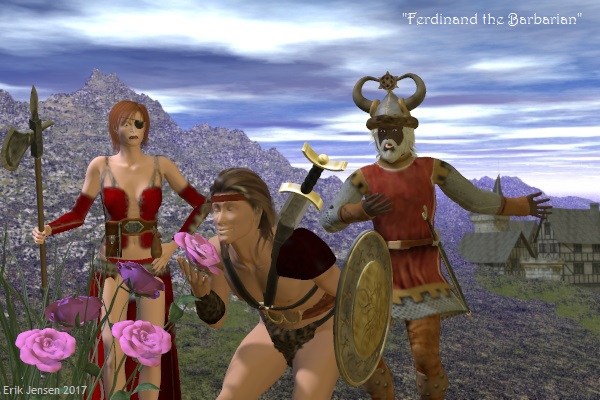
As you burn and pillage your way through life, don’t forget to stop and smell the roses.
Image by Erik Jensen
In Making Stuff occasional feature, we share fun arts and crafts done by us and our fellow geeks and nerds.
As you burn and pillage your way through life, don’t forget to stop and smell the roses.
Image by Erik Jensen
In Making Stuff occasional feature, we share fun arts and crafts done by us and our fellow geeks and nerds.
Creating medieval(esque) city maps just got a lot easier: Oleg Dolya (watabou) made an automated generator to do it.

Choose size of city with the click of a button, and color scheme and line or shading types from the options. You can export the image either as png or svg. Unfortunately the ward names (temple, merchant, crafts, etc.) aren’t saved on the exported map, though.
Watabou also built a 3d-visualiser to support Medieval Fantasy City Generator called Toy Town. Although I haven’t played with that, it sounds like both should be a great help to storytellers—unless you enjoy the process with paper and pen, of course!
Found via N.K. Jemisin on Twitter.
Image: screenshot from a map created by Eppu Jensen with Medieval Fantasy City Generator by watabou
In Making Stuff occasional feature, we share fun arts and crafts done by us and our fellow geeks and nerds.
We have continued our rewatching-and-rating project into a series with a bigger fan following: the rebooted Doctor Who that began its broadcast life in 2005. We know that there are a lot of Who fans out there who are passionate about the series and feel strongly about certain episodes and characters. Here’s how we felt about the first season, starring Christopher Eccleston as the Doctor and Billie Piper as his companion Rose.

It’s a rocky start to the new show, which is understandable given how much weight this first season had to carry: living up to the nostalgia for the old show while proving that the Doctor Who formula could be made fresh, new, and relevant for a new generation. The average episode rating for this season is 5.3, which is low but decent.
The lowest-rate episode of the season is the finale, “The Parting of the Ways,” in which the Doctor faces off against a Dalek invasion of Earth in the future while Rose desperately tries to get back to him from the present. It rated only a 3 for several reasons. There are pacing and structural issues with the story and its ending relies too much on an almost literal dea ex machina. We find Dalek stories generally weak because the Daleks are flat as characters and overpowered as antagonists.
The standout best episode of the season, though, is “The Doctor Dances” at a full 10. In WWII-era London, the Doctor and Rose deal with both dashing Time Agent-turned-con artist Jack Harkness and a monster that looks like a little boy in a gas mask but who turns those he touches into mindless gas-mask-faced shadows of themselves. As the conclusion to a two-part story after the very strong “The Empty Child,” this episode is full of both sparkling wit, clever sci-fi ideas, and powerful human drama.
This season’s heart (or hearts) are in the right place, even if it doesn’t always deliver. The “dig in the couch cushions and see what you find” special effects budget of the old show was always part of its quirky charm, but the fist season of the new show clearly struggled to live within its means. Not every episode pulled off the right balance of whimsy and pathos. Still, this season did what it needed to: it brought us back the Doctor and the TARDIS and prepared the way for greater adventures to come.
We know there are lots of other Doctor Who fans out there, and some of you probably feel quite different about this season and its episodes. We’d love to hear your take. Let us know which episodes of season 1 worked for you or didn’t.
Image: Doctor Who Series 1 via IMDb
In the Seen on Screen occasional feature, we discuss movies and television shows of interest.
Time for the annual turkey day! We’ll be off for the next week or so for Thanksgiving.
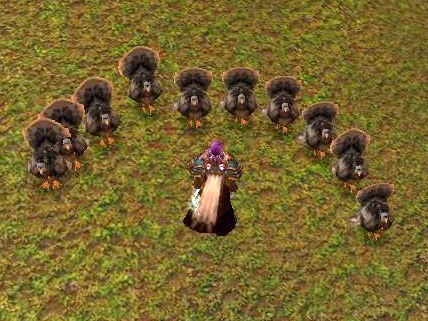
If you’re celebrating, hope you’ll have a good one!
Image: screenshot from the World of Warcraft Critter Gitter achievement with turkeys
This post has been edited for formatting.
Some things are just too silly not to share!
“What race were the ancient Greeks and Romans?”
It sounds like a simple question that ought to have a straightforward answer, but both the question and its answer are far more complicated than they appear. In this and some other posts, I dig into the topic to explore what we know, what we don’t know, and what we mean by race in the ancient Mediterranean world.

Part 2: Identities
Race as we know it today is an invention of European imperialism in the last five hundred years. Because most of the world was touched by European imperialism, whether directly or indirectly, race has become a vital category of identity for people in many parts of the modern world. Race creates distinctions that benefit some and disadvantage others, and—whether we agree with its effects or not—we cannot ignore or escape them. Most of us can readily identify ourselves and the people around us in racial terms, and we often have cause to do so.
There are many other categories through which we define our identities, such as gender, sexuality, religion, nationality, language, occupation, and so on. Being a white straight male Buddhist French-speaking Canadian cheese-seller is different from being a black straight male Buddhist French-speaking Canadian cheese-seller, but so is being a black straight female Buddhist French-speaking Canadian cheese-seller, or an Asian asexual trans male atheist Spanish-speaking Peruvian piano tuner, etc.
The rules that govern racial identity are perceived to be less flexible than the rules that govern other categories of identity. In most (though, notably, not all) of the modern West, these rules are defined by an ideology that is problematic and not always compatible with lived experiences or scientific thinking, but whose components are grounded in three fundamental assumptions. According to these assumptions, race is:
Biological. We recognize race primarily in terms of physical features like skin color and facial geometry. Science defines certain genetic and physical features as characteristically “Caucasoid,” “Negroid,” “Mongoloid,” or other categories.
Hereditary. Our race is defined by the race of our parents. A person with two black parents is automatically and necessarily black. Even people of mixed racial heritage can parse out their racial identity into specific proportions.
Immutable. We cannot choose or change our racial identity; a person born white can never be any race other than white, and the same is true of other races.
The ancient Greeks and Romans, and other peoples of the ancient Mediterranean, also recognized that identities are complex, made up of different categories, and that some identities have advantages over others. An ancient Greek sage (the quote is attributed to both Thales and Socrates) said:
I thank fortune for three things: first, that I was born a human, not an animal; second, that I was born a man, not a woman; third, that I was born a Greek, not a barbarian.
– Hermippus of Smyrna, frag. 13
(All translations my own.)
In addition to these categories—humanity, gender, and culture—other categories were important for ancient identity, such as legal status (freeborn, freed, or slave), language, occupation, citizenship, and family affiliation, but race, as we recognize it today, was not among them. No category matching the modern racial assumptions of biology, heredity, and immutability existed in Greek or Roman culture.
There is no word in Greek or Latin that corresponds to “race.” The nearest equivalent is “gens” in Latin or “genos” in Greek, both of which imply a group of people with a coherent cultural identity and a common ancestry. It is better translated as “tribe” or “extended family.” The idea of dividing people up on the basis of skin color would have made no sense to a Greek or Roman, nor would the idea of a category of humanity that did not differentiate between people from Greece, Spain, Ireland, and Ukraine.
Greek and Roman authors were aware of variations in physical features. The Greek philosopher Xenophanes, for instance, noted that different peoples imagine the gods as resembling themselves:
Ethiopians say the gods are dark and snub-nosed; the Thracians give them red hair and blue eyes.
– Xenophanes of Colophon, frag. 16
The Roman historian Tacitus similarly made suggestions about the origins of the Britons based on their physical characteristics:
The physical variety [of the Britons] is suggestive. The golden-red hair and burly limbs of the Caledonians shows them to be of Germanic origin. The colorful faces and curly hair of the Silures, plus their position opposite Spain, suggests their ancestors were Spaniards who came across the ocean.
– Tacitus, Agricola 11
Nevertheless, physical features were not regarded as sufficient to divide people into categories. Languages, customs, and ways of life carried far more weight. When the Greek historian Herodotus argued that the Colchians of the Black Sea region were related to the Egyptians, he dismissed the similarities of their appearances as unreliable and based his argument instead on similarities in their cultures:
It is evident that the Colchians are Egyptians… I guessed this myself since they are both dark-skinned and thick-haired, but that amounts to nothing since others are as well. A better proof is that the Colchians, Egyptians, and Ethiopians are the only peoples who have always practiced circumcision… [The Colchians] and the Egyptians produce linen in the same way; plus their ways of life and their languages resemble one another.
– Herodotus, Histories 2.104-5
Heredity mattered for defining identities, but not in the same way as in modern racial thinking. When Greeks and Romans looked to their ancestry for claims of identity, they discussed it in terms of descent from a specific (historical or mythical) individual, not collective ancestry. King Alexander I of Macedon (the great-great-great-grandfather of Alexander the Great) argued that he ought to be allowed to participate in the Olympic Games, which were open only to Greeks, on the grounds that he was a descendant of the Greek hero Heracles. (Herodotus, Histories 5.22) This kind of ancestral argument could even bridge cultural divides. When the Persian king Xerxes was preparing to invade Greece in 479 BCE, he sent emissaries to the Greek city Argos to persuade them to remain neutral and not join the other Greeks resisting his campaign. He based his argument on the claim that the Persians were descended from the Greek hero Perseus, who came from Argos, and so Persians and Argives, as distant relatives, should not fight one another. (Herodotus, Histories 7.150)
For many ancient authors, culture was far more important than heredity in assessing people’s identities. The Greek historian Dionysius of Halicarnassus declared:
For, in my opinion, Greeks are not distinguished from barbarians by name or language, but by intelligence and the inclination to proper behavior, and more than this by the fact that they do not behave inhumanly to one another. Those whose natures are of this kind, I think, ought to be called Greeks; those who are the opposite, barbarians.
– Dionysius of Halicarnassus, Roman Antiquities 14.6
Furthermore, identity was not always assumed to remain stable across generations. The last king of Rome, Tarquinius Superbus, was identified as a Roman, but his father, Tarquinius Priscus, was an Etruscan, whose own father, Demaratus of Corinth, was a Greek. (Livy, History of Rome 1.34; Dionysius of Halicarnassus, Roman Antiquities 3.46) This same instability applied on a collective basis. Many people in the ancient Mediterranean claimed descent from other peoples. Most famously, the Romans claimed to be descended from the Trojans, but some also claimed the Romans were descended from Greeks. Gauls likewise claimed descent from Troy. Jews asserted that the Spartans of Greece were their long-lost kin, while Tacitus declared that the Jews were descended from Ethiopian exiles. (Vergil, Aeneid; Livy, History of Rome 1.1; Dionysius of Halicarnasus, Roman Antiquities 1.31, 41-44, 60, 72, 89; Lucan, Pharsalia 1.427-8; 1 Maccabees 12.5-23; Josephus, Jewish Antiquities 12.225-7; Tacitus, Histories 5.2)
Even individuals might change their identities over time. The Greek physician Galen described his Roman clientele as:
… those who are born barbarians but cultivate the ways of Greeks.
– Galen, On the Preservation of Health 1.10
Ancient Greeks and Romans thought about their identities in many different ways, but none of these ways corresponds to race as we define it today. These differences in how ancient peoples thought about identify shaped how they wrote about themselves and others. The things that mattered to them in defining identities were not always the same things that matter to us.
When we ask what race the ancient Greeks and Romans were, we are applying concepts that the people we are investigating would not themselves have understood. Acknowledging this fact is essential when we look to the primary sources to try to answer our questions. We cannot simply read ancient sources as if we were reading a modern newspaper or Twitter feed and assume that we can identify the people they describe as surely as if we met them on the street today. Looking for evidence of race in antiquity requires understanding what the ancient sources don’t say as much as what they do.
Other posts on Race in Antiquity:
Image: Bull leaping fresco (restored), photograph by Nikater, via Wikimedia (Knossos; 1550-1450 BCE; fresco).
History for Writers is a weekly feature which looks at how history can be a fiction writer’s most useful tool. From worldbuilding to dialogue, history helps you write. Check out the introduction to History for Writers here.
Oh, wow: quite possibly the oldest attempt at animation ever comes from some four thousand years ago. It’s a depiction of a goat jumping up a tree to eat the leaves:

The sequence laid flat looks like this:

And here’s a photo of the cup:

Found via The Real Iran on Tumblr. My Tumblr source doesn’t unfortunately give any more info, but it sounds like the cup was found in the Bronze Age site of Shahr-e Sūkhté (or Shahr-e Sukhteh) in Sistan, southeastern Iran.
Just reading the Wikipedia page for Shahr-e Sūkhté makes my imagination run—a large trading route hub with connections to Mesopotamia, Central Asia, and India with rich material culture would make an excellent setting for historical or speculative fiction. (For example, among the archaeological finds from the Burnt City is apparently the world’s first artificial eyeball.)
Finding real-world inspiration like this is when I really wish I was a writer!
Images: Animation via Wikimedia. Reproduction via Wikimedia. Cup photo via Wikimedia (Shahr-e Sūkhté, Iran; late half of 3rd millennium BCE; clay).
The Visual Inspiration occasional feature pulls the unusual from our world to inspire design, story-telling, and worldbuilding. If stuff like this already exists, what else could we imagine?
“With that, Maggie took Frank’s arm, and together, they strolled down the broad avenue without talking. That was one thing Frank liked about Maggie—she didn’t feel the need to fill the silence with gabbing. He wasn’t even sure if she enjoyed his company or not—and frankly, he could say the same of hers—but they could at least coexist in the same space well enough. There were worse things.”
– Michael J. Martinez: MJ-12: Inception
Maggie and Frank belong to a team of superpowered U.S. operatives in a 1940s Cold War speculative world. Even though Maggie is the token female character, it’s really very refreshing that the author doesn’t try to shove in that bane of Smurfette stories, the inevitable romantic subplot.
Martinez, Michael J.: MJ-12: Inception: A Majestic-12 Thriller. New York, NY: Night Shade Books, 2016, p. 247.
Serving exactly what it sounds like, the Quotes feature excerpts other people’s thoughts.
 From Gandalf’s “Naur an edraith ammen” to Harry Potter’s “Expelliarmus,” words carry the power to work magic in many stories. The idea is not a new one. Here, for example, is some medical advice from the early Roman writer Cato the Elder’s treatise on agriculture:
A dislocation can be made whole with this incantation. Take a green reed four or five feet long, split it in half, and have two people hold it at your hips. Begin to chant: “Motas uaetas daries dardares astataries dissunapiter” and continue until the halves touch. Flourish an iron blade over them. Where they touch one another, take them in your hand and cut left and right. Bind the pieces to the dislocation or fracture and it will be healed. Keep chanting every day like this: “Haut haut haut istasis tarsis ardannabou dannaustra.”
– Cato the Elder, On Agriculture 160
(My own translation.)
Cato was a Roman traditionalist who preferred folk remedies like this one to the more scientific Greek medicine that was becoming popular in Rome in his day, but Greeks had magic words of their own. A set of six words, known as the “Ephesian letters,” were believed to be particularly powerful: askion, kataskion, lix, tetrax, damnameneus, and aision. These words may have been used for spoken incantations like Cato’s charms, but they were particularly used in writing. Reportedly, they originally came from an inscription on the statue of Artemis at Ephesus. It later became a common practice to write the words on scraps of papyrus which were then tied up in small pouches and carried or tied to various parts of the body for magical protection. Boxers were especially known to use these sorts of amulets for strength and defense in competition.
Magic words often seem to sit somewhere on the line between meaning and nonsense. These magic words—both Cato’s spells and the Ephesian letters—are not meaningful in themselves, but they suggest meanings to those who know Latin and Greek. Cato’s incantation implies the movement of something broken. The Ephesian letters suggest words relating to power—damnameneus, for instance, seems to derive from the verb damazo, meaning to tame an animal.
Other examples of magic words from Greece and Rome are derived from real words in other languages the Greeks and Romans had contact with, such as Egyptian, Hebrew, and Persian. Osoronnophris, for example, another magic word used in various Greek and Roman spells, comes from an Egyptian phrase meaning “Osiris (god of the dead) is beautiful.” In much the same way, although J. K. Rowling’s “expelliarmus” may not be a real word, it sounds a lot like Latin and it is not hard to guess that it is intended to disarm an opponent.
Another way of invoking the magic of nonsense is to use words in ways that disrupt normal understanding. Repetition, for example, like Cato’s “haut haut haut” makes real words into magical nonsense. In written spells, words were sometimes written backwards or with letters reversed.
There’s magic in words, spoken or written.
Image: “Expelliarmus” from Doctor Who, “The Shakespeare Code” via Giphy
History for Writers is a weekly feature which looks at how history can be a fiction writer’s most useful tool. From worldbuilding to dialogue, history helps you write. Check out the introduction to History for Writers here.
In no particular order. Spoiler warnings in effect.

Additional thoughts by Eppu
Recommended reading
Dan Taipua at The Spinoff reveals the Maori / New Zealander mentality hidden in T:R.
Emily Asher-Perrin’s writeup at Tor.com on all the three Thor movies is really good.
Taika Waititi: Paying It Forward on Thor: Ragnarok (found via Good Stuff Happened Today on Tumblr)
Image: Still from Thor: Ragnarok via IMDb
In the Seen on Screen occasional feature, we discuss movies and television shows of interest.
Somehow I’ve completely missed the fact that the World of Warcraft: Legion expansion includes so-called hidden appearances for artifacts. I confess I haven’t been terribly excited about the appearances to begin with; I tend to transmog my artifacts to look like some of the older weapons in game.
This past weekend, however, I got an exciting random drop on my fire mage: an item that triggers a hidden artifact appearance. It’s called The Stars’ Design, and using the item opens the appearance directly (without any quests or other tricks). And it’s quite beautiful—I managed to get a screencap!
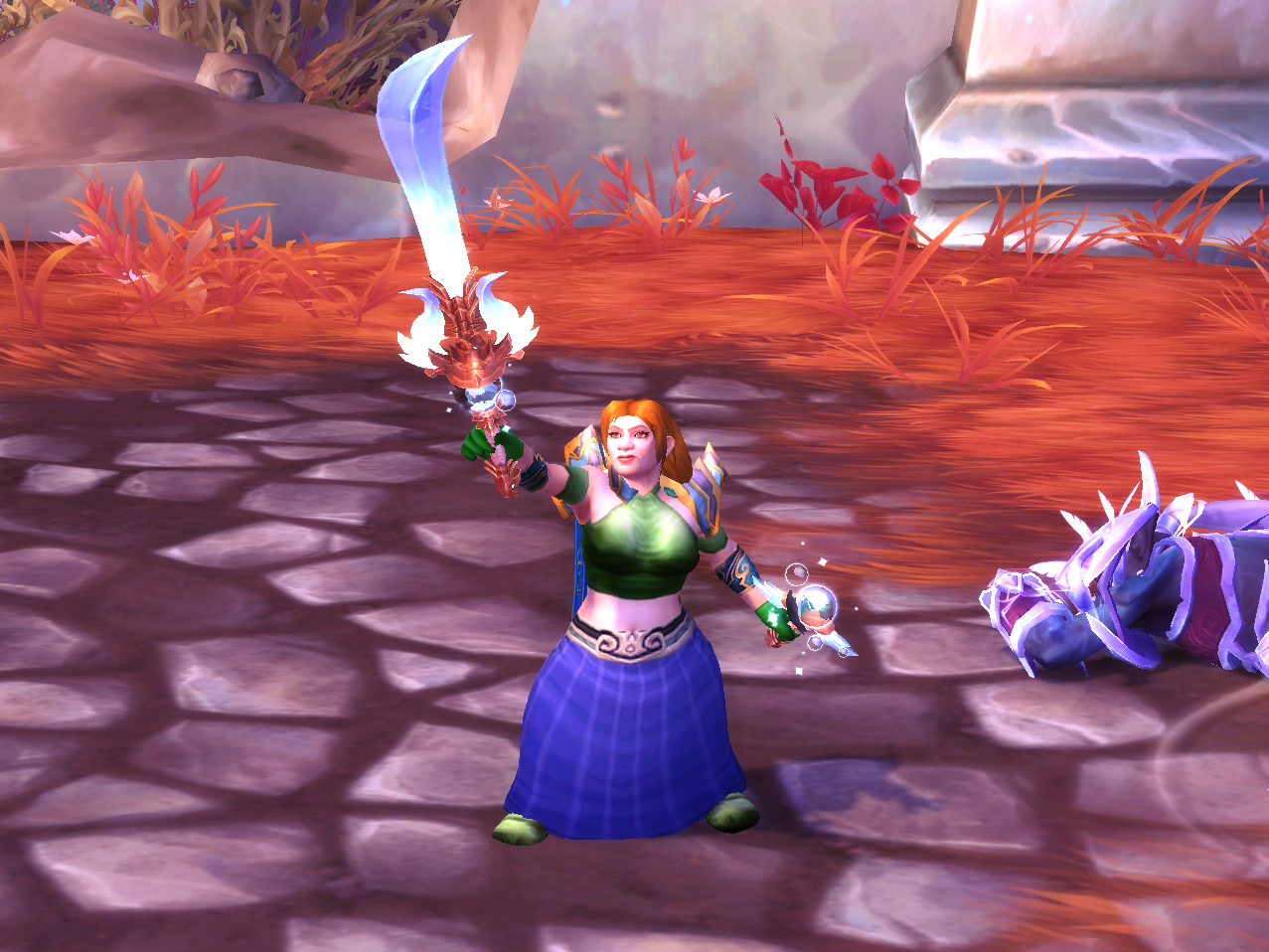
Once you’ve gotten your first hidden appearance, apparently there are additional color variations you can open by running 20 Legion dungeons, doing 200 world quests, or killing 100(?) enemy players. I don’t do pvp, and I’m still dungeoned out (from *cough cough mumble mumble* when we were running them in a row to gear up for raiding). But: I’ve had less much time for playing this year than before, so when I do get a chance I tend to grind hours on end, so perhaps 200 world quests would be doable… 🙂
Image: screenshot from World of Warcraft
This post has been edited for formatting.
Of Dice and Dragons is an occasional feature about games and gaming.
 Co-Geeking
