NYC Subway Library Offers Free Reads This Summer

Subway riders in New York City are in for a treat this summer: e-books, e-shorts, and excerpts from full-length books are available in subway stations for free download.

This six-week Subway Library promotion comes from the cooperation of the New York Public Library, Brooklyn Public Library, and Queens Public Library with the Metropolitan Transit Authority and Transit Wireless.

The e-books and short stories come from the NYPL’s permanent collection, while excerpts have been made available by big-name publishers (including Hachette, HarperCollins, Penguin Random House, Plympton, and Simon & Schuster).

Along with the free reading, there is a social media competition, and a special Library Train will alternate running along the 6th and 8th Avenue lines (E and F trains). The latter has a car decorated to look like the Rose Main Reading Room inside the 42nd Street branch of the NYPL.

Publishers Weekly Subway Library Train Interior

Read more about and browse the free selection at the Subway Library website!

Found via Tor.com and Publishers Weekly.

Image: interior of Subway Library train car by NYPL via Publishers Weekly

Out There is an occasional feature highlighting intriguing art, spaces, places, phenomena, flora, and fauna.

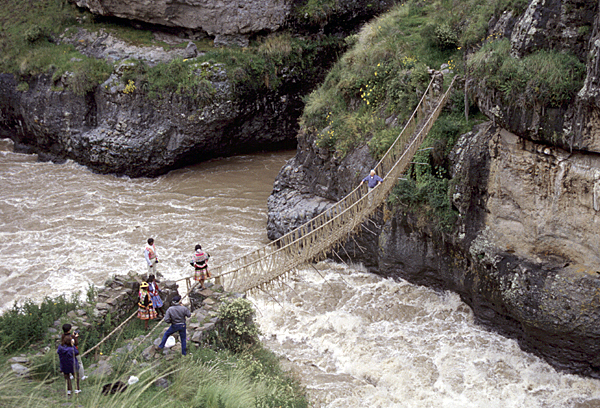
Inca Rope Bridges and the Importance of Landscape

The Inca empire of South America was connected by a network of roads used by chasqui runners and pack llamas carrying messages and supplies around the empire. The Inca, creating their empire in the Andes mountains, faced challenges unlike those of flat-land and river-valley empires, among which was the problem of crossing numerous steep mountain valleys and rivers that ran dangerously swift in the flood season. Their solution to this problem was: rope bridges.

160229QiswaChaka

Suspension rope bridges spanned rivers and valleys, the longest reaching a length of 45 meters. They were made with ropes twisted out of grass and had to be rebuilt every year or two. The rebuilding was dangerous work that was assigned to local villagers as part of their obligation to the empire. Most Inca bridges have long since been replaced with modern structures, but one, the Q’iswa Chaka over the Apurimac River in Peru, is still rebuilt every year by local people as a way of preserving their heritage.

Continue reading →

Travel: Animals

160222reindeerFrom the grand howdah-backed elephant to the plodding pack pony, from the solitary stallion to the caravan of a thousand camels, animals are often a part of how our characters get around. In previous entries to the travel series we’ve considered small and large groups traveling on foot. This time we bring animals into the mix.

Animals can be useful for travel, but they also bring their own challenges with them. The first thing we need to consider is what kinds of animals are useful for long-distance travel. Then we’ll look at the three main ways of using animals for travel: riding, pack, and draft. Finally, a word on the care and feeding of transport animals. As usual in this series, we are looking at real-world history: no griffins or dragon-drawn chariots. Take the information here and adjust as necessary for whatever setting you happen to be writing.

Continue reading →

Ostrich for Breakfast, Ostrich for Lunch, Ostrich for Dinner

Or: Some History behind Ostrich Riding, Part 6 of 7

Background: I ran into two historical images from California with ostriches used as transportation. That got me wondering about the history of ostrich riding. And that lead me down quite a rabbit hole.

I’ve divided my findings into separate posts (find them with the ostrich riding tag). Warning: serious early history and language nerdery ahead in Serious Academic Voice.

TL;DR – Tracing ostrich riding to a 3rd century BCE tomb find (a statue of Arsinoe II) from Egypt doesn’t hold up. The use of various ostrich products in human material culture dates back thousands of years. A few ancient depictions involve humans handling ostriches; however, extant sources don’t tell us whether ostriches were merely hunted or whether they were also tamed in the ancient world. The most promising source seems to be a description of a magnificent parade put together by Arsinoe II’s husband-brother Ptolemy II. This Grand Procession included eight chariots drawn by pairs of ostriches, and the ostriches may have been ridden by boys in costumes.

I had hoped to find a nice, neat selection of ancient texts putting the Greek word for ‘ostrich’ in context, but even a cursory look reveals that the history of the word strouthos is complex. At best, we can say that there are no immediate red flags either in the original Greek or modern English translations for Arsinoe II’s statue or Ptolemy II’s Grand Procession. The poem Berenice’s Lock was said to contain further evidence of ostriches as mounts in Ptolemaic Egypt after Arsinoe II’s death. Instead, what we seem to have is a case of poetic ambiguity translated with poetic license and taken uncritically as evidence.

Some centuries after Arsinoe II and Ptolemy II, ostrich riding may appear in the Roman Empire. Claims in some secondary sources turn out unverifiable, however. Researching primary sources helps but a little: on one hand, many of these texts either have problematic histories or their authorship or accuracy may be questionable; on the other, ostriches tend to appear in context of fighting in gladiatorial games, not being ridden or raced. Surviving visual art only confirms the appearance of ostriches in hunting and arena scenes the Roman territories, not riding or chariot-pulling. A description in the life of Emperor Firmus comes closest, but Historia Augusta, the source of his life, is considered unreliable.

Below is the long story.

Continue reading →

Travel: Some Basics

151116caravanWhether it’s carrying the One Ring to Mount Doom or sailing the Azure Sea, travel is an important part of a lot of fantasy stories and games. For those of us more accustomed to traveling by car, train, bus, and plane than by foot, horse, oxcart, or galleon, this poses a lot of practical problems. How far can your characters travel in a day? How long will it take them to get from point A to point B? And what do they need in order to make the journey successfully?

This is the introduction to a History for Writers series that looks at the evidence of history to help provide practical answers to your questions about travel in the pre-modern world. We’ll look at a few basic issues today. In future installments we’ll examine specific modes of travel, terrains, and problems.

Note that what we’re discussing here is based on real-world history, so it applies only to the extent that your world resembles historical conditions. If your characters travel by foot, horse, and sail, much of the information here will be directly applicable. If they have teleportation and magic carpets, adjust accordingly.

Here are a few basic issues that apply to just about any kind of travel in a pre-industrial world:

Continue reading →

A Lock of Hair Swept off to the Heavens… on an Ostrich?

Or: Some History behind Ostrich Riding, Part 5 of 7

Background: I ran into two historical images from California with ostriches used as transportation. That got me wondering about the history of ostrich riding. And that lead me down quite a rabbit hole.

I’ve divided my findings into separate posts (find them with the ostrich riding tag). Warning: serious early history and language nerdery ahead in Serious Academic Voice.

TL;DR – Tracing ostrich riding to a 3rd century BCE tomb find (a statue of Arsinoe II) from Egypt doesn’t hold up. The use of various ostrich products in human material culture dates back thousands of years. A few ancient depictions involve humans handling ostriches; however, extant sources don’t tell us whether ostriches were merely hunted or whether they were also tamed in the ancient world. The most promising source seems to be a description of a magnificent parade put together by Arsinoe II’s husband-brother Ptolemy II. This Grand Procession included eight chariots drawn by pairs of ostriches, and the ostriches may have been ridden by boys in costumes.

I had hoped to find a nice, neat selection of ancient texts putting the Greek word for ‘ostrich’ in context, but even a cursory look reveals that the history of the word strouthos is complex. At best, we can say that there are no immediate red flags either in the original Greek or modern English translations for Arsinoe II’s statue or Ptolemy II’s Grand Procession. The poem Berenice’s Lock was said to contain further evidence of ostriches as mounts in Ptolemaic Egypt after Arsinoe II’s death. Instead, what we seem to have is a case of poetic ambiguity translated with poetic license and taken uncritically as evidence.

Below is the long story.

Continue reading →
The Curious Case of the Ostrich Statue and Ancient Vocabulary

Or: Some History behind Ostrich Riding, Part 4 of 7

Background: I ran into two historical images from California with ostriches used as transportation. That got me wondering about the history of ostrich riding. And that lead me down quite a rabbit hole.

I’ve divided my findings into separate posts (find them with the ostrich riding tag). Warning: serious early history and language nerdery ahead in Serious Academic Voice.

TL;DR – Tracing ostrich riding to a 3rd century BCE tomb find (a statue of Arsinoe II) from Egypt doesn’t hold up. The use of various ostrich products in human material culture dates back thousands of years. A few ancient depictions involve humans handling ostriches; however, extant sources don’t tell us whether ostriches were merely hunted or whether they were also tamed in the ancient world. The most promising source seems to be a description of a magnificent parade put together by Arsinoe II’s husband-brother Ptolemy II. This Grand Procession included eight chariots drawn by pairs of ostriches, and the ostriches may have been ridden by boys in costumes.

I had hoped to find a nice, neat selection of ancient texts putting the Greek word for ‘ostrich’ in context, but even a cursory look reveals that the history of the word strouthos is complex. At best, we can say that there are no immediate red flags either in the original Greek or modern English translations for Arsinoe II’s statue or Ptolemy II’s Grand Procession.

Below is the long story.

Continue reading →

Add Eight Ostrich Teams and Call It a Procession

Or: Some History behind Ostrich Riding, Part 3 of 7

Background: I ran into two historical images from California with ostriches used as transportation. That got me wondering about the history of ostrich riding. And that lead me down quite a rabbit hole.

I’ve divided my findings into separate posts (find them with the ostrich riding tag). Warning: serious early history and language nerdery ahead in Serious Academic Voice.

TL;DR – Tracing ostrich riding to a 3rd century BCE tomb find (a statue of Arsinoe II) from Egypt doesn’t hold up. The use of various ostrich products in human material culture dates back thousands of years. A few ancient depictions involve humans handling ostriches; however, extant sources don’t tell us whether ostriches were merely hunted or whether they were also tamed in the ancient world. The most promising source seems to be a description of a magnificent parade put together by Arsinoe II’s husband-brother Ptolemy II. This Grand Procession included eight chariots drawn by pairs of ostriches, and the ostriches may have been ridden by boys in costumes.

Below is the long story.

Continue reading →

That’s a Large-Ass Egg, All Right!

Or: Some History behind Ostrich Riding, Part 2 of 7

Background: I ran into two historical images from California with ostriches used as transportation. That got me wondering about the history of ostrich riding. And that lead me down quite a rabbit hole.

I’ve divided my findings into separate posts (find them with the ostrich riding tag). Warning: serious early history and language nerdery ahead in Serious Academic Voice.

TL;DR – Tracing ostrich riding to a 3rd century BCE tomb find (a statue of Arsinoe II) from Egypt doesn’t hold up. The use of various ostrich products in human material culture dates back thousands of years. A few ancient depictions involve humans handling ostriches; however, extant sources don’t tell us whether ostriches were merely hunted or whether they were also tamed in the ancient world.

Below is the long story.

Continue reading →

How Easy It Is to Be Wrong about Early History on the Internet

Or: Some History behind Ostrich Riding, Part 1 of 7

Background: I ran into two historical images from California with ostriches used as transportation. That got me wondering about the history of ostrich riding. And that lead me down quite a rabbit hole.

I’ve divided my findings into separate posts (find them with the ostrich riding tag). Warning: serious early history and language nerdery ahead in Serious Academic Voice.

TL;DR – Tracing ostrich riding to a 3rd century BCE tomb find from Egypt is rubbish, but the concept is, indeed, ancient.

Below is the long story.

Continue reading →