Star Trek: Discovery Theme as Disco!

There’s a brilliant version of Star Trek: Discovery theme—in disco style:

Star Trek Discovery Theme but the theme is DISCO by Craven In Outer Space on YouTube

It really packs a lot into its minute-and-a-half running time. I can’t figure out a single thing that’s extraneous or out of place; everything fits either into disco or Discovery, even the tempo change at the end. Ha! 🙂

Found via Daniël Franke on Mastodon.

Stories in which Being Good is Smart

I’ve been thinking a bit lately about how to describe the kind of stories I want to experience, whether on the page or the screen. I’ve long known that I enjoy stories about characters solving problems. But that’s not the only thing I look for in fiction.

I enjoy reading about people who are good to one another, kind, compassionate, and generous. I don’t enjoy stories in which kindness is portrayed as weakness, or in which the most manipulative, cruel, or ruthless characters prosper at the expense of others. I want to see how being kind and treating others well is the best way to go about solving problems. I like stories in which being a good person isn’t just the right thing to do, it’s the smart thing to do.

I don’t mean stories with a moralistic bent, in which some outside force (be it divinity, fate, or just the author’s guiding hand) intervenes to reward virtue and punish vice. I don’t want to see good people win just because they are good. I want to see them win because complicated problems can’t be solved by one person acting alone, no matter how devious or ruthless they may be. Big problems only get solved by people working together, and the best way to get people working together is to treat them decently.

Here are a few my favorite stories on page and screen that fit what I’m looking for.

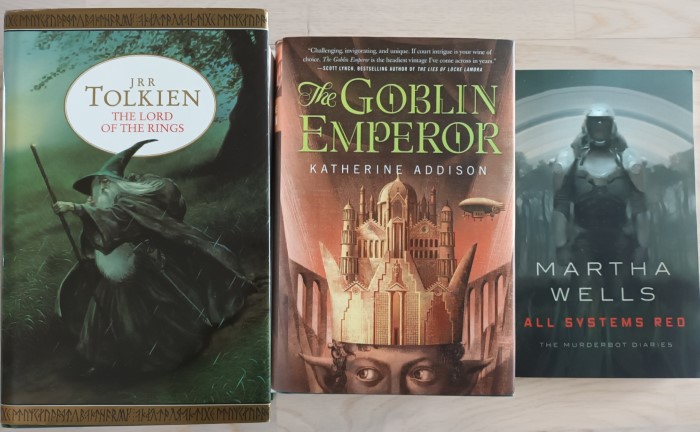
J. R. R. Tolkien’s The Lord of the Rings is a tale of cosmic good and evil, but one that plays out on the individual level. The forces of good ultimately triumph because many individual people, some of them quite small and unimportant, choose the good of others over their own safety or comfort. Katherine Addison’s The Goblin Emperor follows Maia, a neglected half-goblin prince, as he is thrust by circumstance onto the throne of an Elvish empire. Maia is surrounded by devious plotters and dangerous revolutionaries, but he keeps his throne and his head by listening to others, finding trustworthy allies, and being compassionate to the weak and vulnerable. In Martha Wells’s Murderbot Diaries series, the sarcastically self-named Murderbot is a human/machine construct designed by a ruthless ultra-capitalist corporation to fight and kill, but who would rather just be left alone to watch media. Over the course of the stories, it discovers humans who are not ruthless ultra-capitalists, whom it ends up learning to trust and value.

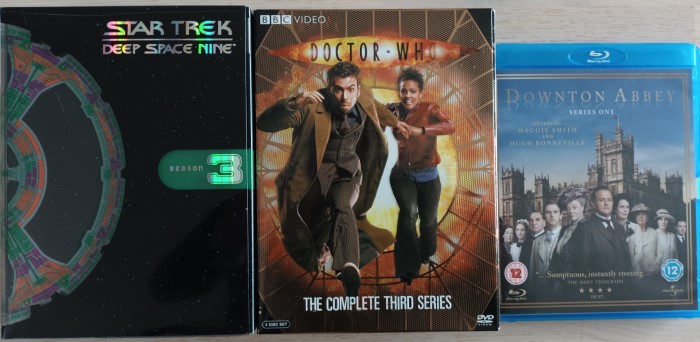
Star Trek is all about characters being good. Deep Space Nine pushes its characters to the limits of the universe’s hopeful utopianism through trauma and war, but ultimately finds them trusting one another, working together, and finding compassion even for their most implacable enemies. In Doctor Who, the wandering Time Lord stumbles into one disaster after another, but approaches them all with a spirit of hope and understanding, asking questions always and shooting never. Downton Abbey follows the inhabitants of the titular manor, both the family upstairs and the staff downstairs, through the tumultuous social changes of the early twentieth century. All the characters have their flaws, and some can be quite vicious, but the series follows how the characters come to rely on one another, and how even the most mercenary of them learn that kindness and compassion are vital for surviving in a changing world.

These are the kinds of stories I want more of: people being good or learning to be good, not just because it’s the right thing to do, but because it works.

Images by Erik Jensen

Acoustic Cha Cha Cha in Klingon

Jen Usellis, who goes by the name The Klingon Pop Warrior jenbom, worked with Michael Lubetsky to translate Finland’s 2023 Eurovision song by Käärijä into Klingon. The results are pretty marvellous. Here’s the video:

Cha Cha Cha (Klingon Version, Acoustic) – Klingon Pop Warrior Eurovision 2023 Cover by The Klingon Pop Warrior jenbom on YouTube

Usellis writes:

“At the beginning of May of 2023, I was completely burned out. Then I watched Eurovision and this awesome Finnish dude with a bowl cut, a lime green bolero, and a name that’s a multi-level pun (Käärijä = wrapper) reminded me why I love performing and gave me some desperately needed inspiration with a song called ‘Cha Cha Cha.’ […]

“We had a fun day in the recording studio and I hope that fans of Käärijä, of which I am one, will catch the small details musically, in the translation effort, and in the accompanying lyric video.

“It’s my sincere hope that Käärijä fans who know nothing about Star Trek or Klingon enjoy this acoustic cover as much as my nerdy Trekkie fans.”

Wow—they got the spirit down pat! I mean, Klingons aren’t my cup of tea, but as far as I can tell, bang on. And how amazing is it that cha means ‘torpedoes’ in Klingon?

Cha cha cha! 🙂

Hey, look! We found a thing on the internet! We thought it was cool, and wanted to share it with you.

A Compelling Mashup of Columbo and Star Trek: TOS

Someone ingenious—who only goes by the moniker cursedtrekedits on Tumblr—photoshopped Lieutenant Columbo (played by the inimitable Peter Falk) into screencaps from Star Trek: The Original Series. Take a look:

Tumblr cursedtrekedits ST-TOS Mashup5
Tumblr cursedtrekedits ST-TOS Mashup4

Very nice, isn’t it! Make sure to visit cursedtrekedits’s Tumblr for more; I’ve only shown two of the photos.

Although I haven’t seen either series in full, this combo seems plausible—with a wink and a little handwaving—and I’d definitely watch it. 🙂

Images by cursedtrekedits Tumblr.

Hey, look! We found a thing on the internet! We thought it was cool, and wanted to share it with you.

A Drink with Star Trek Characters

Red Headed Trekkie posed a question on Twitter:

I thought of a quick, throw-away answer and moved on. For some reason, however, the question didn’t leave me alone, so we’re bringing it back to discuss here.

Eppu: It would depend a lot on my mood and energy levels. Hm. In the end, I think for me it may be easier to weed out some of the more difficult choices first.

Even though she seems fun, not Dax; I don’t have the stamina to keep up with her. As much as I admire Kira’s frankness and relentlessness, a drink with her might be too strained if we don’t hit it off. Janeway seems too active and tireless for me to sit back with.

Erik: Agreed. There are some iconic Star Trek characters and drinks that come to mind right away: Janeway and coffee, Picard and tea (Early Gray, hot), anybody from Deep Space Nine and raktajino. I don’t think any of those would work for me, though. I hate coffee and don’t care for Earl Gray, and whatever is in a raktajino would probably not be good for me.

Eppu: It would be nice to have a cup of tea with Captain Picard, but I’m not sure of how informal the conversation would be. He seems such a consummate commander and politician, and I’d like a tea break to be more personal, relaxing, and homey than I imagine possible with him. Ditto for Worf and prune juice.

Erik: For good company, I might enjoy sharing a glass of whiskey with Dr. McCoy. That man probably has some interesting stories to tell. He could probably also drink me under the table, though, so maybe not. I could have a root beer with Rom, since I love root beer and Rom is a sweetheart, he’d probably be too nervous to enjoy it, and that wouldn’t be a nice thing to do to him.

Eppu: Garak would be an in-te-res-ting drinks partner—never mind your beverage choice!—but I suspect I’d feel too dumb half the time and would question the whole conversation the other half.

Erik: I suppose it isn’t really a fair answer to say a glass of wine with Kai Winn, with iocaine powder in it!

Eppu: In the end, I think it’s a tie between Chakotay and Guinan. Both are curious and considerate, have excellent listening skills but are not withdrawn, and show a combination of both humor and tact, so they seem excellent partners for unwinding with. And since it’s fall, I’d pick a sweet, alcoholic, toffee-flavored cider, preferably a low-alcohol version. (Note to Europeans: In North America, cider refers to freshly-pressed apple juice, which I only learnt after living there.)

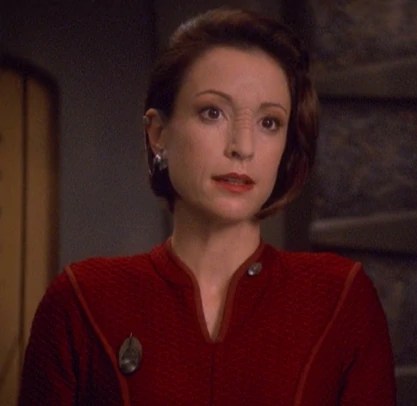
Erik: I like both those options, but I guess I would settle on cocoa with Kira. One of the things I love about the character is that, as tough as she is and as much awful stuff as she’s seen in her life, she still has warmth and an appreciation for simple pleasures. I think she’d enjoy cocoa, and I’d enjoy getting to talk with her about everything and nothing.

Memory Alpha Guinan Chakotay Mashup

What about you? Any clear favorites one way or another? (Bonus points for type of drink!)

Images: Guinan via Memory Alpha. Chakotay via Memory Alpha. Kira via Memory Alpha

Q&A is an occasional feature in which we share our responses to quizzes, questions, and quirky ideas for your entertainment.
The Importance of Being Spock

When I was young, there wasn’t a lot to choose from in children’s media. This was before the internet and back when there were only a few tv channels. What there was was mostly written for the “average kid.” Those of us who weren’t “average kids” (whatever that even means) didn’t have much chance to see ourselves reflected in the things we watched and read.

As a young person who enjoyed reading books, learning things, and thinking, I didn’t have many role models in my media. “Smart” characters tended to be portrayed as weirdos and outsiders. At best they could be inventive but eccentric cranks like Professor Calculus from Tintin. More often they were comically bumbling know-it-alls like Dr. Bunsen Honeydew from the Muppets or Owl from Winnie-the-Pooh. They were often insufferably arrogant about their intelligence, like Brainy Smurf. This was the image of smartness I saw as a young child: smug, generally useless, and barely tolerated by the people around them. (It’s also true that these characters were invariably male, but that’s a separate issue for another time.)

Then I discovered Star Trek. I can’t remember how old I was, but I was still pretty young when my sister and I stumbled across afternoon reruns of original series episodes on one of the local channels. I was hooked. It was my first exposure to adult speculative fiction, and it opened up a whole new world of storytelling to me, but there’s no question that there was one thing about Star Trek I loved above all else: Spock.

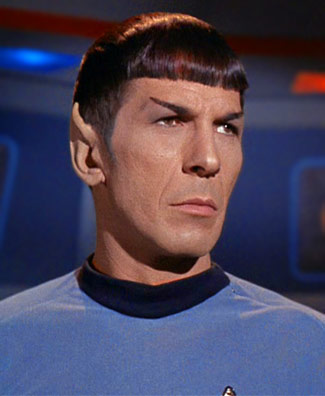
Spock from Star Trek

In some ways, Spock was like the other “smart” characters I had seen before. He was an outsider, an alien on a ship full of humans. He had quirks. He was sometimes razzed on by other characters (especially Dr. McCoy). But despite these things that set him apart, he was emphatically part of the crew, embraced and appreciated by them. His knowledge and intelligence were respected by his fellow spacefarers and often contributed to solving the problem of the episode. Spock was the first time I saw a smart character who was valued for being smart.

Anyone who knew me as a child knows how deeply I identified with Spock. I was Spock for Halloween at least once (and probably more often, though I can’t remember). When teased by my classmates (I wouldn’t say I was bullied, but kids are kids—sometimes people were mean to me, sometimes I was mean to them) I imitated his arch emotionlessness in self-defense. I devoured any kind of Star Trek trivia, but it was always Spock I loved the most.

As I grew older I gathered more role models for people who loved knowing things and whose knowledge was appreciated by those around them, from Sherlock Holmes and Brother Cadfael to Professor McGonagall and Jadzia Dax. But you never forget your first. Spock will always have a special place in my heart because in him I saw the first glimmer of what I wanted to become: someone whose love of books and ideas could become something valuable I could contribute to the world around me. I know I’m not alone in these feelings. I think a lot of the quiet, bookish kids of my generation first saw ourselves in Spock.

We’ve come a long way since then. There’s lots more to choose from for kids’ tv, movies, and books these days. I wonder if that makes a difference, or if there are other touchstone characters for younger generations of thoughtful, curious kids.

What about the rest of you? Who was the fictional character you first looked at and thought: “That’s me?”

In Character is an occasional feature looking at some of our favorite characters from written works and media to see what drives them, what makes them work, and what makes us love them so much.

Rating: Deep Space Nine, Season 7

Star Trek: Deep Space Nine ends on a high note. Here’s our ratings for the seventh and final season:

  1. “Image in the Sand” – 5.5
  2. “Shadows and Symbols” – 5
  3. “Afterimage” – 4.5
  4. “Take Me out to the Holosuite” – 10
  5. “Chrysalis” – 2
  6. “Treachery, Faith, and the Great River” – 6.5
  7. “Once More unto the Breach” – 2
  8. “The Siege of AR-558” – 5
  9. “Covenant” – 1
  10. “It’s Only a Paper Moon” – 8.5
  11. “Prodigal Daughter” – 3.5
  12. “The Emperor’s New Cloak” – 6
  13. “Field of Fire” – 4
  14. “Chimera” – 2
  15. “Bada-Bing Bada-Bang” – 8
  16. “Inter Arma Enim Silent Leges” – 5
  17. “Penumbra” – 4.5
  18. “’Til Death Do Us Part” – 3.5
  19. “Strange Bedfellows” – 7
  20. “The Changing Face of Evil” – 5.5
  21. “When It Rains…” – 5
  22. “Tacking into the Wind” – 6.5
  23. “Extreme Measures” – 6
  24. “The Dogs of War” – 7
  25. “What You Leave Behind” – 7

The final season comes with an average rating of 5.4, a solid way to end and the best season of the whole series. This average comes from a whole lot of episodes the decent-but-not-stellar range of 4-6. This season has only one real standout, but only a couple of clunkers, too. The final ten episodes of the season make up an arc covering the conclusion of the Dominion War, and these mostly hold up well (apart from “Penumbra” (4.5) and “”Til Death Do US Part” (3.5), which are a bit weaker as both mostly serve to set up plotlines for later episodes to pay off).

Nicole de Boer joins the cast this season, playing the next host to the symbiont Dax after Jadzia’s death. As the newest addition, she gets a fair number of episodes focused on her and her struggles to reconcile herself to her new memories without the years of preparation usually given to Trill host candidates. We’re sad to lose Terry Farrell and her swashbuckling smart-ass science officer Jadzia, but Ezri Dax is a worthy addition to the crew.

The weakest episode this season is “Covenant,” in which we discover Gul Dukat leading a cult of Bajoran pah wraith worshipers in an abandoned Cardassian station. Marc Alaimo is as brilliantly slimy as ever in his performance, but he can’t save an episode that feels both predictable and hollow. The pah wraiths had potential as an inscrutable foil to the equally inscrutable prophets, but the writers decided to turn them into standard-issue evil gods and never put much effort into thinking about their relationship to Bajor.

At the other end of the scale, though, we get the wonderfully warm and silly “Take Me out to the Holosuite,” a full 10, in which Sisko goes a bit off the rails trying to beat an old rival who challenged him at his favorite game: baseball. It’s charming to see how the crew rallies around Sisko, even as he gets too caught up in the competition, and utterly heartwarming to see him finally realize how his obsession with winning had blinded him to what made him love the game in the first place. This episode is a refreshing break from the ongoing Dominion War story, and the best realization I’ve seen of the old adage that “It’s not whether you win or lose that matters, but how you play the game.”

A couple of other episodes are worth noting. “It’s Only a Paper Moon,” at 8.5, deals with the consequences of Nog losing his leg a couple of episodes earlier in “The Siege of AR-558.” This episode rests on the performances of Aron Eisenberg as Nog and James Darren as the holographic singer Vic Fontaine. Both pull the episode off with subtlety and depth, and it is a tribute to the series that it trusted such a weighty episode to two side characters. Vic also features in “Bada-Bing Bada-Bang,” (8) a light-hearted holosuite casino caper that gives us a nice breather before the plunge into the final arc.

Thanks for being with us for our Deep Space Nine rewatch. Feel free to share your favorite episodes and memories!

Image: The Niners celebrate a manufactured triumph, from “Take Me out to the Holosuite” via IMDb

In the Seen on Screen occasional feature, we discuss movies and television shows of interest.

Rating: Deep Space Nine, Season 6

The Dominion war heats up, taking the characters of Star Trek: Deep Space Nine in lots of new directions, some more interesting than others. Here’s our take on what season 6 has to offer.

  1. “A Time to Stand” – 6
  2. “Rocks and Shoals” – 7
  3. “Sons and Daughters” – 0
  4. “Behind the Lines” – 3.5
  5. “Favor the Bold” – 5
  6. “Sacrifice of Angels” – 6
  7. “You Are Cordially Invited” – 8.5
  8. “Resurrection” – 2
  9. “Statistical Probabilities” – 4
  10. “The Magnificent Ferengi” – 8.5
  11. “Waltz” – 3
  12. “Who Mourns for Morn?” – 7.5
  13. “Far Beyond the Stars” – 8
  14. “One Little Ship” – 9
  15. “Honor Among Thieves” – 0
  16. “Change of Heart” – 4
  17. “Wrongs Darker than Death or Night” – 0
  18. “Inquisition” – 2
  19. “In the Pale Moonlight” – 7
  20. “His Way” – 1
  21. “The Reckoning” – 4
  22. “Valiant” – 2
  23. “Profit and Lace” – 2
  24. “Time’s Orphan” – 6
  25. “The Sound of Her Voice” – 4
  26. “Tears of the Prophets” – 5.5

This season’s ratings are all over the place. There are a number of strong episodes in the 7-9 range, but also multiple 0s. The average comes to 4.4, in line with season 5 and a bit less than seasons 3 and 4. It seems a bit unfair to average out this season’s episodes, though, because there are so many different things going on. The Dominion war storyline runs through the season and provides a lot of solid episodes. There are also big moments of character development, some good—Worf and Dax getting married in “You are Coridally Invited”, everyone’s favorite barfly getting a backstory in “Who Mourns for Morn?”—some less good—Kira doing a reverse Back to the Future on her mother and Gul Dukat in “Wrongs Darker than Death or Night,” Quark learning what it’s like to be a feeeemale in “Profit and Lace”. Then there are some episodes that just come out of nowhere, like Sisko having a vision of twentieth century science fiction and racism in “Far Beyond the Stars.”

At the bottom end of the scale, we have a trifecta of absolute 0s. There’s “Sons and Daughters,” in which Worf’s son Alexander and Dukat’s daughter Ziyal both get to have strained relationships with their respective fathers. There’s “Honor Among Thieves,” in which O’Brien inexplicably has an undercover mission infiltrating a seedy crime syndicate, an episode with no good reason to exist, let alone be in this series. And there’s the aforementioned “Wrongs Darker than Death or Night,” a limp episode for such a pretentious title that is both overly contrived and weightless at the same time. I’ve mentioned before that it sometimes feels like there was a frustrated noir writer in the writers’ room, and they have their fingerprints on this season as well. “Honor Among Thieves” is straight-up noir, and “Wrongs Darker than Death or Night” leans hard in the same direction. It’s as uninterseting now as it was before.

But this season also has some great episodes at the other end of the scale. The best of the season is “One Little Ship,” at 9, in which a miniaturized Dax, Bashir, and O’Brien in a miniaturized runabout help rescue the Defiant from being captured by the Jem’Hadar. It’s a fun episode that gives all the characters something to do and nicely balances the silliness of its main conceit with the seriousness of the ongoing war plot. Two more episodes that also strike a good balance between goofiness and gravity are “You Are Cordially Invited” and “The Magnificent Ferengi,” both at 8.5. In “You Are Cordially Invited,” the weighty question of whether Worf and Dax can make it as a couple despite their differences is interwoven with Klingon wedding rituals that are as gloriously over the top as you would imagine. “The Magnificent Ferengi” finds Quark, Rom, Nog, and some of our other favorite Ferengi mounting a rescue operation when their Moogie is captured by the Dominion, and it goes both hopelessly wrong and delightfully right.

For all that Deep Space Nine is remembered as the dark, gritty version of Star Trek, filled with tension and war, it has also given us some of the goofiest, most wonderfully weird episodes of the franchise.

Image: Little O’Brien and Little Dax contemplate big problems on the Defiant, from “One Little Ship” via IMDb

In the Seen on Screen occasional feature, we discuss movies and television shows of interest.

Rating: Deep Space Nine, Season 5

It’s a bit of a lackluster fifth season for Deep Space Nine, but that doesn’t mean there aren’t bright spots. Here’s our take:

  1. “Apocalypse Rising” – 4
  2. “The Ship” – 5.5
  3. “Looking for Par’Mach in All the Wrong Places” – 7
  4. “Nor the Battle to the Strong” – 5
  5. “The Assignment” – 2.5
  6. “Trials and Tribble-ations” – 9
  7. “Let He Who Is Without Sin” – 1
  8. “Things Past” – 1.5
  9. “The Ascent” – 7.5
  10. “Rapture” – 5.5
  11. “The Darkness and the Light” – 1
  12. “The Begotten” – 4
  13. “For the Uniform” – 3.5
  14. “In Purgatory’s Shadow” – 4.5
  15. “By Inferno’s Light” – 5.5
  16. “Doctor Bashir, I Presume” – 6
  17. “A Simple Investigation” – 2
  18. “Business as Usual” – 1.5
  19. “Ties of Blood and Water” – 2
  20. “Ferengi Love Songs” – 5
  21. “Soldiers of the Empire” – 6
  22. “Children of Time” – 4.5
  23. “Blaze of Glory” – 3.5
  24. “Empok Nor” – 1
  25. “In the Cards” – 8
  26. “Call to Arms” – 8.5

The average rating for the season is 4.4, not terrible but a bit weak. There are some good episodes this season, even some great ones, but there’s also a lot of crud at the other end of the scale dragging the average down.

The worst episode of the season is a rare three-way tie between “Let He Who Is Without Sin,” a character study of a grumpy Klingon; “The Darkness and the Light,” an overblown bit of noir that kills off some of Kira’s more entertaining old resistance buddies; and “Empok Nor,” another bit of noir which forces the usually sparkling Andrew Robinson to play a duller, flatter version of Garak. All of these rate a 1 for having tedious plots (if any at all) and wringing the joy and life out of the performances. In fact, a pall of noir hangs over a lot of the lowest-rating episodes this season, suffused with angst, tension, and cynicism. “The Assignment” (2.5), “Things Past” (1.5), “A Simple Investigation” (2), and “Business as Usual” (1.5) all feel like the writers’ room was full of frustrated 40s detective pulp scribes.

On the other hand, there are some brilliant episodes this season, too. The best of the lot is “Trials and Tribble-ations,” coming in at 9 with a joyful celebration of both the spirit and the silliness of classic Star Trek. The loving recreation of the classic sets, costumes, and props, plus the ingenious ways our DS9 crew get to have their own adventure in the background of one of the great comedy episodes of the original, make this episode a delight to rewatch. The same spirit of fun animates “In the Cards” (8) and “Looking for Par’Mach in All the Wrong Places” (7), two episodes that part the gloom of war and politics for a moment to let the relationships between the characters flourish. And the season ender, “Call to Arms” (8.5) is a gripping action piece that throws all of our characters into unexpected situations for the start of the next season.

There may be a lot to skip this season, but there are definitely some episodes that are well worth going back to.

Image: Sisko and Dax blending in on the original Enterprise, from “Trials and Tribble-ations” via IMDb

In the Seen on Screen occasional feature, we discuss movies and television shows of interest.

Rating: Deep Space Nine, Season 4

Season 4 of Star Trek: Deep Space Nine has some great episodes and some fairly bad misfires. The Klingons, having been quiet for years, are suddenly feeling aggressive again, and our favorite Klingon, Worf, joins the station crew to help them deal with the consequences. This story fuels a good part of the season, but there’s plenty more to see, too. Here’s our take:

  1. “The Way of the Warrior” – 7
  2. “The Visitor” – 9
  3. “Hippocratic Oath” – 5.5
  4. “Indiscretion” – 5.5
  5. “Rejoined” – 8
  6. “Starship Down” – 8
  7. “Little Green Men” – 8
  8. “The Sword of Kahless” – 1.5
  9. “Our Man Bashir” – 10
  10. “Homefront” – 3
  11. “Paradise Lost” – 5
  12. “Crossfire” – 2
  13. “Return to Grace” – 4
  14. “Sons of Mogh” – 1
  15. “Bar Association” – 7
  16. “Accession” – 2
  17. “Rules of Engagement” – 2
  18. “Hard Time” – 2
  19. “Shattered Mirror” – 3.5
  20. “The Muse” – 2
  21. “For the Cause” – 4
  22. “To the Death” – 6
  23. “The Quickening” – 4.5
  24. “Body Parts” – 6
  25. “Broken Link” – 4

The average rating this season is 4.9, the same as in season 3, but season 4 gets there a different way. Where season 3’s episodes were mostly in the weak-average to average-good range, season 4 sends its episodes to the far ends of the scale. Only a handful fall in the 4-6 okay-but-not-great range; most are either well above or well below.

The distribution of ratings shows a certain level of confidence by the writers this season. You can tell that they felt comfortable enough with the characters and the setting at this point that they were ready to try new ideas, even really weird ones. What if we spent an episode in the holosuite playing a James Bond pastiche? What if we met a suicidal Klingon? What if Quark, Rom, and Nog were the Roswell aliens? What if there were a conspiracy to stage a military coup on Earth?

Some of these ideas really flop, like “Sons of Mogh,” scoring only a 1, in which Worf has to deal with his brother Kurn, who is depressed about the loss of status their family has suffered in the empire. The story presents the kind of ethical dilemma Star Trek specializes in—suicide is an honorable end for a Klingon with no hope, but it is unacceptable for a Starfleet officer like Worf—but never goes anywhere interesting with it. The episode boils down to Kurn standing on one side of Worf shouting “Kill me!” and the rest of the station crew on the other shouting “Don’t!” There’s nowhere interesting for this story to go.

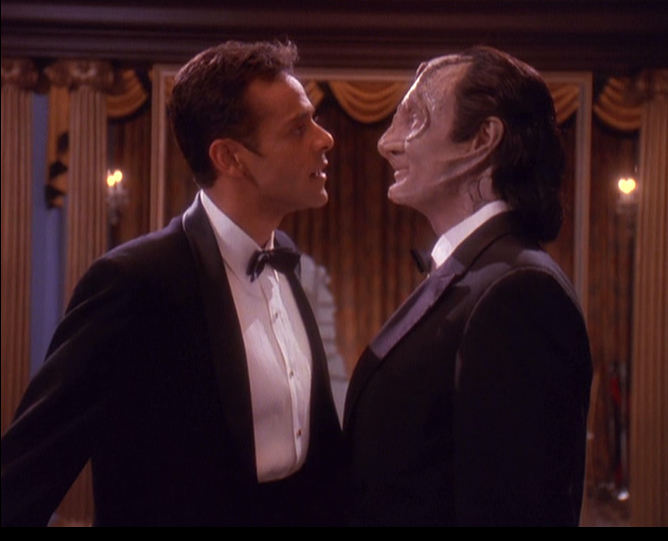
On the other hand, some of these ideas pay off brilliantly, like “Our Man Bashir,” a full 10, which finds Dr. Bashir and Garak playing a swinging-sixties spy game in the holosuite for much higher stakes than they expected. DS9 largely avoids the Next Generation shtick of having the holodeck go haywire so the crew can have an adventure in period garb, but this episode figures out a way to make the holosuite matter: after a transporter accident, the main station crew’s physical patterns are stored on the holosuite until they can be rescued, but if the game shuts down they could be lost forever. This set-up gives us several delightful results: Bashir, the doctor playing spy, and Garak, the spy playing tailor, take their witty repartee to new heights in this episode, while some of the other regular cast get to go full ham in their holosutie roles—Nana Visitor as a sultry Russian agent and Avery Brooks as an omnicidal mad scientist steal every scene they’re in.

The rest of this season largely follows suit. Some ideas, like sending Worf and Dax on a quest for a lost Klingon artifact in “The Sword of Kahless”, just sputter and die. Others yield fantastic episodes, like “Little Green Men,” a hilarious romp through pulp sci-fi tropes, or “The Visitor,” a touching meditation on the power of love and memory.

While the Klingon war story at times just feels like a holding action while waiting for the Dominion to make its move, it also gives the series some new avenues to explore. This season does a lot of interesting work by overturning the status quo and seeing what happens to familiar characters in unfamiliar situations. Worf, Quark, Odo, and Dukat all find themselves cut off from their people in different ways; Sisko faces the possibility of treason within Starfleet; Dax has to grapple with the legacy of her past lives in ways she has not faced before; and Rom and Nog start new lives outside the traditional bounds of Ferengi culture.

Season 4 has a lot going for it, even if not every idea works. There’s a lot here that’s well worth coming back to.

Image: Bashir and Garak all tuxed up from “Our Man Bashir” via IMDb

In the Seen on Screen occasional feature, we discuss movies and television shows of interest.