Hoplites, the Chigi Vase, and the Problems of Artistic Sources

Art can be a priceless source of evidence for early history, especially for areas and periods with limited surviving written sources, but, just like texts, artistic sources can be tricky to interpret.

Chigi Vase, reconstructed frieze via Wikimedia (7th c. BCE; painted pottery)

Take, for example, this scene from an archaic Greek vase (commonly known as the Chigi Vase, named for one of its modern owners). It provides us with some of our earliest evidence for Greek hoplites and the phalanx formation. Although we understand a lot about the essentials of how hoplite warfare worked, many questions remain unanswered about the precise details of both how a hoplite battle was fought and how the hoplite style of warfare developed over time. Arguments about these topics often depend in part on interpretations of the Chigi vase.

The vase depicts warriors arming themselves and marching into battle as hoplites. Many of the characteristic features of hoplite armament and warfare are on display: heavily armored fighters with large round shields and spears confronting one another in a head-on clash. We can date the creation of this vase to the seventh century BCE, around the same time that the hoplite style of warfare first appeared, so this artwork offers us crucial evidence about what the earliest phase of hoplite warfare looked like and how early some of its defining features emerged.

We can be fairly confident that the artist who painted the decorations on this vase was familiar with the realities of hoplite warfare. The ranks of the phalanx were filled by small farmers and prosperous crafters, including potters and artists. If the painter of this vase was not well-off enough to have fought as a hoplite themselves, they would certainly have known people who had. At the same time, the images are also artistically stylized in ways that make it hard to be sure how much we can rely on them as evidence.

For example, all the warriors shown on this vase are similarly equipped: they have the helmets, breastplates, greaves, and round shields that we think of as the standard parts of the hoplite panoply. Is this vase evidence that hoplite equipment was standardized from an early period, or did the artist depict a standard set of armor to create a pleasing image at a time when real hoplite gear was more of a hodge-podge with individuals equipping themselves as best they could? This question goes to more than matters of artistic taste: one of the most vexed questions in the history of the hoplite phalanx is whether it developed gradually out of older, less rigorously organized styles of warfare or it was created as a fully-realized concept in some particular place and time. Because hoplite warfare was connected with the rise and subsequent fall of early Greek tyrants, understanding the origins of the hoplite phalanx better would have implications for our understanding of major developments in political and social history. Knowing what the Chigi vase painter had in mind would tell us some important things about the early history of ancient Greece.

Out There is an occasional feature highlighting intriguing art, spaces, places, phenomena, flora, and fauna.

Quotes: Infohistory Is a Mess

Elizabeth Bear’s scifi novel Machine has a succinct sum-up of just some of the problems concerning information retrieval:

“Wait,” I said. “How can information decay?”

“They used to call it bit rot. Servers get taken down, data falls through the cracks and doesn’t get backed up. Physical substrates are destroyed or damaged, or degrade over time—especially the primitive ones. A holographic diamond is very durable but can’t be changed once it’s written to, and magnetic media only lasted a decan or so under ideal conditions.

“And even if the data is preserved somewhere, that somewhere might not be networked. If it’s networked, it might not be indexed. Even if it’s indexed, it might be half the galaxy away and take two or three ans for the file request to get there, be fulfilled, turn around, and come back. And then you might find out that you needed different files entirely.” He huffed with great satisfaction. “Infohistory is a mess.”

– from a discussion between Dr. Brookllyn Jens and the medical librarian AI Mercy in Machine by Elizabeth Bear [original emphasis]

Despite this being from a fictional work, it rings very true. My librarian heart was delighted to read an account that acknowledges not just the physical difficulties of dealing with old media—whatever shape that media might take, from cuneiform to CDs—but also the search-related problems. Metadata, or in case of libraries, the information about the items in the collection, doesn’t feature in stories very often. Also, it is why good reasearch librarians and archivists are worth their weight in gold.

Bear, Elizabeth. Machine. London: Saga Press, 2020, p. 203.

Serving exactly what it sounds like, the Quotes feature excerpts other people’s thoughts.

A Preview of The Greco-Persian Wars

I am pleased to announce that my second book, The Greco-Persian Wars: A Short History with Documents, is coming out in just a few days. This book tells the story of the wars between Greeks and the Persian Empire in the early fifth century BCE through translations of ancient documents.

While the wars of the early fifth century in Greece dominate modern histories of Greco-Persian interaction, they were only part of a larger history in which the main actors were not Greeks but Persians, and whose events played out not simply in Greece but across the eastern Mediterranean. Looking at a broader history allows us to put the Greco-Persian Wars into a more meaningful context. The story of Persia’s engagement in Greece is not one of East-West cultural clashes or Greek ascendancy, but of Persia’s success in adapting to the challenges of an unstable, frequently violent frontier region, and that is the history my book explores.

This book features over eighty-five separate selections translated from Greek, Old Persian, Elamite, Akkadian, Hebrew, Aramaic, Egyptian, and Lycian, each with contextual notes. They are accompanied by a short historical introduction, a glossary, a chronology, maps, and a select bibliography.

Here is a selection from one of the documents. In this text, set some hundred years after the famous battles of Marathon, Thermopylae, Salamis, and Plataea, we see how complicated relations between Greeks and Persians remained. This text is a useful reminder that we have to think not of relations between Greece and Persia but between Greeks and Persians. On both sides, individuals had their own motivations and interests that could lead to unexpected alliances and tricky rivalries.

* * *

Friendship and its complications

Xenophon, Hellenica 4.1.31-39

Relationships of xenia, or guest-friendship were a traditional way in which Greek aristocrats formed personal relationships across the boundaries of the polis. Similar relationships were also extended to Persians who dealt with the Greek frontier. While these relationships could be channels for diplomacy and political negotiation, they could also create conflicting loyalties. The exchange between the Spartan king Agesilaus—at that time ravaging the Persian-held territories in Ionia—and the satrap Pharnabazus in 395 or 394 BCE shows both the potentials of xenia and its dangers.

First they greeted each other and Pharnabazus held out his right hand. Agesilaus clasped it. Then Pharnabazus spoke first, since he was the elder.

“Aegsilaus, and you other Spartans here,” he said, “I became your friend and ally when you were fighting the Athenians. Not only did I support your fleet with money, but I myself fought alongside you on horseback and we drove your enemies into the sea together. You cannot accuse me of ever having played you false, like Tissaphernes. Yet despite this, you have now left my land in such a state that I cannot even feed myself, unless I gather up the scraps you leave behind like an animal. All the beautiful houses and woods full of trees and beasts that my father left me, which I used to enjoy so much, I now see either cut down or burned up. Well, if I don’t know what is righteous and just, you tell me how these are the acts of men who know how to repay favors.”

The thirty Spartans were ashamed and said nothing, but then after a time Agesilaus spoke up.

“Pharanbazus,” he said, “I think you understand that in the Greek cities, people also become guest-friends to one another. But when their cities go to war, such people fight on behalf of their homelands against their friends, and even kill them, if it should so happen. In the same way, since we are now at war with your king, we are compelled to treat everything of his as enemy territory. However, we would think it the best thing in the world to become your friends. Now, if it were a matter of throwing off the king to be ruled by us instead, I certainly would not advise it, but if you side with us now you will have the chance to flourish without having any master or humbling yourself to anyone. I think freedom is, after all, worth any amount of money. Even so, we are not urging that you should be free and poor. Rather, by taking us as your allies, you will increase your own power, not the king’s, and by subduing those who are now your fellow slaves you will make them your own subjects. You will become both free and rich—what else could you need to have perfect happiness?”

“In that case,” said Pharnabazus, “shall I tell you plainly what I will do?”

“That would be a good idea,” said Agesilaus.

“Well then,” he said, “if the king sends another general here and makes me subordinate to him, I will gladly become your friend and ally. On the other hand, if he gives the command to me, ambition is such a powerful force that I will fight you to the best of my ability.”

When he heard these words, Agesilaus grasped Pharnabazus’ hand and said:

“My dear friend, I hope you will be our ally! But know this: I will leave your territory now as quickly as I can, and in the future, even if the war continues, we will leave you and your land alone as long as we have other foes to fight.”

That was the end of the meeting, and Pharnabazus mounted up and rode away, but his son Parapita, a fine young man, stayed behind. He ran up to Agesilaus and said:

“Agesilaus, I make you my guest-friend.”

“For my part, I accept,” Agesilaus replied.

“Remember it,” said Parapita. He at once gave the beautiful javelin he was carrying to Agesilaus. In return, Agesilaus took a splendid decoration from the horse his secretary Idaeus was riding and gave it to Parapita. Then the young man leapt upon his horse and followed after his father.

* * *

If you’ve found some of my previous posts about Persians, life in the Persian Empire, and the complicated relationships between Persians and Greeks interesting, you may enjoy The Greco-Persian Wars.

The Greco-Persian Wars: A Short History with Documents comes out February 24th from Hackett Publishing.

Hardcover: $49 / Paperback: $18 / e-book versions available

You can pre-order directly from Hackett or on Amazon or Barnes and Noble, or from your local bookseller.

Image: Greco-Persian Wars paperback cover by Hackett Publishing

Announcements from your hosts.


An Ancient Minoan Saffron Gatherer

Here’s a beautiful ancient Minoan fresco of a woman gathering saffron on a rocky hillside.

Saffron is a spice derived from the crocus flower, and since each flower produces only a tiny amount of the spice, gathering it on any scale is a labor-intensive process. With her large earrings and the many colorful, decorated layers of her clothing, this lady seems a little overdressed for such hard work. There may be various explanations. Perhaps this fresco represents a ceremonial harvest, not unlike the use of a golden shovel to dig the first scoop of dirt on a building project, or possibly a small harvest for religious use. It might also be simply an artistic depiction suitable for an elite home and not intended to represent the actual attire of an agrarian worker.

Whatever the case, it’s a beautiful work of art.

Image: Detail of saffron-gathering fresco, photograph by Yann Forget via Wikimedia (Akrotiri; c. 1700 BCE; fresco)

Out There is an occasional feature highlighting intriguing art, spaces, places, phenomena, flora, and fauna.

Two-Question Worldbuilding

There are lots of different ways to imagine new secondary worlds and the cultures within them. You can start from the ground up—literally—by drawing a map and thinking about how the landscape shapes the cultures within it. You can start with a big concept and work your way down into the details from that, or go the other way and start with a single detail that serves your narrative, then build the rest of the world around it.

But sometimes you don’t want to mess with all that. Sometimes you’re writing a story or mapping out a game and you need your characters to have a little bit of interaction with a far-off foreign land, but not enough to make it worth developing in every detail.

Here are two quick questions you can ask to lay the basis for simple worldbuilding for side cultures in pre-industrial worlds that still gives them some substance:

  • How many people have control over their own source of food?
  • How much do those people have to compete with others for food sources?

We’re not talking actual numbers or anything quantifiable here, just a general sense: a little bit, a fair amount, or a lot?

(Food sources come in many forms. We most often think of farms and herds of animals, but consider also fishing and hunting, trading with food-producing regions abroad, or raiding richer neighbors.)

The first question tells you about social structure: food is crucial to life, so access to it is one of the most powerful ways people can assert control over others or claim their own independence.

Where only a few people control the available food sources and most other people are in some way dependent on them, there is strong social stratification. It could take many forms: tenant farming, slave plantations, highly-regulated trade markets, or organized piracy of trade routes. Whatever the case, the society will have a small elite marked out by their wealth, way of life, or social privileges.

When most people control their own food sources, you have a much less stratified society. It could be small farms, independent merchant families, or bands of friends who hunt and fish together. The society need not be perfectly egalitarian—some farmers or trading partnerships may be wealthier than others—but when most people are self-sufficient, the rich have less leverage to get the poor to go along with any claims they make to special privileges. Societies where people aren’t dependent on others for survival can also have trouble organizing any kind of large-scale collective action, whether it’s setting up an organized legal system or sending an army on campaign.

In between, you get a range of possibilities: some people manage by fishing and keeping market gardens, others labor on the estates of the rich, while bands of young warriors form up now and then when things get tough to go plunder richer lands, then come home and return to their homesteads. In a society where people live at many different levels of subsistence, social stratification can be complicated, but also fluid. A tenant farmer may be able to save enough over time to buy a plot of their own and join the ranks of independent farmers, while an aristocrat who suffers a run of bad harvests may have to sell their tenanted estates and buy a smaller patch they can farm themselves, but that doesn’t make them social equals.

The second question goes to internal conflict: the more people who have to compete over resources, the more turmoil you are likely to see within a society.

When there is little competition over resources—either because they are abundant enough for everyone or because those who control them have a grip too tight to be challenged—societies are likely to be stable. Some may be inward-looking and peaceful, others may simply export their conflicts abroad: a state full of rich farmers might support a large army to invade and colonize other lands, or a society with no resources available at home might drive the poor and desperate to raid their neighbors or move away as laborers or mercenaries.

By contrast, in a culture where there’s not enough to go around or where those who have resources can’t effectively defend them, expect a high level of internal conflict. This conflict might take violent forms, from ongoing petty raiding between neighbors to civil wars, or it might be channeled into cutthroat negotiations between rival trading houses or a frantic scramble for royal patronage among the highborn families.

In between the extremes, at a moderate level of competition, you are likely to see a society that goes through cycles of stability and fractiousness, where the winners know that they can’t hold onto their gains forever, but the losers can afford to lick their wounds, build new alliances, and hope to come out on top next time.

Below is a rough chart of what a society with a particular combination of resource distribution and competition may look like. Remember that these are patterns and tendencies, not absolute rules. Our own world’s history will furnish plenty of examples of societies that don’t fit these patterns, and you can certainly imagine worlds that don’t. But if you find yourself in need of some quick-and-dirty worldbuilding, this is a good place to start.

Chart by Erik Jensen

History for Writers looks at how history can be a fiction writer’s most useful tool. From worldbuilding to dialogue, history helps you write.

A Busy Paeonian Woman

The Greek historian Herodotus tells a story about how the Persians were induced to conquer the Paeonians, a people of the southern Balkans. Like many of Herodotus’ stories, this one is probably more folklore than fact, but it’s a story with a point.

The story takes place while the Persian king Darius was campaigning in the Aegean from his base in the Lydian city of Sardis. A couple of ambitious Paeonian aristocrats figured that if they could convince Darius to conquer Paeonia, they could set themselves up as his local representatives and rule the Paeonians in his name. Here’s how they went about piquing Darius’ interest:

After Darius had crossed over to Asia, two Paeonians by the names of Pigres and Mantyes came to Sardis along with their tall and beautiful sister. They wanted to make themselves tyrants over the Paeonians, and when they had observed Darius sitting outside the town of the Lydians to hold his court, they went about it like this: they dressed their sister up in her best and sent her to fetch water carrying a pitcher on her head while leading a horse by her shoulder and spinning flax. Went she went by, the sight of her caught Darius’ interest, since no Persian or Lydian woman did what she did, indeed no woman of Asia at all did. He was so intrigued that he sent some of his guards to keep an eye on the woman and see what she did with the horse. They reported what they had seen: when she reached the river, she watered the horse, filled the pitcher up to the top with water, and went back again by the same route, carrying the water on her head, leading the horse by her shoulder, and turning her spindle.

– Herodotus, Histories 5.12

(My own translation)

Darius falls for the trick and is convinced that such amazingly hardworking people should be added to his empire.

There are some things to notice about this story. One is some rather complicated gender politics. On one hand, you could hardly find a more literal example of men exploiting the hard work of women for their own gain. On the other hand, it’s interesting that the Paeonian brothers thought that the best way to impress the Persian king was not with the bravery or endurance of Paeonian men but with the diligence and skill of Paeonian women. The fact that it worked implies that Darius both appreciated how difficult a task it was to do three things at once—fetch water, manage a horse, and spin flax—and saw such skill as a good addition to his empire. Herodotus’ story is likely fictional, but it may suggest some Greek awareness of how highly women’s labor was valued in Persia.

To look at it from a different point of view, however, we have to remember that the whole thing was a con, and Darius was the dupe who fell for it. Ordinary Paeonian women weren’t going around carrying jugs, watering horses, and spinning all at the same time while looking their best, and Darius was a fool for thinking they did. That’s something for all of us to remember in these days of social media and the fetishization of busy-ness. We are all like Darius, seated outside the city walls watching carefully curated false images of people doing impossible amounts of work and looking fabulous doing it. And, just like Darius, we’ll all be better off it we recognize it for the lie that it is.

History for Writers looks at how history can be a fiction writer’s most useful tool. From worldbuilding to dialogue, history helps you write.

Cephalopodic Human Figures Drawn by Bored Children in 13th-Century Novgorod

Erik Kwakkel, Professor of Book History & Director, School of Information, UBC, Vancouver, Canada, shares all sorts of interesting tidbits online. Among the older ones—posted over seven years ago now and dating from the Middle Ages—are some wonderful children’s drawings made on birch bark.

This piece of bark is from among a large find made near the city of Novgorod, Russia, from the 13th century.

Tumblr Erik Kwakkel C13th Novgorod Birch Bark Drawing

Isn’t it interesting? Look at the eyebrows and the noses! And the torsos! Incredibly cephalopodic, in a charming way. And the hands look like rakes. The figures are clearly identifiable as humans, but the customary ways of drawing some of the details seems to have changed over the centuries quite a bit.

Check out Kwakkel’s Tumblr or Twitter for more book history particulars.

Image via Erik Kwakkel on Tumblr

Out There is an occasional feature highlighting intriguing art, spaces, places, phenomena, flora, and fauna.

Matrilineality

Most traditional societies around the world have been patrilineal: power and property are passed down the male line of succession, usually from father to son, sometimes from grandfather to grandson, only on rare occasions to other relatives such as nephews, brothers, or cousins who share a common male ancestor. Some societies, however, have been matrilineal, where lines of succession are defined by descent from a common female ancestor. In these societies, power and property typically pass from brother to brother or uncle to nephew, only rarely from father to son.

Matrilineality should not be mistaken for matriarchy. Matrilineal cultures are often just as patriarchal as patrilineal ones are. Matrilineality is not a matter of women having power or being more important in society than men; it’s just a different way of determining which man is important and powerful.

Matrilineal succession can seem confusing and hard to follow for those of us who are used to the rules of patrilineality, but the principle is straightforward: to identify the next in line, find the nearest male relative who can trace their descent through their mothers, grandmothers, great-grandmothers, etc. to a common female ancestor with the current holder of the property or position in question. The nearest would be a brother by the same mother. Next nearest would be a nephew whose mother was the current person’s sister by the same mother.

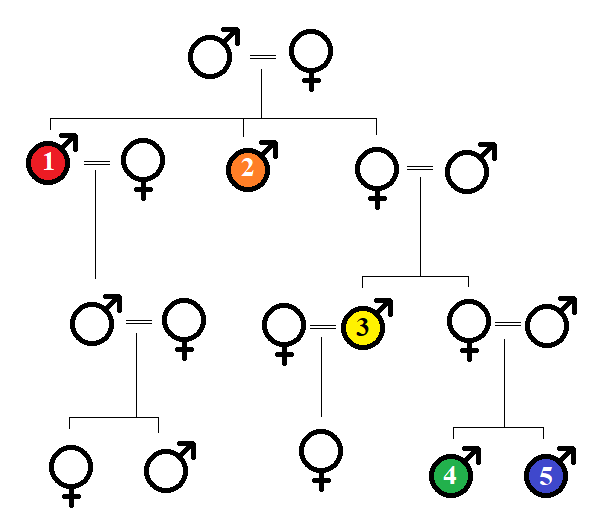
Here’s an example. Consider this extended family.

In a patrilineal society, here’s how property and power would pass down from the eldest son of the original couple to his son and grandson.

In a matrilineal society, the line of succession from the same eldest son would go first to his brother, then to a nephew, then another nephew, then his brother.

Matrilineal succession has advantages for certain kinds of societies under certain circumstances. For one thing, it spreads power and property out among the family lines of a clan or extended kin group, rather than letting one line have a monopoly. It can also create incentives for skilled and ambitious men to marry into the family—if we image the example above tracing the lines of succession for a kingdom, the men who marry into the family will never be king themselves, but their sons and grandsons might be. Another advantage to matrilineality is it multiplies the number of legitimate heirs within any given generation, which can be helpful in times of crisis when a man might die leaving no sons of age to take over his position.

For these reasons, matrilineal patterns of succession often appear in societies that need to encourage cohesion and cooperation among different families in the face of a dangerous world.

Thoughts for writers

Lots of good stories involve questions of succession, whether its the return of a lost heir to claim their rightful inheritance, a struggle for power among rival families, or the mysterious death of a rich old miser. If you’re in the mood to write that kind of story, it’s worth thinking about the rules of succession in your world and what consequences they might have for your characters. Even if a matrilineal society isn’t in the cards, it’s good to remember that not everything has to go from father to eldest son.

Charts by Erik Jensen

History for Writers looks at how history can be a fiction writer’s most useful tool. From worldbuilding to dialogue, history helps you write.

History for Writers Compendium: 2020

History for Writers explores history to offer ideas and observations of interest to those of us who are in the business of inventing new worlds, cultures, and histories of our own. Here’s what we’ve been talking about in 2020:

Thinking historically

Thinking mythically

Imagining other places

Living other lives

Writing other worlds

People in the past

Join us in 2021 for more history from a SFF writer’s perspective.

History for Writers is a weekly feature which looks at how history can be a fiction writer’s most useful tool. From worldbuilding to dialogue, history helps you write.

Good Health with Telesphorus

With Covid-19 still largely unchecked and the winter flu season closing in on us (in the northern part of the world at least), health and illness are on a lot of our minds. So here’s a votive statuette of an ancient Greek god of health, Telesphorus.

Telesphorus represents an interesting combination of influences from several different cultures. Mythology describes him as a son of the Greek healing god Asclepius specifically concerned with recovery from disease or injury. In art he was often shown as a short, squat man similar to some earth-related deities from Phrygia in inland Anatolia wearing a type of hooded cloak typically associated with Gauls. This version, found in France and carved at some time when the Roman Empire ruled the region, has heavily outlined eyes, a triangular nose, and straight bands of hair, all of which are characteristic of Gaulish and British art. Somehow, this seems an appropriate image for a season in which we face a worldwide pandemic.

We wish you all good health in the times ahead.

Image: Telesphorus statuette, photograph by Millevahce via Wikimedia (found Moulézan, currently Musée Archéologique de Nîmes; Roman period; limestone)

Out There is an occasional feature highlighting intriguing art, spaces, places, phenomena, flora, and fauna.