Video of 14th-Century Techniques of Bridge Building

Here is an interesting animation of how the Charles Bridge in Prague, Czech Republic, was built with 14th century techniques:

Karlův most – Stavba pilíře a klenebního pole ve 14. století by praha-archeologicka.cz on YouTube

3D graphics and postproduction is by Tomáš Musílek, with assists from Ondřej Šefců and Zdeněk Mazač. More information about Charles Bridge can be found at the portal Prague – the City of Archaeology. (Note: most of the site’s content and functionality seems to be in Polish, or link from the English summary to the equivalent full page in Polish.)

I love it how we’re now able to not just model but animate many old or even ancient building projects. It really reveals how far we’ve come and the skills and persistence we have as a species.

Found via File 770.

Out There is an occasional feature highlighting intriguing art, spaces, places, phenomena, flora, and fauna.
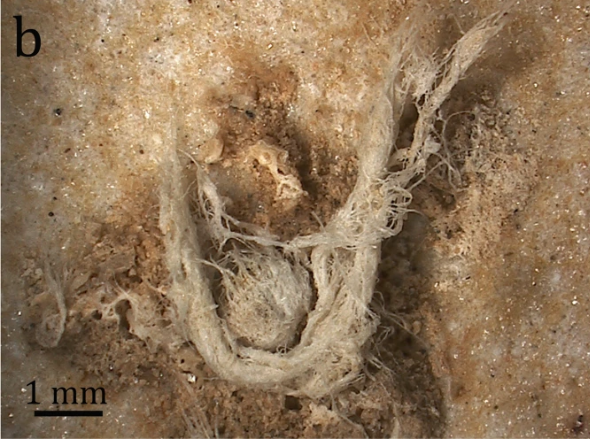
New Find: Neanderthals Worked with Fibers to Make Yarn or Cord

The world’s oldest yarn or cord has been found. The fragment was discovered at the prehistoric cave site Abri du Maras in the south of France.

Scientific Reports Hardy et al Neanderthal Fiber

The 3-ply cord fragment was made from fibers by twisting, likely of inner conifer bark, and found on a stone tool. A number of artefacts at the same site also have plant / wood fibers adhering to their surfaces, but the remains are not extensive enough to classify as cords.

The researchers estimate the meaning of the find thus:

“While it is clear that the cord from Abri du Maras demonstrates Neanderthals’ ability to manufacture cordage, it hints at a much larger fibre technology. Once the production of a twisted, plied cord has been accomplished it is possible to manufacture bags, mats, nets, fabric, baskets, structures, snares, and even watercraft. […]

“Ropes and baskets are central to a large number of human activities. They facilitate the transport and storage of foodstuffs, aid in the design of complex tools (hafts, fishing, navigation) or objects (art, decoration). The technological and artistic applications of twisted fibre technologies are vast. Once adopted, fibre technology would have been indispensable and would have been a part of everyday life.”


Fascinating! Like the research team says, fiber making allows for an incredibly large variety of material culture, from utilitarian objects to clothing to decorative motifs. As a bit of a fiber nerd, it’s tantalizing to think that people were making yarn already 40,000 years ago.

Found via CNN. Read more in Scientific Reports.

Image: Hardy, B.L., Moncel, M., Kerfant, C. et al. in “Direct evidence of Neanderthal fibre technology and its cognitive and behavioral implications” via Scientific Reports

Slavic Pagan Fusion Photoshoot Is Out of This World

This photo project is an older one, but due to the buzz generated by The Witcher screen adaptation it might be of interest.

(FYI: I can’t find a webpage dedicated solely to the project, so what I know mainly comes from an article at Design You Trust.)

Polish photographer and graphic designer Marcin Nagraba collaborated with designer Agnieszka Osipa to create a photoshoot entitled Pagan Poetry. Stylistically it can be described as Slavic fusion meets myth, fantasy, or Baroque. Osipa’s outfits certainly are out of this world—just check out the three examples below!

FB Marcin Nagraba See No Evil

FB Marcin Nagraba White and Red

FB Marcin Nagraba Alberta Ushakova

Nagraba’s personal Facebook page states he’s a “Former Photographer at Marcin Nagraba – Photography & Art”, so it sounds like he will not be continuing this project. Osipa is active, however, and she’s posting new work on Instagram and Facebook.

Found via Design You Trust. Check out the article and Nagraba’s Facebook page for more photos!

Images by Marcin Nagraba via Facebook: See No Evil, red and white, Alberta Ushakova.

Out There is an occasional feature highlighting intriguing art, spaces, places, phenomena, flora, and fauna.