Western Asian Science Fictional Art

Omar Gilani is an illustrator, designer, and concept artist currently based in Pakistan. Not all of his art has sci-fi elements, but the pieces that do are amazing. Take a look:

Omar Gilani 2
Omar Gilani
Omar Gilani 5
Omar Gilani

The engineer-turned-artist takes inspiration from everyday life and combines traditional drawing with digitally created elements.

Omar Gilani sits4
Omar Gilani
Omar Gilani maybe3
Omar Gilani

I am very sorry I found out about his work only a day(!) after the Hugo nomination period closed. Well, hopefully he’ll continue producing genre art so I can nominate him next year.

Found via Islam and Science Fiction.

This post has been edited.

Out There is an occasional feature highlighting intriguing art, spaces, places, phenomena, flora, and fauna.

Random Thoughts on Kong: Skull Island

In no particular order. Spoiler warning in effect.

  • Kong: Skull Island is a much better movie than anything called Kong: Skull Island has any right to be. We went in with pretty low expectations and we were pleasantly surprised.
  • This movie is a fine demonstration of how important good acting is, even in a movie that is mostly about a giant ape smashing stuff. Tom Hiddleston and Samuel L. Jackson stand out, but the entire cast is solid. (After this movie and Avengers, I’m going to say yes to any movie that includes Hiddleston and Jackson squaring off.)
  • Kong very smartly avoids two of the major tropes for what happens when modern white westerners encounter native cultures. One is the Heart of Darkness / Apocalypse Now trope: the westerner goes out of control and loses his sense of humanity. The other is the Dances With Wolves / Avatar trope: the westerner “goes native” and becomes a better native than the natives. In Kong (despite the ways the movie plays with Heart of Darkness and Apocalypse Now), the newcomers and natives achieve mutual understanding and respect while still remaining who they are.
  • The movie is littered with the sorts of characters who always die in this kind of film: the nerdy sidekick who provides occasional comic relief; the soldier who keeps talking about how much he wants to go home; the crazy old man in the wilderness who has information vital for everyone’s survival. Two of these guys are even black. And they all survive to see the end credits.
  • It’s so nice that we have started to see movies that respect that men and women can go through difficult experiences and form close bonds of friendship without automatically becoming romantically attached.
  • It wasn’t a surprise when Deadpool used the post-credits scene for a meta joke, but when big action movies like this start doing it, that might be a sign that the post-credits scene is getting played out.


Additional randomness by Eppu

  • I agree—KSI is an exceptionally good monster movie.
  • I also noticed the presence of several competent black men who weren’t clones of each other and who didn’t die first. (About fricking time!) Now do the same for black women!
  • Speaking of women, it’s really rather pathetic that there are only two female characters with a major speaking role in this movie. Even more pathetic than that, we saw the photographer (played by Brie Larson, whose coat check girl in The Community is fantastic) shoot plenty of film throughout the story, but the biologist (Tian Jing, whom we first saw being awesome in The Great Wall) had hardly anything to do that showcased her expertise. Jing’s character didn’t get an arc, either. Boo.
  • Also seconding the merits of no forced romance.
  • KSI was also brutal, as it should, what with the predators the size of skyscrapers. I hesitate to say “refreshingly brutal” because I don’t find explicit gruesomeness appealing (like Game of Thrones, blech). On the other hand, I’m also quite fed up with sanitized movie violence (Warcraft: The Beginning was particularly ridiculous in this respect). I guess what I’m trying to say really is that, for my taste, KSI danced the line between making the stakes high and turning off the audience expertly.
  • It was nice that Kong got to stay on his island instead of being dragged off.
  • I saw several reviews that praised KSI‘s visuals. I was sceptical—how special can you make a war movie with a giant primate?—but, boy, was I wrong. It. Was. Beautiful. The directing and cinematography (as far as I can tell, being a complete civilian) were fresh and innovative.
  • KSI referred to historical events from the storytelling point of view effectively and efficiently, and the movie was really well styled and propped. The usage of archival film footage, photos, and other visuals was plentiful but not overwhelming, and the invented elements fit in seamlessly. Kudos. (And I don’t even like the 1960s-1970s style!)

Image: Kong: Skull Island poster via IMDb

In the Seen on Screen occasional feature, we discuss movies and television shows of interest.

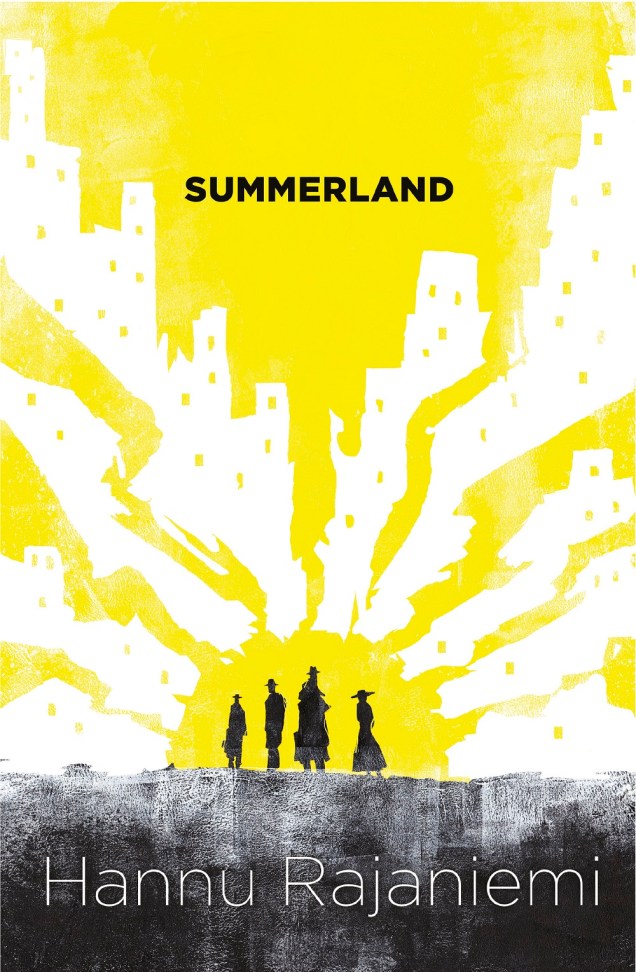
A Hannu Rajaniemi Standalone to Come in August 2017

Mathematician and author Hannu Rajaniemi, known for his Jean le Flambeur series, will publish a new novel later this year.

Gollancz Summerland_revised

Called Summerland, the novel is a standalone and sounds like a mix of ghost and spy stories:

“Loss is a thing of the past. Murder is obsolete. Death is just the beginning.

“In 1938, death is no longer feared but exploited. Since the discovery of the afterlife, the British Empire has extended its reach into Summerland, a metropolis for the recently deceased.

Yet Britain isn’t the only contender for power in this life and the next. The Soviets have spies in Summerland, and the technology to build their own god.

“When SIS agent Rachel White gets a lead on one of the Soviet moles, blowing the whistle puts her hard-earned career at risk. The spy has friends in high places, and she will have to go rogue to bring him in.

“But how do you catch a man who’s already dead?”

Summerland will be published at the end of August.

Having read the Jean le Flambeur trilogy, though, “ghost and spy story” is a woefully flat and utterly inadequate description. I’ve no doubt Rajaniemi will again produce something extraordinary. I’m looking forward to reading this particular fellow Finn again.

Image: Summerland cover by Jeffrey Alan Love via Gollancz

Johanna Sinisalo on the 2016 James Tiptree Jr. Award Honor List

Finnish author Johanna Sinisalo’s novel The Core of the Sun (Auringon ydin, translated by Lola Rogers) made it onto the 2016 James Tiptree Jr. Award Honor List.

Amazon Sinisalo The Core of the Sun

The James Tiptree Jr. Award is a juried award presented annually to works of science fiction or fantasy that explore and expand the understanding of gender and gender roles. In addition to selecting the winners, the jury chooses a Tiptree Award Honor List. The Honor List is a strong part of the award’s identity and is used by many readers as a recommended reading list.

Onnea! That’s fantastic news. Earlier, The Core of the Sun was also voted onto the BSFA Awards 2016 longlist for best novel. Sounds like a very good year for the book.

The Award announcement has several books that I’ve already read or that are on my TBR pile. I might also have to check out some of the others; several sound interesting.

Image via Amazon

The Long and Pointless War

One of the common tropes in stories about war is that war is pointless and goes on far too long. This trope goes back at least as far as the Trojan War cycle in Greek mythology but a particularly strong version of it became prominent in twentieth-century American science fiction with works like Heinlein’s Starship Troopers and Haldeman’s The Forever War. These works portrayed wars that have gone on for as long as anyone can remember and which show no signs of ever ending. The original causes for the war are long forgotten and both sides just continue to fight for no reason other than to avenge the ravages of previous battles. In more optimistic stories, all it takes to stop the carnage is for an outsider to point out to the combatants how meaningless their war is. In more pessimistic versions, the war just keeps going as the populations on both sides are blinded by warmongering propaganda and either unable or unwilling to ask what they’re fighting for in the first place. While stories of this kind may have a lot to say about what it feels like to be at war, however, they don’t match with what history shows us about the real causes of war.

Almost every society large enough to organize a substantial number of fighters, from ancient hunter-gatherer tribes to modern nations, has engaged in war. Some societies go to war readily, other reluctantly, and the immediate causes of individual conflicts vary, but certain patterns recur throughout history. Most wars ultimately come down to the need to control the resources that are essential to survival and prevent outsiders from threatening those resources. Most crucially, this means food, but other kinds of resources, such as access to trade routes, metals, and labor also contribute. People go to war because they are afraid of starving to death, not because they hate their neighbors.

The threat to survival may not always be immediate. Some wars are fought not for a direct tangible gain but to preserve reputation or prevent hostile forces from acquiring a competitive advantage. The danger that people fear when they go to war is also sometimes illusory or misjudged. Just because wars happen for a reason doesn’t mean that we all will (or should) agree that those reasons are good ones. Still, when you look behind the rhetoric and propaganda of a nation at war, you will almost always find a real fear about fundamental survival.

Ideologies, religions, political ideals, and other kinds of identities do play a role in shaping conflicts. They help to draw the lines between “us” and “them” and to justify why, in a time of crisis, “we” should live and “they” should die. Differences of identity alone, however, are not enough to cause wars. The history of the world is full of people of different faiths, ethnicities, and political persuasions living together in peace—not always harmony, but at least peace. War is the rare exception. To put it another way: war is a practical problem, not a moral problem.

Wars that arise from pragmatic fears will tend to last as long as those fears remain, or until the cost of continuing to fight outweighs the cost of accepting a settlement. History offers us plenty of examples of long wars. There were conflicts that lasted decades of more or less continual hostilities such as the Peloponnesian War between Athens and Sparta or the Thirty Years’ War in early modern Europe. There were also conflicts that recurred between the same forces on more or less the same terms over generations or centuries, such as between the Roman and Parthian Empires or China and the peoples of the Central Asian steppes. From the point of view of ordinary soldiers and civilians living through them, any of these wars may well have seemed interminable and pointless, but behind all of them were real and practical fears of the threat that rival powers posed to control of essential resources. They continued for so long because these fears remained unresolved, not because of ingrained hostility. When they ended, it was because circumstances had changed—one power decisively defeated another, all powers were too exhausted to continue, or an outside force changed the dynamics of the conflict—not because people suddenly came to their senses and stopped hating one another.

Thoughts for writers

I’m not going to tell you that you shouldn’t write stories about long and pointless wars. This trope exists for a reason and it has an important place in our literature. It’s no surprise that the trope became popular among writers who lived through the Cold War and, in the United States, the war in Vietnam. Both of those conflicts seemed especially pointless to many, soldiers and civilians alike. Almost any war can seem meaningless from the point of view of the common soldier following orders and just trying to stay alive. Stories of this kind express something important about the dehumanizing effects of war and the common yearning for peace.

It’s not our job as fiction writers to try to perfectly replicate history. We have the freedom to be unrealistic, but we should know when we’re doing it. If you want to have noisy explosions in space because they make your story more exciting, go ahead and have them. If you want to write a story about vampires in Victorian London, don’t let the fact that vampires aren’t real stop you. Likewise, if you have a story to tell about war, tell it the way you want to tell it. Just be aware that actual wars begin and end because of practical need and fears, not because people just can’t get along.

Image: Modern soldiers visit the ancient city of Hatra in northern Iraq, photograph by George Gieske via Wikimedia

Post edited for clarity.

History for Writers is a weekly feature which looks at how history can be a fiction writer’s most useful tool. From worldbuilding to dialogue, history helps you write. Check out the introduction to History for Writers here.

Happy Twentieth Anniversary, Buffy!

“Welcome to the Hellmouth,” the first episode of Joss Whedon’s cult series Buffy the Vampire Slayer, premiered on March 10th 1997. Happy twentieth anniversary, Buffy!

Here are a few of our favorite Buffy episodes or moments.

One of the better-executed truly creepy episodes I’ve seen is “Hush,” season 4, episode 10.

Buffy The Vampire Slayer | The gentlemen via SpookyTube

“Once More, with Feeling,” the musical episode (s. 6, ep. 7), is so much fun despite its cheesiness! Also has one of my favorite throw-away scenes ever: “They got the mustard ooooooouuut!”

They Got The Mustard Out! via PrincePrimeval

In “Grave” (s. 6, ep. 22), Xander saves dark Willow, who’s about to destroy the world, without any superhuman powers by reminding her of their friendship.

Xander saves Willow via ChrisPhaleus

Buffy’s speech to potential slayers and allies before the final battle in “Chosen” (s. 7, ep. 22) is also epic.

Buffy The Vampire Slayer – 7×22 – Chosen – Speach [sic] via Tito Luiz Pereira

“In every generation, one Slayer is born, because a bunch of men who died thousands of years ago made up that rule. They were powerful men. This woman [points to Willow] is more powerful than all of them combined. So I say we change the rule. I say my power, should be our power. Tomorrow, Willow will use the essence of the scythe to change our destiny. From now on, every girl in the world who might be a Slayer, will be a Slayer. Every girl who could have the power, will have the power. Can stand up, will stand up. Slayers, every one of us. Make your choice. Are you ready to be strong?”

What are your favorite Buffy memories?

In the Seen on Screen occasional feature, we discuss movies and television shows of interest.

Mysteries vs. Puzzles: The Problem with Sherlock

170309sherlockNote: this post contains spoilers for some of the original Sherlock Holmes stories and some episodes of Sherlock.

I’m a fan of the BBC series Sherlock. I enjoy the show and its inventive modern take on the Sherlock Holmes mythos. When I say that I have a problem with the show, it comes from a place of love. But I do have a problem with the show, and it largely comes down to this: not enough mysteries, too many puzzles.

Here’s what I mean by mysteries and puzzles. A mystery is when a real event is made obscure because we either don’t have all the facts or don’t see how the facts fit together. The pleasure of watching a mystery comes in the moment of revelation when we see past the obscurity to the truth and suddenly understand how the separate pieces fit together.

The original Sherlock Holmes stories are masterpiece mysteries. Most stories begin with a client consulting Holmes about some odd occurrence. Often, it is nothing overtly criminal or even threatening, just peculiar. In “The Adventure of the Speckled Band,” a young lady comes to see Mr. Holmes because she has been woken in the night by a whistling sound followed by a clang. She had heard the same whistle years before, on the night her sister died; her sister’s last words were about a “speckled band.” Holmes investigates and finds that the bell-pull in the lady’s bedroom is a dummy hanging from a hook on the wall. At first, none of these facts makes any sense, but when the truth is revealed, everything falls into place. The client’s step-father is attempting to kill her for her inheritance, just as he killed her older sister. He has been sending a deadly snake through a grate from the adjoining room, down the fake bell-pull to her bed at night. To cover his tracks, he recalls the trained snake with a whistle, then shuts it in a safe, hence the clang. The sister’s last words were her delirious attempt to describe the creature that had bitten her. The mystery works because all of the clues turn out to have a rational basis. Once you know the truth, everything makes sense.

Sometimes, the obscurity in a mystery is deliberately created, but even then it serves a practical purpose. In “The Adventure of the Read-Headed League,” the client is lured out of his place of business by the promise of high-paying easy work in a fake company concocted by the criminals. They had a reason for getting him out of the way, though: they were digging a tunnel from his basement to a nearby bank for a robbery. Holmes easily sees through the con, but that still leaves the mystery of why the con was perpetrated in the first place.

Puzzles are different. In a puzzle, there is no reality hiding behind the obscurity, just obscurity for obscurity’s sake. When you solve a puzzle, there is no reveal. The clues don’t suddenly make sense. There is no “why” to a puzzle other than “Someone wanted to make a puzzle.”

Sherlock has a few mysteries. In “The Blind Banker,” spray-painted symbols and a disappearing bank employee eventually reveal a smuggling ring moving illicit Chinese antiquities to the European market. In “The Sign of Three,” a collection of seemingly unrelated events, including a wounded soldier and a ghost date, adds up to an attempted murder at a wedding.

Too much of Sherlock, however, depends on puzzles rather than mysteries. Once the clues are solved and the questions are answered, all we learn is that Moriarty is bored and wants to play, or that Eurus is unstable and wants a hug. There’s no satisfaction in the reveal, just some clever person expounding on how clever they are. Instead of discovering that the inexplicable pieces all mean something once you know what was behind them, we discover that they were all meaningless and there was never anything behind them at all.

Even a well done puzzle (and some of Sherlock‘s puzzles are quite well done) is still a puzzle. If I want a puzzle, I’ll do a crossword. I want mysteries in my mystery stories, not puzzles.

Image via IMDb

In the Seen on Screen occasional feature, we discuss movies and television shows of interest.

Quotes: Stereotypes … Sometimes Bear Truth’s Imprint

“Stereotypes are untrue. Sometimes, though, they bear truth’s imprint. Sometimes they spring up from what truth has crushed down. As they manifest they can co-opt and mispurpose inescapable realities.”

– Nisi Shawl in the introduction to Ancient, Ancient by Kiini Ibura Salaam

I’ve been thinking of reductivism lately and, serendipitously, found more food for thought in my fiction reading.

Shawl, Nisi. “Annunciation” (introduction). In Ancient, Ancient by Salaam, Kiini Ibura. Seattle, WA: Aqueduct Press, 2012.

Serving exactly what it sounds like, the Quotes feature excerpts other people’s thoughts.

Online Finds: Trappist-1 Illustrations

A NASA Tumblr post about the newly found exoplanets in the Trappist-1 system included fantastic artist’s renderings of what the system and the planets might look like.

NASA Tumblr Trappist-1 Illustration System

“The planets also are very close to each other. How close? Well, if a person was standing on one of the planet’s surface, they could gaze up and potentially see geological features or clouds of neighboring worlds, which would sometimes appear larger than the moon in Earth’s sky.”

NASA Tumblr Trappist-1 Illustration Planet

One is even a retro-style travel poster! (See other NASA retro travel posters here.)

NASA Tumblr Trappist-1 Illustration Poster

Love ’em! Find more at NASA on Tumblr!

Note: I wasn’t paid or perked to mention this; just passing along a good thing.

Images by NASA, via the NASA Tumblr blog.

This post has been edited.

Out There is an occasional feature highlighting intriguing art, spaces, places, phenomena, flora, and fauna.

5,000-Year-Old Beer Comes Alive

How would you like to make beer and get college credit for it? Students at Stanford got to do just that. Their final project for Professor Li Liu’s course Archaeology of Food: Production, Consumption and Ritual involved practical experiments with ancient brewing techniques and materials. The oldest “recipe” they tried is 5,000 years old:

“Liu, together with doctoral candidate Jiajing Wang and a group of other experts, discovered the 5,000-year-old beer recipe by studying the residue on the inner walls of pottery vessels found in an excavated site in northeast China. The research, which was published in Proceedings of the National Academy of Sciences, provided the earliest evidence of beer production in China so far.”

The materials for the ancient Chinese beer contained millet, barley, Job’s tears (Chinese pearl barley), and traces of yam and lily root parts. The students tried other combinations as well. Watch a short video explaining the experiments:

Stanford students recreate 5,000-year-old Chinese beer recipe by Stanford

Professor Liu’s research also shows it’s possible that barley (a very popular beer grain even today) may have been introduced to China from western Asia hundreds of years before previously thought and specifically for brewing instead of a food crop.

Fascinating! It shows that as long as we have records—or material remnants, not just written word—there have been people interested in the minutiae of food and food production. I for one am grateful to be able to enjoy the fruits of such a long history of delicious experiments.

This post has been edited.

Geeks eat, too! Second Breakfast is an occasional feature in which we talk about food with geeky connections and maybe make some of our own. Yum!