Artifacts and Transmogrification: Blood Death Knight and Demonology Warlock

I’ve talked before about how some of the Legion artifacts just don’t work for my characters, but sometimes the issues go even deeper.

With Legion, Blizzard declared that they were pushing the idea of “class fantasy:” your druid should feel like a druid and your mage should feel like a mage, not just interchangeable combinations of game mechanics. In many ways, they’ve done an excellent job of bringing flavor and distinctiveness back into the classes we play. But what if Blizzard’s idea of what your class is all about doesn’t fit with your idea, either about the class as a whole or your individual character themselves? That’s what’s happened with a couple of my characters this expansion: my blood death knight and my demonology warlock.

Now, death knights and warlocks have always been “dark” classes. In the game’s story, death knights are the corpses of fallen fighters reanimated by the nefarious Lich King, who then reclaimed their individual will by force. Warlocks are spellcasters who summon demons to do their bidding and dabble in forbidden magic. It’s easy to play both of them as edgy, angst-ridden characters, but before Legion there were other ways you could approach the classes.

Though not an active role-player, I generally have some vague sense of backstory and personality for my characters. My death knight chose to stand strong in the face of the darkness and reclaim her past identity as a righteous defender of the innocent. My warlock was a sort of magical naturalist who viewed her demon minions as interesting specimens to be studied and put to good use, but carefully managed and controlled.

With Legion, it’s gotten harder to maintain those distinct perspectives under the weight of Blizzard’s “class fantasy” push. For both classes, Blizzard has been ramping up the dark, grim, angsty aspects of these classes, and that comes through in the artifact weapons. I’ve used my transmog to push back and reassert how I see my characters and how I want to play them.

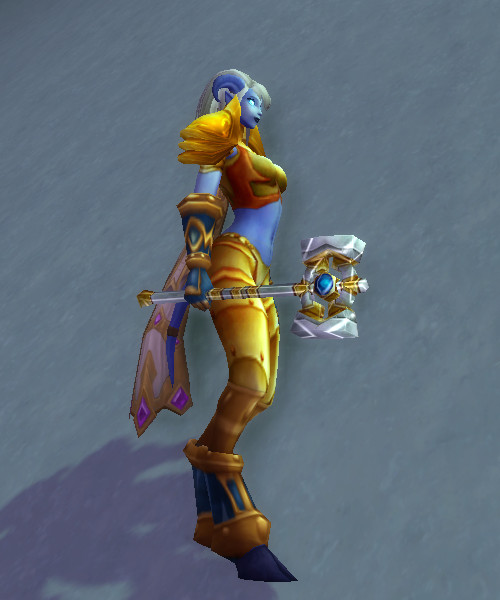
For my death knight, I’ve shunned the dark, spiky, skull-heavy style that Blizzard seems to love and put her in glorious golden armor with touches of blue and purple. The artifact axe that blood death knights get does not suit the look at all, so I’ve transmogged over the axe with a gleaming silver and blue mace that feels much better for her.

(Here’s what the weapon looks like un-mogged. Bleah.)

My warlock has been more of a problem. The demonology artifact is a floating skull that follows you around. (Someone at Blizzard is really in love with skulls.) The trouble is that the demonology artifact, unlike all the rest, cannot be transmogrified. It’s either walk around followed by a hideous floating skull or just not use the artifact. (I could, of course, change her spec, but she has always been a demonologist and she always will be, no matter how ugly Blizzard tries to make the spec.)

So, she has simply not used the artifact this expansion. I know that makes her very underpowered and means she misses out on most of the character advancement in this expansion, but it’s a price I’m willing to pay to make her look the way I want. She carries a staff which I have transmogged to one of the most beautiful and extraordinary appearances in my collection. She’s not a character I try to do challenging or group content with, so it’s good enough for me.

How are you feeling about Blizzard’s attempt at class fantasy? It it working for you? Are you rebelling against it? Share your thoughts (and your transmogs!).

Of Dice and Dragons is an occasional feature about games and gaming.

Good Night, Cassini, Good Work, I’ll Most Likely Kill You in the Morning

Tomorrow, Friday September 15, 2017, the Cassini orbiter comes to the end of its mission and will be driven into the atmosphere of Saturn.

To celebrate, The Ringer asked members of the Cassini science team to pick an image that they considered the most personally or scientifically significant. Below are my favorites of those images.

A false-color image of Saturn’s rings made from uncalibrated ultraviolet data, created and selected by Joshua Colwell, UVIS co-investigator:

The Ringer NASA False Color Saturns Rings by Joshua Colwell

The colors are incredible—the red is a real stand-out.

Titan and Epimetheus, selected by Morgan Cable, Project Science and system engineering assistant:

The Ringer NASA Titan and Epimetheus

The size differences of Saturn’s moons are amazing. Moreover, this photo almost looks like it’s framed by a professional photographer when, in fact, it’s from outer space. Love it.

Enceladus’s plumes, selected by Molly Bittner, systems engineer, Cassini Spacecraft Operations:

The Ringer NASA Enceladus Plumes

Jets of water bursting from a subsurface ocean. On an icy moon. In Saturn’s orbit. And NASA got photos of it!

Check out my previous post (with more photos), or follow the grand finale milestones, read the mission-end FAQs, browse graphics, documents, videos in a dedicated grand finale gallery, or read Cassini on Twitter.

Images courtesy of NASA via The Ringer.

Out There is an occasional feature highlighting intriguing art, spaces, places, phenomena, flora, and fauna.

Eppu’s Worldcon 75 Highlights

A random assortment of memorable moments, thoughts, views, and quotes from our time at Worldcon 75 in Helsinki. From the panel: Always Connected, It’s Mandatory with Effie Seiberg, Fred C. Moulton, Jo Lindsay Walton, Kristina K., and Tommi Helenius
  • I missed who said it and whether there were further details, but one panelist mentioned a study with the finding that merely having a cell phone on your desk, even if it’s off, lowers your ability to concentrate by about 20 percent.
The tidbit certainly gives food for thought. If true, it gives an added bonus my decision to keep my phone out the way on a small side table. Phone out of direct line of sight: +2 to concentration roll! From the panel: Pronouns, Who Needs Gender Pronouns with Cenk Gokce, Johanna Sinisalo, Catherine Lundoff, Kelvin Jackson, and John Chu
  • Johanna Sinisalo shared a story from producing the freebie anthology given to congoers, Giants at the End of the World. The translator for a story she was editing asked the gender of a very minor character that passes by in the background in order to use the correct pronoun, so she passed the question on to the author. Their reply was: “Who knows?”
  • John Chu continued on the effect that grammatical details like that have on thinking: in English you have to specify, whereas in languages that have different pronoun systems, speakers may specify the gender of their characters.
  • There was an audience comment on the 3rd person singular pronoun it used of people (in reference to a panelist who remarked that that’s possible in some dialectal uses in some languages). In the commenter’s view, people want to contain multitudes, and using it of people would be taking something away.
Clearly, defining characters’ gender matters greatly to some people and not so much to others (like the “Who knows?” Finnish author). Of course, not all writing nor all works of fiction are or should be the same, or created for the same purpose. For example, when the mood takes me, I’m delighted to read fluffy comfort lit that at other times would drive me to distraction. I think the variety that exists is fantastic, and limiting our expressions—especially in speculative fiction—is, well, limiting. We as a species do indeed contain multitudes. Instagram Lada ladule_b W75 Fandom Is Family Autographs: I got my copy of Maresi by Maria Turtschaninoff signed.
Maresi w Author Autograph
From the panel: Editor’s Dream with Thoraiya Dyer, Masumi Washington, Katrina Archer, and Robert S. Malan
  • Katrina Archer, a Canadian copyeditor who works with both Canadian and American writers, mentioned that she creates a style sheet for each individual story. She includes, among others, notes on word selections (in consultation with the authors) and the dictionary and spellings used.
Self-evident, when you think about the pragmatics of editing. I’m going to steal that idea to apply for my various projects. From the panel: Reviewing 101 with Juan Sanmiguel, Markku Soikkeli, John Clute, and Fred Lerner
  • Fred Lerner, by his own description “a recovering librarian” (yay librarians!), quoted Sturgeon’s Law (to the effect of: 90% of everything is crap) and noted that it therefore follows 10% is of use, so if a reviewer cannot find that 10% maybe they should do something different.
I’ll have to try and remember this. Not that I review things that often, but to vet other reviewers. (Also, note to self, a related critique panel mentioned Mary Robinette’s method which I believe is the one she tweets about here.) In the exhibits hall: On guest of honor Nalo Hopkinson’s table, a puzzle featuring her book covers had been set out for passersby to work on. Irresistible! And a really inventive, unintrusive promo method. Patreon Nalo Hopkinson W75 Book Cover Puzzle Made it: There’s photographic proof I was at Worldcon! From the panel: Jack of All Trades, Master of Several with Carl, Roseanne Rabinowitz, and Jani Saxell
  • Carl remarked that “external brains” (=tech) can help us branch out because looking up information is very easy.
  • Jani Saxell noted that as SF operates at the edges of the new and strange, you cannot prepare for everything; there should be a place for generalists in SFnal stories.
As a Jill of Many Trades myself, I found the topic fascinating. I’d note that finding information may have gotten much easier, but a lot still depends on an individual’s ability to sift the useful from useless and absorbing the appropriate bits. Seen in person: We’ve streamed it a few times before, so we knew the routine, but it was surprisingly exciting to be able to attend the Hugo Awards ceremony. Instagram writer_aki Aki Parhamaa W75 Hugo Awards Seen in person: I also had several nice random meetings with both old friends (some of whom I haven’t seen in over 15 years) and new-to-me people. For example, on Friday we saw a Finnish journalist and fan Jussi Ahlroth on morning tv talking about the con and later that day actually met him. Cool. 🙂 Speaking of cool: Did you know that John Howe (yes, THAT John Howe!) was at Worldcon?!? Instagram writer_aki Aki Parhamaa W75 John Howe From the panel: Older Women in Genre Fiction with Catherine Lundoff, Delia Sherman, Liisa Rantalaiho, and Helena McCallum
  • The panel noted among other things that women’s bodily needs aren’t usually present in stories. Older women don’t have to deal with e.g. menstruation, but they do have physical ailments due to age. Elizabeth Moon was mentioned as someone who is great at describing the difficulty of getting going in the morning, for example. The panelists also talked about how, just like in real life, older women in stories are often hiding in plain sight (i.e., ignored).
  • Liisa Rantalaiho noted: Older women have sex.
Another fascinating panel through and through. Elizabeth Moon’s name came up in other panels, too; clearly I need to look her up. Seen in person: Speaking of looking people up, I found a few other new-to-me authors and artists to try. I often do that if I like what someone’s said at a panel or program item. The end is nigh: At some point during the con, signs for marking the end of the line (when queueing into program rooms) appeared for people to hold up and pass on. Of course it would’ve been nicer if long lines hadn’t happened at all, but it was a practical and humorous solution to an annoying facilities problem. Instragram Tiina Vastamaa tiinatupuna W75 End of Line Please Queue Here From the panel: Gender and “Realistic History” with Cheryl Morgan, Thomas Årnfelt, Gillian Pollack, Jo Walton, and Scott Lynch
  • Jo Walton said that women are left out when canons get formed; if you go looking for women in extant documents, they are there.
  • Thomas Årnfelt mentioned a few examples of women’s occupations gleaned from 12th c. Parisian tax documents: various positions in food and textile industries, barber, goldsmith, locksmith, and night guard, among others.
  • Cheryl Morgan talked about how people have been constructing gender(s) in many various ways in history / around the world. E.g. beer brewing and tavern keeping are now seen as male professions, when in fact they were purely women’s work at one point. Another example she gave is that a man couldn’t work in Nelson’s army (or Napoleon’s?? can’t make out my handwriting) if he didn’t know how to sew.
Lively discussion and many, many examples. I kept missing references writing down others. I wish this panel had been videotaped! Seen in person: A live astronaut. All three presentations / panels with Kjell Lindgren were fascinating! Here’s the video of The Kjell & Jenny Show: A NASA Astronaut and his PAO where Kjell talks about the astronaut selection and preparation process.
The Kjell & Jenny Show: A NASA Astronaut and his PAO by Worldcon 75 Once upon a time on a lunch break: I ate at the Messukeskus Hesburger fast food joint (also fondly known as Hese) purely out of nostalgia. And was proud of myself, both as a Finn and an introvert, for sharing a table and a conversation with a total stranger. I don’t typically do that. At the same place my top half was also, memorably but unfortunately, splattered with hot chocolate. Oh well. Accidents happen, and I wasn’t scalded. From the panel: Pullantuoksuinen – Writing While Multilingual with Nina Niskanen, Aliette de Bodard, Emmi Itäranta, Ken Liu, and Jakob Drud
  • Emmi Itäranta commented that juggling two languages simultaneously is sometimes a hindrance (if you find a fantastic phrase in one language but not the other), but it also makes you a better writer because it forces you to be more specific in your meaning.
  • Ken Liu noted that it’s perhaps more important to explain a cultural concept for yourself than the audience.
I have a bad habit of code-switching out of pure sloth with Erik since he knows Finnish so well. Perhaps I ought to try and stick to one language at a time. Apart from making puns; that I won’t give up. 😀 From the panel: On the Care and Feeding of Secondary Characters with Fiona Moore, Carrie Patel, Mur Lafferty, Teresa Nielsen Hayden, and Diana ben-Aaron
  • “Knowing why characters exist tends to make them flat. Try not to know that.”
Really great quote. If you know who said it, please let me know! (Jo Walton???) Another choice quote:
“I liked the way everyone was pleasant and polite. Panelists seemed to get along well with each other, even when they disagreed. Audiences seemed appreciative. The whole thing was good, low-tension fun. I sometimes think the discussions on the Internet leave people with a really wrong idea of what the experience of attending a convention is like. Problems are few, attitudes are positive, and people laugh and smile a lot.” – Greg Hullender commenting at File 770
There were problems, and I witnessed some true clueless behavior first hand, but on the whole I agree with Greg. I saw so many examples of people greeting each other, sharing small moments of connection, helping each other out in general, troubleshooting tech issues, sharing tips and smiles, and giving up their seats to those who needed it or who might enjoy a panel more. Fandom definitely is my family. ❤ From the panel: Book Blogs with Cora Buhlert, Teresa Nielsen Hayden, Shaun Duke, and Thomas Wagner
  • Shaun Duke of The Skiffy and Fanty Show (I think—please correct me if I’m attributing this to the wrong person) said some authors don’t seem to understand how the Internet works. Apparently he’s chosen not to review some people because he’s seen how they’ve treated other fans and reviewers online.
Yup. Rep gets around. 160204dingy Images: Fandom Is Family by Lada (ladule_b) via Instagram. Maresi by Eppu Jensen. Nalo Hopkinson puzzle by Nalo Hopkinson via Patreon. Art of the Snapshot panel audience by Baron Dave Romm (david_e_romm) via Instagram. Hugo Awards ceremony collage by Aki Parhamaa (writer_aki) via Instagram. John Howe by Aki Parhamaa (writer_aki) via Instagram. End of Line by Tiina Vastamaa (tiinatupuna) via Instragram. Dingy bird via MTV. How It Happens is an occasional feature looking at the inner workings of various creative efforts.

Rating: Miss Fisher’s Murder Mysteries, Season 2

We’ve rewatched and rated season 2 of the Australian 1920s detective series, Miss Fisher’s Murder Mysteries. The first season gave us lots of great episodes. Here’s how season 2 measured up:

  1. “Murder Most Scandalous” – 5.5
  2. “Death Comes Knocking” – 6
  3. “Dead Man’s Chest” – 7.5
  4. “Deadweight” – 6
  5. “Murder a la Mode” – 7
  6. “Marked for Murder” – 6
  7. “Blood at the Wheel” – 6.5
  8. “The Blood of Juana the Mad” – 5.5
  9. “Framed for Murder” – 10
  10. “Death on the Vine” – 7
  11. “Dead Air” – 7.5
  12. “Unnatural Habits” – 8
  13. “Murder under the Mistletoe” – 9.5

The average for this season is 7.1, which is pretty good and not too far off from season 1’s average of 7.4. There are some lackluster episodes balanced by a number of gems.

The lowest-rated episode is a tie between “Murder Most Scandalous,” in which our hero Phryne Fisher goes undercover at a gentlemen’s club, and “The Blood of Juana the Mad,” about the murder of a university professor which involves a secret hidden in a sixteenth-century manuscript. Both episodes have their good points, but they don’t hold together very well.

At the top of the chart this season we have “Framed for Murder,” a spirited romp surrounding a murder on a movie set which lovingly recreates both the glamour and the spit-and-bailing-wire spirit of early movie-making. When the movie’s director is killed, Phryne gets to step in and take over the job, complete with jodhpurs.

Any Miss Fisher fans out there want to weigh in? Got a different pick for the best or worst episodes of the season? Let us know in the comments!

Image: Miss Fisher’s Murder Mysteries via IMDb

In the Seen on Screen occasional feature, we discuss movies and television shows of interest.

Quotes: Little Moments of Being Sure

One of Anne Corlett’s characters in the novel The Space between the Stars grasps at the meaning of life:

“Was this how it was for everyone? Little moments of being sure, of fitting into the world around you, all strung together on a flimsy thread of doubt and confusion and not belonging?”

– Jamie, The Space between the Stars by Anne Corlett

On one hand, sounds legit; on the other, not entirely, but when it does it’s terribly sad…

Corlett, Anne. The Space between the Stars. New York, NY: Berkeley, 2017, p. 310.

Serving exactly what it sounds like, the Quotes feature excerpts other people’s thoughts.

Erik’s Worldcon 75 Highlights

A random assortment of memorable moments, thoughts, and quotes from our time at Worldcon 75 in Helsinki.

From the presentation: Crackpot Archaeology in Scandinavia by Martin Rundkvist

  • One of the distinguishing traits of the crackpot is the insistence on finding meaning in every discernible pattern. To the crackpot, randomness is never acceptable.

(This is a particularly useful observation for me as a historian who works on areas and periods where we have extremely limited evidence. When evidence is so scarce, it is tempting to squeeze as much meaning as we can out of every text or artifact. Sometimes we just have to accept the randomness.)

From the workshop: Beyond the Great Wall of Europe: Worldbuilding for Non-European Settings by Jenn Lyons

  • In this workshop, we were divided up into small groups and assigned to come up with various aspects of worldbuilding for a hypothetical fantasy world. The group assigned to government (which I was not part of) described a society of small scattered bands without permanent leadership who pull together in times of crisis and select a temporary leader. Their ideas were based on certain Native American societies of the northeastern woodlands and gave a fairly accurate description of how societies at that scale historically tended to operate. Some other folks in the room—including the workshop leaders—critiqued them based on a European colonial misunderstanding of native North American cultures.

(It was a good reminder of how difficult it can be, even with the best of intentions, to think ourselves out of Eurocentric traditions—and why it might have been a good idea to spend a little more time working through what we mean by “European.”)

From the panel: Non-Binary Representation with Nick Hubble, D Franklin, and Nino Cipri

  • Non-binary characters in fiction written by binary authors have a tendency to feel like thought experiments rather than people.

From the panel: Editor’s Dream with Thoraiya Dyer, Masumi Washington, Katrina Archer, and Robert S. Malan

  • Always follow the submission guidelines!

(As someone who has coordinated academic conferences, I cannot agree with this strongly enough!)

From the panel: Asexuality in SF with Todd Allis, Kat Kourbeti, and Jo Walton

  • The portrayal of asexuality in fiction tends to be gendered. Female asexual characters are often portrayed as inexperienced, with the assumption that she will blossom into sexuality once she finds the right person, while male asexual characters are often portrayed as quirky, damaged, or focused on obsessions that leave no room for romantic love.

From the presentation: Logic of Empire: Economics of Colonialism in Fantastic Fiction by Jesper Stage

  • North America in the age of European colonialism was a real post-apocalyptic setting, once European diseases had wiped out over 90% of the native population.

(I’ve never thought of it in those terms, but it’s one of the most apt descriptions I’ve ever heard.)

From a panel presenter whose name I didn’t catch, when the audience let him know they couldn’t hear him:

  • “You’re different to English audiences; they just sit quietly and complain at the end.”

From the panel Loses Something in the Translation: Conveying Humor, Idioms, and Cultural Concepts across Languages with Gili Bar-Hilel, Shaoyan Hu, Elena Pavlova, Dirk van den Boom, and Mirka Sillanpää

A few choice quotes:

  • “Writing something funny is actually very serious and hard work.”
  • “Toilet jokes work in most languages”
  • “As you know, Germans are not funny.”

From the panel: Fantasy Worldbuilding without Ableism with Fran Wilde, Marieke Nijkamp, Likhain, Nalo Hopkinson, and Leon Adams

  • Disability can be a too-easy go-to for authors who want to make a hero “unlikely” without engaging with the reality of living with disability.
  • What counts as a disability depends on context. Issues that are trivial to us, such as eyesight problems that are easily corrected with glasses, could be serious disabilities in a world without that technology. On the other hand, dyslexia, which is a challenge in the highly literate modern world, would be trivial in a world without writing.

How It Happens is an occasional feature looking at the inner workings of various creative efforts.

Worldcon 75: Successful Preparations

Our Worldcon 75 trip was a combination of a family visit and con activities. First we went to the north to see relatives, and the latter half of our visit we spent south in Helsinki. Although we were in town primarily to do the con, we did have a chance to visit family there, too, and enjoy some of Helsinki’s offerings, including some walking and eating at our favorite places.

Since it was a long trip and since our luggage needed to accommodate our clothes, presents for family, and books for the con, we needed to prepare more carefully than usual. I’ll share below some of our successful preparation strategies.

For more of our Worldcon 75 thoughts, check out the collected links page.

Accommodation sticker shock: Airbnb to the rescue

We tried Airbnb for the first time, because we knew we wanted to stay extra days in Helsinki both before and after the con and therefore hotel fares would’ve gotten hair-raisingly high. Fortunately, we managed to book an entire apartment in a quiet building about 10 minutes’ tram ride away from Messukeskus, with really considerate, friendly, and helpful hosts, plus in-building laundry, a neighborhood grocery store, all-round excellent transit connections and several restaurants in the vicinity.

Self-catering worked really well. Skipping a hotel meant also missing out on the fantastic, enormous hotel breakfasts, but we made hardy breakfasts ourselves. We also packed a few small ziplock bags for veggies and other finger food instead of buying overpriced snacks at Messukeskus.

Would I do it again: Yes. I would research the heck of the host(s), though, and pack cloth napkins to avoid using disposable ones at the flat.

Con notes: Add a folder

I typically keep notes of my con trips in small paper notebooks. In addition, I lug around a random assortment of A4 / letter-sized papers (notes on directions, restaurants, programming, etc.) folded and tucked into the notebook. At W75 I ended up picking up way more than my usual share of papers, though. For one, I was for some reason completely unprepared to get a bagful of freebies at registration, even though I knew we were going to get at least the pocket program and a souvenir book. (D’oh!)

Would I do it again: Yes, with improvements. I plan to continue using a small notebook for the actual note-taking, but upgrade to a letter-sized folder for the rest. Also, note to self: bring a few sheets of blank paper and maybe a Sharpie.

Day pack: Needs improvement

I traveled with a fairy sizeable day pack, because the trip was a long one and because Helsinki weather forecasts had looked unsettled and uncertain before we left the U.S. I tend to get cold easily, so I wanted carrying capacity for extra clothes, umbrella, water bottle, snacks, etc. Unfortunately, my backpack turned out too bulky for my comfort in the crowded Messukeskus corridors even when it was half-full.

Would I do it again: Probably not, unless I’m planning on cosplaying and need the space. I’m considering getting a smaller backpack (or maybe a cross-body bag) for my extra sweater, scarf, umbrella, book(s), and other bigger con gear, and using it with a small cross-body purse for faster access to water, snacks, pens, and notes.

Fun with flags: So. Many. Languages!

For the first Nordic worldcon, I wanted to flag myself as able (and delighted!) to function in more than one language, so I made myself a language tag to stick on my badge: Finnish and Swedish flags for my Nordic languages, and U.S. flag for American English. (I learned British English at school and at university, but I’ve since gone over to the dark side. Bwahahaha!) For good measure, I added my pronouns (she / they / hän).

Would I do it again: Yes, although I’d print out the flags instead of drawing them freehand. (Poor, butchered U.S. flag!) And make them larger. And as long as I’m including Swedish, I’d add those pronouns as well (hon / hen).

W75 Badge w Ribbons

Introvert care: Off days between activity days

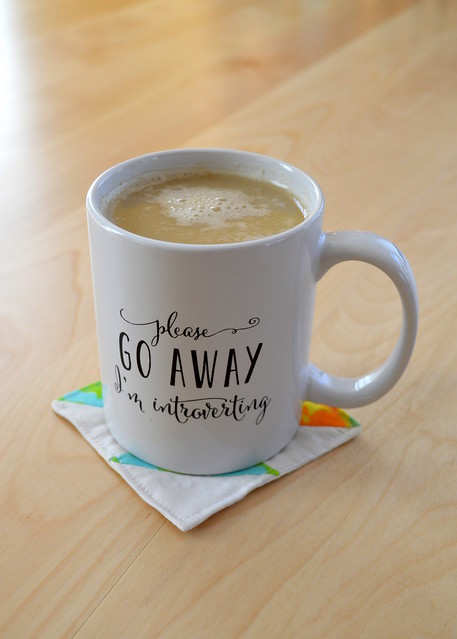
We’re both introverts. When planning this trip, we knew we were likely to feel overwhelmed, so we consciously scheduled introvert care days into our itinerary both before and after the con. Introvert time before the con was necessary, because our visit in the north was a whirwind of family meetings. And it was necessary after the con, because the thought of flying into one of the high-traffic airports in the U.S. in a tin can stuffed full of strangers, then standing in line for goodness knows how long in a room stuffed full of strangers in order to get a shuttle stuffed full of strangers, and, finally, exhausted, to find ourselves driving on roads stuffed full of strangers was just too much immediately after a five-day event—you guessed it—stuffed full of strangers.

Would I do it again: YES! I’m not sure I would’ve been able to do this trip without blocking off the no-people days.
Introverted Tea Mug

Making many meetings succeed: Plan for a spot

I had heard through a Finnish contact that it’s very easy to lose track of people at a Messukeskus con. Although I have a Finland-compatible cell phone, Erik doesn’t, so we couldn’t count on being able to text each other updates during the times when we wanted to go our separate ways. So, after the Messkeskus floor plan was available, we found a spot that looked out of the way enough (to not clog any passageways) but easy to find and fast to get to. Each morning we’d go over our schedules and find at least one and preferably two times that we could meet at our spot to connect and re-plan if necessary. And if it should happen that we didn’t get into any programming we wanted, or didn’t feel like attending, or just had a change of heart and were available for doing things together again, our spot was where we’d find each other.

Would I do it again: Absolutely. We even arranged to meet my sister at our spot a few times.

Maintenance medications and time zones: Make it into a program item

Figuring out the proper time, in Finnish time, to take my maintenance medications was easy. However, I had the darnest time remembering to do it, until I wrote it in my personal con schedule. (Outside the con I had an alarm on my phone, but in Messukeskus I kept the phone on silent.)

Would I do it again: Yes! So easy! If it’s Saturday and 4 o’clock, it must be Food Lies panel and pill time.

Public transit pass for the win!

The W75 membership included a 5-day transit pass for the greater Helsinki area, and it was marvellous. It allowed for so many options for the week. About half the time we just used it to get to Messkeskus and back, but half the time we took additional trips.

Would I do it again: Yes, even if I had to pay for a weekly ticket myself.

Pre-prep is next to godliness: Following Worldcon 75 online

I’m a preparer. Even though I’m a Finn and have visited both Helsinki and Messukeskus before, I’ve been away from Finland long enough to know my local knowledge is partially outdated. I followed W75 on social media and read each and every one of their publications. (I didn’t mind possible overlap; the info put out through different channels varied to some extent and any repetitions were really easy to skip.) Just before the con, the W75 KonOpas / Grenadine guide / online program guide was hugely helpful for updates of new, deleted, or moved program items.

Would I do it again: Yes. And enthusiastically yes for any possible future worldcons, too.

Images: Eppu Jensen

How It Happens is an occasional feature looking at the inner workings of various creative efforts.
Global Medieval Sourcebook Brings More Manuscripts Online

Stanford University’s Global Medieval Sourcebook (GMS) now brings English versions of previously untranslated Middle Ages literature to everyone’s fingertips for free.

Global Medieval Sourcebook The Gosling

The open access, open source teaching and research tool offers manipulable scans of the manuscripts alongside transcribed texts in their original language and in new English translations. Also a brief introduction for each text is included, providing a commentary on the text’s cultural context and transmission history, its content, and the scholarly conversation around it.

The texts come from Europe, North Africa, the Middle East, and Asia between the years 600 and 1600. The current selection of languages is impressive: Old and Middle High German, Middle Low German, Medieval Dutch, Old and Middle French, Old and Middle English, Medieval Italian, Medieval Latin, Old Spanish (including Aljamiado), Medieval Hungarian, Chinese, Arabic, and Persian.

Texts are searchable by genre, author, period, language, and keyword. The GMS also includes a few audio files of specialists reading the texts in their original language.

Sounds like a fascinating resource! I’m especially intrigued by the audio files, since that’s not a typical resource in medieval text databases. Stanford seems just to be getting started, however, since at this writing only some dozen or so texts are included in the sourcebook. I also encountered some glitches, hopefully to be fixed shortly.

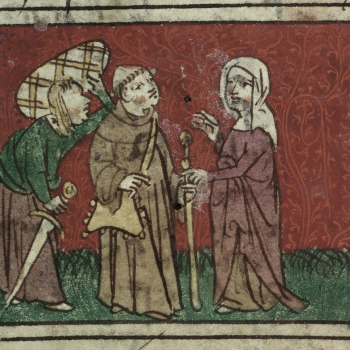
Image: The Gosling / daz genselin from British Library MS Harley 4399 f.37 via Global Medieval Sourcebook / Stanford University (Middle High German, c. 13th, illuminated manuscript)

Out There is an occasional feature highlighting intriguing art, spaces, places, phenomena, flora, and fauna

What Makes a Fantasy World Feel European?

One of the workshops I attended at Worldcon 75 was about non-European-based fantasy worldbuilding. It was a lively and enjoyable workshop, but—no doubt for logistical reasons—the discussion of what exactly makes a setting seem European was cut rather short. It’s not a question that is easy to answer, even though—from Tolkien to Game of Thrones—it is obvious that a lot of fantasy literature and media draws heavily on European, and specifically medieval European, influences. What is it about a fantasy world that makes it feel European, and what kinds of things should we consider changing if we want to create something that doesn’t?

Our popular collective sense of medieval European history is a fairy-tale world of knights on horseback, castles, kings and queens, pageantry and chivalry. For people growing up in the West, fairy tales in this tradition shape some of our earliest exposure to storytelling and it is no surprise that their forms and characters continue to inform how we approach fantasy. If you want to make your fantasy world feel less European, one approach is simply to look around the world for different terms to slot into the formula. Instead of telling a story about a dashing knight riding his trusty steed to rescue the princess from the castle of the wicked queen, you can tell a story about a dashing jaguar warrior riding his trusty ostrich to rescue the geisha from the stone fortress of the wicked maharani. This kind of “palette-swapping” (as Jeannette Ng calls it in an excellent recent Twitter thread) can work, up to a point, but the more depth and detail you have in your story, the more shallow this kind of worldbuilding will feel.

Let’s take a closer look at the details of “fairy tale” Europe. Knights, castles, kings and queens all have some basis in reality, but they are complicated. Mounted knights played only a small part in medieval European warfare and only in certain regions and periods. The crenellated stone fortresses we think of as “castles” had a similarly limited scope. Kingship was a precarious position across most of medieval Europe (where it existed at all). The most powerful actors were often local warlords. Chivalry meant the rules of war, which were followed as haphazardly as rules of war generally are. Their more romantic aspects were an embellishment of popular literature. Indeed, modern fantasy literature that imagines a world of chivalrous knights and fair damsels wandering from castle to castle draws far more on medieval fantasy literature (not to mention the self-serving propaganda of a small warrior elite) than on any of the realities of European history.

Furthermore, many of the things we commonly associate with medieval Europe were not originally European. Heavily-armed cavalry had been pioneered by the Parthians and depended on technologies—most crucially stirrups and large, strong horse breeds—developed in Central Asia. Stone fortifications had a long history of development in the Levant, and European castle designs drew heavily on Islamic examples encountered by Crusaders. Speaking of the Crusades, the Christian texts and ideologies that guided medieval intellectual culture were rooted in Jewish traditions and the cultural turmoil of the Roman empire’s eastern provinces.

So, what, after all, is so European about Europe? When we say that the fantasy we’re reading feels European, or that we want to write something that doesn’t, what are the things that add up to that?

My basic advice for worldbuilding is: start with the land, so let’s look at the land of Europe.

Europe, geographically speaking, is not really a continent but rather the long, vaguely triangular western end of Eurasia. Compared with most other major land areas, Europe is relatively compact. Most of the landmass falls between the 40th and 60th parallels. Many bays and small seas penetrate the land and break it up into numerous peninsulas and islands. A long mountain system sprawls across the southern half, a smaller and more fragmented one across the northwestern diagonal. Wedged between them is a broad plain threaded with numerous rivers, with forests in the west giving way to grasslands in the east. The North Atlantic current brings warm water and wet winds to the western coast while the many bays and small seas bring the climate-moderating effects of water to much of the land.

This geography has several significant effects for human cultures in Europe. One is that the climate is relatively stable and uniform across most of Europe. The southern half tends more warm and dry while the northern half is more cool and wet, but broadly speaking, the temperatures, rainfall, seasonal weather patterns, and growing conditions are similar enough across most of the land that the same crops can be grown and animals raised in most regions. (No, I’m not saying the climates of Spain and Finland are identical; I’m saying they have enough in common that a farmer from one place would not have to learn a whole new way of farming and acquire entirely new crops and animals to get by in the other.) The major staple crops are grains, primarily wheat and barley, with hardier alternatives like rye and oats appearing farther north. The principal farm animals are pigs, cattle, sheep, goats, and poultry, with goats being more common in the mountainous south and cattle more common in the northern plains.

The geography also makes travel and transport relatively easy. Most places in Europe are within a few hundred kilometers of the sea and much of the area is crossed by navigable rivers. Since waterborne transport is more efficient than overland, large cargoes can be carried around Europe more easily than in many other regions.

Put together the similarity of climate and the ease of transport and the result is a land where many basic elements of economic and social life—the organization of agricultural labor, the rhythms of the farming year, the structure of local trade—are similar in many different places. The relative ease of connecting local economies into long-distance trade means that goods, people, and ideas flow readily from one region to another.

Despite the ecological cohesiveness of Europe, this landscape has different effects on political life. The profusion of islands, peninsulas, and bays breaks up the landmass into many smaller regions. So do the mountains of the south and the forested areas of the north. While these smaller regions are connected by trade and travel, they are difficult to assemble into large coherent states. There are many places in Europe where one leader with a small following of warriors could easily control a handful of villages or a stretch of river valley, but these small territories are much harder to unite under one leader’s power.

These two tendencies have underlain much of European history and are still visible today: cultural and economic interconnectedness at odds with political fragmentation.

When people are united by culture but divided by politics, their warfare tends to focus on establishing dominance over the enemy rather than destroying them. The respect for shared institutions and values facilitates the development of common diplomatic customs which can limit the destructiveness of warfare and channel competition into symbolic contests. On the other hand, diplomacy can draw conflicts out by delaying a decisive clash. People are likely to find themselves at war repeatedly over the same issues, a feature we can also see in European history.

These factors tend to draw European societies into internal connections and conflicts, but Europe is also well connected to the outside world. The Mediterranean Sea is easy to cross to North Africa or the Levant and the there is an extensive land connection to the rest of Eurasia. A short overland trip from the southeastern Mediterranean leads on to the Red Sea and the Indian Ocean. North America can be reached either by riding the circular North Atlantic trade winds or by island-hopping by way of Britain, the Faroes, Iceland, and Greenland. People have always been moving into and out of Europe both individually and in larger migrations, bringing the influence of outside ideas and cultures into the region and taking European ideas abroad.

All of these factors are part of what makes Europe European. We can see their influence even in the fairy tale version. Many kings and queens (and other kinds of rulers) have competed for power across stretches of Europe, relying on knights (and warriors of other descriptions) who supported themselves on the agricultural produce of small local regions. In parts of this fragmented landscape, local magnates built castles (and other kinds of fortified dwellings) to secure their control of territory and resources. The cultural and economic connections between many of these warring parties fostered the development of a common set of norms for the conduct of warfare, which literature elaborated into a fanciful code of chivalry. Contact with the outside world and immigration of foreign peoples brought new ideas and technologies—like stirrups and stone castles—which then spread widely through networks of trade.

These forces are not always visible in storytelling, but they underlie many of the basic assumptions, social structures, and cultural habits that make so many fantasy worlds feel European. Even some of the most basic staples of fantasy literature have their roots in the European landscape—of course everyone eats bread and cheese when wheat is the dominant crop across most of Europe and cattle are the primary herd animal on half the continent.

If we want to build fantasy worlds that don’t follow the same familiar patterns, we need to understand where those patterns come from.

Images: La Belle Dame sans Merci via Wikimedia (Bristol City Museum and Art Gallery; 1901; oil on canvas; Frank Dicksee). Satellite map of Euopre via Wikimedia. A View of Tallanton Castle via Wikimedia (Scottish National Gallery; 1816; oil on canvas; Alexander Naysmith).

Post edited for clarity and to correct historical inaccuracies.

History for Writers is a weekly feature which looks at how history can be a fiction writer’s most useful tool. From worldbuilding to dialogue, history helps you write. Check out the introduction to History for Writers here.

Octavia Butler to Be Adapted for TV

I missed this when it was first announced, but here it is nevertheless: Octavia Butler’s novel Dawn is to be adapted for tv!

https://twitter.com/ava/status/895354839567171586

Dawn (originally published in 1987) opens the Xenogenesis trilogy (also known as Lilith’s Brood), where the Earth is mostly uninhabitable and humanity almost extinct until the alien Oankali intervene. Writer / producer / director Ava DuVernay and Charles D. King (Macro Ventures) are slated for executive producer posts, and writer / director Victoria Mahoney for the adaptation itself.

I first read the trilogy in the early 1990s in Finnish translation. The books have stayed with me, although over the years it became clear I’d forgotten quite a bit. Some 20 years later, I got my own omnibus in English to (re)read, and the trilogy was just as excellent as I remembered.

Looking forward to seeing what the team makes of Dawn! (Also, note to self: read more Butler!)