Our rewatching and rating project carries on with season 6 of new-series Doctor Who. Here’s our ratings for this season’s episodes:
“A Christmas Carol” – 7
“The Impossible Astronaut” – 6
“The Day of the Moon” – 7
“The Curse of the Black Spot” – 4
“The Doctor’s Wife” – 4.5
“The Rebel Flesh” – 4
“The Almost People” – 1.5
“A Good Man Goes to War” – 6.5
“Let’s Kill Hitler” – 6
“Night Terrors” – 2
“The Girl Who Waited” – 2
“The God Complex” – 3.5
“Closing Time” – 4
“The Wedding of River Song” – 3.5
The average episode rating for this season is 4.4, which is a rebound from last season’s 3.7, but still well below the first four seasons.
This season has its good moments. The production team seems to have gotten a better handle on things and most of the episodes feel polished. The actors seem more comfortable in their roles and more willing to stretch their interpretations of the characters. A few episodes deliver new and creative stories. At the same time, a lot of this season feels underwhelming or poorly thought-out.
Our lowest-rated episode for the season, at 1.5, is “The Almost People,” the second part of a grimy industrial-punk story about goop-doppelgangers (goopelgangers?) gone rogue in a future acid-mining operation that for some reason happens in the remains of a medieval monastery. (Someone on the Who team clearly has a thing for goopelgangers: see season 4’s “The Sontaran Strategem” and “The Posion Sky.”) The first part was a bit nonsensical and left a lot of unanswered questions hanging (Why is acid-mining such a big deal in the future? Why use goopelgangers for it? Why are they in a medieval monastery? How did any of this get past health and safety, let alone the heritage council?), but at least it promised the possibility of a good old classic sci-fi “Who’s real?” and “What is the measure of a human?” story. The second part, though, just kind of falls apart and doesn’t pay off. Like last season’s “Flesh and Stone,” and “Cold Blood,” the second half of the story gets sidetracked into serving the season-long arc.
There are brights spots this season, though. Things start off at a strong 7 with an ingenious Christmas episode in which the Doctor finds himself traveling back in time to play Ghosts of Christmases Past, Present, and Future and save the soul of a heartless old plutocrat just in time to save a crashing spaceship with his friends Amy and Rory on board. A two-parter follows, “The Impossible Astronaut,” rated 6, and “The Day of the Moon,” another 7, about the Doctor’s friends trying to save the Doctor from being killed by a mysterious figure in a spacesuit and in the process discovering the sinister Silence, who erase themselves from the memory of anyone who sees them. These episodes are a good mix of horror, action, and comedy, and the Silence make interesting counterparts to the Weeping Angels: while the Angels disappear when you look at them, the Silence disappear when you look away.
Although this season has its ups and downs, it also has some larger problems. One is the ongoing obsession with an arc story, which gets significantly more convoluted in this season, sometimes to the detriment of what could have been decent stand-alone stories. New-series Doctor Who has a pretty bad track record when it comes to season-long arcs. Most of them feel obligatory and ratings-driven rather than organic and meaningful. Arc-dependent episodes have consistently been some of the worst, while the best episodes have been those that have nothing to do with the arc. I’d be happy to see Doctor Who stop trying to be Lost and focus on being Doctor Who.
Another problem, which appeared in earlier seasons but gets significantly worse over seasons 5 and 6, is the amount of time and narrative attention given to other characters talking about how great the Doctor is. It was used as a cheap get-out-of-plot-free card at the end of season 3’s “The Last of the Time Lords,” in which a world full of people thinking good thoughts about the Doctor powers the deus ex machina ending, but in season 6 it becomes a recurring theme as ubiquitous as the whooshing of the Tardis. Even River Song, who started off as a fascinating character in her own right, gets reduced to a chorus girl singing the “Oh, Doctor, you’re so amazing” refrain this season. This character shilling goes along with the continuing attitude that special people get a pass on basic human decency to make some scenes really uncomfortable to watch.
How do the rest of you feel about this season? Got any favorites (or anti-favorites) you want to share? We know that not everyone shares our tastes or out perspective on Doctor Who, so let us know in the comments what you loved or didn’t about this season.
Due to a post-winterstorm blackout a week more than two weeks ago, I’m still catching up on my Internet reading, so I only saw these awesome, nerdy motivational postersnow after the International Women’s Day. It was worth the wait, though:
Risa Rodil on Tumblr.
“Just because something works doesn’t mean it can’t be improved.”
Referring of course to Shuri from the movie Black Panther. As another tinkerer, I wholeheartedly agree! 😀
Risa Rodil on Tumblr.
“Behind every successful woman is herself.”
The posters are by letterer, illustrator and designerd Risa Rodil. She posted them on Tumblr in honor of the International Women’s Day (March 08).
I’m not a fan of the Victorian age per se, but watching Murdoch Mysteries has piqued my interest somewhat. Here are some intriguing photographs from the later 1800s to early 1900s.
From a set of unscripted photos taken in the streets of 1890s Norway by Carl Størmer, a young woman with books:
Young woman with books, photograph by Carl Størmer via Imgur (Oslo, Norway, 1890s)
All of the subjects in this set are remarkably relaxed. Love the contrast to the stiff studio portraits of the era!
(I’ve had trouble finding a more detailed source, unfortunately. Possibly Størmer’s photos are gleaned from the 2008 book 80 millioner bilder: Norsk kulturhistorisk fotografi 1855-2005 [’80 Million Pictures: Norwegian Culture-Historical Photography 1855-2005′], edited by Jonas Ekeberg and Harald Østgaard Lund.)
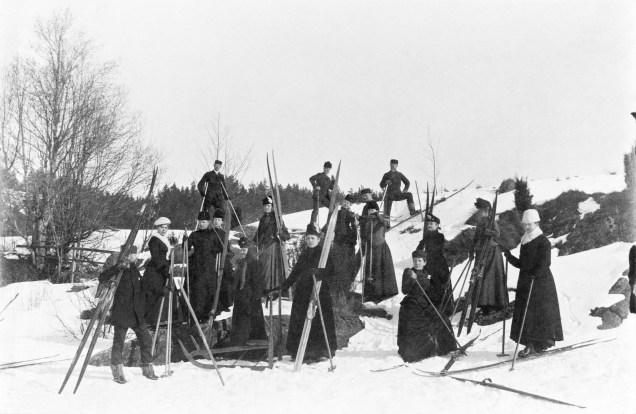
Finnish ladies and gentlemen on a ski trip in the 1890s:
Hiihtoretkeläiset ryhmäkuvassa (‘ski trip participants in a portrait’), photograph via Helsinki City Museum (Helsinki, Finland, 1890s, image number N252030, CC BY 4.0)
Judging by their attire, they are indeed ladies and gentlemen. What struck me is that, apparently, it wasn’t at all odd for the upper class to go skiing in their regular daywear.
Speaking of sports and Victorians, from 1891, here is high school dressage equestrian Selika Lazevski by Félix Nadar:
Selika Lazevski, photograph by Félix Nadar courtesy of Ministère de la Culture, France, via Black Female Equestrians (Paris, France, 1891)
What an arresting portait!
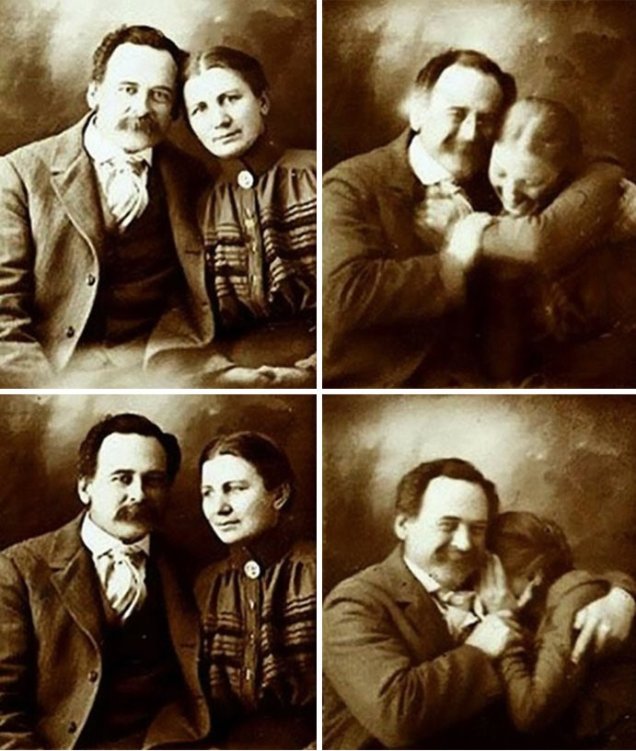
A Victorian couple from Leeds trying not to laugh while getting their portraits done in the 1890s:
Victorians certainly loved their wheels! I wonder exactly how one would’ve operated this chair—there’s clearly a handle bar connected to the front wheel, but if grabbing it with both hands, where does the propelling force come from?
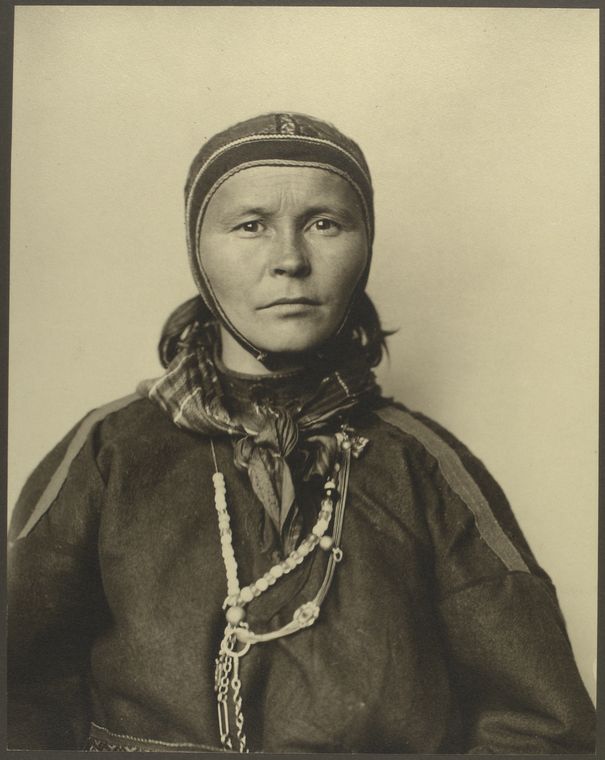
A Sami woman from Finland photographed at Ellis Island in the U.S., so presumably immigrating, around 1905-1914:
Laplander / Sami woman from Finland, photograph by Augustus F. Sherman via New York Public Library digital collections (Ellis Island, New York, NY, c. 1905-1914, image ID 418041, public domain)
I wish the portrait hadn’t cut off at the waist; I would’ve liked to see the rest of the details of her dress (the belt looks especially interesting). I know that nowadays Sami outfits (gákti) are unique. Each is made for its wearer to reflect the personal / family history and area (and possibly the people as a whole?). I don’t know, however, how far back in time that practice goes.
Anyway. These old photos give fascinating glimpses of western life only about 100 years ago. So similar and yet so, so different.
Out There is an occasional feature highlighting intriguing art, spaces, places, phenomena, flora, and fauna.
bearing his bright cheeks and walking by the right hand of Isis.
…
You boast how you provide for the people,
how day and night and all the seasons revere you
and call you kin, Breith and Mandulis,
stars, emblems of the gods rising in heaven.
– Paccius Maximus
(My own translation)
These lines come from a poem written by a Roman soldier named Paccius Maximus and painted on the wall of the temple to Mandulis at Kalabsha, in modern Sudan. We know very little about Paccius besides what he tells us in this and one other poem, but based on some clues he is believed to have been a local African officer in the late Roman army.
Mandulis, often associated with his twin brother Breith, was a Nubian sun god. It’s interesting to note how Paccius readily connected Mandulis with both the Olympian gods and the Egyptian goddess Isis, easily harmonizing Greco-Roman, Egyptian, and Nubian religious traditions. His poem gives us a glimpse at how culturally complex and interconnected the world of the Roman empire was.
But, as fascinating as Paccius’ poem is, it’s on my mind today for a different reason.
It snowed here last night. Again. That’s the fifth snowstorm we’ve had this March.
You see this stuff? You see it? I’m sick of it. I like winter just fine, but it’s time for this winter to be over.
Mandulis, wherever you are, we could really use you and your bright cheeks right now. Any time you want to come start providing for us people here, buddy. Any time. I’ll be waiting.
Yareta or llareta (Azorella compacta) is a low evergreen that grows in the Andes mountains in Peru, Bolivia, northern Chile, and Argentina.
Looking at the landscape where it’s found, it seems that the yareta latches onto ground or rock and grows up and out into the rounded shape over the years.
The rounded, cotton-ball-like shape reminds me of how some mosses grow. Unlike them, though, the yareta can grow in dry conditions and nutrient-poor soil, if slowly. (According to Wikipedia, their growth rate is approximately 1.5 cm / 0.6 inches per year; however, an article in Pharmacognosy Magazine cites 1 cm in 20 years.)
Apparently the Andean people used yareta since Pre-Columbian times for the treatment of colds, pains, diabetes, asthma, bronchitis, womb complaints, gastric disorders, backache, wounds, and altitude sickness (Pharmacognosy Magazine Aug 2014).
Yareta looks like a great option for speculative writers and artists looking to break out of the Eurocentric worldbuilding mold.
Images: Yareta at Ollague Volcano lookout by Miguel Vieira via Flickr (CC BY 2.0). Yareta – Bolivian Altiplano by Knut-Erik Helle via Flickr (CC BY-NC-ND 2.0)
Out There is an occasional feature highlighting intriguing art, spaces, places, phenomena, flora, and fauna.
Apart from various aspects of the story and the movie series, the exhibition covers for example illustrations, the history of real-world magic, and early sketches and notes by J.K. Rowling. In addition, on display are a number of items from the Museum of Witchcraft and Magic.
My favorite feature is perhaps the section covering the real-world history of various Hogwarts classes, closely followed by the animals and fantastical beasts section.
It sounds like a simple question that ought to have a straightforward answer, but both the question and its answer are far more complicated than they appear. In these posts, I dig into the topic to explore what we know, what we don’t know, and what we mean by race in the ancient Mediterranean world.
Part 4: Skin Color in Art
In the previous post, we looked at how Greeks and Romans wrote about skin color. Today we look at how they represented it in art.
In looking at how ancient artists handled skin color, we have to begin by recognizing that not all ancient artworks have come down to us intact or preserving their original colors. We must especially shake off the association of ancient art with gleaming white marble. Marble was favored for sculpture in the ancient Mediterranean because the stone is slightly translucent and it reacts to light in a way similar to human skin, but marble statues were not usually left white. They were painted, often in bright colors which have faded or disappeared entirely after thousands of years of exposure. To get a more accurate sense of how ancient artists represented skin color, we have to choose our sources carefully and look for types of artwork that hold color better over time or that have been protected from exposure.
Although people of the ancient Mediterranean were aware that human skin tones could vary widely, they did not attach the same meaning to this variation that we tend to today. Since skin color was not a primary way of marking ethnic identity, artists could use it to convey other meanings, or simply for decorative effect.
It was a widespread custom in the ancient Mediterranean to use skin color as an indicator of gender. Men were often portrayed with dark reddish-brown skin, women with pale yellow-white skin. This artistic convention reflects a conventional ideology in which the socially acceptable activities for men were agriculture and war, outdoor occupations which exposed them to the sun. Women were similarly expected to stay indoors, working in the home and preserving their pale skin. For a man to be pale suggested that he worked indoors at trades that, though necessary for society, were less prestigious. Similarly, for a woman to appear dark-skinned suggested that she had to work outside the home, implying that her household was not rich enough to be self-sustaining. When patrons directed artists to depict them with conventional skin colors, they were responding to the social pressure to look their best. We cannot assume that artworks like these represent the actual appearance of their subjects.
Funerary statues of Rahotep and Nofret via Wikimedia (Egyptian Museum, Cairo; c. 2500 BCE; painted limestone)
Portrait of a couple from Pompeii via Wikimedia (Pompeii, currently Museo Archeologico Nazionale di Napoli; 1st c. CE; fresco)
Skin color could also be used to indicate other features of identity. Darker skin, for instance, was associated with age, lighter skin with youth. Children were often depicted with light-colored skin, regardless of gender. In this portrait of the family of the Roman Emperor Septimius Severus, Septimius’ skin is distinctly darker than his wife Julia Domna’s, but their son Caracalla’s skin is even a little paler than his mother’s. (Their other son Geta’s face was obliterated in antiquity after Caracalla became emperor and assassinated his brother).
Portrait of Septimius Severus and family, photograph by José Luiz Bernardes Ribeiro via Wikimedia (currently Altes Museum, Berlin; c. 200 CE; painted panel)
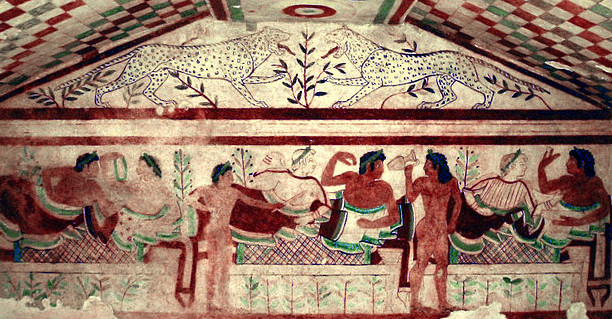
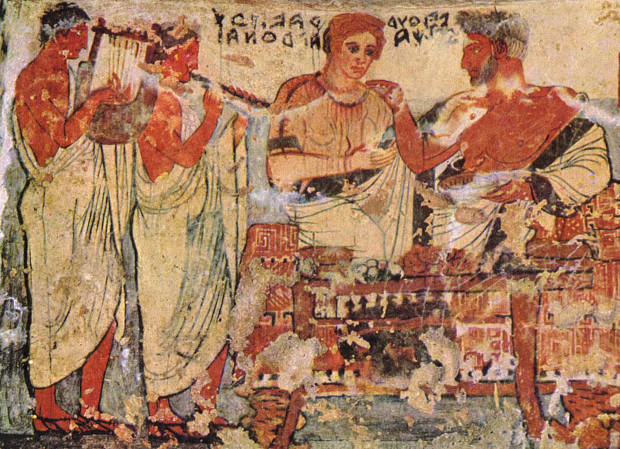
The degree to which skin color was emphasized as a feature in art also varied between cultures and across time. These two examples of Etruscan tomb art from Tarquinia show how much variation there could be even within the same community. While both follow the dark men / light women pattern (gender is also marked by differences in clothing, hair style, and activity) one makes the distinction very stark and schematic while the other is much more subtle.
Banquet scene from the Tomb of the Leopards, photograph by AlMare via Wikimedia (Tarquinia; 480-450 BCE; fresco)
Banquet scene from the Tomb of the Shields via classconnection (Tarquinia; c. 340 BCE; fresco)
In many cases, the skin color of human figures in ancient art is dictated by the choice of medium more than by a desire to convey any message. The two sides of this vase, for instance, present similar scenes, the hero Heracles at a feast, in opposite color schemes.
“Bilingual” vase, composite of photographs viaWikimedia (Vulci, currently Staatliche Antikensammlung, Berlin; 520-510 BCE; pottery; believed to be by Andokides Painter)
This statue of the Tetrarchs, four emperors who governed the Roman Empire in a short-lived experiment in joint rule, is carved out of porphyry, a very hard stone with a dark purple hue. This stone was chosen for several reasons, partly because of the traditional association of purple with imperial power and partly because the dense, hard stone suggested the strength of the institution the joint rulers were trying to create. A realistic depiction of skin tone was not a priority.
Tetrarchs statue, photograph by Nino Barbieri via Wikimedia (currently St. Mark’s Square, Venice; early 4th c. CE; porphyry)
When depicting beings beyond the human realm, skin color could carry many other meanings. The Egyptian god of the dead, Osiris, was traditionally depicted with green skin, symbolic of regrowth and new life. In these wall paintings, the green-skinned Osiris appears in two different scenes in the company of other gods.
Wall paintings from the tomb of Horemheb, photograph be Jean-Pierre Dalbéra via Wikimedia (Valley of the Kings; c. 1292 BCE; fresco)
Similarly, the Etruscan god Charu, who was responsible for guiding the souls of the dead into the afterlife, was typically shown with blue skin, representing decaying flesh.
Charu from the François Tomb, detail of photograph via Wikimedia (Vulci; c. 330 BCE; fresco)
Sometimes ancient artists used skin color to indicate ethnicity in ways that are easy for us to recognize, such as this vase representing two women’s faces. The light-skinned woman’s features, such as her pointed nose, thin lips, and wavy hair, suggest that she is meant to be of European descent while the black-skinned woman has features characteristic of a sub-Saharan African origin, such as a flat nose, fuller lips, and tightly coiled hair.
Janiform aryballos, photograph by Jastrow via Wikimedia (from Greece, currently Louvre; 520-510 BCE; pottery)
In other cases, we cannot be entirely sure what the skin color in ancient art is meant to convey. This fresco from Minoan Knossos depicts bull leapers in distinctly different skin tones, but it is difficult to be sure what significance, if any, that difference has. It may be meant to show differences in gender, although the figures’ similar proportions, clothing, and hair do not confirm it. It might be intended to indicate people of different ethnic origins. Alternatively, it could be simply for aesthetic variation. We do not know enough about Minoan culture and its conventions for representing ethnicity, gender, and other identities in art to be certain.
Bull leaping fresco (restored), photograph by Nikater via Wikimedia (Knossos; 1550-1450 BCE; fresco)
As with literary descriptions of skin color, we have to approach ancient artistic representations with a cautious awareness of how far removed we are from the cultures that created them. The artists who made these images and the patrons who commissioned them did not share many of our basic assumptions about what skin color means and how it should be represented. Their cultural context was unlike ours and they created their works to communicate with other people of their place and time, not to send time capsules to us millennia later. It is not enough for us to stroll through museums or flip through the pages of art books looking for faces that look the way we think people of different ethnic origins ought to look.
Ancient art is not a representative snapshot of ancient demographics. Art represents what people consider important, not necessarily the reality of the world they live in. In a world in which privilege, power, and identity were not wrapped up with race in the same way they are today, the representation of race in art was much less of a priority. Just because ancient artists, like ancient writers, often chose not to depict skin color as a defining mark of ethnic identity does not mean that they did not live surrounded by people of all different hues with ancestries spanning the globe. As with how we read literature, we have to learn to read ancient art in new ways if we are to make sense of it as evidence for the diversity of ancient Mediterranean societies.
History for Writers is a weekly feature which looks at how history can be a fiction writer’s most useful tool. From worldbuilding to dialogue, history helps you write. Check out the introduction to History for Writershere.




















 Co-Geeking


_(Vall%C3%A9e_des_Rois_Th%C3%A8bes_ouest)_-4.jpg)


