National Museums Scotland Online

National Museums Scotland have made their collections available online.

First, you can tour the National Museum of Scotland in Edinburgh through Google street view. Around 20,000 objects on display at the permanent galleries can be seen this way.

Google Arts National Museums Scotland Screencap

In addition, over 1,000 objects from the National Museums have been added to the Google Arts & Culture online collection. They are arranged in groups that work much like online photo albums. Clicking on an image opens a detailed view of that item with additional information.

Four separate museums form the National Museums Scotland: in Edinburgh, the National Museum of Scotland and the National War Museum, plus the National Museum of Flight in East Lothian and the National Museum of Rural Life in East Kilbride.

This is so great! I’ve been lucky enough to be able to visit the National Museum of Scotland in person, but that was years ago and I couldn’t get to everything I wanted to see. Now I can patch those holes in my not-quite-a-bucket-list. 🙂

Image: screencap from National Museums Scotland Google Arts & Culture webpage

Built-in Brick Space Invaders

When you really love a game: Klopper & Davis Architects in Perth, West Australia, built Space Invaders critters into the walls of this house. The critters are made with depressed brick, and appear both indoors and outdoors. Take a look:

Desire to Inspire florence_141

Desire to Inspire florence_231

Desire to Inspire florence_363

Not an easily DIY-able project, but very neat.

Found via Desire to Inspire. (Visit the DtI blog post for additional Space Invaders views!)

Images: Klopper & Davis Architects, via Desire to Inspire

In Here is an occasional feature highlighting geeky spaces created by our fellow geeks all over the world.

I’m Still Angry about How I Met Your Mother

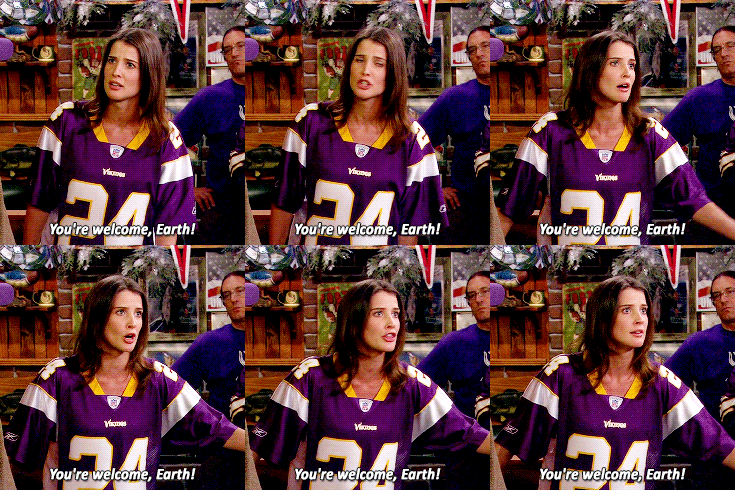
I realize I’m several years late to this particular party, but I have a huge problem with the originally aired final episode of the sitcom How I Met Your Mother. It’s not just that I don’t like what the episode did to the main characters and their relationships; it’s that the final episode undid much of what I liked about the series as a whole.

How I Met Your Mother is the story of five friends and their adventures as the main character, Ted, tries to find Miss Right, as told in retrospect by an older Ted to his children. A lot of the charm of the series is the way it plays with the idea of story-telling and memory: episodes often tell events out of order or literalize old Ted’s slips of memory and half-truths (a person whose name Ted can’t remember is just called Blah-Blah, all flashbacks to college-age characters smoking pot have them eating sandwiches instead, etc.). But beyond this narrative playfulness, one of the things I appreciate most about the series is that it undercuts three of the big toxic tropes about relationships that pervade so much of popular culture. Unfortunately, all three of these tropes are snapped right back into place by the final episode.

At its best, How I Met Your Mother showed that:

1. Women do not exist to serve men’s emotional needs

Robin and Lily, the main female characters of the series, are not just emotional props for the men in their lives but are fully-rounded characters with lives, careers, ambitions, desires, and foibles of their own. The Mother, who finally turns up in the last season, is also a well-developed character with her own quirks, history, and emotional life. Although they all have relationships with men, none of them exists solely to serve the needs of a man’s emotional fulfillment.

In the final episode, however, Lily is largely absent, the Mother—having given Ted the children he wanted but that Robin couldn’t have—swiftly dies of a convenient cancer of the plot, and Ted is finally free to pursue Robin at last, who gamely falls into his arms. From three full and interesting characters, the women of the series are at the end reduced to a nonentity, a plot device, and a cereal-box prize.

2. Men and women can be friends

When Ted and Robin split up after a brief early relationship, they don’t just go their separate ways. After an understandable period of awkwardness and division, they remain part of the same group of friends and develop a comfortable, even intimate friendship. They rely on one another, confide in one another, and look out for each other’s well-being. This is what reasonable people do in the real world. The idea that any relationship between a man and a woman must necessarily lead to either romance or heartbreak has robbed the world of too many potential friendships. How I Met Your Mother showed up this lie for what it is.

Until the final episode, when we discover that Ted and Robin’s friendship was just a holding pattern until they were both ready to fall back into each other’s arms.

3. A relationship doesn’t have to be perfect to be good
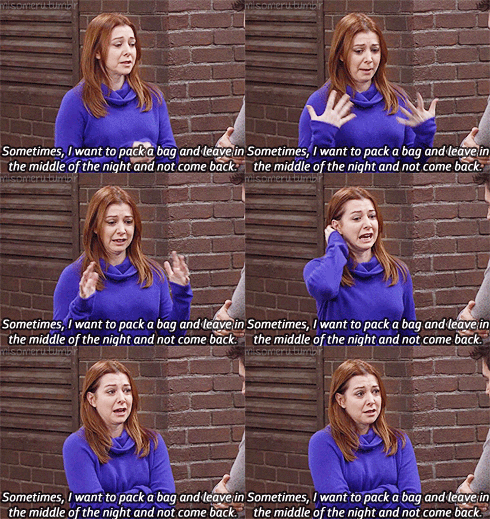
In fiction, the conservation of narrative detail usually means that any conflict within a couple is a sign that the relationship is either broken and in need of transformative repair or else fatally flawed and doomed to end badly. How I Met Your Mother avoided this trope by showing us how Lily and Marshal have a good, strong, loving relationship despite their conflicts, upsets, and rough patches, just like most real-world couples. The last few seasons show us how Robin and Barney, despite their own individual problems, grow together into a couple that works.

Then the final episode comes around and the need to release Robin to be scooped up by Ted means that Robin and Barney’s marriage has to come apart at the seams. After several years of the characters figuring out how to make their relationship work, one on-screen argument is enough to break it all to pieces.

As I said, I know I’m far from the first person to gripe about the show’s final episode, but the reason it bothers me so much is because it directly undercuts so much of what was good about the series to begin with. Somehow, good things that end up going bad annoy me more than things that are just bad to begin with.

Images: Robin via Giphy; Robin and Barney via Giphy; Lily via Giphy

In the Seen on Screen occasional feature, we discuss movies and television shows of interest.

Gleaned from Bodleian Libraries Workshop on Ultramarine Blue

Did you know that the Bodleian Libraries at the University of Oxford have a Tumblr micro blog? I didn’t until just recently. And oh my, it’s a treasure trove!

Bodleian Libraries Ultramarine Young Man Blue Rock Bodl MS Elliott 287 fol34a

A short post gives a few tantalising details on lapis lazuli, the mineral that was ground down to get bright blue pigment for example for illuminating Medieval manuscripts:

“In his travels Marco Polo vividly described the cold province of Badakhshan, a prosperous land where horses that descended from Alexander’s horse Bucephalus were once bred and where priceless rubies and the finest lapis lazuli were found.

“Since ancient times lapis lazuli has been sourced in this remote region, north-east of modern Afghanistan, and exported over vast distances. Its mines on the steep Hindu Kush Mountains, above the Valley of the Kokcha River, can only be reached through a tortuous and dangerous route.

“Lapis lazuli consists of a large number of minerals, including the blue mineral lazurite, the white mineral calcite and golden specks of iron pyrites.

“A laborious process transforms this composite mineral into the pigment ultramarine; various grades of ultramarine can be obtained, from the purest extremely expensive deep blue, composed mostly of lazurite particles to the pale grey so-called ultramarine ash.”


Tumblr Bodleian Libraries Ultramarine Workshop Screencap

The conservators at Bodleian (Anita Chowdry, David Margulies and Marinita Stiglitz) learned how to make pigment from scratch in a two-day workshop, and shared their notes in a longer post.

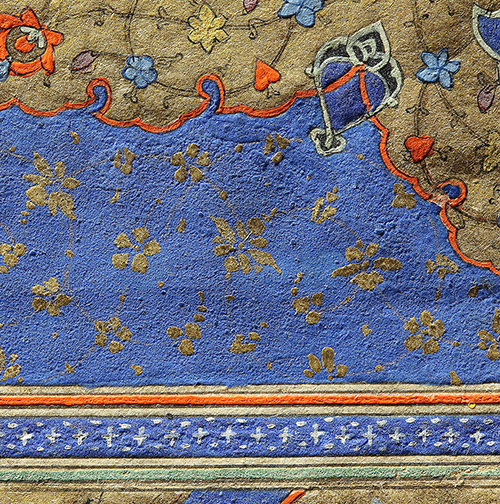
Bodleian Libraries Ultramarine Detail Bodl MS Arab d98 fol1b

Both the historical process and conservators’ efforts are fascinating! Did you know, for instance, that before explosives were developed, lapis lazuli was mined with the help of large fires and cold water?

Visit the Tumblr post for more photos, and read more in the Bodleian blog post “Exploring Ultramarine”.

Found via MedievalPOC on Tumblr.

Images via Bodleian Libraries: Young man picks a blue rock, Bodleian Library, MS. Elliott 287, fol. 34a. Workshop image collage screencapped from Tumblr. Detail of Bodleian Library, MS. Arab. d. 98, fol. 1B.

How It Happens is an occasional feature looking at the inner workings of various creative efforts.

An Extant Map as Evidence of Native American Cartography

In the U.S., and indeed more widely in the Anglo-American world, Meriwether Lewis and William Clarke are known for their two-year expedition of the Louisiana territory (purchased from France in 1803) and the land beyond the “great rock mountains” in the west.

Less commonly remembered in cursory mentions is the extent of Lewis and Clarke’s interactions with local Native Americans. (Apart from Sacagawea, who is known at least in the U.S.) The whites didn’t just exchange gifts or talk about trade or clash with the local population; they received invaluable help and information (like when the expedition wintered with the Mandan people in present-day North Dakota).

Now it seems that western historians need to re-evaluate that extent.

According to The Jefferson Watch, cartographers have identified at least ten places in the journals of Lewis and Clarke where the captains talk about the maps by Native American hosts to help them figure out the lay of the land.

Christopher Steinke, at the time a graduate student at the University of New Mexico, found one of those maps at the archives of the Bibliothèque nationale de France (BnF) in Paris. It was drawn by Inquidanécharo, a chief of the Arikara (in French, Ricara), who was apparently also known as Too Né.

LudditeLabs on Twitter did some of the heavy lifting and linked to the BnF digital copy of the map:

BnF Gallica Inquidanecharo Map Missouri Valley

An article by Steinke is available at JSTOR, where this abstract comes from:

“The Bibliothèque nationale de France contains a hitherto unnoticed map attributed to Inquidanécharo, a Ricara chief. Lewis and Clark knew him as Too Né, an Arikara village leader who accompanied them upriver to the Mandan and Hidatsa villages in 1804. The map, which Too Né showed to playwright and artist William Dunlap when he visited Washington in 1806, is the most detailed surviving Indian representation of the Great Plains from this period. It invites scholars to reorient early American exploration and cartography from indigenous perspectives. Too Né interpreted his map as a work of history and cartography and situated the American explorers in the historical and religious landscape of the Arikara people.”

In “Here is My Country”, Steinke outlines some of the main features of Inquidanécharo’s map, and recounts some history surrounding it. He also lists a few other Native American maps from the eighteenth and early nineteenth centuries.

What most struck me, though, is that Native American maps seem to have contained more information than just geographical details—they also depicted cultural connections and ethnographical information.

I knew Native Americans used symbols and pictograms, and had to have—like people everywhere—a way of talking about and remembering locations outside their immediate surroundings. I had no idea, however, that Native American cartography was as polished or wide-reaching as it was (a hint for the Finnish school system), let alone that their maps might still be extant. Fascinating!

Found via bluecorncomics on Twitter.

This post has been edited to correct a typo.

In Live and Active Cultures we talk about cultures and cultural differences.

Midsummer Fire Festival Transmogs

Alunaria of Alunaria’s Avenue has proposed a new transmogging challenge: transmogs for the Midsummer Fire Festival that also fit with your class. We’re always up for transmogging fun, so here’s our ideas.

Erik here.

For my Tauren shaman, the Midsummer celebration is very important. It is a time to honor the spirits of the fire, which she does by dancing in her Flamedancer Regalia.

My Gnomish warlock is a different case. You see, when it comes to fire, warlocks are professionals, so the Fire Festival is a bit of a bus-driver’s holiday for her. It’s the one time of the year when people who don’t know what they’re doing try to set things on fire, so if she hung around the festivities she would just find herself screaming at everyone:

You’ve built that bonfire all wrong! There’s nowhere near enough kindling, the wood isn’t properly seasoned, it’s too close to the tent, and you put it upwind of the dance pole! Does no one here know what they’re doing but me!?”

So, for her, Midsummer is a time to get away from it all and go have her own private little fire way up in the snowy mountains where no one will bother her. She dresses appropriately for the climate in her Aurora-Seeker’s Garb.

Eppu here.

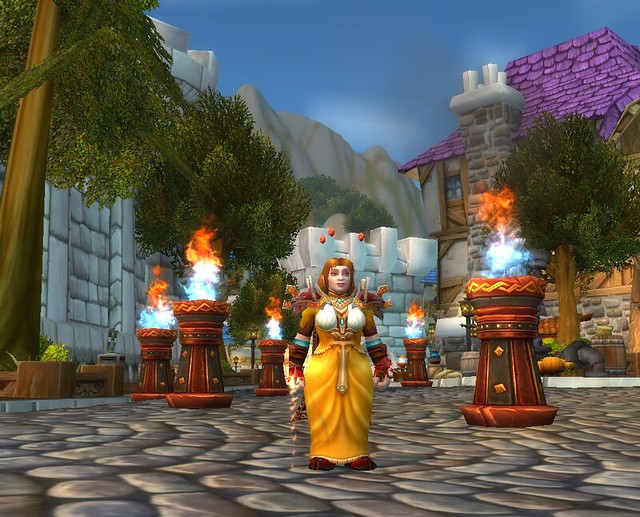
My fire mage’s hidden artifact appearance mog is already so gorgeous there isn’t really improving it, but I did change a few things to make it more Fire Festival-y.

WoW Fire Festival Fire Mage Braziers 2018

I was able to find a decently matching shirt, so it looks like the dress has sleeves (Elegant Robes plus Golden Filigreed Shirt). Otherwise, I pushed the accent colors (headpiece, boots, gloves, shoulders, cloak) more towards red and orange. Finally, I borrowed a red wand and a red flower (Flash Wand, Penelope’s Rose) from my arcane mage’s Love Is in the Air mog.

Now she’s ready to light up the town! 🙂

Of Dice and Dragons is an occasional feature about games and gaming.

Black Panther Is Coming to the Smithsonian African American Museum

Earlier this year, the Smithsonian African American Museum of History and Culture screened the superhero movie Black Panther as part of their programming.

Smithsonian African American Museum Black Panther Hero Suit

Now the museum has plans to incorporate the movie into their collections in a larger way:

“The museum acquired several objects from Disney’s record-breaking film Black Panther, including the hero costume worn by actor Chadwick Boseman; a shooting script signed by Ryan Coogler (co-writer; director), Kevin Feige (producer, president of Marvel Studios), Nate Moore (executive producer) and Joe Robert Cole (co-writer; producer); two pages of spec script; and 24 high-resolution production photographs. Plans for display of the objects are under consideration by the museum.” […]

Black Panther is the first superhero of African descent to appear in mainstream American comics, and the film itself is the first major cinematic production based on the character. Black Panther illustrates the progression of blacks in film, an industry that in the past has overlooked blacks, or regulated them to flat, one-dimensional and marginalized figures. The film, like the museum, provides a fuller story of black culture and identity.”

Interesting! “Plans for display … are under consideration” definitely sounds like museum speak for planning a permanent exhibit. 🙂 In the meanwhile, the collection spotlight blog post, “Wakanda to Smithsonian”, includes a few images of the Black Panther hero costume (armor) on the premises.

Found via File 770.

Image by The Smithsonian National Museum of African American History and Culture

Ant-Man and the Wasp Trailers

Ant-Man and the Wasp opens July 06, 2018—in about ten days! I didn’t know anything about Ant-Man going into the first movie, and I liked it a lot more than I thought I would. Just on the basis of that, I have high hopes for AM&tW.

This French poster certainly rocks:

IMDB Ant-Man and the Wasp French Poster

Here’s the trailer from January:

Marvel Studios’ Ant-Man and the Wasp – Official Trailer #1 by Marvel Entertainment

And one from the beginning of May:

Marvel Studios’ Ant-Man and The Wasp – Official Trailer by Marvel Entertainment

Basically the new one is the same as the January trailer except with more info. Still looks like great fun, though.

As for favorite side characters, Michael Peña returns as Luis, Judy Greer as Maggie Lang, and Abby Ryder Fortson as Cassie Lang—it’ll be great to see them all. Laurence Fishburne makes a first-time appearance as Dr. Bill Foster / Goliath. I didn’t realize that Michelle Pfeiffer is in the movie, too—cool cool cool. Hannah John-Kamen I haven’t seen before even though she’s been in Ready Player One and Game of Thrones; at least I don’t remember spotting her as a First Order officer in The Force Awakens.

Also, I just want to officially say that the GINORMOUS HELLO KITTY PEZ DISPENSER IS SO AWESOME! 🙂 😀

Image: Ant-Man and the Wasp poster via IMDB

Hey, look! We found a thing on the internet! We thought it was cool, and wanted to share it with you.

Equal Pay for Persian Women

A cache of administrative documents from the ancient Persian empire reveals an intriguing facet of Persian economic life: female workers were often paid the same amount as their male counterparts. Some women were even paid more than men.

While slavery existed in the Persian Empire, the Persians did not enslave conquered people en masse in the way that other ancient empires like the Assyrians and Romans did. Much basic agricultural and craft labor was done by workers who were paid in rations of grain, wine, beer, and livestock, either for their own consumption or to barter for other goods. Ensuring that everyone got properly paid was the work of administrators who documented the distribution of these commodities from royal and aristocratic estates to the workers who supported the elite. The documents created by these administrators were not intended for posterity, but some survived by chance when Alexander the Great’s army destroyed the palace at Persepolis. The collapse of part of the building protected the archive it contained of about fifty years’ worth of documents. Excavations in the 1930s recovered documents like these two below.

An arashshara was a female supervisor managing a group of pashap, who were workers of some kind. The exact meaning of the term pashap is unclear, but it seems to have applied to agricultural and craft laborers who were supported with monthly distributions of food and supplies. The different levels of rations assigned to groups of workers in these texts probably reflect different ages and levels of responsibility.

1 arashshara of the pashap subsisting on rations at Umpuranush, whose apportionments are set by Irshena, received as rations 30 quarts of wine supplied by Irtuppoya. Month 2, year 22.

– Persepolis Foundation Text 876

(Translations from Maria Brosius, The Persian Empire from Cyrus II to Artaxerxes I. London Association of Classical Teachers Original Records 16, London: 2000. Slightly adapted for clarity)

30 quarts of wine for a month was typical for local supervisors like this one. It was a generous, if not luxurious, standard of pay.

Pashap at Liduma, assigned by Irshena, subsisting on rations, received as rations for one month: 2,615 quarts of grain supplied by Irtuppiya

  • 16 men (each receive) 30 quarts
  • 7 boys 20
  • 5 boys 15
  • 6 boys 10
  • 1 woman 50
  • 34 women 40
  • 1 woman 20
  • 2 girls 20
  • 2 girls 15
  • 9 girls 10

Total: 92 workers.

– Persepolis Foundation Text 847


It is worth noting how many women in the second text were paid as much or more than their male colleagues, and also that the highest paid worker on the list was a woman (probably the arashshara of the workers at Liduma). If we break down the numbers, there are a total of 34 male workers being paid an average of just over 22 quarts of grain a month, while 49 female workers were paid an average of more than 32 quarts.

Other tablets show that this distribution of pay was not universal, but neither was it atypical. Not every woman in Persia was paid as much as a man for her work, but many of them were, and those who were placed in positions of responsibility received pay to match.

If the ancient Persians could do it, what’s stopping us from doing the same today?

History for Writers is a weekly feature which looks at how history can be a fiction writer’s most useful tool. From worldbuilding to dialogue, history helps you write. Check out the introduction to History for Writers here.

Rating: Doctor Who, Season 8

We have carried on our rewatching and rating to season 8 of the modern Doctor Who. Here’s our take:

  1. “Deep Breath” – 5.5
  2. “Into the Dalek” – 5
  3. “Robot of Sherwood” – 2
  4. “Listen” – 1.5
  5. “Time Heist” – 5
  6. “The Caretaker” – 3
  7. “Kill the Moon” – 6
  8. “Mummy on the Orient Express” – 6.5
  9. “Flatline” – 5.5
  10. “In the Forest of the Night” – 5
  11. “Dark Water” – 1.5
  12. “Death in Heaven” – 1.5

The average rating this season comes out to exactly 4, which is weak but not terrible. This comes in as the second-lowest-rated season after season 5, at 3.7. This season’s episodes are all over the place, which for Doctor Who is not a bad thing. Not all of the episodes work, but we appreciate the willingness to try out strange ideas, unexpected settings, and dramatically different moods.

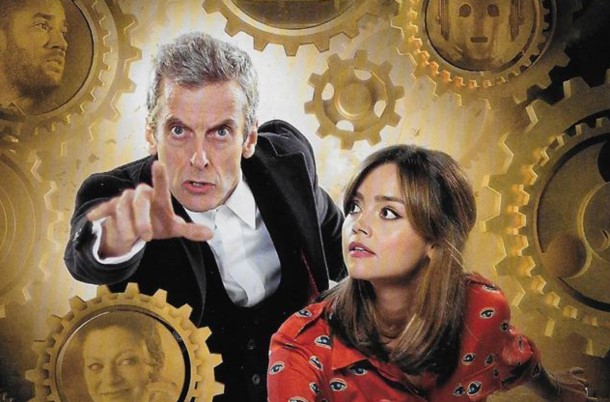
This season also introduces Peter Capaldi as the Doctor, and it’s a bit of a shaky start. Capaldi’s intensity is a nice change from Matt Smith’s quirky detachment, but too often it manifests as anger. As that anger often gets focused on Clara, we have the uncomfortable dynamic of a young woman saddled with the emotional labor of managing a cranky older man’s moods, and one begins to wonder if someone in the production team is having a bit of a temper tantrum about changing gender dynamics in the workplace. Still, straight out of the gate, Capaldi is more convincing as the Doctor than Smith ever was.

Three episodes are tied for our lowest rating of the season, at 1.5. The first is “Listen,” an ambitiously strange episode that tries to recapture the atmospheric spookiness of the classic “Blink,” but falls flat. The Doctor is looking for a creature so good at hiding that no one has ever seen it. This intriguing setup leads to a disjointed series of maybe / maybe-not monster hunts that for some reason revolve around Clara’s fellow teacher and potential boyfriend Danny Pink. Despite some well-written and tensely-directed individual scenes, the episode remains too unfocused and too committed to the is-it-or-isn’t-it schtick to develop any meaningful narrative drive or reach any satisfying conclusion. The pieces of the puzzle lie scattered on the floor, refusing to come together and make a picture.

The other two 1.5s are the obligatory concluding two-parter “Dark Water” and “Death in Heaven,” in which the latest regeneration of the Doctor’s old nemesis, the Master—now female and going by Missy—reveals that she has been hijacking dead people to make liquid cybermen out of their bodies so that she can make the Doctor uncomfortable by… you know, nothing about the plot of these episodes makes any sense, or, really, matters. Michelle Gomez has a blast chewing the scenery as Missy (and provides a valuable canonical precedent for Time Folks gender-flipping during regeneration), but as usual in this series, the Master’s overly contrived plans just come off as a juvenile play for attention. As tends to happen on Doctor Who, putting the whole world in peril actually serves to lower the stakes, rather than raise them, and this season’s ender comes off as more petty than anything else.

At the other end of the scale, “Mummy on the Orient Express” is the best episode of the season, at 6.5. In this episode, a version of the Orient Express train flying through space is plagued by the appearance of a legendary monster only visible to its victims. On one hand, this episode would have benefited from some more development. Unlike on the replica Titanic of “The Voyage of the Damned,” we never get any kind of explanation as to why a space train in the future is a replica of the Orient Express with all the guests wearing period clothing. The guest cast, though excellent, is underused, and the ending leaves a huge plot thread conspicuously dangling. On the other hand, there are a lot of strong elements. The mystery is intriguing and its resolution neatly ties up the clues. The pacing runs along smoothly, and the device of an on-screen timer counting down the mummy’s attack is cleverly used to build tension. For mystery fans, there is also a subtle nod to Agatha Christie’s Murder on the Orient Express, as what seems like a train full of strangers turns out to have been assembled for a very particular purpose.

What’s your take on this season? Does Capaldi do it for you? Is “Listen” just your cup of tea? Not enthused by the mummy on the space train? Let us know!

Image: Doctor Who season 8 cover via IMDb

In the Seen on Screen occasional feature, we discuss movies and television shows of interest.