Matrilineality

Most traditional societies around the world have been patrilineal: power and property are passed down the male line of succession, usually from father to son, sometimes from grandfather to grandson, only on rare occasions to other relatives such as nephews, brothers, or cousins who share a common male ancestor. Some societies, however, have been matrilineal, where lines of succession are defined by descent from a common female ancestor. In these societies, power and property typically pass from brother to brother or uncle to nephew, only rarely from father to son.

Matrilineality should not be mistaken for matriarchy. Matrilineal cultures are often just as patriarchal as patrilineal ones are. Matrilineality is not a matter of women having power or being more important in society than men; it’s just a different way of determining which man is important and powerful.

Matrilineal succession can seem confusing and hard to follow for those of us who are used to the rules of patrilineality, but the principle is straightforward: to identify the next in line, find the nearest male relative who can trace their descent through their mothers, grandmothers, great-grandmothers, etc. to a common female ancestor with the current holder of the property or position in question. The nearest would be a brother by the same mother. Next nearest would be a nephew whose mother was the current person’s sister by the same mother.

Here’s an example. Consider this extended family.

In a patrilineal society, here’s how property and power would pass down from the eldest son of the original couple to his son and grandson.

In a matrilineal society, the line of succession from the same eldest son would go first to his brother, then to a nephew, then another nephew, then his brother.

Matrilineal succession has advantages for certain kinds of societies under certain circumstances. For one thing, it spreads power and property out among the family lines of a clan or extended kin group, rather than letting one line have a monopoly. It can also create incentives for skilled and ambitious men to marry into the family—if we image the example above tracing the lines of succession for a kingdom, the men who marry into the family will never be king themselves, but their sons and grandsons might be. Another advantage to matrilineality is it multiplies the number of legitimate heirs within any given generation, which can be helpful in times of crisis when a man might die leaving no sons of age to take over his position.

For these reasons, matrilineal patterns of succession often appear in societies that need to encourage cohesion and cooperation among different families in the face of a dangerous world.

Thoughts for writers

Lots of good stories involve questions of succession, whether its the return of a lost heir to claim their rightful inheritance, a struggle for power among rival families, or the mysterious death of a rich old miser. If you’re in the mood to write that kind of story, it’s worth thinking about the rules of succession in your world and what consequences they might have for your characters. Even if a matrilineal society isn’t in the cards, it’s good to remember that not everything has to go from father to eldest son.

Charts by Erik Jensen

History for Writers looks at how history can be a fiction writer’s most useful tool. From worldbuilding to dialogue, history helps you write.


Rating: Deep Space Nine, Season 4

Season 4 of Star Trek: Deep Space Nine has some great episodes and some fairly bad misfires. The Klingons, having been quiet for years, are suddenly feeling aggressive again, and our favorite Klingon, Worf, joins the station crew to help them deal with the consequences. This story fuels a good part of the season, but there’s plenty more to see, too. Here’s our take:

  1. “The Way of the Warrior” – 7
  2. “The Visitor” – 9
  3. “Hippocratic Oath” – 5.5
  4. “Indiscretion” – 5.5
  5. “Rejoined” – 8
  6. “Starship Down” – 8
  7. “Little Green Men” – 8
  8. “The Sword of Kahless” – 1.5
  9. “Our Man Bashir” – 10
  10. “Homefront” – 3
  11. “Paradise Lost” – 5
  12. “Crossfire” – 2
  13. “Return to Grace” – 4
  14. “Sons of Mogh” – 1
  15. “Bar Association” – 7
  16. “Accession” – 2
  17. “Rules of Engagement” – 2
  18. “Hard Time” – 2
  19. “Shattered Mirror” – 3.5
  20. “The Muse” – 2
  21. “For the Cause” – 4
  22. “To the Death” – 6
  23. “The Quickening” – 4.5
  24. “Body Parts” – 6
  25. “Broken Link” – 4

The average rating this season is 4.9, the same as in season 3, but season 4 gets there a different way. Where season 3’s episodes were mostly in the weak-average to average-good range, season 4 sends its episodes to the far ends of the scale. Only a handful fall in the 4-6 okay-but-not-great range; most are either well above or well below.

The distribution of ratings shows a certain level of confidence by the writers this season. You can tell that they felt comfortable enough with the characters and the setting at this point that they were ready to try new ideas, even really weird ones. What if we spent an episode in the holosuite playing a James Bond pastiche? What if we met a suicidal Klingon? What if Quark, Rom, and Nog were the Roswell aliens? What if there were a conspiracy to stage a military coup on Earth?

Some of these ideas really flop, like “Sons of Mogh,” scoring only a 1, in which Worf has to deal with his brother Kurn, who is depressed about the loss of status their family has suffered in the empire. The story presents the kind of ethical dilemma Star Trek specializes in—suicide is an honorable end for a Klingon with no hope, but it is unacceptable for a Starfleet officer like Worf—but never goes anywhere interesting with it. The episode boils down to Kurn standing on one side of Worf shouting “Kill me!” and the rest of the station crew on the other shouting “Don’t!” There’s nowhere interesting for this story to go.

On the other hand, some of these ideas pay off brilliantly, like “Our Man Bashir,” a full 10, which finds Dr. Bashir and Garak playing a swinging-sixties spy game in the holosuite for much higher stakes than they expected. DS9 largely avoids the Next Generation shtick of having the holodeck go haywire so the crew can have an adventure in period garb, but this episode figures out a way to make the holosuite matter: after a transporter accident, the main station crew’s physical patterns are stored on the holosuite until they can be rescued, but if the game shuts down they could be lost forever. This set-up gives us several delightful results: Bashir, the doctor playing spy, and Garak, the spy playing tailor, take their witty repartee to new heights in this episode, while some of the other regular cast get to go full ham in their holosutie roles—Nana Visitor as a sultry Russian agent and Avery Brooks as an omnicidal mad scientist steal every scene they’re in.

The rest of this season largely follows suit. Some ideas, like sending Worf and Dax on a quest for a lost Klingon artifact in “The Sword of Kahless”, just sputter and die. Others yield fantastic episodes, like “Little Green Men,” a hilarious romp through pulp sci-fi tropes, or “The Visitor,” a touching meditation on the power of love and memory.

While the Klingon war story at times just feels like a holding action while waiting for the Dominion to make its move, it also gives the series some new avenues to explore. This season does a lot of interesting work by overturning the status quo and seeing what happens to familiar characters in unfamiliar situations. Worf, Quark, Odo, and Dukat all find themselves cut off from their people in different ways; Sisko faces the possibility of treason within Starfleet; Dax has to grapple with the legacy of her past lives in ways she has not faced before; and Rom and Nog start new lives outside the traditional bounds of Ferengi culture.

Season 4 has a lot going for it, even if not every idea works. There’s a lot here that’s well worth coming back to.

Image: Bashir and Garak all tuxed up from “Our Man Bashir” via IMDb

In the Seen on Screen occasional feature, we discuss movies and television shows of interest.

Quotes: We Humans Need Cinema, as a Collective Experience

Director Denis Villeneuve (whom I know from Arrival and Blade Runner 2049) talks about the decision made by Warner Brothers to release their new movies concurrently in theaters plus their streaming platform in an interview with Variety:

“I strongly believe the future of cinema will be on the big screen, no matter what any Wall Street dilettante says. Since the dawn of time, humans have deeply needed communal storytelling experiences. Cinema on the big screen is more than a business, it is an art form that brings people together, celebrating humanity, enhancing our empathy for one another — it’s one of the very last artistic, in-person collective experiences we share as human beings.

“Once the pandemic is over, theaters will be filled again with film lovers.

“That is my strong belief. Not because the movie industry needs it, but because we humans need cinema, as a collective experience.”

This is a hairy situation. I fully agree with Villeneuve in that the theater experience—both movies and traditional plays, not to mention concerts of all varieties—was created with the physical presence of masses in mind, and, indeed, it benefits enormously from our physicality.

Technology has drastically changed how many things can be achieved digitally instead of physically. However, the fact has not changed that we are physical beings and crave physical experiences. There’s nothing quite like being drawn into a story and hearing the crowd around you reacting to it with you. (Think of sports events if you’re a sports fan.)

At the same time, however, I cannot but applaud the decision from an accessibility point of view. Personally, I literally understand and enjoy movies much, much better when I can access subtitling or captioning (and this is before the reduced hearing that’s in my family’s genes has really affected me; subtitles will only get more important for me in the future). And despite the theaters Erik and I usually visited in the Before Times being physically accessible, I have also visited theaters that aren’t, or theaters that have inaccessible bathrooms, or theaters that have bad seating.

Of course, one doesn’t have to have a disability or chronic conditions to enjoy streaming brand new movies. Coming from a large family I know herding kids in and out of theaters isn’t always easy. And there have been times I might have wanted to see a movie, but it would’ve meant slogging back out after a long day, waiting for a bus to take me downtown (or riding my bike in the wind and the rain) and all of it back again afterwards, so instead I stayed comfortably home.

There are a number of ways in which streaming content immediately on release day will benefit ordinary folks of all kind. At the same time, I do hope, most fervently, that movies made for the big screen do not disappear. For me, like for Villeneuve, they’re one of the major cultural features of 20th and 21st centuries.

Serving exactly what it sounds like, the Quotes feature excerpts other people’s thoughts.

Latest Wonder Woman 1984 Teaser

Warner Brothers has released a new 60-second Wonder Woman 1984 teaser:

WONDER WOMAN 1984 – CCXP :60 by Warner Bros. Picture on YouTube

We see a few new scenes and voiceovers. I assume it’s Diana’s mother who says in the first half of the video “This world is not yet ready for all you will do” as a lead-in to some amazing stunts, like lassoing the tail of an airplane or a bolt of thunder(!).

I confess I’m sceptical of how well those kinds of stunts might work; I mean that I have a hard time imagining them not looking ridiculous. I guess we’ll see. (Eventually. We’ve been too busy to talk about when we might want to see WW84.)

2020 has been a difficult year for the performing arts, too. Apparently, to recoup some of the losses, Wonder Woman 1984 will be shown in selected theaters in the U.S. and concurrently streamed on HBO Max. The release date here is December 25, 2020.

Hey, look! We found a thing on the internet! We thought it was cool, and wanted to share it with you.

Living Vicariously Through Social Media: Inspiration for Moria Doors

Sophie Berry on Twitter shared this amazing photo of a church door flanked by two trees that have basically grown into the wall:

Twitter Sophie Berry St Edwards Stow-in-the-Wold Back Door

Apparently it’s thought to be the inspiration for the doors of Moria in Tolkien’s Lord of the Rings. No surprise there. How incredible!

Image via Sophie Berry on Twitter.

Out There is an occasional feature highlighting intriguing art, spaces, places, phenomena, flora, and fauna.

History for Writers Compendium: 2020

History for Writers explores history to offer ideas and observations of interest to those of us who are in the business of inventing new worlds, cultures, and histories of our own. Here’s what we’ve been talking about in 2020:

Thinking historically

Thinking mythically

Imagining other places

Living other lives

Writing other worlds

People in the past

Join us in 2021 for more history from a SFF writer’s perspective.

History for Writers is a weekly feature which looks at how history can be a fiction writer’s most useful tool. From worldbuilding to dialogue, history helps you write.

Rating: Deep Space Nine, Season 3

We’re back with season 3 of Star Trek: Deep Space Nine, and things are starting to look up as the series moves further toward developing its characters and its longer-term plots. Here’s our episode ratings:

  1. “The Search, Part I” – 4
  2. “The Search, Part II” – 5.5
  3. “The House of Quark” – 8
  4. “Equilibrium” – 4.5
  5. “Second Skin” – 5.5
  6. “The Abandoned” – 2
  7. “Civil Defense” – 6.5
  8. “Meridian” – 3.5
  9. “Defiant” – 4.5
  10. “Fascination” – 4.5
  11. “Past Tense, Part I” – 3
  12. “Past Tense, Part II” – 3
  13. “Life Support” – 4
  14. “Heart of Stone” – 7
  15. “Destiny” – 6
  16. “Prophet Motive” – 6.5
  17. “Visionary” – 6
  18. “Distant Voices” – 3.5
  19. “Through the Looking Glass” – 4
  20. “Improbable Cause” – 6
  21. “The Die is Cast” – 5
  22. “Explorers” – 6
  23. “Family Business” – 5
  24. “Shakaar” – 4
  25. “Facets” – 5
  26. “The Adversary” – 4.5

The average rating for this season is 4.9, a good step up from last season’s 3.9. There are few particularly good episodes this season, but also few particularly bad ones. Most sit comfortably in the okay-but-not-great 4 to 6 range.

You can tell that both the writers and the actors are more at ease with the characters and ready to push them in interesting directions. This season Kira has to reckon with the consequences of her violent past as a freedom fighter, Jake takes his first faltering steps as an adult, while Sisko the elder gets a promotion to captain, a new ship, and a handsome bald head. Even minor characters such as Nog, Garak, and Kai Winn experience substantial changes. No one faces as much of a challenge this season, though, as Odo, who discovers his people only to learn the horrible truth about them.

Our lowest rating this season goes to “The Abandoned,” at 2, in which Odo tries to show a young Jem’Hadar an alternative to violence. Despite a strong performance by Rene Auberjonois, this episode falls flat. There is little development and no payoff in this story. Other episodes do a much better job of both exploring the Jem’Hadar and showing us how Odo deals with the atrocities committed by the Founders. It also hews uncomfortably close to the racist 90s discourse of “superpredators.”

At the other end, we have the delightful “House of Quark,” at 8, as our highest-rated episode. This episode is a violent but entertaining comedy of manners as the bloody, honor-bound world of Klingon dynastic politics collides with the cowardly but cunning financial chicanery of the Ferengi. Armin Shimerman and guest star Mary Kay Adams play marvelously off one another as the lovable Ferengi rogue Quark and the imperious Klingon grande dame Grilka, while Robert O’Reilly, who plays the normally intense and calculating Chancellor Gowron gets to do a bit of slapstick comedy. Also worth noting is “Heart of Stone,” at 7, in which Odo confesses his love to what he thinks is a dying Kira, and Nog seeks Sisko’s support for joining Starfleet Academy; both stories give us some excellent acting and interesting character development.

This season sees some significant shifts toward the long-term storytelling that would define DS9‘s later seasons. Although most episodes remain standalone (or self-contained two-parters), many of them bring important changes to characters or plotlines which are picked up by later episodes. The politics of both Bajor and Cardassia, as well as the relationship between them, see major upheavals this season, while the threat of the Dominion becomes more sharply defined and its relationship with the Alpha Quadrant more complicated.

Got any favorites of your own from season 3? Let us know!

Image: Grilka and Quark in a marriage of (in)convenience, from “House of Quark” via IMDb

In the Seen on Screen occasional feature, we discuss movies and television shows of interest.

Nordic Myth and Magic School Vølurheim

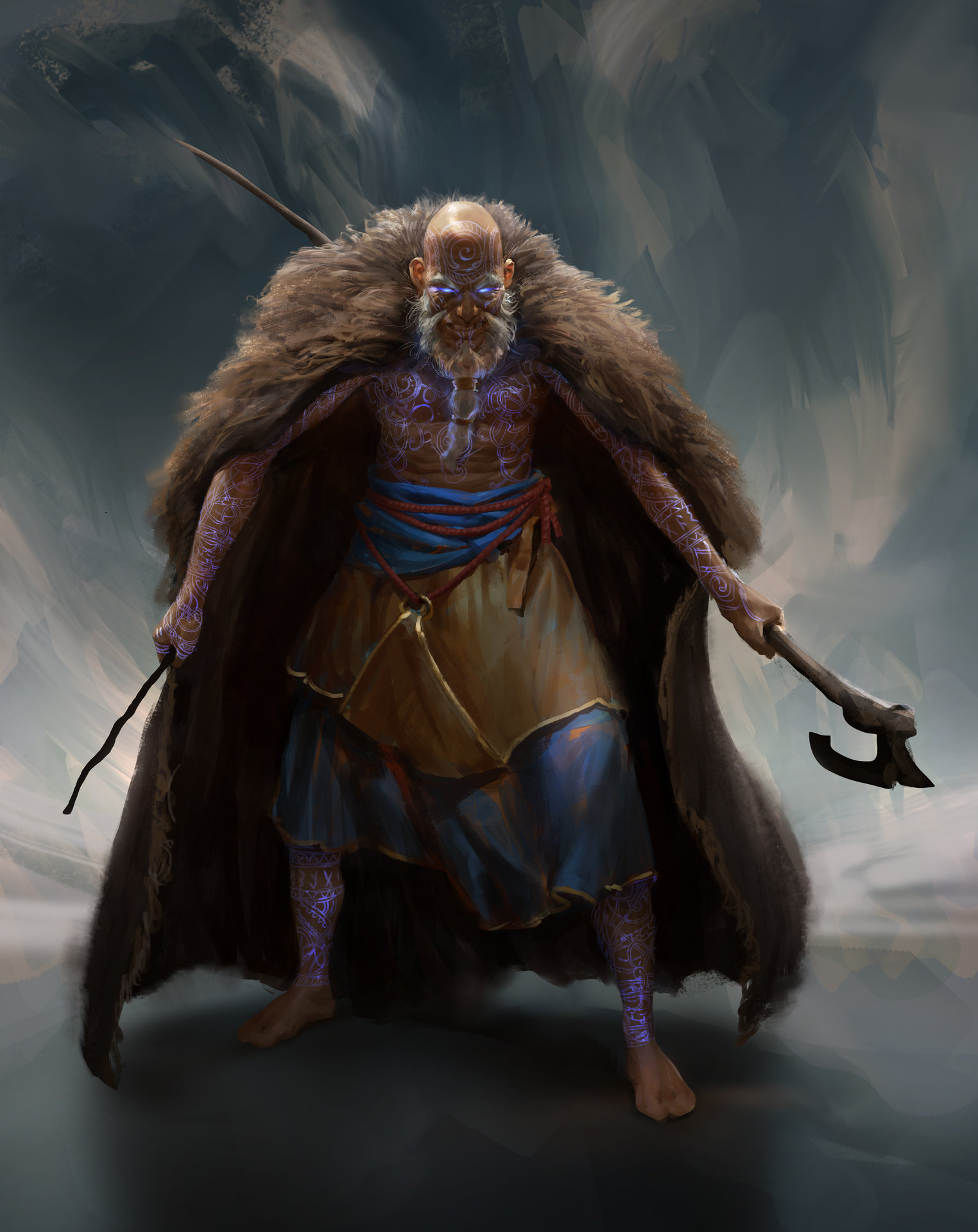
Artist Even Amundsen has been doodling character portraits for teachers at a hypothetical Harry Potter -style Scandinavian myth and magic school. He calls the school Vølurheim.

The names of the Professors include very Scandi monikers such as Hulda Kvænangsdottir, Dagfinn Snauholt, and Kari Sigfridsdotter. Amundsen has even come up with a background for everyone.

The portraits are fabulous in every sense – and as a bonus, the outfits are very reminiscent of historical Scandinavian garb and folk costumes. Below are some of my favorite characters.

Ragnhild Stubbemoen is the Professor of Dragon Lore and Care:

ArtStation Even Amundsen Volurheim Ragnhild

Apparently she’s taught at Vølurheim for 79 years already—and by the looks of her, she’s ready for another 80.

Mumrikk Stigandur is the Professor of Herbology:

ArtStation Even Amundsen Volurheim Mumrikk

Amundsen said he’s “heavily inspired” by Snufkin (Snusmumriken in Swedish or Nuuskamuikkunen in Finnish) from the Moomin stories. You can definitely see the resemblance!

Professor of Defense Against the Dark Arts and veteran warlock of the Troll Wars is called Grimstav Draugsleiven. His portrait really shows his survival capabilities:

ArtStation Even Amundsen Volurheim Grimstav

Magnificent, isn’t it? (Elemental shaman in WoW, anyone?)

Even Mehl Amundsen is a freelance concept artist from Norway who has worked for studios like Ubisoft, Blizzard, Riot, Axis Animation, and Wizards of the Coasts, among others. You can see more of his work at ArtStation.

In Making Stuff occasional feature, we share fun arts and crafts done by us and our fellow geeks and nerds.

Make Your Own Superhero Snowflakes

Some awesome people’s skills include puzzling out how to have paper snowflakes come out gorgeous. You remember the ones we made in elementary school: fold a piece of paper in sixths or eights, go to town with scissors, unfold the paper, and Bob’s your uncle. Mine weren’t always that decorative, but the ones below sure are.

Sonia Harris designed five template patterns for free download (personal use only): Batman, Iron Man, Punisher, Storm from X-Men, and Wonder Woman.

Sonia Harris Mashup by Eppu

Laughing Squid shared designs by Abby Bartels from Fun.com. (Note: My browser gives me a security warning about Fun.com, so proceed with discretion.) My favorites are Captain America and Iron Man; also included are Batman, Harley Quinn, Hulk, Joker, and Thor.

Laughing Squid Bartels Captain America
Laughing Squid Bartels Iron Man

Thanks to these templates even I could do some scissor magic for this end-of-the-year season!

Images: mashup of Sonia Harris’s snowflakes from her photos by Eppu Jensen. Captain America and Iron Man by Abby Bartels via Laughing Squid.

In Making Stuff occasional feature, we share fun arts and crafts done by us and our fellow geeks and nerds.

Good Health with Telesphorus

With Covid-19 still largely unchecked and the winter flu season closing in on us (in the northern part of the world at least), health and illness are on a lot of our minds. So here’s a votive statuette of an ancient Greek god of health, Telesphorus.

Telesphorus represents an interesting combination of influences from several different cultures. Mythology describes him as a son of the Greek healing god Asclepius specifically concerned with recovery from disease or injury. In art he was often shown as a short, squat man similar to some earth-related deities from Phrygia in inland Anatolia wearing a type of hooded cloak typically associated with Gauls. This version, found in France and carved at some time when the Roman Empire ruled the region, has heavily outlined eyes, a triangular nose, and straight bands of hair, all of which are characteristic of Gaulish and British art. Somehow, this seems an appropriate image for a season in which we face a worldwide pandemic.

We wish you all good health in the times ahead.

Image: Telesphorus statuette, photograph by Millevahce via Wikimedia (found Moulézan, currently Musée Archéologique de Nîmes; Roman period; limestone)

Out There is an occasional feature highlighting intriguing art, spaces, places, phenomena, flora, and fauna.