The Misunderstood Vomitorium

Content note: bodily fluids and disordered eating

Latin, like any foreign language, can be confusing sometimes, especially when so many Latin words have been adopted into other languages and often changed in the process. Still, it’s hard to think of a Latin word more misunderstood than vomitorium. The popular image is that Romans had rooms in their houses where they went to purge themselves mid-orgy so they could go back and keep eating. It’s an entertaining image (for certain values of entertainment), but it’s also completely false.

The word vomitorium is a form of vomitorius, derived from the verb vomo, meaning “to vomit.” In normal usage, vomitorius refers to emetics, substances used to induce vomiting for medical purposes. Pliny the Elder uses the word in this sense to describe the medicinal properties of some sort of plant (the exact plant is unclear, but it seems to be something in the allium family).

There is a plant with leek-like leaves and a reddish bulb that the Greeks call “bulbine.” It is considered very effective in treating wounds, so long as they are recent. The bulb that is called “vomitorius” because of its emetic effect has dark, glossy leaves that are longer than those of other types.

Pliny the Elder, Natural History 20.40

(My own translations)

Only one extant source uses the word vomitorium in reference to an architectural feature, and it was not a room for vomiting. The passage is from the Saturnalia by Macrobius, a late Roman writer. The Saturnalia is a fictional account of a dinner party conversation, a popular genre among Greek and Roman writers. In this case, the diners spend a good deal of time talking about the origins and usage of various words, particularly those connected with eating and digestion. Vomitorium comes up in a discussion of metaphorical and poetic uses of vomo:

Lucilius said in his fourteenth book:

“If there were no praetor hanging around bugging me

that wouldn’t be bad, I tell you. He’s the one disemboweling me.

In the morning every house vomits a wave of sycophants.”

That’s well said, and it’s an old expression, too, for Ennius says:

“And the Tiber river vomits into the salt sea”

And so nowadays we talk about “vomitoria” in the theatre, through which crowds of people pour in to get to the seats.

Macrobius, Saturnalia 6.4.2-3

Macrobius is describing the monumental entrances of public buildings that were built to accommodate large flows of people, such as we typically find on Roman theatres and amphitheatres. They look something like this:

Vomitorium of the Colosseum looking outward, photograph by Ank Kumar via Wikimedia (Rome; 80 CE; stone)
Vomitorium of the Roman amphitheatre in Bordeaux looking inward, photograph by Michaël Van Dorpe via Wikimedia (Bordeaux; 3rd c. CE; stone)

It’s hard to say how formal or widely used the term was. We don’t have any mention of it from Roman texts on architecture. It certainly carries more than a whiff of aristocratic disdain for the crowds of ordinary folks who had to jostle their way into the seats, unlike Macrobius and his upper-crust set who could count on reserved seating. Still, it must have been a word that late Roman aristocrats like Macrobius would recognize, or else there would be no reason to bring it up in a discussion of etymology and poetry. In modern times, architectural historians have taken Macrobius’ bit of upper-class slang and turned it into a technical term for describing the wide entry passages of Roman public buildings, and you’ll find it in more than one scholarly work on Roman architecture, but there’s no evidence that the people who designed, built, or used those structures referred to them as such.

Now, it’s not entirely clear how we got form a misapplied architectural term in historical scholarship to the idea of upper-class Romans pausing mid-party to go to a separate room and throw up, but somewhere along the way there are probably a couple generations of bored school kids enlivening their Latin lessons with overactive imaginations and gross-out humor. They may well have gotten inspiration from some of the more revolting passages in Latin literature. In one such passage, the philosopher Seneca laments the maltreatment of enslaved household workers who are made to stand silent and hungry while the man of the house overindulges:

For this reason, I laugh at those who think it is unseemly to share a meal with their slaves. Why should it be, when it is only haughty habit that has a crowd of slaves standing around while the lord dines? He eats more than he can handle and in his overpowering greed stretches out his belly until it can no longer do its job, then he has to work harder to get it all out than he did to put it in. And all this time, the poor slaves cannot move their lips, not even to speak.

Seneca, Moral Letters 47.2

Another, even more explicit example comes from Suetonius’ biography of the emperor Claudius:

He rarely left the dining table until he was gorged and sloshed, and as soon as he was on his back and snoring, a feather was slipped into his mouth to get him to unburden his stomach.

Suetonius, The Lives of the Caesars, “The Deified Claudius” 33.1

Both of these passages pretty clearly describe elite Romans overeating and then inducing themselves or being induced to vomit. It would be a mistake, however, to take either of these passages as evidence that self-purging was a normal enough part of Roman life to require a dedicated room.

Seneca is condemning the greed, vanity, and inhumanity of wealthy Romans. The point of his imagery is the revolting contrast between the master who eats more than he can handle and the slaves who get nothing to eat at all. Seneca is not describing the real behavior of a real person but concocting a repulsive mental image to make a philosophical point. Suetonius, on the other hand, is describing a real person’s real behavior, but that person was not a typical Roman. The Roman elite found Claudius eccentric and off-putting, a fact Suetonius illustrates with multiple anecdotes. What Suetonius describes here is not the lifestyle of an average Roman aristocrat but a weird, gross habit of a weird, gross person.

Both of these passages are meant to disgust the audience, but neither was written with modern sensibilities in mind. They were meant to be disgusting to an audience of elite Romans. Seneca and Suetonius wrote about self-purging Romans not because it was something Romans did but because it was something their Roman readers would cringe at. If a mid-feast vomit had been a common enough practice to warrant making it a special feature of the home, these passages would have had no force.

Now, none of what I’ve explained here should be taken to mean that no Roman ever induced a post-feast hurl, nor even that there were no Romans who made a habit of it. People do a lot of strange things, and people of any culture or time can have a troubled relationship with food, but a few people acting strangely does not amount to a cultural practice. The idea of the vomitorium as a purging room is a bizarre pile-up of misunderstood slang, schoolkid humor, and a pruriently selective reading of sources. The ancient Romans weren’t any more likely to be intentionally losing their dinners than anyone is today, and they certainly didn’t build rooms for it.

History for Writers looks at how history can be a fiction writer’s most useful tool, from worldbuilding to dialogue.

Light Magnifier out of a Spherical Water Bottle

I stumbled upon a Tumblr post by Peter Morwood on non-electric light sources in period and/or fantasy writing and screen adaptations, and found out about a brilliant (no pun intended!) historical lighting aid. It’s simply a spherical water bottle or a glass globe arranged in front of a candle to concentrate the light.

It’s surprisingly effective as a magnifier: placing a candle behind the bottle does diffuse much more light around than placing a candle beside it. Morwood tried it in his kitchen with good results.

Tumblr Peter Morwood Light Magnifier Comparison

The principle works with electric light bulbs, too, as the photo below with a woodcarver shows.

Tumblr Peter Morwood Wood Carver

Similar to for instance burning glasses or reading stones, these light magnifiers are apparently often called lacemaker’s lamps, (glass) focusing lamps, or magnifying globes or condensers. If interested, you can read more e.g. at LaceNews blog post Collecting: Lighting for the Lacemaker.

Morwood even refers to one in Peter Jackson’s movie Fellowship of the Rings:

Tumblr Peter Morwood LotR FotR

Well, what do you know! From the extensive making-of documentaries I already knew how carefully the Weta teams worked on the Lord of the Rings props. This just proves it again. Great job!

Found and images via Peter Morwood on Tumblr.

History for Writers looks at how history can be a fiction writer’s most useful tool from worldbuilding to dialogue.

Top Five Posts for 2022

2022 was… well, it was certainly a year. It didn’t have the apocalyptic awfulness of 2020 or the confused energy of 2021. 2022 had some good parts and some terrible parts, but for a lot of us the year just kind of happened.

It was a calmer year for the two of us, being finally settled in our new home. We haven’t done a top five post in the last few years, but now that 2022 is coming to a close, we thought we’d have a look at what you guys have been looking at here.

Here are our posts from 2022 that got the most views this year:

  1. World of Warcraft Dragonflight Talent Calculator. Eppu posted a link to Wowhead’s talent calculator in the run-up to Dragonflight along with some of her own thoughts, and it looks like a lot of you found that helpful.
  2. Blood Elf Protection Paladin Transmog. Erik’s flashy paladin transmog got some views.
  3. Gold and Silver in Fantasy Coinage. Erik wrote about why gold and silver make historical sense for coinage in a fantasy setting.
  4. Fine Art as a Three-in-One Quilt. Eppu shared an amazing piece of textile art that has to be seen to be believed.
  5. Ukraine Is at War, and I’m Not Okay. Eppu’s heartfelt post about how one of the year’s worst stories touches her as a Finn.

The most viewed posts overall this year also include some older posts. Here’s the all-time Co-Geeking posts that got the most views this past year:

  1. Testing Witches with Water. A lot of you are still really interested in how (or how not to) determine if someone is a witch; this post from 2019 still gets a lot of views.
  2. Race in Antiquity: Skin Color. A post from 2018 about an important topic: looking for evidence of racial diversity in the ancient Mediterranean.
  3. Race in Antiquity: Who Were the Romans? Another 2018 historical post about coming to terms with the complexities of identity in the Roman world.
  4. World of Warcraft Dragonflight Talent Calculator. This 2022 post got a lot of traction this year!
  5. A Striking Greek Gods Photoshoot. A post from 2020 celebrating some beautiful design and photography.

That’s our last word for 2022. Thanks, everyone, for being with us this year. We’ll see you in the next one!

Messing with numbers is messy.

Living Vicariously Through Social Media: Eagle-Winged Northern Lights

The Astronomy Photographer of the Year contest is hosted by National Maritime Museum, part of the Royal Museums Greenwich in Britain. In 2022, the competition was run for the 14th time. This shortlisted photo by Alexander Stepanenko didn’t win the award for auroae, as astounding as it is:

Colossal Alexander Stepanenko Winged Aurora orig Sm

Stepanenko’s shot was taken in Murmansk, Murmansk Oblast, Russia, and was highly commended by the jury.

Spectacular, isn’t it? As a Finn who grew up two hours south of the Arctic Circle, I’ve seen my share of northern lights, but never this, hm, I guess curvy is the right word. I know they undulate and can therefore make fancier shapes; I’ve only managed to see them fairly linear, though, or curving over quite a large swath of the sky, just like I haven’t seen any purple or yellow ones myself.

Come to think of it, there is a thin lining of white and purple at the right edge of this aurora. Wow! Is it any wonder that natural scenes like these have lead the earlier hominids and humans to think of magic and gods?

Image by Alexander Stepanenko, found via Colossal.

Out There highlights intriguing art, places, phenomena, flora, and fauna.

Calendars and Their Discontents

Our Western calendars will soon be moving on from 2022 to 2023. Since most of us are used to living with calendars that count forward inexorably year after year, it may be hard to grasp that the idea was, at one time, revolutionary and even provocative.

In the ancient world, most peoples’ ways of tracking time were cyclical rather than linear. Observing the natural cycles of day and night, the moon’s phases, and the turning of the seasons led people to construct methods of tracking time that always returned to the same starting point. In small-scale agrarian societies, there was rarely a need to keep track of time periods longer than a year or to know exactly how long ago events out of living memory had happened. Larger, more organized societies began to think on longer time scales, but still within a cyclical framework. Monarchic states like Egypt, Babylon, and Persia dated events by regnal years: the year in which a new king acceded to the throne was year 1, the next year was year 2, and so on, until the king died and the cycle started over again with year 1 of the next king.

Sometimes the idea of the cycle was even more important than the reality: some Egyptian inscriptions record thirty-year celebrations for kings whose reigns lasted only ten or twenty years. A king was expected to celebrate his thirtieth year, so it was recorded in inscriptions whether it had happened or not. The cycles of regnal years were thus treated as if they were as natural and dependable as the rise of the sun and the waning of the moon. These calendars had no defined beginning or regular way of determining how far back events of the distant past were.

For those with an interest in the past, these cycles could be organized in order. Many states, from the Assyrian Empire to the Roman republic, kept annals, records of reigning figures and significant events on a year by year basis. The structure of the calendar in which these events were recorded, though, continued to prioritize the regular return of cycles rather than linear movement forward.

The first Western calendar to have a defined beginning and a linear count of years was initiated by the Seleucid dynasty after the collapse of Alexander the Great’s empire. One of Alexander’s generals, Seleucus, was appointed governor of Babylon under Alexander’s successor in 311 BCE. A few years later, Seleucus broke away and declared himself king of a new kingdom stretching from the Mediterranean Sea to the borders of India. Rather than use regnal years like earlier kings, Seleucus instituted a new calendar that was backdated to begin with his appointment as governor and continued numbering the years from then on, never resetting when a new king came to power.

The novelty of Seleucus’ calendar was a response to the unusual nature of the kingdom itself, a cobbled-together empire of diverse peoples, many of whom had traditions of civic life and imperial rule thousands of years older than the upstart Macedonian warlords now running the show. Seleucus’ calendar was meant to unify the many peoples of his realm but also to mark a definitive break with the past. The Seleucid dynasty was to be unique, its claims to power not dependent on anything that had come before. Its subjects should not be allowed to imagine that the Seleucid kings might have their time and then fall to be replaced by new cycles of native rulers. The Seleucid era was intended to be eternal, and the way it counted endlessly into the future, never cycling back, was a key part of the regime’s propaganda.

Like all imperial propaganda, however, the Seleucid calendar met resistance. Local people throughout the empire continued to use their own traditional ways of marking time alongside the official calendar. Other powers responded by creating their own linear calendars with different starting points. An inscription from Greece known as the Parian Chronicle takes the idea of a definitive turning point and inverts it, recording historical events in terms of how far in the past they happened before a defined date. This chronicle made an implicit challenge to the Seleucid kings in two ways. First, the date from which it counted back was the date of a major treaty between Greek cities and the Ptolemaic dynasty of Egypt, one of the Seleucids’ major rivals. More subtly, by looking backwards rather than forwards, it emphasized the antiquity and historical importance of the Greek cities in contrast to the parvenu status of the Seleucids.

Other peoples found other ways of challenging the Seleucids’ claims to authority. Among the Jewish people, who struggled for freedom from Seleucid rule, the new calendar inspired a rethinking that made the shift from cyclical time to linear time a rallying point against oppression. If time could have a definitive beginning, it could also have a definitive end. Apocalypticism, the belief that the end of the world was foreseeable, even imminent, became one of the unifying ideas of Jewish resistance to Seleucid rule. Apocalyptic narratives gave an urgency to resistance: if the world was coming to an end, then the time to act in the name of justice was now. They also inspired the hope that no matter how powerful the Seleucid king and his armies might seem, the divine plan for the world was greater.

This apocalyptic thread remained part of Jewish thought, if not always in the mainstream, even after the defeat of the Seleucid kings. It saw a revival when the Jews faced another imperial intrusion under Rome. Rome had its own linear calendar, counting years forward from the supposed founding date of the city in 753 BCE, and apocalyptic narratives were as useful in organizing anti-Roman resistance as they had been in the face of the Seleucids. The early Christian movement took shape in the turmoil of this time and took on the idea of a foreordained end to time as part of its own narrative.

Something as seemingly straightforward and utilitarian as a calendar can have complicated layers of meaning. Enjoy 2023!

Image: Ancient sundial, photograph by Ad Meskens via Wikimedia (Currently Side Archaeological Museum, Side, Turkey; Roman period; stone and metal)

History for Writers looks at how history can be a fiction writer’s most useful tool. From worldbuilding to dialogue, history helps you write.

Mandip Gill and Jodie Whittaker Pushed for Doctor Who Romance

This fall we’ve worked on catching up on Doctor Who, including some reading. Apparently, the romantic signals between Yaz and the Doctor essentially came from the actors, Mandip Gill and Jodie Whittaker, after they saw some fan speculation in social media.

Bleeding Cool Thirteenth Doctor and Yaz

Intriguing! I have often wondered how much say actors typically have over their characters, but I guess there isn’t a typical situation. At least on the basis of movie and series documentaries, it really seems to be up to each individual showrunner / writer / director how much creative control they’re willing to hand over to anyone else.

As I don’t read fan fic of any kind, this development was surprising to me. It was played nicely, though—subtle, not a hammer to the head (like some other stories I could point to).

Anyway; delighted to finally have a female Doctor! I’m looking forward to what writer Russel T. Davies and actor Ncuti Gatwa have in store for the fifteenth Doctor.

Image by BBC via Bleeding Cool

In Seen on Screen, we discuss movies and television shows of interest.

First trailer for Indiana Jones and the Dial of Destiny

The first trailer for Indiana Jones and the Dial of Destiny is out!

Indiana Jones and the Dial of Destiny | Official Trailer by Lucasfilm on YouTube

It’s still hard or impossible to say what the story is about. De-aging Harrison Ford looks impressive, from what we can see. But yay, more archaeology fan fiction with our favorite grumpy professor!

Hey, look! We found a thing on the internet! We thought it was cool, and wanted to share it with you.

Inkarnate for Gaming Maps

A good-looking map for a tabletop role-playing session can not only help your players figure out where they are and where to go, it can also give atmosphere to the adventure. As someone with no artistic skills to speak of, I’ve never been able to make nice maps on my own, but fortunately there are services for that now.

One I’ve been playing around with lately is Inkarnate. Inkarnate can produce maps in several different styles, including large-scale geographic maps, regional brid’s-eye views, and maps for individual buildings and dungeons. You can define coastlines and paint in ground and water textures. Then you can add individual items like mountains and towns on larger maps, or walls, chairs, and treasure chests on smaller-scale ones, each of which can be individually scaled and rotated.

There’s a good free version you can try out if you want to see how it works. It has only a limited set of assets to use, but there’s plenty you can do with just these. I made these maps below for a game earlier this year just using the free assets.

Brass Bay
Windward Shore House, first floor

I like Inkarnate enough that I’m considering paying for a full membership. I really like what it is helping me produce. If you’re looking for an easy way to make your own game maps, you might want to check it out.

Images created by Erik Jensen using Inkarnate

Of Dice and Dragons talks about games and gaming.

Living in the Science-Fictional Now: Flying Cars Are Closer than Ever

Flying cars have been dreamed of as long as cars have been around. If certain projects or companies are to be believed, flying cars will actually become available soon. For certain values of soon, anyway, and for certain values of car.

Current designs are as varied as the propulsion technologies and terminologies: flying cars, hovercars, gyrocopters, passenger drones, quadcopters, VTOL aircraft, eVTOL, maglev cars, personal air vehicles… Whatever you call them, aircraft that look less like airplanes and more like other small personal vehicles do seem be closer than ever to everyday reality.

Klein Vision AirCar in Flight Sm

For example, Volocopter’s air taxis have been demonstrated in Singapore (2019). The Dutch PAL-V Liberty gyroplane has not only test flown (2012) but also been approved for road use in Europe (2022). The AirCar by Klein Vision (pictured above) has completed a test flight between two cities(!) in Slovakia (2021) and received a certificate of airworthiness from the Slovak Transport Authority (2022). Reportedly, recent projects are also ongoing in Turkey and China. And, related to flying cars, a smart city and tourist destination being built in northwestern Saudi Arabia—dubbed Neom—has been planned for rail traffic and air taxis according to some reports.

Now, I’d assume all of the above is predicated on plentiful energy. How P*tin’s attempted extortion of Europe’s energy market (which has wider ripple effects, I’m sure) affects the development of flying cars will remain uncertain for some time yet.

I have to say, if flying cars do become common enough to be relatively easily available, I am tempted to get a pilot’s license (whatever kind might be required)—if I’m not too old by that time. (Planes are too high a hurdle, but small personal vehicles might just do for me.)

As a linguist, though, I’m mostly engaged with the question of a handy everyday name. That, too, is likely to be wrangled over at least as much as the technology side of their development.

Image: AirCar by Klein Vision

Hey, look! We found a thing on the internet! We thought it was cool, and wanted to share it with you.

Sound Sample Played on a Paleolithic Instrument Replica

A group of French researchers published their study of a conch shell from the Upper Paleolithic period based on an assumption that it was used as a musical instrument. The article includes a sound sample gained by blowing into it—the first such sample published.

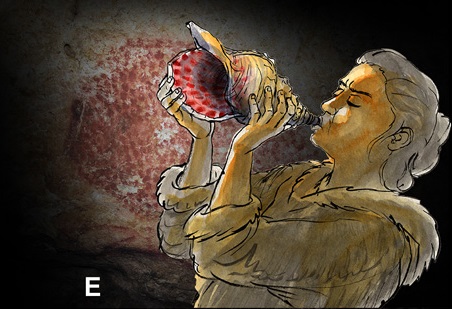
The conch shell in question, a Charonia lampas—a handsome marine mollusk—was found already in 1931 at the cave of Marsoulas, which is a so-called decorated cave. The shell is dated to roughly 16,000 BCE. And, interestingly, the shell was not only modified—presumably to make it fit a human mouth more easily—but also decorated with traces of colors and engravings.

Science Advances Conch Shell Horn Sm

The color is mostly found in fingerprint-sized and -shaped red dots on the internal surface of the shell. They are similar to motifs present on the cave walls, including a bison covered with a layer of red dots (seen in the background of the image above).

Aren’t the dot decorations fascinating? Apparently, similar conch shells have been used around the world as musical instruments in later periods, with similar modifications. Also, the oldest known flutes discovered thus far come from earlier paleolithic periods, roughly 40,000-20,000 years BCE, so the the concept of horn or flute should have been known. It certainly would make sense, then, that this shell was a horn.

You can hear the sound by downloading an audio file attached to the article.

Fritz, C. et al. “First record of the sound produced by the oldest Upper Paleolithic seashell horn” in Science Advances, Vol 7, Issue 7 (10 February 2021). https://doi.org/10.1126/sciadv.abe9510

Image by G. Tosello via Science Advances

An occasional feature on music and sound-related notions.