Dark Academia: A Moody Celebration of Higher Ed and Cultivation

Have you heard of the style dubbed dark academia? According to Wikipedia, dark academia is “a literary and social media aesthetic and subculture concerned with higher education, writing/poetry, the arts, and classic Greek and Gothic architecture.”

Sounds very geeky and nerdy, doesn’t it? (Apparently, again according to Wikipedia, a number of genre novels are, indeed, cited either as inspiration for or popular among the subculture.)

Well, it seems dark academia is now sufficiently popular that mainstream sites have started catering to its fans. While digging into it, I’ve seen clothing, books (of course), movies (ditto), and PC wallpapers for sale. There are also beginner’s guides, playlists for studying, recommended emoji combos, mood guides, critiques, and opinion pieces. (You know a thing has made it when opinion pieces appear!)

I found dark academia when a DIY / thrifting / home decorating blogger I follow and admire, Sarah Ramberg, published her own take on it for the October 2022 challenge in their Thrift the Look series. Here’s one view of her vignette:

Sadie Seasongoods Dark Academia Challenge

Ramberg used mostly thrift store items to outstanding effect. The crystal skull is in fact a thrifted vodka bottle, and it looks stunning. (It’s my favorite element in her recreation, in fact.)

While dark academia (like its kissing cousin steampunk) is not quite my cup of tea, I found it an interesting version of literary appreciation.

Image by Sarah Ramberg at Sadie Seasongoods

In Here highlights interesting spaces created by our fellow geeks all over the world.

Dragonflight: Our Thoughts So Far

Dragonflight, the newest World of Warcraft expansion, has been out three months now. Here are some initial opinions.

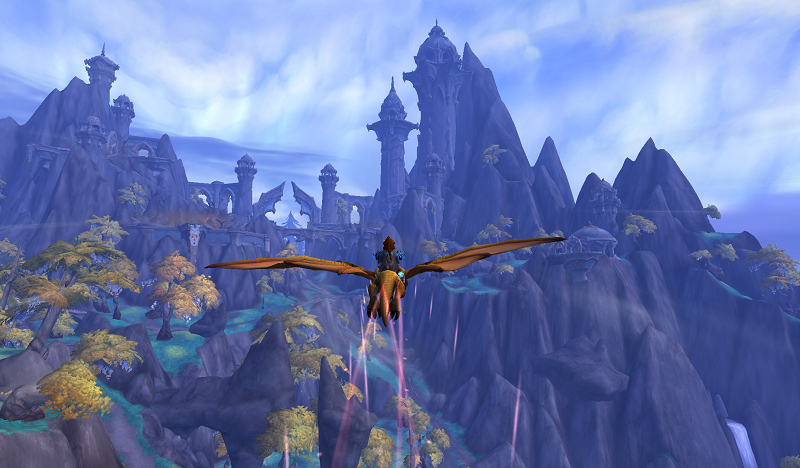
WoW Dragonflight Valdrakkar

Eppu’s thoughts

Let’s get the negatives out of the way first:

  • The world quest cycle seems too slow. Way too slow!
  • The climbing-related world quests seem to have inordinately many glitches. (I stopped doing them for quite a while, in fact.)

Positives:

  • Playing Horde and Alliance together outside of dungeons as well seems to have been enabled (at least for world quests) even before Dragonflight launched properly. Yay!
  • It’s so nice that the Horde don’t continue to embody only awful-looking designs. In the earlier expansions—speaking very roughly, of course—Alliance areas and characters looked normal and nice, whereas Horde ones were full of spikes and angst. In the past Blizzard has introduced nods in the direction of changing it (Blood Elves, Pandaren, Vulpera), but then they eventually slide back to the dark/awful-pretty/shiny divide (e.g. Maldraxxus and Revendreth vs. Bastion and Ardenweald in Shadowlands).
  • Dragonriding (which I’ve started to call gliding as opposed to flying with regular flying mounts) is fun!
  • The druid pink paw buff is back—hooray! I’ve so missed having Mark of the Wild.
  • Among the background sounds, there are chickadees! While they’re nothing I grew up with, they’re nevertheless similar enough to some childhood favorite birds that I appreciate having them. (As a rule, I also appreciate including actual northern biomes into any story. There’s little enough of the real north in mainstream media that isn’t ridiculously exaggerated—seriously, it sounds like people think we live on the planet Hoth from the Star Wars universe.)
  • I’d like to retain player choice with regard to dungeons: that, like Torghast, you can choose to faceroll or challenge yourself. However, I’d also like to get actual loot reliably, like a normal dungeon. (Haven’t been in one yet due to life getting in the way.)
  • Taking into account the story, environment and sound design, talents and professions plus the mechanics thereof, and the personal gaming experience (as nebulous as that can be), I’d say Dragonflight is the best WoW expansion so far.

Erik’s thoughts

I really only have one negative, so I’ll get it out of the way up front.

  • I didn’t like dragonriding at first. I really didn’t like dragonriding. I was physically cringing every time I had to do it. Figuring out how to turn off the screen-distorting effects at high speed made a big difference, though, and now I can use it just fine. I still don’t enjoy it, though. It’s useful if you’re starting somewhere high up and want to go somewhere far away and lower down (and you don’t care very much about where exactly you land) but otherwise I miss the reliability, pausability, and accuracy of regular flying. If we get regular flying later in the expansion, which I hope we do, I’m just going back to my old flying mounts and won’t touch dragonriding again.

Now, on to the positives.

  • What beautiful environments! I have a hard time picking out a favorite zone, but Azure Span delights me every time I go there. Unlike Maldraxxus and Revendreth in Shadowlands or Drustvar in Battle for Azeroth, there’s nowhere in Dragonflight that I don’t enjoy spending time in.
  • I’m really enjoying the new talent system. It probably still needs some tweaking, but I like being able to make choices that really affect how I play my characters.
  • I hope that Blizzard continues on the path laid out in Dragonflight for Alliance-Horde relations. It is a relief to finally have an expansion where it just doesn’t feel like it matters what faction you play. Now if they would continue this to let Horde and Alliance characters communicate, group up, and play every part of the game together, that would be great.
  • This one is a little harder to define, but quests feels more meaningful this expansion. It feels as though we are addressing real problems, not cleaning up after someone else’s emotional tantrum, which describes too much of Shadowlands. I rarely get to the end of a questline in Dragonflight and think to myself: “This could all have been avoided if some people had just gotten around a table and talked to each other.”
  • I still don’t quite feel like I have a handle on the new crafting systems, and there are aspects that I don’t like (like having to be near a designated crafting table to make a lot of recipes), but I enjoy the fact that crafting is now more complicated, and I can specialize different characters in different aspects of the same profession.

Anything else come to mind that we didn’t think of? Please share in the comments!

Of Dice and Dragons talks about games and gaming.

A Writing Rabbit

There’s an interesting character in this scene from a Classic Maya vase. In the main scene, an aged underworld god is enjoying the company of a bevy of young women, but below him a rabbit scribe is keeping its eyes out and its ears perked while taking notes.

Scene from the “Princeton Vase” via Princeton University Art Museum (found Nakbe, Guatemala, currently Princeton Art Museum; 670-705 CE; ceramic with painted stucco)

None of the rabbits I’ve ever known in my life have been so practical!

Out There highlights intriguing art, places, phenomena, flora, and fauna.

Trailers for Ant-Man and the Wasp: Quantumania

Tomorrow is the release day for Ant-Man and the Wasp: Quantumania. Here are the official trailers.

Marvel Studios’ Ant-Man and The Wasp: Quantumania | Official Trailer by Marvel Entertainment on YouTube

Marvel Studios’ Ant-Man and The Wasp: Quantumania | New Trailer by Marvel Entertainment on YouTube

Whoa—looks dire and a bit horrible. Messing with quantum stuff can have potential for all sorts of catastrophes, yes, but I didn’t quite expect a timeline-rewriting plot of an Ant-Man movie.

Grown-up Cassie seems a great character, though, and if we find out more about Janet Van Dyne that’s wonderful, too. Come to think of it, I don’t think Hank Pym said a single word in either trailer, which is surprising.

I gather that Kang the Conquerer is going to be a round for quite a while. I hope actor Jonathan Majors does a better job with the character than the hammy clips we were served so far seem so imply (and given that trailers always lie, it’s likely).

Hey, look! We found a thing on the internet! We thought it was cool, and wanted to share it with you.

A Little Martial for Those Sick of the Dating Game

If this Valentine’s Day has you feeling bitter about romance, take some heart in knowing that love has always been a rough ride. Here are a few deliciously nasty little snarks from the Roman poet Martial to laugh at over your dinner for one.

Truth Comes Out

He used to be your lover, Paula, but you said there was nothing between you.

Now you’ve married him. Can you still claim there’s nothing between you?

Martial, Epigrams 1.74

Left on Read

I wrote to Naevia. She didn’t write back. So she won’t have me.

But I think she read what I wrote. So she’ll have me.

Martial, Epigrams 2.9

Too High a Pedastal

You want to be revered, Sextus; I wanted to love you.

You’ll get what you demand, Sextus, and be revered,

but if I revere you, I won’t love you.

Martial, Epigrams 2.55

In Vino Veritas

Lyris wants to know what she does when she’s drunk? The same thing she does sober: she sucks cock.

Martial, Epigrams 2.73

Slut Era

You don’t say no to anyone, Thais, and you’re not ashamed of it.

You should at least be ashamed that you don’t say no to anything.

Martial, Epigrams 4.12

Hard to Get

Say “No,” Galla. Love gets cloying if its pleasures come too easily.

But don’t say “No” for too long.

Martial, Epigrams 4.38

Serving exactly what it sounds like, the Quotes feature excerpts other people’s thoughts.

Visual Inspiration: Bohemian Waxwing in White

Leucism or pigmentation loss results in partial coloring in individuals, like this amazing Bohemian waxwing:

Tumblr Make Rantala Leucistic Bohemian Waxwing

Very striking, isn’t it! A white waxwing would catch your eye anyway, but the red and yellow wing and tail tips are the truly arresting parts. Wow.

I just can’t but wonder how well one would do in nature. In northern Fennoscandia it would be okay in the winter, because even with the climate change the northern Nordic areas get snow, but summer might be tough.

Image by Make Rantala on Instagram, found via Beauty in All Things on Tumblr.

Out There highlights intriguing art, places, phenomena, flora, and fauna.

Second Trailer for Dungeons & Dragons: Honor Among Thieves

A brand-new trailer is out for Dungeons & Dragons: Honor Among Thieves!

Dungeons & Dragons: Honor Among Thieves | NEW Trailer (2023 Movie) by Paramount Pictures on YouTube

We’re not seeing much new plotwise, just some beefed-up scenes from the first trailer. Glimpses of the Red Wizards and the orifice are on par with the typical medieval-inspired D&D worlds, but WHAT ON EARTH is going on with that broomhead wall?!?

Dungeons and Dragons Honor Among Thieves Screencap House

The roof looks properly thatched, but I have serious doubts of the durability of the facade. There’s obviously plenty of timber available in this area of the world for framing the house with, so the little detail above the door must be decorative. Perhaps there wasn’t quite enough to do the whole outer wall? Or the straw is there for easy repairs?? The original builders blew all of their money on framing and had to make do for cladding???

Anyway, if a trailer commentary can be so easily stolen by funky set design, the question arises whether the trailer in question really did fulfil its function or not… I hope we’ll get another, better one before the release day.

According to IMDB, Dungeons & Dragons: Honor Among Thieves is now expected on April 07, 2023, but the trailer still says “this March”, so go figure.

Image: screencap from Dungeons & Dragons: Honor Among Thieves

Hey, look! We found a thing on the internet! We thought it was cool, and wanted to share it with you.

A Viking-age Version of Spider-Man by Madeleine Fjäll

This piece of original artwork by Swedish illustrator and concept artist Madeleine Fjäll captures the essence of Spider-Man but transports him into Viking age:

Madeleine Fjall Viking-Age Spider-Man

Neat, isn’t it?

According to her website, Fjäll is also historical reenactor who sews some of her own clothes. That explains why Spidey’s Viking version looks so authentic. (As far as I can tell, the only piece where artistic license was taken is the lower head covering inside the hood and the spiderweb decoration on the red fabric.) Kudos all round!

In Making Stuff we share fun arts and crafts done by us and our fellow geeks and nerds.

To Crit or Not to Crit?

The next iteration of Dungeons & Dragons is in the works, titled One D&D. Proposed changes to rules and systems are being announced a little at at time. The first round of changes included some revisions to how critical successes work. These changes got a big reaction from the player base, and some elements of them were soon reverted. Still, it’s useful for players and dungeon masters alike to think about what criticals are for and how we use them in the game.

Crits

First, a quick primer on critical successes for anyone not familiar with the game. When a character attempts most anything in the game, whether it be trying to hit a monster with a sword, resist an evil sorcerer’s spell, track a band of Orcs through the wilderness, or persuade a suspicious guard to let them carry their weapons into the king’s hall, the player rolls a twenty-sided die. The number that comes up on the die, plus or minus some modifiers depending on the character’s skills and the situation, reflects how well the character pulled off what they were attempting. Unlike the confusing mechanics in some earlier versions of the game, in the current version of D&D, higher numbers are always better, which means the best roll you can get on the die in any situation is a 20.

Rolling a 20 on the die is known as a critical success, or a “crit.” In combat, a crit represents a lucky strike that hits a weak spot or catches the enemy off guard. A critical success on an attack roll can hit a target that would otherwise be mathematically impossible for the character to hit. For instance, if a character has a -1 modifier on their attack roll and the enemy they are fighting has an armor of 22, there is no roll on a twenty-sided die that, minus 1, equals or exceeds 22, but a natural 20 will always hit, even though 20-1 is only 19. The critical success overrides the normal math. Not only does a critical success in combat always hit, it also does extra damage to the target.

Combat crits

Critical hits in combat bring both positive and negative things to the game. The positive is that they allow for surprise. A character who rolls a natural 20 can pull off an attack that should be impossible or deal a foe an unexpectedly powerful wound. A monster that gets a critical hit can wound or even kill a character who thought they were invulnerable. For players who lean more into the storytelling aspect of the game, these moments of sudden reversal are great opportunities to describe how their character got a lucky shot at the dragon’s weak spot or play out how the party deals with losing a friend and companion. For players who are more interested in the game as a tactical simulation, the possibility of the unexpected adds variety and challenge to the game.

On the other hand, the surprise factor that crits bring to combat is also a negative. The unpredictability of combat has proven to be a problem in current D&D. When the amount of damage player characters and monsters can do to one another is unpredictable, it is hard to calibrate fights so that they present a challenge to the players without overwhelming them. Challenge rating (CR), the tool that is supposed to help DMs plan appropriately difficult fights, has proven to be both difficult to use and unreliable in its results. Crits make it harder for DMs to know how to challenge players without risking outright destroying the party.

The proposed rule changes in One D&D would have kept combat crits for players but made them less powerful while eliminating them entirely for monsters. Many players balked at this proposal, and their reaction led to its reversal. You can have your own house rules about combat crits, though, and many of us do. For instance, in my games I don’t allow monsters to do extra damage with critical hits. Player characters and monsters trading damage is the core of D&D combat, but just doing more damage is the most boring way a monster can threaten a PC. Instead, I try to give monsters interesting abilities that change the flow of battle and make the players rethink their tactics. A monster that can turn invisible, fly, emit a cloud of poison, attempt to control a PC’s mind, or heal an ally presents a more interesting challenge than one who just sometimes hits extra hard.

There were also some players who objected to the proposed rule changes because they didn’t like the idea that player characters would be less likely to be killed in combat. To these folks, I have some words from behind the DM screen: killing PCs is easy. Monsters can hit exactly as often and as hard as I want. I can add more and bigger monsters to the encounter at any time. Did the party come out of the fight alive? I can send in a swarm of angry owlbears before they have a chance to rest up or have the Arch-Demon Xrtplzqtsk cast an unbreakable killing curse on them for its dark amusement. Earthquake. Wildfire. Lightning strike. Rocks fall, everyone dies. Killing a PC is the easiest thing a DM can do.

The question is not whether you should have monster crits in your game, it’s why do you want to do more damage to your PCs and possibly kill them? Sometimes it is the right thing to do. Maybe it fits the story. Maybe the healer wants a chance to break out the big spells and be the hero. Maybe your players like the challenge of mastering the game’s mechanics and want the threat of character death as an incentive. Maybe your players are adrenaline junkies and get bored if they know their characters aren’t in real peril. All of these are perfectly good ways of playing the game if that’s how you like to play, but that’s a conversation to have around your own gaming table. If you’re bothered by the thought that people you don’t know in a game you’re not a part of might be less likely to have their characters die, that’d be a you problem, not a game design problem.

Non-combat crits

While the proposed changes to critical rolls in combat would have made the game more predictable, the changes to non-combat crits were meant to shake things up a bit. Under the current rules, there are no crits outside of combat. When a player is rolling for their character to pick a lock or identify ancient magical runes, a natural 20 is just a number. A clumsy character with a -1 modifier to their roll trying to pick a lock with a difficulty of 20 won’t succeed no matter what. A roll of 20 on the die just turns into a 19, which isn’t enough. Even a more skilled character with a +1 who rolls a 20 on the same task just succeeds; there’s no extra benefit like the bonus damage that comes with a combat crit.

Allowing crits outside of combat, whether by new rules or house rules, can have some interesting effects on the game. It encourages players to try things they might not otherwise try, since there’s always at least a 5% chance of success. An unexpected success in the non-combat parts of the game can be just as thrilling as getting in a critical hit in a fight. Good DMs and players can always invest as much emotion as they want into the game’s storytelling aspects, but it can help to have the mechanics of the game give some support to the idea that what your characters do off the battlefield can be as exciting as what they do on it.

Letting players roll crits outside of combat can lead to some problems, though. DMs already have to deal with a subtype of player who thinks that their character can do anything if they roll well enough, the ones who will argue that a natural 20 means they can seduce a volcano or pickpocket the scales off a dragon. Adopting the principle that a 20 succeeds on anything makes these sorts of interactions more difficult for everyone. The obvious solution is that players should only roll when the DM tells them to, and the DM shouldn’t let players roll for things that are impossible, but in practice that’s a hard rule to enforce. Players like rolling dice, and many are impulsive enough to go ahead and roll as soon as they announce what they are trying to do. It sucks to be the DM who has to tell your players that the 20 they just rolled doesn’t count, and it equally sucks to be the player who has to hear it.

There are also times when, as a DM, you want to let your players roll for something even if they have no chance of success. If one door in the dungeon has an unpickable lock that can only be opened with a magic key, you may want that discovery to unfold as part of the story, and if that’s the only door you won’t let the rogue roll to pick, it calls more attention to the door than you may be ready for. Not letting players roll for something the players have every expectation of being able to roll for is too much like a neon sign saying “This Way to the Plot.” Letting the players try and fail, no matter how good their roll, helps keep the suspension of disbelief intact.

In my games, I don’t exactly have a house rule allowing critical successes outside of combat, but I run with a principle that a 20 should give a favorable result, and an interesting one if possible. When players roll a 20 for something they are capable of doing, the result should add something to the narrative that an ordinary success wouldn’t. If a player tries to get some information out of an NPC and rolls a 20, they may get more information than they were expecting, or make a friend who’s willing to help them in other ways. A natural 20 at my table doesn’t make the impossible possible, but it can yield a result that’s helpful in some way, even if it isn’t what the character was trying for. If someone tries to pick an unpickable lock and rolls a 20, that won’t open the door, but they might get an inkling of what the key could look like or spy something interesting through the keyhole. A player who tries to seduce a volcano won’t succeed with a 20, but at least they’ll get safely away from the lava.

Crit or not?

Whatever Wizards of the Coast ends up doing with One D&D, crits are an area that’s ripe for house rules and discussion around the gaming table. If you like your fights dramatic and unpredictable, combat crits are a simple mechanic to build in some surprises. If you’d rather have a better handle on how a particular fight is likely to go, you can leave them out or tone them down. Likewise, if you like the excitement of crits in combat, bringing them to the rest of the game can be just as exciting. Bringing the thrill of the critical to non-combat encounters gives DMs more leeway to plan campaigns around more than just fighting, as long as you’re prepared to deal with some of the wackier consequences of giving everybody a 5% shot at anything.

Crits have a role in Dungeons & Dragons, and it doesn’t have to be the same role at your table that it is in the official rules.

Image by Erik Jensen

Of Dice and Dragons talks about games and gaming.

Visual Inspiration: Frog Lives up to Its Name

The mossy frog or Vietnamese mossy frog (Theloderma corticale) comes from Southeast Asia. (Apparently it’s known by many other names, too, like Tonkin bug-eyed frog, but that just sounds offputting, doesn’t it?)

Flickr Smithsonian National Zoo Mossy Frog

Not the only animal with camouflage to play dead when threatened, the mossy frog does it cuter than others, if you ask me. Very effectively, too, if the photo below is any indication:

Flickr mamojo Vietnamese Mossy Frog

Just think if your fantasy role-playing game had a party of player characters traveling through a clearing in a wild, overgrown forest dotted with mossy boulders, which suddenly started moving… and turned out to be huge frogs! Or a secondary world story with villagers somewhere in the boonies struggling to catch and cook these abnormally large frogs before they eat the village’s harvest.

As a total side note: while writing this post I learned that one of the synonyms for camouflage is the phrase plain brown wrapper. I’ve no idea how I’ve never come across that before, but now I know it. It’s one of the joys of language learning to me: you never really stop picking up new words and expressions. 🙂

Images: On a stick by Smithsonian’s National Zoo and Rawpixel via Flickr (CC BY 4.0). Camouflaged by mamojo via Flickr (CC BY-SA 2.0).

Visual Inspiration pulls the unusual from our world to inspire design, story-telling, and worldbuilding. If stuff like this already exists, what else could we imagine?