Otherwise, from this trailer, it’s difficult to tell whether there’s much more than your usual ‘find problem, hit to solve’ solutions all too prevalent in the Marvel Cinematic Universe. Dar-Benn both looks and sounds corny, but that could be a case of trailers always lying.
It’s already certain there will be from some excellent dialogue between Kamala Khan, Monica Rambeau, and Carol Danvers; I’m so ready for that. And even more space kittens….?!?
Hey, look! We found a thing on the internet! We thought it was cool, and wanted to share it with you.
Fulvia was a descendant of one of the leading families of the Roman republic and wife of Marcus Antonius, one of the men responsible for its end. Her family commanded both respect and enormous financial resources. While there was no formal role for women in Roman politics, aristocratic women were often important in connecting families and individuals. Fulvia went further than most Roman women, aiding her husbands’ ambitions not just with her family connections but with a canny knack for political theatre. She even raised and helped to lead her own army in the penultimate stage of the Roman civil wars.
The politics of the late republic were chaotic and sometimes violent. The violence of the times was a symptom of a deeper shift in the political and social landscape. Changes were under way in the Roman world that not everyone was astute enough to recognize or skillful enough to manage. Fulvia was among the most skillful players of this game, and although she ended up on the losing side, her history is a valuable window into what it took to survive the politics of the end of the republic.
From its earliest days, the Roman republic had survived by balancing the interests of two groups: the wealthy aristocracy and the ordinary people of Rome. The balance was not always easy to strike, and early Rome went through periods of tension, even violence, as these two groups hashed out a way of living together. Many things bound these groups together. The people fought in Rome’s armies, led by aristocrats; while generals got the glory that came with victories, the citizen-soldiers who fought for them expected to see their share of the profits of war. Elite families dominated the competition for political office, but they depended on the people to elect them, and could not afford to entirely ignore the peoples’ needs and opinions. Ties of patronage ran through all levels of Roman society, as the more privileged exchanged favors and protection for the services and support of those lower down the social ladder. For most of the history of the republic, the rich and the poor found ways of working together—sometimes with gritted teeth and held noses, but together nonetheless.
In the second century BCE, the compromises and concessions that had kept Rome functional began to break down. By this time, Rome had become a Mediterranean empire, but its politics were still organized for a city-state. The profits of conquest on such a grand scale made some of the rich so rich that they could now buy off voters, bribe juries, and force their way through political life without adhering to the traditional compromises. While the rich were getting richer, economic changes buffeted the poor, leaving many without the means of making a living.
Roman politicians of the late republic had divided into two camps, calling themselves the optimates and the populares. The optimates represented the interests of the elite. They tended to be conservative, even reactionary. The populares depended on the common people as their base of support. They pushed for reforms to better the lives of Rome’s poorer citizens at the same time as they rabble-roused in support of their own ambitions. Neither group was a political party as we would understand it, with a coordinated message or strategy, but individual politicians triangulated themselves between these two interest groups.
Optimates and populares alike were slow to realize that the political ground was shifting under their feet. By the end of the republic, there was a third constituency up for grabs whose support would be key to political success. In the last century of the republic, The Roman army had shifted away from the old model of a citizen militia into a professional force, which meant that the interests of soldiers were no longer the same as the interests of civilians. Rome’s soldiers and veterans were themselves slow to coalesce as a political force, but the middle of the first century BCE, astute politicians were starting to realize that Roman politics now had three major interest groups, not two: the aristocracy, the people, and the army. Success would come not to those who most ardently supported one, but who could most skillfully coordinate the support of at least two, if not all three.
Fulvia was one of the people who grasped this new reality. From her early days as a political actor, she was deep in the realm of the populares. Her first husband was Publius Clodius Pulcher, a scandal-prone popularis leader who was loved by the people as much for his outrageous provocations against aristocratic convention as for his reformist policies. Clodius also exerted power through his patronage of armed gangs on the streets of Rome. Fulvia and Clodius were inseparable, and she was as much a part of his public life as any of his male allies. When Clodius was killed in a clash with a rival’s gang, Fulvia had his bloody body publicly displayed, knowing the sight would rouse his supporters among the people. Under her leadership, Clodius’ followers smashed their way into the Senate house and turned it into Clodius’ funeral pyre.
After Clodius’ death, Fulvia retained the loyalty of his street gangs and was one of the few members of Clodius’ circle who remained in Rome amidst the optimatis backlash. She married again to Gaius Scribonius Curio, a former optimatis turned popularis. Unlike Clodius, Curio had some military experience under his belt. He and Fulvia allied with the rising general Julius Caesar, and Curio was tasked with recruiting soldiers for Caesar’s bid to take over the Roman state. Curio died while commanding part of Caesar’s army in Africa.
After Curio’s death, Fulvia married again, aligning herself even more closely with Caesar’s cause by taking his right-hand man Marcus Antonius as her new husband. Fulvia brought with her not only her family’s wealth and connections but also her ties to Clodius’ clients and supporters. After Caesar’s assassination, Antonius skillfully stage-managed his funeral as an opportunity to whip up the anger of the people against the assassins and their aristocratic supporters, and it is likely he was guided by Fulvia’s expertise at provoking and channeling popular outrage.
When Antonius and Caesar’s heir Octavian became the leaders of the two sides in a new round of civil war, Fulvia vigorously supported her husband, not just politically but militarily. Together with Antonius’ brother, she traveled around Italy raising troops for Antonius’ side and visiting towns where veterans had been settled to remind them of their loyalty to Antonius. While Antonius was away in the east, Fulvia’s army briefly held Rome against Octavian before being forced out, besieged at Perusia, and finally defeated. Fulvia was sent into exile, where she died of an unknown illness.
The literary sources are not kind to Fulvia, and they may exaggerate some elements of her life. She was on the losing side of the final stage of the Roman republic’s self-destructive civil wars, and like her husband Antonius, her memory was tarnished by Octavian’s supporters. A frequent theme in anti-Antonius propaganda was to portray him as effeminate, so making out his wife to have been overly masculine was a natural addition. Nevertheless, it seems clear that Fulvia was not shy of engaging with the man’s world of politics and war. She was a confident political operator, a popularis provocateur, a chief of street gangs, and a capable recruiter and leader of soldiers. She learned from the men in her life and shared the lessons she had gained from them.
What’s more, she grasped the fundamental shift in late republican politics: it was no longer enough to be with the aristocrats or with the people. Neither popularis nor optimatis could prosper if they did not get the support of the soldiers. It was a truth that the most successful politicians of the age, men like Caesar and Octavian, had realized, and a fact that laid the ground for the imperial age to come. If some of the civil war’s battles had turned out differently, we might look back to Fulvia as one of the founding figures of Rome’s first dynasty.
Image: Coin portrait of a woman, possibly intended to be Fulvia; photograph by Classical Numismatic Group via Wikimedia (Copenhagen; c. 41-40 BCE; copper alloy)
History for Writers looks at how history can be a fiction writer’s most useful tool, from worldbuilding to dialogue.
A team of University of New South Wales researchers have unveiled a small and flexible device for 3d-printing living cells onto internal organs. The experimental robot named F3DB could, according to the UNSW Sydney newsroom, “potentially be used as an all-in-one endoscopic surgical tool”.
The UNSW Medical Robotics Lab team to pioneer this device is led by Dr. Thanh Nho Do and include among others Mai Thanh Thai, Dr. Hoang-Phuong Phan, and Professors Nigel Lovell and Jelena Rnjak-Kovacina. The device was demonstrated inside an artifical colon and on a pig’s intestine.
The technology isn’t yet commercially viable, but potentially within 5-7 years it could. You can access videos of F3DB in action via the UNSW Sydney newsroom.
Wow—3d-printing inside a human body. Not just within my lifetime, but plausibly in less than 10 years. Makes the various 3d-printed cultivated foods that are in development (e.g. fish fillets) sound like child’s play.
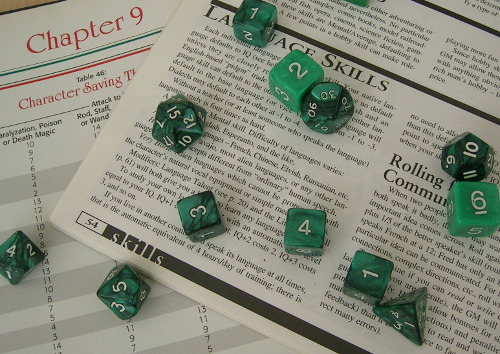
This phrase is sometimes brought out by players in tabletop role-playing games to justify actions that are harmful (or at least annoying) to the rest of the party: “It’s what my character would do.”
My answer to that is: “Then your character wouldn’t be a member of this party.”
Role-playing is, of course, an important part of the game. We take on the personalities, histories, and motivations of characters who are not ourselves and tell stories about them. Sometimes, those motivations can lead to situations where characters come into conflict. There’s nothing necessarily wrong with having conflict, stress, or even outright hostility among the characters in a game, but when conflict between characters becomes conflict between players, that’s a problem that needs to be resolved.
Adventures are, after all, as Bilbo Baggins put it, nasty uncomfortable things that make you late for dinner. The characters in a role-playing game are very often not having a good time, but the players should be. Some players thrive on intra-party conflict; others abhor it. Sorting out what is and isn’t acceptable at your table is an important part of a session 0 conversation. You can have whatever rules suit your group, and if everyone at the table enjoys playing out character conflict, then go for it, but a good player should not be playing in a way that makes other players’ experience worse.
People who like intra-party conflict will sometimes claim that avoiding conflicts is a betrayal of role-playing. “In this situation,” they say, “my character would attack their character. It’s what my character would do.” But this attitude itself reflects a shallow approach to the role-playing aspect of the game.
Role-palying isn’t just about actualizing your own character’s deepest wishes; it’s also about exploring the dynamics of the group as a whole. Players need to remember that they are not just playing a character with a background and motivations, they are playing a character who has agreed, under some terms, to travel, fight, and work with a group of other characters. It may be an alliance of convenience, they may be working together with gritted teeth and watchful eyes, but they have agreed to work together all the same. Playing out how they manage to keep working together even when their interests collide is a greater and often more interesting role-playing challenge than deciding to do something even though it pisses off your fellow players. If you can’t play your character in a way that allows your fellow players to enjoy the game, then your character wouldn’t be a member of that party to begin with.
Keeping a role-playing game going isn’t always easy. It takes a good-faith effort by everyone at the table to make sure that everyone else is having a good time, even when things get rough for the characters they’re playing. Your goal as a player should always be to make sure the game is good for everyone, and sometimes that means putting in the effort to figure out how your character would decide to put the good of the group ahead of their own interests. It’s what your character would do.
Recently I’ve been trying to read more SFFnal classics among my normal selection. I can’t remember why I added Blindsight by Peter Watts (published in 2006) onto my library holds list. When it finally became available and I started to read, I discovered that one of the characters is called Jukka Sarasti (which is a Finnish name), so perhaps that was it.
Content note: spoiler alert!
The novel’s events start in the year 2082. A first contact situation arises after thousands of unknown devices burn up in Earth’s atmosphere in a coordinated manner and radio signals are detected near a Kuiper belt object.
Earth sends a ship captained by an AI (called the Captain) to investigate. Theseus is crewed by five augmented humans or transhumans, including their leader, a genetically reincarnated vampire (Sarasti). When the crew wakes from hibernation they discover that Theseus was rerouted mid-flight to a new destination in the Oort cloud. Orbiting a previously undetected rogue gas giant is an enormous, constantly growing object, presumably a vessel, which the crew dub Rorschach.
The Theseus crew begin studying Rorschach with telemetry and excursions despite some very hostile environmental conditions. Additional challenges are posed by psychological effects (hallucinations) and extremely fast, multi-limbed organisms on Rorschach, and on Theseus the crew’s aggravation with the narrator, synthesist Siri Keeton. Eventually relations between Theseus and Rorschach culminate in physical attacks, and only one crew member, Keeton, is sent back to Earth in an escape pod with copies of the information collected before Theseus detonates its payload to destroy Rorschach.
What was especially delightful is that—setting aside Sarasti, who as mission commander and a predator is kind of outside the crew anyway—Theseus’s crew consists of two men and two women, and everyone is described the same way regardless of the configuration of their bodies. Skills and personalities are what matter most. (This is especially enjoyable after reading certain other classic SF novels, which I will leave unnamed to languish in their stifling obsolescence.)
Another interesting detail is that Susan James, the linguist in the crew, actually carries three other personalities or cores in her head, all working and socializing in harmony, and collectively referred to as the Gang by the rest of the crew.
Blindsight turned out to have one suprisingly topical detail. The Gang figure out that despite conversing with the Theseus crew seemingly normally, Rorschach doesn’t really understand the communication. This sounds very much like the recent discussion of Chat-GPT and other AI engines, doesn’t it?
One of the strengths of Blindsight is that it fuses elements from both the so-called hard sciences and the social sciences. Surely SFF (and all storytelling, for that matter) is at its strongest when it’s questioning our perceived realities or possible realities, starting from what makes humans tick. I’m quite tired of SFF that takes bland “and then they went to x and did y” travel narratives and merely cloaks them in fancy wrappings.
Alas, Blindsight has quite a few horror elements and closes with a rather despondent situation. Despite being skillfully written and constructed, it’s therefore not for me.
Blindsight was followed (in 2014) by the novel Echopraxia to make up the Firefall duology.
ICBIHRTB—pronounced ICK-bert-bee—is short for ‘I Can’t Believe I Haven’t Read This Before’. It features book classics that have for some reason escaped our notice thus far.
I gather that Becky Chambers’s new Monk & Robot series has gotten a mixed reception. Broadly speaking people either love it or are frustrated by it. Since I love Chambers’s Wayfarers series, I thought I’d check the new series out.
I’m still not yet sure what, exactly, to think except to say I see why the dichotomy has arisen. Here’s one section that I found simply mind-boggling:
“The wagon’s lower deck quickly lost any semblance of organization, evolving rapid-fire into a hodgepodge laboratory. Planters and sunlamps filled every conceivable nook, their leaves and shoots constantly pushing the limits of how far their steward would let them creep. Stacks of used mugs containing the dregs of experiments both promising and pointless teetered on the table, awaiting the moment in which Dex had the brainspace to do the washing-up. A hanging rack took up residence on the ceiling and wasted no time in becoming laden to capacity with bundles of confettied flowers and fragrant leaves drying crisp. A fine dust of ground spices coated everything from the couch to the ladder to the inside of Dex’s nostrils, which regularly set bottles rattling with explosive sneezes.”
– Becky Chambers: A Psalm for the Wild-Built
The section starts quite well, and I see why the word cozy is applied to the series. Then, sadly, it gets worse. I don’t even terribly mind the mess in a food-prep space (dirty dishes to the ceiling and a coating of dust), as it could conceivably be just eccentric. (I mean, I prefer a clean home myself since I’m allergic to dust, and plant dust doesn’t help, but to each their own.)
But. Dex is “regularly” sneezing “explosive[ly]” all over the space where they mix the teas they’re offering to people they serve as a tea-monk.
Excuse me? SNEEZING—REGULARLY—ON DRINKS THEY SERVE TO OTHERS?!?
Disgusting is an understatement! The exact opposite to cozy. Ew! Ew, ew, ew, eww!
I do get that getting a book to print takes a good long while (a highly technical term, that). I wasn’t able to find out when Chambers started to write A Psalm for the Wild-Built, but the publishing deal was announced in July 2018 and the first book published in July 2021. In the acknowledgments for the sequel, A Prayer for the Crown-Shy, she writes that she finished book 1 “just before lock-down started” and handed in book 2 “three months before I was eligible for my first [covid vaccination] jab”. It is therefore possible that it was not feasible to change the text.
Still, I should think that it’s not too much of a stretch to NOT SNEEZE ON FOODS AND DRINKS. In real life or in fiction. With or without a pandemic behind you (i.e., having been filled to the gills with information about cough etiquette and sneezing hygiene).
EWWWWWWWWW!!!
Chambers, Becky. A Psalm for the Wild-Built. New York: Tordotcom, 2021, p. 22-23.
Image by Eppu Jensen
Serving exactly what it sounds like, the Quotes feature excerpts other people’s thoughts.
The ancient Greeks had certain stereotypes about the people they called barbaroi: Romans were brutes; Scythians were drunkards; Persians were perverts, and so on. Like all ethnic stereotypes, these conventional views were based on prejudices and assumptions rather than truth. Not everyone necessarily believed in or agreed with these stereotypes, but they were recognizable elements of Greek culture in the same way that “French are cowards” or “Italians are reckless drivers” are recognizable stereotypes today. But what stereotypes did other peoples have for the Greeks? We don’t have very many sources that offer non-Greek views of the Greeks, but there are some hints that suggest that the common view of the Greeks, and Athenians in particular, is that they talked too much.
The Greek historian Herodotus reports a story that a Scythian named Anacharsis had traveled in Greece and come home to Scythia with a pointed opinion on the Greeks:
In fact, I have heard a story told by the Peloponnesians about Anacharsis, who was sent by the king of the Scythians to Greece to learn about our ways. When he returned, he told the king that all the Greeks strive for wisdom except the Spartans, but the Spartans are the only one who talk and listen thoughtfully.
Herodotus, Histories 4.77
Since the Spartans were famous for being people of few but well-chosen words, the point of the anecdote is that other Greeks talked to much and said too little. We can compare the story of Anacharsis visiting Greece with Herodotus’ account of the Greek scholar Hecataeus visiting Egypt and getting a lesson from the priests there about Greek pretensions:
The scholar Hecataeus was once in Thebes and recounted his genealogy back to the sixteenth ancestor, which he made out to be a god. The priests of Zeus did the same thing for him that they also did for me, though I made no such claims about my ancestry. They led me into the hall of the temple and counted out the wooden statues that were there, which equaled the number they had already told me. Every high priests erects a statue of himself there during his lifetime. Pointing to these statues and counting as they went, the priests showed me that each was the son of the man before him, from the one who most recently passed away back to the earliest of them all. When Hecataeus claimed to be descended from a god in the sixteenth generation, they did not believe that was possible. They instead traced the ancestry of the priests by counting the statues, each one a piromis, the son of a piromis (piromis being their word for a gentleman), counting back three hundred and forty-five statues, and not a one of them a god or demigod.
Herodotus 2.143
The stories of Anacharsis and Hecataeus both come to us from a Greek source, so neither is a direct report of a foreign view of the Greeks, but it is interesting that they seem to have the same point. Anacharsis approved of the Spartans because they were careful with their words. Hecataeus got put in his place by the Egyptian priests because he had made an outrageous claim before listening to people who knew better. In both cases, the Greeks would have been better off if they talked less and paid attention more. Since Herodotus was widely-traveled and had spoken with people of many different cultures, he may be giving us something reflecting an authentic perception of the Greeks by outsiders.
The richest source we have for outside views of the Greeks is the Romans. The Roman perspective is complicated because so many Romans admired and identified with Greek culture, but when we hear negative views of the Greeks from Roman sources, they often tend the same way: Greeks, and Athenians in particular, talk too much.
The Greek antiquarian Plutarch, in his life of the Roman politician Cato the Elder, reports that Cato’s opinion of the Greeks as long-winded and superficial:
He dealt with the Athenians through an interpreter, although he could have spoken to them himself […] He said that the Athenians were astonished at the speed and punch of his [Latin] words, for what he said briefly [in Latin] took the interpreter many words to say [in Greek]. It was his opinion that on the whole, the words of Greeks came from their lips, those of Romans from their hearts.
Plutarch, Life of Cato the Elder 1.12
The Roman satirist Juvenal gives a similar anti-Greek attitude to his character Umbricius:
Quick-witted, damned audacious, always ready with a
speech, and they can out-talk Isaeus [a famous orator]. What do you
suppose that one is? He’s brought us a bit of everything:
schoolteacher, professor, surveyor, painter, wrestling coach,
seer, tight-rope walker, doctor, magician—your hungry little Greek
does it all! Tell him to fly and up he goes!
Juvenal, Satires 3.73-78
While we don’t know what words non-Greeks would have used for the Greeks, parallel to the Greek word barbaros for non-Greek-speakers, there’s a good chance it was something along the lines of “blabbermouth” or “bore.”
History for Writers looks at how history can be a fiction writer’s most useful tool, from worldbuilding to dialogue.
Someone ingenious—who only goes by the moniker cursedtrekedits on Tumblr—photoshopped Lieutenant Columbo (played by the inimitable Peter Falk) into screencaps from Star Trek: The Original Series. Take a look:
At the end of Shadowlands, I was planning to retire my holy priest. He’s the first character I ever played, so I’m never going to delete him, and he will always be holy specced, but I don’t do group play any more where a healer would be needed, and leveling up a holy priest has been a slog for a long time. I put together a nice transmog for him to wear and was thinking about where I was going to leave him to enjoy his retirement.
Then the talent changes in Dragonflight made leveling as a holy priest pretty okay, so he’s come back out of retirement after all, but I thought I’d share his transmog anyway. Here you go!
Rainbow eucalyptus trees (Eucalyptus deglupta) shed their bark at a strip at a time, and the tree trunks look stripy as a result. That’s not all, however—the stripe colors can vary surprisingly much. A freshly revealed area will look bright pale green, which then darkens and changes to orange, red, brown, and grey or blue.
Rainbow eucalyptuses are native to the Philippines, Indonesia, and Papua New Guinea, but have been planted elsewhere in suitable climates.
Amazing, aren’t they? I wonder whether the Weta artists looked at rainbow eucalyptus trees as an inspiration for their saturated, weird Mirkwood trees for the Hobbit movies. (They talked about the design in the behind-the-scenes documentaries; the movies as released are too dark to see the colors properly, if memory serves.)







 Co-Geeking
