A Wondrous Jaina Proudmoore by Ibelinn Cosplay

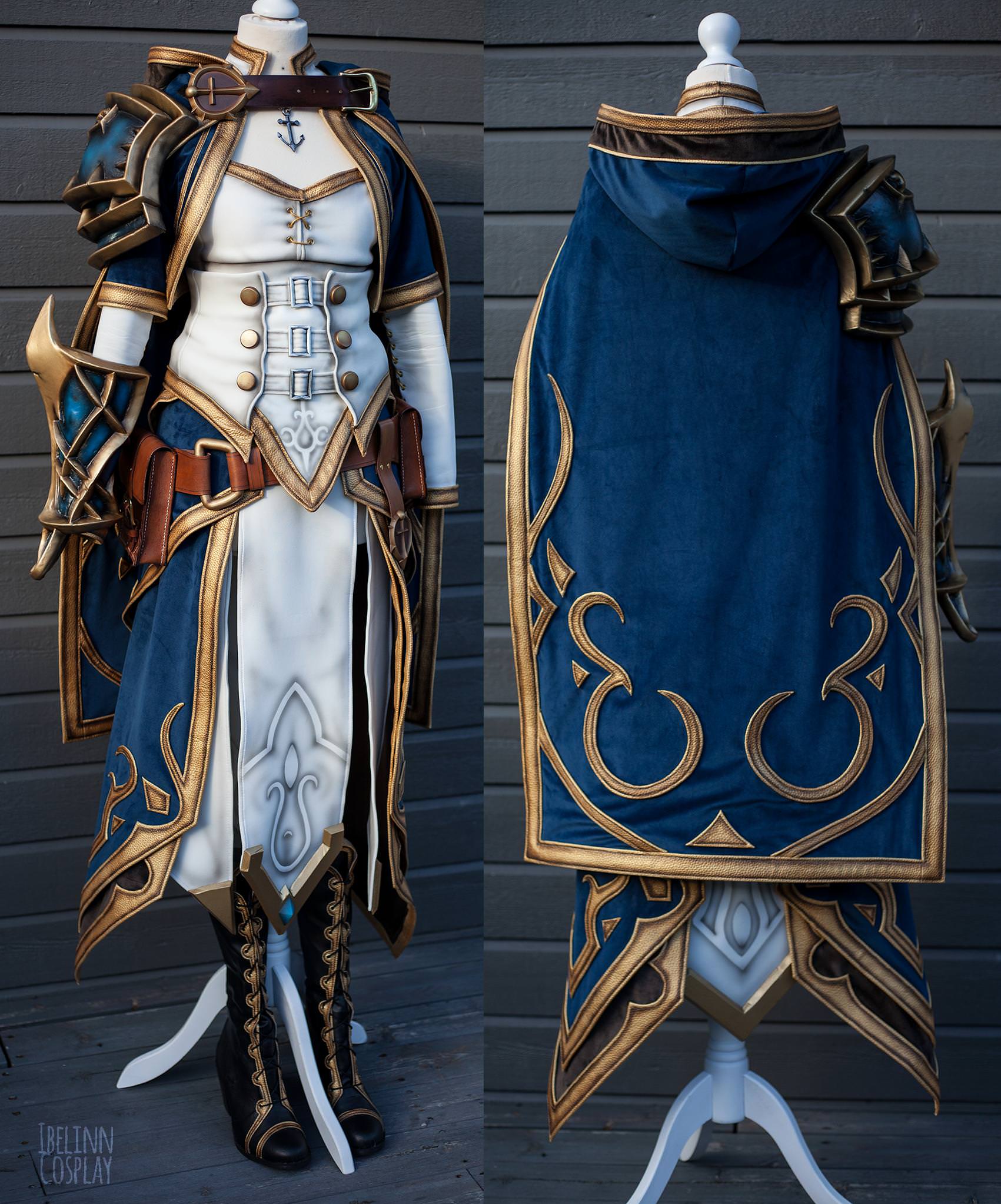
Ibelinn Cosplay from Norway made an absolutely astoundingly accurate cosplay outfit of Jaina Proudmoore. Take a look:

Imgur Ibelinn Cosplay Jaina Proudmoore

Everything looks like an exact match: the layers, the embellishments, the shading, the shapes—down to the stupid-awkward blocky shape of the World of Warcraft cloaks. It’s almost uncanny!

She shares more photos of her version of Jaina on Imgur, including the staff for the outfit, and more Ibelinn cosplays on Instagram. I highly encourage you to visit and admire!

Image by Ibelinn Cosplay via Imgur

A Nautical Blood Elf Mage Transmog

Summer is here, and while for some folks that means hitting the beach and riding some waves, my Blood Elf mage is getting nautical in a more piratical way. Here’s her transmog for the season, and the pieces that went into it.

Yo-ho-ho and a bottle of Pupellyverbos Port!

Image: World of Warcraft screencap

Quotes: Her Backstory Unfolded Pretty Much as I Typed It

In the acknowledgements for her novella Thornhedge, author T. Kingfisher talks a little about the process of writing this particular story.

–T. Kingfisher in the acknowledgements for Thornhedge
Kingfisher Thornhedge

I’m not a fiction writer, but I do recognize the phenomenon of suddenly uncovering details from role-playing. It’s delightful to just suddenly realize a pertinent, obscure, or particularly distinguishing detail about your character.

(This kind of serendipitous discovery also makes me think any algorithmically generated (“AI”) content won’t be replacing the most original types of human-generated content terribly soon, nor will machine translation replace human translators in a hurry. Oh, make no mistake, people will try to replace human creators with machines. But at least thus far we’re still more sophisticated when it comes to pure innovative leaps or getting smoother translations.)

There have been many times I’ve wished to be able to tap into the unconscious mulling process or consciously force a creative leap, but of course it doesn’t work that way. It makes the moments when it does happen all the more precious, doesn’t it? 🙂

Kingfisher, T. Thornhedge. London: Titan Books, 2023, p. 122.

Image by Eppu Jensen

Second Trailer for Star Wars: The Acolyte

The second trailer for Star Wars: The Acolyte is out, and the premier is only a week away. Let’s have a look at the trailer:

The Acolyte | Official Trailer | Disney+ by Star Wars on YouTube

“I sense this is only a small part of a larger plan. Some sort of shift to tip the scales.” Now, that sounds interesting—is it a nod to some sort of a loooong-time change in the force whose end we see acted out in the three movie trilogies? I have no idea.

Perhaps more interesting to me is the whodunnit portion of the story, however. I wish a little more about that was included in the trailers.

There’s also a behind-the-scenes clip:

The Acolyte | Creating the Acolyte | Streaming June 4 on Disney+ by Star Wars on YouTube

Sadly, it’s quite short. I’d be happy to have a much longer piece to whet my appetite.

Joonas Suotamo is still listed at IMDB for SW:TA, but unfortunately only for two episodes. Maybe that’s why I haven’t spotted him in either trailer. Looking forward to seeing more of him.

The two-episode opener for SW:TA premiers on June 4, 2024.

One (or More) Rings to Rule Them All

For an artifact as iconic as the One Ring from Tolkien’s Lord of the Rings, it’s not surprising that people have come up with some creative versions of their own. Here are a few interesting ones that could be yours if you want!

If you want a classic ring that you can wear on your finger or as a pendant, TimJewelerCo makes them, both in gold and in silver. As a bonus feature, the Elvish writing on the band glows in the dark!

Glow in the Dark Elvish Ring Necklace by TimJewelerCo via Etsy

For a different take on what you can do with a ring, 3DMadeGifts makes a scaled-up version as a shallow planter. Now your potted succulents can enjoy the power of everlasting evil.

Gold Ring of Power One Ring Succulent Planter by 3dMadeGifts via Etsy

Or roll for initiative with this ring-themed dice set from DracaenaDraco. One die to roll them all!

Lord of the Rings Dice Set by DracaenaDraco via Etsy

All these products are available on Etsy, if you want to get a good head start on holiday shopping.

Living Vicariously Through Social Media: Flowering Cacti

Just look at the mass of flowers on these cacti:

Tumblr mutant-distraction Flowering Cacti

I grew up essentially on a flood plain. While I have visited a few, and know that a lot of deserts are not mostly smooth sand dunes like the Tatooine and Dune stereotype would have us believe, I’ve never actually experienced deserts as a living environment. This is a fabulous glimpse—especially after the long and cold winter Finland had this year.

Image via mutant-distraction on Tumblr

Quotes: Women Have Also Painted

The ancient Roman naturalist Pliny the Elder wrote a good deal about painting. His interest stemmed from curiosity about which plants and minerals were used to make make pigments, but he also recorded the names of famous artists and some details about their paintings.

Unlike the stretched canvases we are used to today, ancient painters worked on wooden panels, of which extremely few survive, or on plastered walls, a few of which have survived in places like Pompeii and Dura-Europus. Most of the famous painters of antiquity were men, but Pliny makes sure to note that women also took up the brush.

Women have also painted. Timarete, daughter of Micon, created the very old panel painting of Artemis of Ephesus. Irene, daughter and student of the painter Cratinus, painted an Eleusinian maiden, Calypso, Theodorus the juggler, and Alcisthenes the dancer. Aristarete, daughter and student of Nearchus, painted Aesculapius. Iaia of Cyzicus, who was a lifelong virgin, painted and engraved ivory at Rome during the youth of Marcus Varro [late second century BCE]. She mostly made images of women, including a large panel painting of an old woman at Naples, as well as a self-portrait made using a mirror. Nobody had a faster hand for painting than she did, and in fact she was so accomplished an artist that the prices for her works far exceeded those commanded by Sopolis and Dionysius, who were the most celebrated portrait painters of the time and whose paintings fill the galleries. A certain Olympias was also a painter, but all that is recorded about her is that Autobulus was her student.


Pliny the Elder, Natural History 35.147-48 (=35.40)

(My own translation)

Women created famous works, were paid well for their craft, and taught others. It is unsurprising that some of these women were daughters of well-known male painters, since art was often a family business in the ancient Mediterranean.

Wooden panel paintings were among the most highly-prized forms of art in ancient Greece and Rome. Thanks to writers like Pliny, we know more about the famous painters of antiquity and their paintings than we would ever know from the few examples that survive today. It is good to have evidence that women, too, took part in this prestigious art form.

Image: Women preparing for a ritual, cropped from a photograph by WolfgangRieger via Wikimedia (Pompeii, Villa of the Mysteries; 1st c. BCE; fresco)

News on the Murderbot Screen Adaptation, with Thoughts

You might know that a screen adaptation of The Murderbot Diaries, a series (of mostly novellas) written by Martha Wells, is under development by Apple TV+. Behind the production are brothers Chris and Paul Weitz, who will write, direct, and produce, and Wells will serve as consulting producer.

The release date has not been publicized yet, but according to Reactor, the episode scripts have already been written. Presumably, the tv series will be based on All Systems Red, the first installment of the book series.

As I love Murderbot, I started off highly suspicious. (Suspicious of any adaptations, that is; I have no special qualms with Apple TV.) This team seems to get it, though. Their pitch reads as follows:

“‘Murderbot’ is an action-packed sci-fi series, based on the award-winning books by Wells, about a self-hacking security android who is horrified by human emotion yet drawn to its vulnerable ‘clients.’ Murderbot must hide its free will and complete a dangerous assignment when all it really wants is to be left alone to watch futuristic soap operas and figure out its place in the universe.”

When comparing this one-paragraph description to some other write-ups about the adaptation, a few things stand out. Firstly, Murderbot is not a robot. Furthermore, Murderbot never describes itself as a he (but doesn’t object to it). Also, Murderbot is horrified by human emotion and bored with human drama in real life and certainly not drawn to the emotion; if Murderbot is drawn to anything non-media-related, it’s its job of protecting clients, particularly certain kinds of clients (the smart, or small and soft kind). Finally, Murderbot does emphatically not want to live like a human, it wants to be left alone to consume media (which is only a tiny fraction of living like a human).

The adaptation team does get Murderbot; those other writers don’t. (The only iffy detail that copy includes is calling Murderbot an android; The Murderbot Diaries use the word construct. An android is less wrong than a robot, IMO.)

Since December 2023, when Apple TV+ announced the ten-episode Murderbot adaptation, I’ve kept an eye out for more detailed news. Initially, casting was left almost entirely open; only Alexander Skarsgård as Murderbot was announced. Now we know a little more: Noma Dumezweni will play Dr. Mensah.

Murderbor Mashup Dumezweni Skarsgard

In addition, David Dastmalchian will play Gurathin. Ratthi will be played by Akshay Khanna, Arada by Tattiawna Jones, Pin-Lee by Sabrina Wu, and Bharadwaj by Tamara Podemski.

Murderbor Mashup Dastmalchian Wu Jones Khanna Podemski

Having once spent a sleepless night watching part of The Legend of Tarzan, I know Skarsgård will have no trouble keeping his face SecUnit expressionless. (That is confirmed by stills I’ve seen of The Northman. I’ve also seen him in Godzilla vs. Kong, but I have no memory of his character.) The only productions I’ve seen Dumezweni in are two episodes of Doctor Who and two episodes of Only Murders in the Building. (And I know she was well-reviewed for her role as Hermione in the stage play Harry Potter and the Cursed Child.) What I remember of her impresses me, though; I’m glad she got cast as Dr. Mensah.

Dastmalchian I remember from the Ant-Man movies and Dune: Part One. (IMDB tells me I’ve also seen him in Blade Runner 2049 and an episode of CSI, but again, no memory.) Wu I’ve seen in one episode of Abbot Elementary and Jones in one ep of Murdoch Mysteries; Khanna and Podemski are completely new to me.

As the two core characters of All Systems Red, Murderbot and Dr. Mensah should have a lot of screen time, so I’m delighted that actors of renown have been cast for the roles—indeed, the big names bode well for the adaptation, I hope.

At this point, there’s still one thing that bothers me: I haven’t seen enough of Skarsgård’s work to tell whether he can creditably do nuance, and a lot is riding on that, since Murderbot is all about nuance.

On the surface, there’s as much action as in any generic mindless sci-fi action story, but the focus in Murderbot stories is not the what (the action), but the why and how: why do the events of the story unfold as they do, how do people work, how does Murderbot work, and how does it slot itself into this world it doesn’t fully comprehend (or care about). If the writer’s room doesn’t understand that—or isn’t allowed to fully feature the nuance—the adaptation is less likely to be a success. I fervently hope it will be good!

Images: Mashup 1: Noma Dumezweni via BazBam on Twitter and Alexander Skarsgård by Thierry Sollerot via Flickr (CC0 1.0 Universal). Mashup 2: David Dastmalchian by Gage Skidmore via Flickr (CC BY-SA 2.0). Sabrina Wu by Jordan Ashleigh via IMDB. Tattiawna Jones via IMDB. Akshay Khanna by East Photography via IMDB. Tamara Podemski by Thosh Collins via IMDB. Mashups by Eppu Jensen.
Barbarian Migrations: The Imaginary and the Real

Previously we considered how large the groups of people who moved around the ancient world actually were and what challenges such large groups faced in migrating from one place to another.

The idea of large, cohesive groups traveling across the map to resettle elsewhere is largely a product of two things: ancient literary conventions and modern historiography. Ancient Mediterranean writers had their own literary habits. Among them was positing large groups of people picking up and resettling elsewhere as a way of explaining cultural relationships (such as, for instance, the legend that the Romans were the descendants of Trojans, or that the Spartans were long-lost kin of the Jews). These stories were not based in any reality but served the literary and political needs of those who told them.

Modern historians of the nineteenth and early twentieth centuries approached ancient history with the assumption that ethnic groups were coherent units with definable traits whose history could be traced across time and space. There was, they believed, a distinct “Gothic” or “Celtic” character that could be identified in literature and art and that marked the movement of whole peoples to replace or subjugate others. These assumptions were grounded in the systems of modern imperialism and the ideals of Romantic nationalist movements, not the realities of ancient history, but they shaped how scholars read ancient literary sources. The idea that there were mass migrations across Europe at any point in antiquity is largely a figment of the modern imagination.

When we revisit the ancient sources and the archaeological evidence, we can identify several different kinds of movement, each of which faced different versions of the problems outlined above and had different ways of dealing with them.

Long-term movement: Many of the “migrations” identified by nineteenth-century scholars are better understood as the result of small groups of people such as families, extended kin groups, or raiding parties taking similar routes over time. Each individual group was small enough to travel without overstraining the resources of the lands they moved through, but many such groups taking the same journey over an extended time period could eventually lead to significant shifts in population and local culture. This kind of movement can be seen for example in the migration of Gaulish warbands into northern Italy in the fifth and fourth centuries BCE and the large-scale shift of populations from northern and western Europe into the southern and eastern Mediterranean in the later centuries of the Roman Empire.

Armies: Other movements did involve large groups of people moving within a short time frame, and are best understood as armies on the march, attended by followers and hangers-on. The frontier peoples of the late Roman period were deeply interconnected with the Roman world. Under their own leaders, they competed for power and wealth in much the same way that Roman armies competed to put their leaders into power. Many of these groups included veterans of the Roman army and had diplomatic relations with the Roman elite. Their movements were directed at political ends, and they drew on the same resources that Roman armies did to manage the logistics of travel. The late Roman Franks and Vandals, for example, functioned essentially as armies with large civilian followings.

Refugees: Other groups of people moved en masse not by choice but because the alternative was worse. Economic and political changes could uproot some people and force them to relocate, whether they were prepared for a journey or not. Those forced to relocate could face extreme hardship, just as modern refugees too often do. We can get an idea of how desperate ancient refugees could be from accounts of peoples crossing into eastern Roman territory in the late fourth century selling their fellow refugees to the Romans as slaves at bargain prices just to feed themselves. Refugees faced the same challenges that traveling armies did, but with none of the same support; these groups probably lost many members along the way to illness, hunger, combat, or enslavement. Refugee groups include the Cimbri and Teutones in the late second century BCE and the Visigoths in the fourth century CE.

Migrating groups in antiquity were mostly small. The idea of barbarian hordes hundred of thousands strong is more fiction than history. Those who did travel in large groups mostly did so either as organized armies drawing on the same logistical resources that other ancient armies did or as refugees driven by desperation who managed the best they could under terrible circumstances.

The idea of massive hordes of barbarians migrating at once across the ancient landscape is a figment of the imagination, but that doesn’t mean that they ancient world was static. People moved, and sometimes they moved in large groups, but any such group faced enormous practical challenges. Some groups were in a position to overcome these challenges; many were not. “Barbarian” peoples did not have any special way of overcoming the practical problems of migration. They solved those problems the same way that other peoples did, in small groups, as armies, or as refugees.

Image: “Battle of Guadalete,” photograph by Christie’s via Wikimedia (1882; oil on panel; by Mariano Barbasán Lagueruela)

Deadpool & Wolverine Official Teaser Trailer

Deadpool isn’t one of my favorite superheroes; the stories tend to be too explicitly violent, and the humor is about half and half hit or miss for me. I’m therefore not really following any DP news, so the fact that the third DP movie is called Deadpool & Wolverine was, well, news to me. It also made me perk up my ears, so to speak—Hugh Jackman’s performance as the mutant superhero that goes snikt was fabulous and got me to care about the character more than I otherwise would have.

The first trailer for DP&W was released last month:

Deadpool & Wolverine | Official Teaser | In Theaters July 26 by Marvel Entertainment on YouTube

Looks like the violence isn’t going to be any less gory this time either (even if the trailer itself was relatively clean as DP movies go). The bratty humor is also still there, as you’d expect—gotta keep the fans happy and the character consistent, right? But what I can’t yet figure out is how they’ll interweave the X-Men and DP.

It’s always a joy to see Morena Baccarin and Hugh Jackman. According to IMDB, however, Patrick Stewart will make an appearance, presumably as Professor Xavier, as will Jennifer Garner as Elektra. Whoa. I’ve mixed feeling about Matthew Macfadyen on the basis of past productions of his, so we’ll see what he makes of the Marvel Cinematic Universe.

It should also be interesting to see how, exactly, is Marvel going to untangle (if at all?) their multiverse mess, which certainly hasn’t gotten easier with Jonathan Majors being dropped from the role of Kang. DP&W might actually hold my interest longer than the previous DPs. Here’s hoping!

At this writing, the movie is set to release on July 26, 2024.