“This isn’t about good or bad. It’s about power… and who is allowed to use it.”
Sounds intriguing. Apparently, however, SW:TA takes place towards the end of the High Republic era, well before The Phantom Menace. That’s completely new to me. Not all new-to-me settings in the Star Wars tv series have been winners, IMO, so whether SW:TA will work for me or not is still very much in the air.
Also, I’ve never been interested in the Sith, and it sounds like the Sith will feature heavily in the series. (Not that I’ve watched much outside the movie trilogies anyway.) However, it looks SW:TA just might provide a more refreshing backstory than a vague ‘they want power and that makes them evil’ handwave. (And I’m sure I’m grossly misrepresenting some SW writers’ thoughts here, but that’s what the Sith appear to this non-superfan.)
What worries me to some extent is they seem to have cast another woman of color as the main antagonist. (Compare to Inquisitor Reva in Obi-Wan Kenobi.) The last thing we need is more typecasting.
(Speaking of negatives: I’ve looked very little into the series and have already seen quite a bit of waah-waahing about too many wimmen starring or whatnot. Look, m’dudes: my money is green, too. If the production is good and shows people like me as active characters and people in their own right, I will pay to see it, and so will many others. Di$ney will love our money just as much as yours.)
One source of joy is that we get to see Carrie-Anne Moss and my countryman Joonas Suotamo in the series, too. 🙂
Hey, look! We found a thing on the internet! We thought it was cool, and wanted to share it with you.
In a previous post, we considered the sizes of migrating groups in antiquity. We can probably dismiss any idea of hundreds of thousands of people pouring across the Roman Empire, but the challenges of moving even 10,000 people long distances in ancient conditions are significant.
People need things: clothing, bedding, medicine, tools, weapons, and most of all food and water. People on the road have to make do with less, but some things are still essential for survival and must be either carried with the group or found along the way. The more stuff people carry with them, the slower they move and the longer it takes for them to get to a place where they can settle down and start rebuilding; the faster people move, the less they can carry with them and the more they have to either rely on finding what they need along the way or suffer without. The logistics for moving a large group of people are always a compromise between stuff and speed.
The amount of stuff people can carry is limited. A healthy adult can typically carry around 20-25 kilos and still manage to walk long distances. Trained individuals can carry more, but people who can manage this feat are few, and in a large group will be outweighed by the young, elderly, sick, and disabled who can carry less. Animals can add to carrying capacity, but they also create greater demands for food, water, and medical care; carts or sledges can add capacity, but they are slower and limit what terrain a group can cover. The best way to carry large amounts of stuff long distances is over water, but this also limits what routes a group can take.
Healthy adults traveling by foot in good conditions can typically maintain a walking pace of about 4-5 kilometers an hour, and keep up that pace for hours at a time, covering between 20 and 40 km a day, but large migrating groups were not all made up of healthy adults and did not always have the luxury of traveling in fair conditions. A large group traveling across country would have been slow, and the larger the group, the slower it would have traveled.
The most important supplies for a traveling group are food and water. In extreme circumstances people can do without bedding, tools, weapons, even clothes, but if they run out of food and water they are done for. The average adult needs about 1.5 kilos of food and 1.5 liters of drinking water every day to sustain the exertion of long-distance travel by foot. Fresh water is available from wild sources across many parts of the temperate world, but large groups can exhaust local supplies. Some amount of food can be foraged or hunted in the wild, but there are very few landscapes anywhere rich enough in wild food sources to sustain a group of 10,000 while still allowing them time to make significant progress on their journey. A large group of people traveling across an ancient landscape had only two practical choices: carry food with them, or acquire it from the farms and fields of the regions they passed through.
Carrying your own food for a journey is helpful, but it has limits. Considering that typical adult carrying capacity is 20-25 kilos, and an adult needs 1.5 kilos of food a day, even a person carrying nothing but food can only carry about two weeks’ worth of rations. Carrying that much food means sacrificing any other gear, even the tools to prepare and cook the food with. In a large group including young, old, sick, and disabled, some people have to carry food for others. Even in the best conditions, a large group traveling overland could carry its own food for only about 10 days. Adding pack animals does not help the situation, because the proportion between what a horse, donkey, or camel eats and how much food it needs to sustain itself is the same as for a human being: even a pack animal loaded with nothing but food will eat up its entire cargo in less than two weeks. Allowing animals to graze extends the number of days they can go, but also slows them down. A large group traveling for 10 days might just be able to carry all their essential supplies with them. 10 days of travel would allow them to cover a distance of at best around 200 km, but in practice most migrating groups could not maintain such a speed. Realistically, any large group undertaking a long journey would have to acquire food (and other supplies) from the regions they traveled through.
Acquiring supplies locally is its own challenge. Ancient agriculture was of limited productivity. Most ancient farming towns did not produce a large surplus. Large migrating groups were unlikely to be carrying with them either trade goods or cash sufficient to buy or barter for all the food they needed (unless they were willing to sell off some of their own number as slaves). Any large migrating group probably reached a point, willingly or not, where they had no option but to take by force the food they needed to keep going. Such raiding surely provoked the local population to either fight back or hide their food supplies, either of which was another problem for the migrating group that slowed down their travel and stretched their resources.
Now, all of these problems did have solutions in ancient conditions. They are essentially the same problems that an army on the march faced, and there were plenty of armies in the ancient world, some of which may even have numbered in the hundreds of thousands. Armies, though, had two advantages that migrating groups did not: 1) they were mostly made up of healthy adults, and 2) they had the financial and logistical support of a state behind them. Groups of people that did not have these two advantages faced serious challenges if they wanted to move long distances en masse.
Next time, we’ll put together what we know about the realities of numbers and logistics to see what we can say about what a “barbarian migration” might have actually looked like.
Image: Huns via Wikimedia (1910; painting; by Georges-Antoine Rochegrosse)
History for Writers looks at how history can be a fiction writer’s most useful tool, from worldbuilding to dialogue.
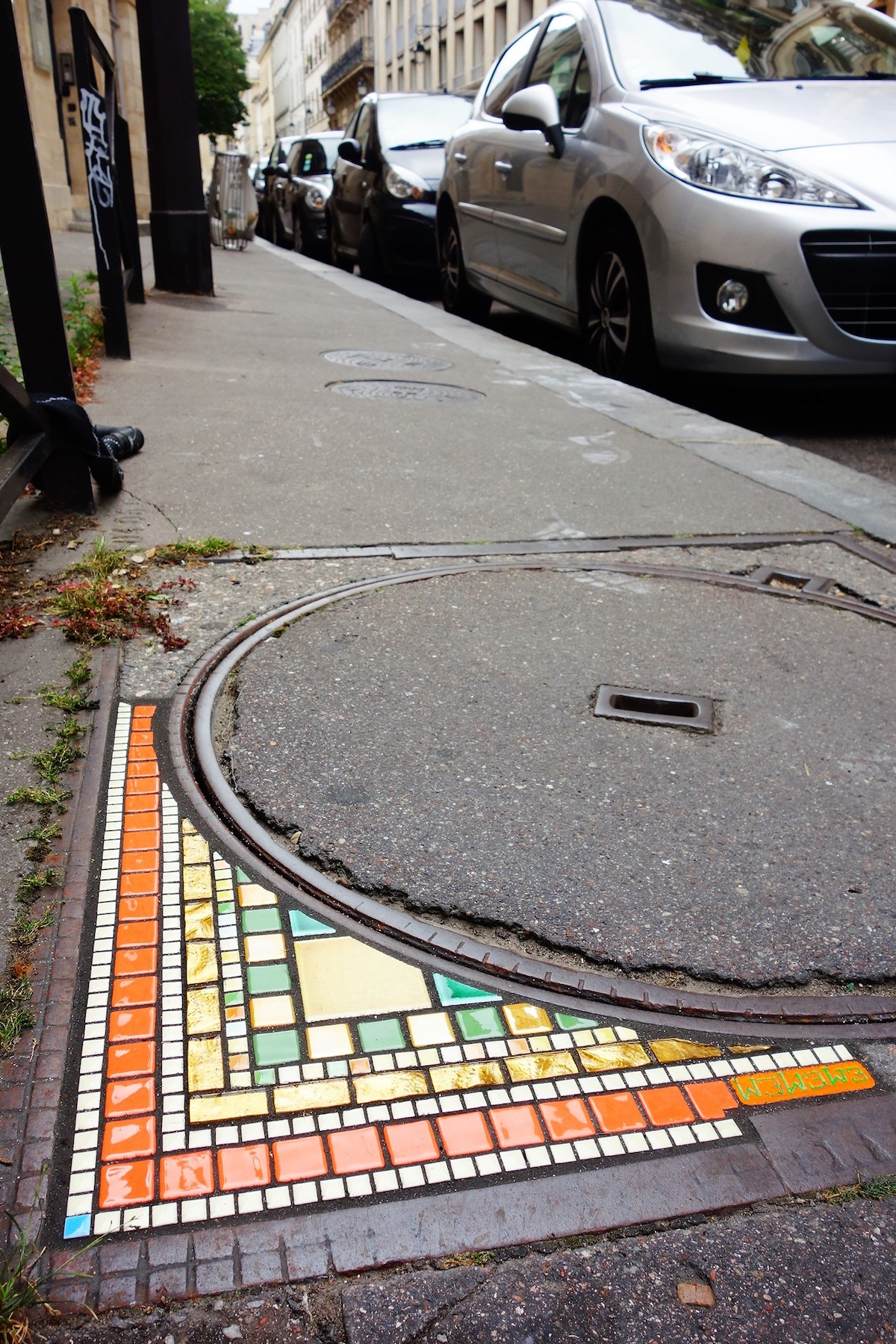
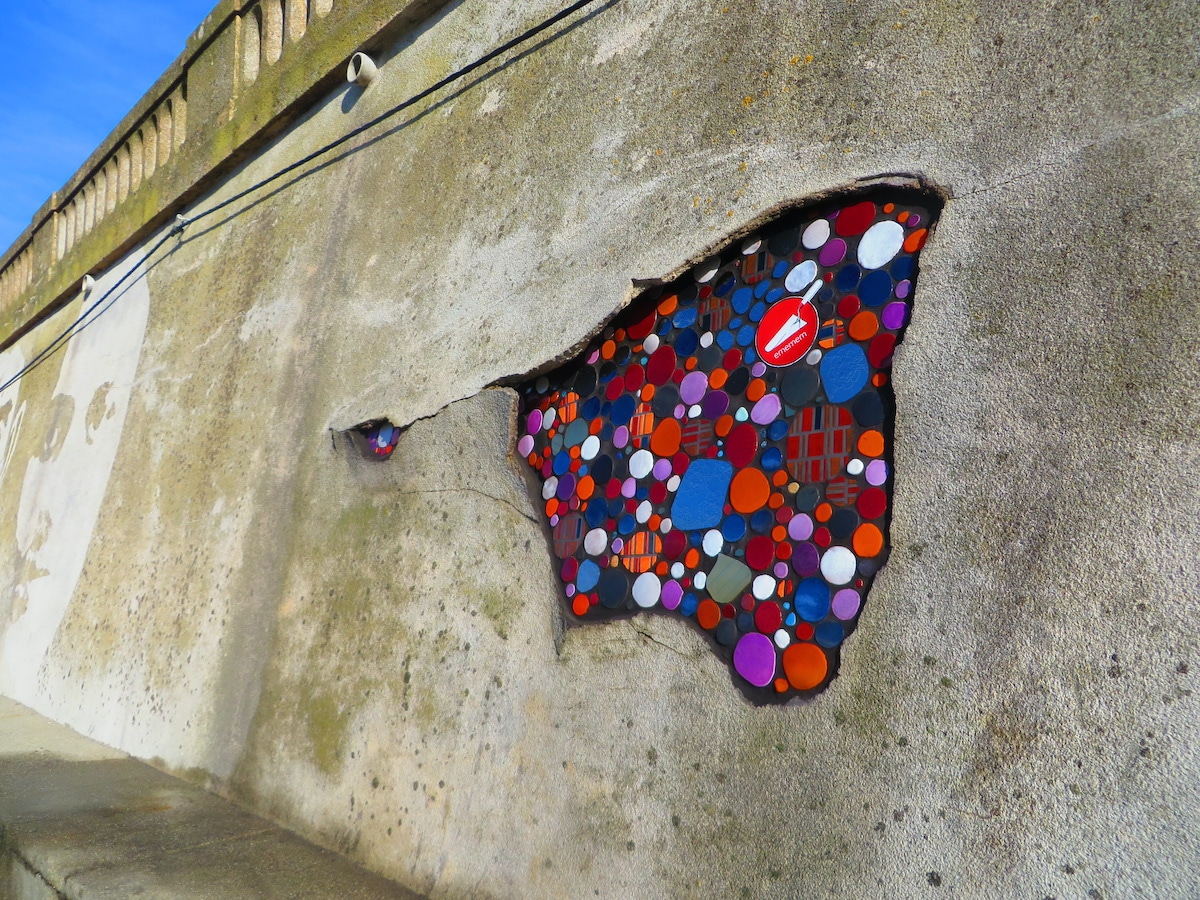
Ememem is a France-based visual artist known for repairing small areas in urban environments with colorful mosaics. He calls his technique flacking.
Since 2016 he’s been anonymously patching cracks in Lyon and Paris, and other European cities for instance in Norway, Scotland, Germany, Italy, and Spain.
He typically works at night. His efforts are usually discovered in the morning as people start their day. Most of his efforts seem to focus on street surfaces, but some retaining walls or building walls also get some Ememem love.
Ememem’s repairs are absolutely delightful! They remind me a lot of visible mending or quilting. I wish this type of repair were more common, but I understand the financial realities of why not.
Barbarian migrations are a staple of popular histories of the ancient world. From early wandering groups like the Cimbri and Teutones in the late second century BCE to massive hordes of Goths, Vandals, Juthungi, and the like streaming across the map of the late Roman Empire, it seems that gathering up in huge masses and tromping around the world is just what barbarians do.
But is it? The popular image of migrating barbarian hordes comes from older scholarship, many of whose assumptions and conclusions have been challenged in recent generations. No one today doubts that people in antiquity moved, sometimes in groups, and sometimes long distances, but the idea of massive hordes pouring across the landscape is becoming less and less tenable.
To get an idea of why massive barbarian migrations are questionable, we’ll consider two interrelated issues: numbers and logistics. How large were the groups that moved long distances in antiquity? And how did those groups manage the practical problems that come with moving long distances? This post addresses numbers. In the next post, we’ll talk about logistics. Finally, we’ll see what conclusions we can draw about how and why large groups of people moved around the ancient world.
Ancient sources are notoriously unreliable when it comes to estimating the numbers of people in large groups. Greek and Roman writers trying to describe the movements of large groups of potentially hostile outsiders are especially unreliable. Even today it is difficult to estimate the size of crowds, and we have much better tools at our disposal than ancient authors did. Most writers who report figures for the movement of large groups were not eyewitnesses, and were certainly not in a position to get an accurate count.
Greek and Roman authors had reasons to exaggerate the scale of forces they perceived as hostile intruders. A large movement was more dramatic to write about, and the defeat of a large hostile force reflected more glory on the Greek and Roman armies and leaders who fought them. The literary mood of late antiquity was particularly pessimistic, influenced both by the competition for power among rival generals who needed to claim that they had triumphed over unbeatable odds and the Christian hope for an apocalyptic end of the world. The image of massive hordes of invading barbarians suited the needs of contemporary writers, but that does not mean that barbarians were actually invading in massive hordes. The same dire language was used to describe urban unrest, rural banditry, undisciplined soldiers, even overzealous monks.
Still, there was nothing new about Greek and Roman authors wildly overestimating the size of outside groups on the move. The Greek historian Herodotus in the fifth century BCE famously estimated the size of the Persian king Xerxes’ expeditionary force in Greece (army and navy combined) at a ludicrously high figure of 5,283,220; modern estimates vary, but generally put the total at less than 100,000.
Given these facts, we should be skeptical of ancient sources that breezily conjure up 80,000 Vandals, 150,000 Goths, or 400,000 followers of Radagaisus. While any of these figures could theoretically be correct, and we cannot categorically reject them, none of them is any better than an estimate by an outside observer passed through several hands and recounted by a writer with literary and political axes to grind.
So, how large were the actual groups of people moving around the ancient world? It is impossible to say with any certainty, but we can make a few suggestions. To begin with, the lower literary estimates are a workable upper bound. 80,000 is repeated by enough sources in enough different contexts that it probably represents a literary convention for “a very big number of people.” If we suppose that this literary convention is derived from actual experience of the practicalities of moving large groups of people, then it makes sense to suggest that few if any moving groups in antiquity numbered more than 80,000, and most were much smaller.
Accounts of some late antique battles give figures of approximately 10,000 fighters in the “barbarian” armies. These figures are questionable for all the same reasons described above, but they are not out of proportion to the sizes of known ancient armies. Fighting forces represent only a fraction of an entire population, conventionally estimated at an eighth, or perhaps as much as a quarter in extreme circumstances. A fighting force of 10,000 would then represent a total population of 40,000-80,000. Since the “barbarian” armies in these battles were often temporary alliances of disparate groups, the constituent groups themselves must have been smaller.
Our numbers can only be speculative, but drawing together these inferences, we are probably not terribly far wrong if we imagine most migrating groups in antiquity on the scale of 10,000-20,000 people, with some temporary alliances adding up to 80,000 or so.
In the next post, we’ll think about what it would actually take for even a group of 10,000 or so people in ancient conditions to migrate from one place to another.
Image: Ludovisi sarcophagus, photograph by Jastrow via Wikimedia (currently Museo Nazionale Romano di Palazzo Altemps, Rome; c. 251 CE; marble)
History for Writers looks at how history can be a fiction writer’s most useful tool, from worldbuilding to dialogue.
The Indian black narrowmouth frog (Melanobatrachus indicus) is a vulnerable species endemic to wet evergreen forests in southern India.
Not much is known about them outside of academia and/or research circles (and I’m currently too sick to start combing through more in-depth sources). They seem to be quite small, though. And how cute are those tiny blue polka dots! And its face, too! At least this individual looks so smart it could easily be the model for a dungeon boss for a computer game.
Visual Inspiration pulls the unusual from our world to inspire design, story-telling, and worldbuilding. If stuff like this already exists, what else could we imagine?
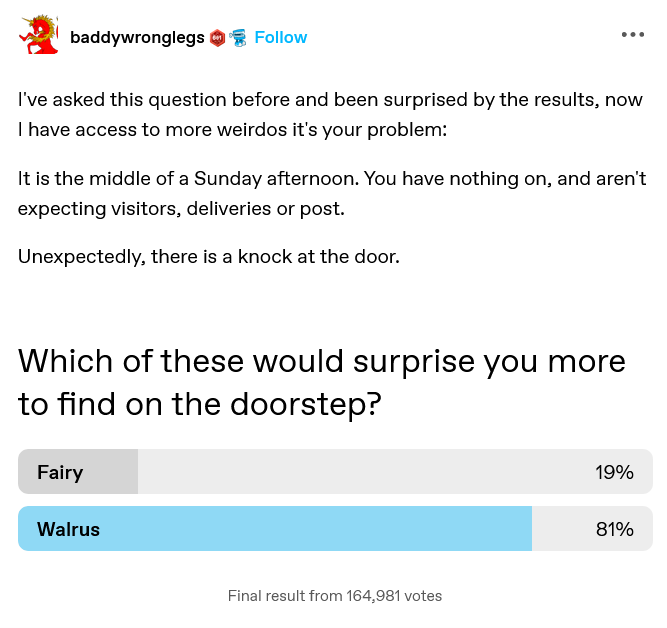
There’s been a thing going on in the past month on the Internet about fairies and walruses. If you’re not in the loop, it all started with a poll posted on tumblr by user baddywronglegs that asked respondents to consider which one they would be more surprised to find at their front door, a fairy or a walrus?
The fun of this poll is that it pits two very surprising (in most parts of the world) things against one another, but those things are surprising in two different ways. Fairies don’t exist, but if they did, it would be perfectly plausible for one to knock on your door. Walruses do exist, but the idea that one would survive the trip out of the Arctic, make it to your front door, and knock is beyond belief. What’s more surprising: the most unsurprising surprising thing or the most surprising unsurprising thing?
Yes, Finland is an Arctic country in the sense that we straddle the Arctic Circle, even though most of our land area is south of it. We do not, however, currently have any coastline in the north; all of our salt water access is to the south and west, i.e., to the Baltic Sea. Visits like this are, therefore, extremely rare. The walrus had to travel all the way around Scandinavia, through the Danish Straits (Kattegat and Skagerrak), and east along the Gulf of Finland to reach Hamina and Kotka.
It’s quite staggering that we live in a place where, theoretically—very much in theory, but nevertheless—a walrus could turn up on the yard! (No sign of fairies, though.)
Saint Patrick’s Day is coming, and while some folk will be out there marching in parades or drinking green beer, I am reminded that Patrick is the source of one of the clearest early accounts of sleep paralysis and the frightening sensations that can come with it.
Patrick wrote an account of his life, called the Confession. This document was written late in his life and in response to some unknown allegations of misconduct during his mission in Ireland. Patrick’s Confession accordingly focuses on his humility and spiritual piety as it tells the story of how he was enslaved in Ireland as a young man, escaped to Britain, and finally returned to spread the Christian message. At one point in narrating his escape, Patrick recounts a frightening nighttime experience which he perceived as a demonic attack:
On that very night as I was sleeping, Satan tested me powerfully, such that I shall remember it for as long as I am in this body. He lay on top of me like an enormous stone, and I had no strength in any of my limbs. How did it occur to me, ignorant in spirit, to cry out “Elias?” In the midst of this, I saw the sun begin to rise in the sky, and as I shouted “Elias! Elias!” with all my strength, behold, the splendor of the sun fell over me and at once all the weight left me.
Saint Patrick, Confession 20
(My own translation)
Sleep paralysis is a frightening experience that happens when the brain’s processes for falling asleep or waking up are not quite in sync. In normal sleep, the body becomes paralyzed at the same time the brain becomes unconscious, and both states pass when we wake up. Sleep paralysis happens when the body is paralyzed but the brain is partially aware of its surroundings. Unable to properly process stimuli, the brain fills in the gaps with hallucinations. Because the brain is aware of the body’s vulnerability in its paralyzed state, these hallucinations often feel threatening. It is not unusual for a sufferer to scream themselves awake in response. Sleep paralysis most often happens in the evening when first going to sleep or in the early morning while waking up.
Many cultures have folk traditions that interpret sleep paralysis as the effect of hostile supernatural visitation. Old-fashioned explanations include incubi, night hags, and ghosts; more modern folktales may feature alien abduction. Patrick details a clear account of sleep paralysis—it happens at dawn, he is unable to move, he feels a weight on his body and perceives a hostile presence which he shouts away—but interprets the events in a specifically Christian context.
Patrick’s night terrors are a reminder of both the universality of human experiences, and how powerfully our own specific cultural outlook can shape our reactions to those experiences.
Serving exactly what it sounds like, the Quotes feature excerpts other people’s thoughts.
Most often, nerdy and geeky home decor is the work of enthusiastic fans channeling their love of the genre into their spaces. Sometimes, though, you do see a mainstream professional hired for the work. One such is the case of a fantasy-loving family in Finland, who hired interior designer Minna Haapakoski to plan a reno of their bland basement mancave. And she pulled out all stops.
Entry to the space is now hidden behind a tall, ornate mirror. Visitors are greeted at the door by an armor-wearing figure. In addition, decorative arches were added to divide the space into two working / gaming spaces separated by a tv / lounge area with a large built-in seat.
Both open shelving and cabinets provide storage. Surface materials have been cleverly used to change the feel of the room. Wall paneling is made from reclaimed wood, and the faux tiles are made with plaster and painted. All the lighting is on dimmers, and sound-proofing was applied to the door as well as walls.
Now, the room looks fantastic, doesn’t it? (No pun intended!) It houses not just one but two desks plus the lounging area, which is great for versatility. The design elements all work towards creating a harmonious whole, the colors are nicely balanced, and details like faux bois plant pots add to the illusion.
Even so, I’d have a hard time picking useable ideas for a potential reno of my own. First of all, many of the surface materials would be out for me for health reasons, but to each their own. Secondly, the entry with the armored dummy is merely there for looks, which means it’s basically a wasted area. (Then again, if you have a home of 200+ square meters / 2,150 sq ft or so—I’m wildly guessing here—and money to burn…)
Furthermore, there’s a pragmatic issue with the floor plan that would drive me absolutely nuts. There doesn’t seem to be open floor between the two desks. Say what?!?
While I love spaces that indicate that some thought has gone into making them look nice, I absolutely, utterly, ardently must have function first. Especially if it’s my home, it has to work for me; having to battle hindrances every single day is simply unacceptable. If this mancave were in my home, having to clamber over (or through?) the built-in lounge to get to the far side would JUST. NOT. WORK.
I guess it just goes to highlight how unique individual wants and needs can be. This family loves their new mancave, and good for them. 🙂
There is one final thing that I’d kinda like to know. The dummy seems to be from the game Dark Souls II. (If you look carefully, you can see writing on the riser below his step.) Now, where does one buy a life-sized dummy from a ten-year-old gaming franchise, and how everloving much does it take in effort and cost to a) freight it in, AND b) install it into your basement mancave? That’s some serious fan action!
Persepolis was the ceremonial capital of the Achaemenid Persian Empire. While other cities such as Babylon, Susa, and Ecbatana had royal residences and centers of administration, Persepolis was the symbolic heart of the empire. It was here that one of the central rituals of Achaemenid rule was carried out, the annual presentation of gifts from the peoples of the empire to the king.
Early Persian kings, like Darius I and Xerxes I, built up the palace at Persepolis into an impressive monument suitable for the ceremony. Persepolis was meant to be both imposing and welcoming, asserting the king’s power while also embracing the diverse peoples of the empire in a peaceful ritual in which they were treated as valued members of the empire, not defeated subjects.
It was in part because of Persepolis’ symbolic significance that Alexander the Great burned the palace in his conquest of Persia. The site of the palace was not reoccupied but was left in ruins, which has allowed modern archaeologists to reconstruct the Achaemenid palace in significant detail.
In a wide view, we see the palace complex as it stood at the edge of the hills. The large columned hall in the center is the apadana or throne room where the king received the delegations of gift-bearers from around the empire. To the left is the Gate of All Nations, through which the procession of gift-bearers entered the complex, and to the right are the buildings of the treasury where the ceremonial gifts were stored after the ritual was completed.
A view of Persepolis, still from a video by ZDF/Terra X/interscience film/Faber Courtial, Gero von Boehm/Hassan Rashedi, Andreas Tiletzek, Jörg Courtial via Wikipedia
From a ground-level view we see the Gate of All Nations, erected by Xerxes, which gave admission to the courtyard before the apadana.
The Gate of All Nations, still from a video by ZDF/Terra X/interscience film/Faber Courtial, Gero von Boehm/Hassan Rashedi, Andreas Tiletzek, Jörg Courtial via Wikipedia
Another ground-level view gives us an idea of what it would have been like to approach the apadana, with some human and animal figures for scale.
The north porch of the apadana, still from a video by ZDF/Terra X/interscience film/Faber Courtial, Gero von Boehm/Hassan Rashedi, Andreas Tiletzek, Jörg Courtial via Wikipedia
The whole video is well worth a watch. It can be quite valuable to try to imagine ancient spaces not as the ruins we find them in today but as living places filled with life and activity.
Out There highlights intriguing art, places, phenomena, flora, and fauna.
I updated my Night Elf survival hunter’s transmog with a small tweak. I like her scale mail look a lot, but, befitting Dragonflight, I wanted a bit more of a dragon-y look.
Three updates created the biggest change: the headpiece is now mogged to Suffused Coif, the shoulders to Bequeathed Spaulders, and back to Anachronistic Wrap.
While the old chest looked ok, I wanted to tweak the colors ever so slightly and went with Trailblazer’s Scale Vest. That left the boots, which also ever so slightly disagreed with the new pieces, so after dinking around I chose Masterwork Boots. The darker color fits the rest of the new set better, I find.






 Co-Geeking


.jpg)
