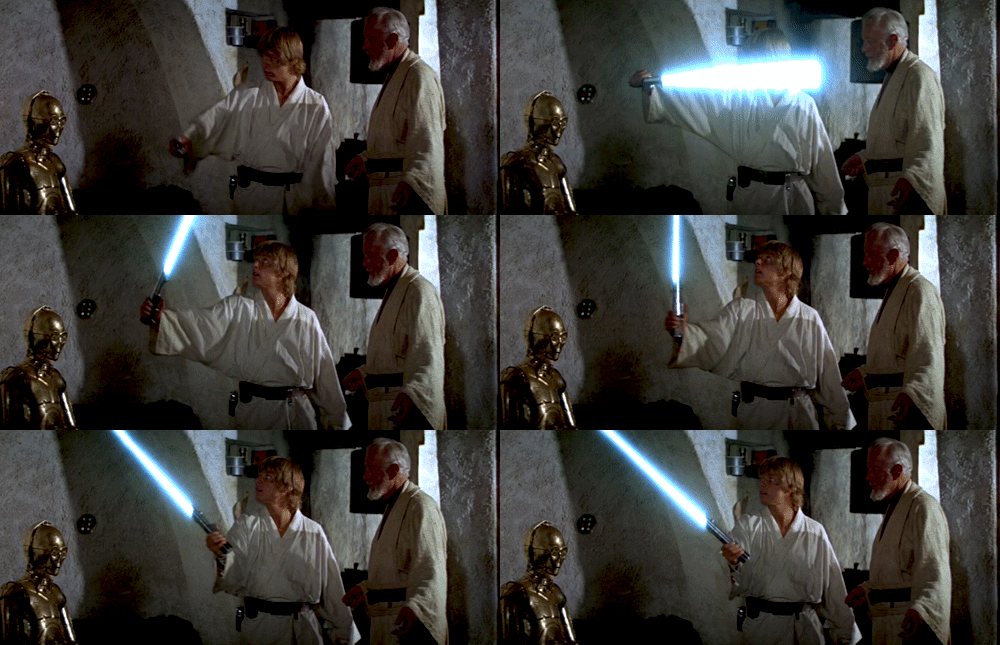
The soundtrack is very effective – I can actually feel the goosebumps moving along my arms and scalp! Apparently the trailer music is a combination of new composition and previous music; see the write-up by Peter Sciretta at /Film.
And this Han’s flashback video by Nick Skywalk does a fantastic(!!) job cutting in scenes from the original trilogy with the Episode VII trailer:
Bonus link: There used to be a Playstation video game called Star Wars: Masters of Teräs Käsi, published by LucasArts 1997. Teräskäsi is Finnish and literally means ‘steel hand’. This was news to me, but apparently it’s part – albeit a mostly forgotten part – of the official canon. Yay, Finland! 😉
Hey, look! We found a thing on the internet! We thought it was cool, and wanted to share it with you.
It’s well known that George Lucas drew inspiration from mythology when writing Star Wars. Luke Skywalker, the young hero from the planet farthest from the bright center of the universe, gets the call to adventure delivered by droid and goes off on a Campbellian journey to rescue a princess, seek out an ancient mentor, and finally confront his fallen father. The prequel trilogy gave us the tragic version in which Anakin, the great warrior, was driven to madness and destroyed the things he loved the most.
There are smaller touches of myth throughout the Star Wars hexalogy. Luke receives his father’s lightsaber like King Arthur drawing his father’s sword from the stone. The escape from the imperial garbage masher has hints of Jonah and the whale. Luke in the Wampa’s cave has shades of Beowulf.
Like most of the rest of geeky internet, I’ve been watching the trailers for The Force Awakens with excitement. I’ve been struck by something, especially in the latest trailer. The mythology that this latest iteration of Star Wars is working hardest to evoke is… Star Wars.
Star Wars: The Force Awakens Trailer (Official) via Star Wars
Star Wars has transcended being a movie franchise or even an expanded universe. It has reached the point where we can speak of it in terms of mythology.
One of the definitions of myth is that it is a story you know even if you can’t recall ever being told it. Star Wars has that. It is part of our cultural consciousness to the point that even people who haven’t seen the movies (yes, they exist) recognize the sound of a lightsaber and the cadences of the imperial march. Star Wars was all over my childhood, and even though I didn’t get around to seeing the movies until I was a teen (I was a Star Trek fan and young and dumb enough to think that I had to pick one over the other), I recognized Darth Vader, Princess Leia and Yoda on my friends’ lunchboxes.
Another characteristic of myth is that all myths are versions. There is no original, no canon. Though some may disagree on whether this is a good thing, Star Wars has always been an evolving story, getting new versions from small tweaks to big changes. (Yes, I see you in the back in the “Han Shot First” shirt, you can put your hand down.) The new wave of Star Wars movies leaves the old hexalogy alone but reboots the post-Return-of-the-Jedi expandeduniverse.
For those of us who grew up in the world of Star Wars, it is hard to imagine a time when these stories were not a part of the popular culture, yet there was a time when no one had heard Darth Vader’s breathing or Yoda’s grammar, when no one knew what a lightsaber or a Death Star was. By connecting to the ancient stories we already knew, Star Wars made itself feel timeless. Now it has become a part of that universal memory to be played upon and invoked in its own right.
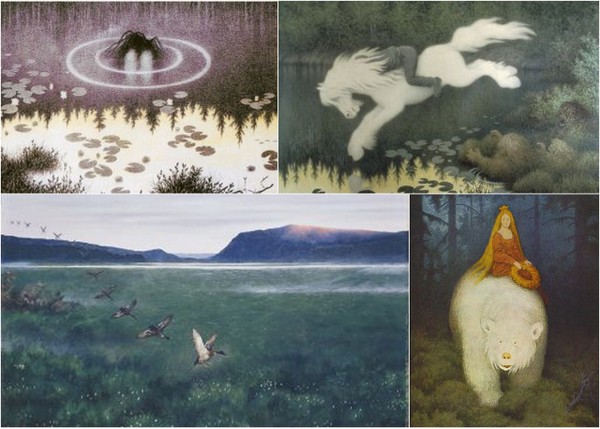
Norwegian Theodor Kittelsen (1857-1914) developed into one of Scandinavia’s most popular artists. He’s especially well known for his nature paintings and illustrations of fairy tales, legends, and trolls.
Theodor Kittelsen: Trollet som grunner på hvor gammelt det er [troll wonders how old it is], 1911. Via Wikimedia Commons.His art clearly shows how strongly the Norwegian nature inspired him. Kittelsen’s style is said to include aspects naturalism, mysticism, and Art Nouveau.
Theodor Kittelsen, clockwise from top left: Nøkken [water spirit], 1887–92; Gutt på hvit hest [boy on white horse]; Kvitebjørn Kong Valemon [white bear King Valemon], 1912; 12 villender [12 wild ducks], 1897. Via emmeffe6 on Flickr (one, two, three, four).The element of a boy on a white horse is connected with water spirit tales. Apparently some näkki water spirits (to use my native Finnish term) can turn into horses to capture humans to pull underwater. I don’t remember that aspect of the näkki stories from my childhood; perhaps there’s a difference between the Scandinavian and Finnish tales.
The landscapes in Kittelsen’s paintings remind me of the Finnish wildernesses a lot. There’s also something solemn and contemplative in the mood of his imagery that makes me connect it with Tolkien’s art and writing, on one hand, and, on the other, with the illustrations of Tove Jansson (see examples of her work on Alice in Wonderland and The Hobbit provided by The Official Moomin site).
Out There is an occasional feature highlighting intriguing art, spaces, places, phenomena, flora, and fauna.
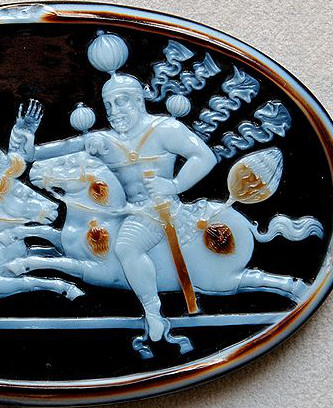
… Marcus Licinius Crassus would have been the first emperor of Rome instead of Julius Caesar.
Stick with me here.
Alfalfa is a plant in the pea family that resembles clover. It originally comes from south central Asia and was cultivated in the northern parts of the Iranian plateau as animal fodder. Compared with other fodder plants, alfalfa is very high in protein, so it is mostly fed to cattle. It can be given in small amounts to most horse breeds, but in large amounts it causes bloating as horses cannot use the excess protein.
The exception is Nisaean horses, a breed of horse that was developed in northern Persia and bred to feed on alfalfa. These horses were able to absorb the extra protein of alfalfa into their bones, giving them denser, stronger bones than other horses. These dense bones enabled the Nisaean horses to make sudden turns while galloping at high speed that would have broken other horses’ legs and to carry heavier weights than other horses of the ancient world could manage.
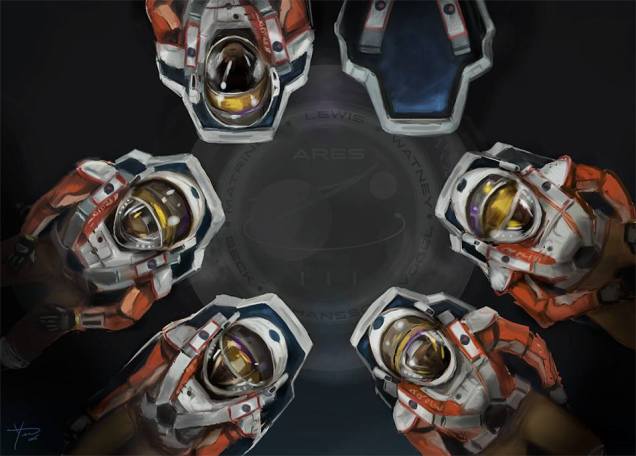
“Was thinking to use this as a reference for a large format painting (in acrylic). After working on this digital painting over a couple of days I’m starting to rethink the feat. My right hand is not happy.”
Beautiful. Reminds me stylistically of some SF book covers I like. I hope a large format acrylic is coming (and published on their website)!
Out There is an occasional feature highlighting intriguing art, spaces, places, phenomena, flora, and fauna.
In honor of its 40th anniversary, Monty Python and The Holy Grail will be re-released on October 14, 2015. The release will be twofold: an anniversary disc version (DVD & Blu-ray) and a limited, one night only theatrical showing.
Co-director Terry Jones goes on YouTube to introduce some never before seen material gleaned from video archives:
“Put together after months of searching through the Python archives, scanning the original negatives and reassembling scenes, this video includes extended versions of ‘Sir Robin and the Three Headed Knight’, ‘Get On With It!’, ‘Old Crone’, ‘Wedding Slaughter’, alternative takes from the ‘Constitutional Peasants’ scene, a shorter take from the ‘Black Knight’ scene and some lost silly bits.”
A nifty tidbit from Jones’s intro: the hip amputee who played the Black Knight with his leg cut off also did the voice work for his lines, and did a pretty good job.
Hey, look! We found a thing on the internet! We thought it was cool, and wanted to share it with you.
Down the crimson marble steps of the temple of Zurukh, god of blood, came a bald priest in the red robes of the Order.
“Heathens!” he cried, pointing with his holy whip at Our Heroes. “Heretics! Blasphemers! You shall bow down and worship Zurukh or burn in the fires of the Scarlet Inquisition!”
“Silence!” answered Inessa, stepping forward from the party and raising aloft her crosier. “Repent of your wickedness! The power of Adnea, Lady of the Pure Light, compels you!”
Religions are tricky to write. If you’ve delved into much fantasy, you’ve probably seen a lot of faiths that seem oddly familiar. In fact, the religions of some fantasy worlds can be charitably described as “Catholicism with the serial numbers filed off.” Even given a profusion of gods with their own temples and cults and spheres of influence, fantasy religions tend to work more like the modern monotheisms than like the actual ancient “pagan” traditions they are outwardly imitating.
How can you make your fantasy religion feel more authentically ancient? There’s no rules to it, but in this and some future History for Writers posts, I’ll share some of what we know about historical beliefs from around the world that may help you imagine a religious worldview that feels less modern.
Finland’s national public broadcasting company Yle interviewed actor Sean Bean (article in Finnish; the 4-minute video in English) during his promo tour for The Martian.
(Note: I wasn’t able to share the video; you’ll have to follow the link to Yle and play it there.)
Bean mentions that the Lord of the Rings reference – Project Elrond – was something he didn’t know how to react to. My partial transcription from the interview (from ca. 1:50-2:30) picks up with Bean’s answer to how it came about:
“I don’t know. I think it was in the script originally and it stayed in there, and it was very funny ’cause I’ve never been in a f– I was in a film that– then– which was– within a film. So it was very funny. [Laughs.] And, erm, you know, I just kind of listened to it, I didn’t know how to react, really [laughs], to that. It’s an unusual kind of situation I was in. But it was great, it’s great. I love that, it’s nice.”
When asked whether they joked about the reference on set, Bean answered:
“Not really, no, you said it and everyone went, like– [indistinct; laughs.] You know, I couldn’t kind of go, like, ‘Oh yeah, I was in [that]’, you know. But I– So I just kind of– [makes a gesture of playing it cool] went on with it.”
Other questions touch on the large number of team leader roles he’s played or characters who die (which Bean doesn’t seek out, specifically), how Bean built the character of Mitch Henderson with director Ridley Scott, and the kind of roles Bean would like to play in the future.
Serving exactly what it sounds like, the Quotes feature excerpts other people’s thoughts.
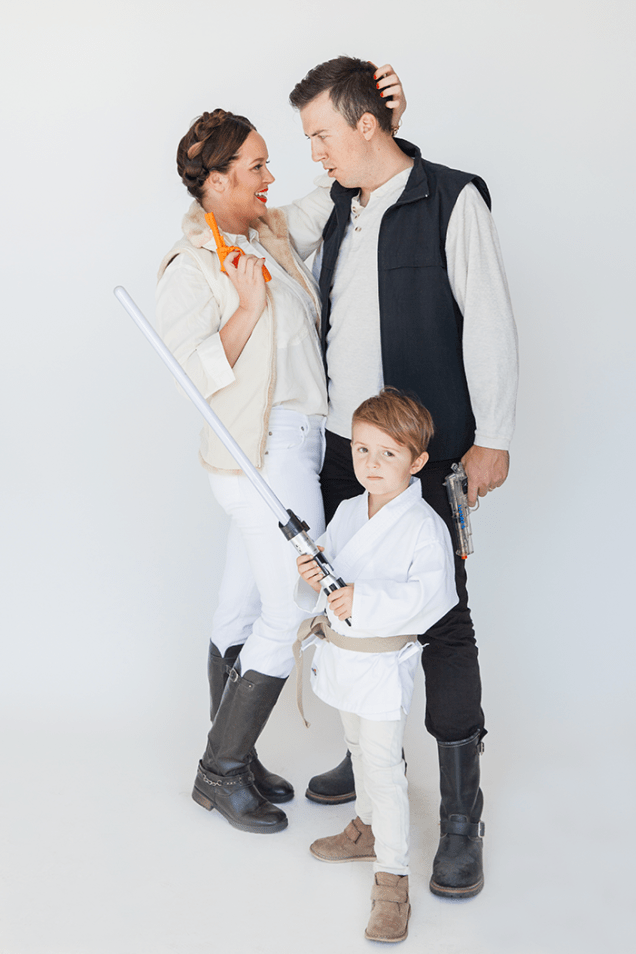
Star Wars group costumes. Photo by Ashley Thalman / Say Yes.
Perfect for Halloween: evocative outfits that are easy to create almost entirely by using everyday items. Sometimes it’s the whole that matters more than individual details. Great job!
Credits: models Aaron, Kayti and little Monroe Oldham; photography by Ashley Thalman; styling by Sarah Larsen; production by site manager Ashley Aikele; creative direction by Liz Stanley at Say Yes.
This post has been edited.
In Making Stuff occasional feature, we share fun arts and crafts done by us and our fellow geeks and nerds.