A Lock of Hair Swept off to the Heavens… on an Ostrich?

Or: Some History behind Ostrich Riding, Part 5 of 7

Background: I ran into two historical images from California with ostriches used as transportation. That got me wondering about the history of ostrich riding. And that lead me down quite a rabbit hole.

I’ve divided my findings into separate posts (find them with the ostrich riding tag). Warning: serious early history and language nerdery ahead in Serious Academic Voice.

TL;DR – Tracing ostrich riding to a 3rd century BCE tomb find (a statue of Arsinoe II) from Egypt doesn’t hold up. The use of various ostrich products in human material culture dates back thousands of years. A few ancient depictions involve humans handling ostriches; however, extant sources don’t tell us whether ostriches were merely hunted or whether they were also tamed in the ancient world. The most promising source seems to be a description of a magnificent parade put together by Arsinoe II’s husband-brother Ptolemy II. This Grand Procession included eight chariots drawn by pairs of ostriches, and the ostriches may have been ridden by boys in costumes.

I had hoped to find a nice, neat selection of ancient texts putting the Greek word for ‘ostrich’ in context, but even a cursory look reveals that the history of the word strouthos is complex. At best, we can say that there are no immediate red flags either in the original Greek or modern English translations for Arsinoe II’s statue or Ptolemy II’s Grand Procession. The poem Berenice’s Lock was said to contain further evidence of ostriches as mounts in Ptolemaic Egypt after Arsinoe II’s death. Instead, what we seem to have is a case of poetic ambiguity translated with poetic license and taken uncritically as evidence.

Below is the long story.

Continue reading

Take the Mirror Empire Quiz

To mentally prepare myself for reading Empire Ascendant by Kameron Hurley, the middle book in the Worldbreaker saga, I took a quiz to find out which character from The Mirror Empire I might be.

Hurley Mirror Empire Cover

I am… Ghrasia Madah:

“You’re a pragmatic defender, with a dim view of stories and mythology, because you’ve been mythologized yourself, and didn’t much like the taste of the world afterward. A hero, a legend, most days you just try to stand very tall so that people don’t notice you aren’t exactly a physical match for the woman they read about in storybooks.

“You fall a bit too hard for young, whip-smart men with mother issues, but after twenty years married to two of the ‘right’ sorts of men, maybe this is nice change.”

I’ll take pragmatic, but otherwise it’s not very accurate. Ghrasia is a tough, no-nonsense, unpretentious, and persistent lady, though, which I appreciate.

Which Mirror Empire character are you?

Q&A is an occasional feature in which we share our responses to quizzes, questions, and quirky ideas for your entertainment.

Statue of Lenin Turned to the Dark Side

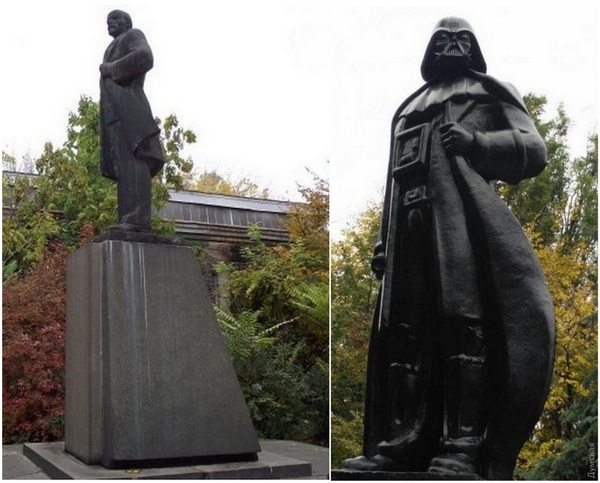
In Odessa, Ukraine, a statue of Lenin fated for demolition instead got a new life – as Darth Vader.

Dumskaya Lenin Vader
Images: Dumskaya.net via Meduza.

The destruction of the statue was called for by a new law that requires the elimination of all landmarks and geographic names dedicated to communist figures. Artist Alexander Milov repurposed the statue and turned Lenin into the dark side. There’s more under Vader’s cloak than a covered-up Lenin’s coat, though: the statue’s head conceals a router delivering Wi-Fi to the immediate area.

Who woulda thunk that Lenin’s pose would be spot on for Vader!

Found via Meduza.

Out There is an occasional feature highlighting intriguing art, spaces, places, phenomena, flora, and fauna.

Feasts and Fools

151026jackHalloween will soon be upon us. The origins of this holiday are obscure. It is often connected with the Gaelic festival of Samhain, which marked the end of the harvest and the beginning of winter, but Halloween, at least as popularly celebrated today in the US and some other countries, has wider connections. It is an example of a type of holiday found in many cultures: the “feast of fools.”

Continue reading

Two Fan-Made Star Wars: Episode VII Videos

This music-only version of the official The Force Awakens trailer edited by Tim Gonzales is awesome:

The Force Awakens Trailer #3 – Music Only Edit

The soundtrack is very effective – I can actually feel the goosebumps moving along my arms and scalp! Apparently the trailer music is a combination of new composition and previous music; see the write-up by Peter Sciretta at /Film.

And this Han’s flashback video by Nick Skywalk does a fantastic(!!) job cutting in scenes from the original trilogy with the Episode VII trailer:

Han Solo’s Flashback

Eight weeks to go!

Bonus link: There used to be a Playstation video game called Star Wars: Masters of Teräs Käsi, published by LucasArts 1997. Teräskäsi is Finnish and literally means ‘steel hand’. This was news to me, but apparently it’s part – albeit a mostly forgotten part – of the official canon. Yay, Finland! 😉

Hey, look! We found a thing on the internet! We thought it was cool, and wanted to share it with you.

The Myth Is Strong With This One

It’s well known that George Lucas drew inspiration from mythology when writing Star Wars. Luke Skywalker, the young hero from the planet farthest from the bright center of the universe, gets the call to adventure delivered by droid and goes off on a Campbellian journey to rescue a princess, seek out an ancient mentor, and finally confront his fallen father. The prequel trilogy gave us the tragic version in which Anakin, the great warrior, was driven to madness and destroyed the things he loved the most.

1501022lightsaber

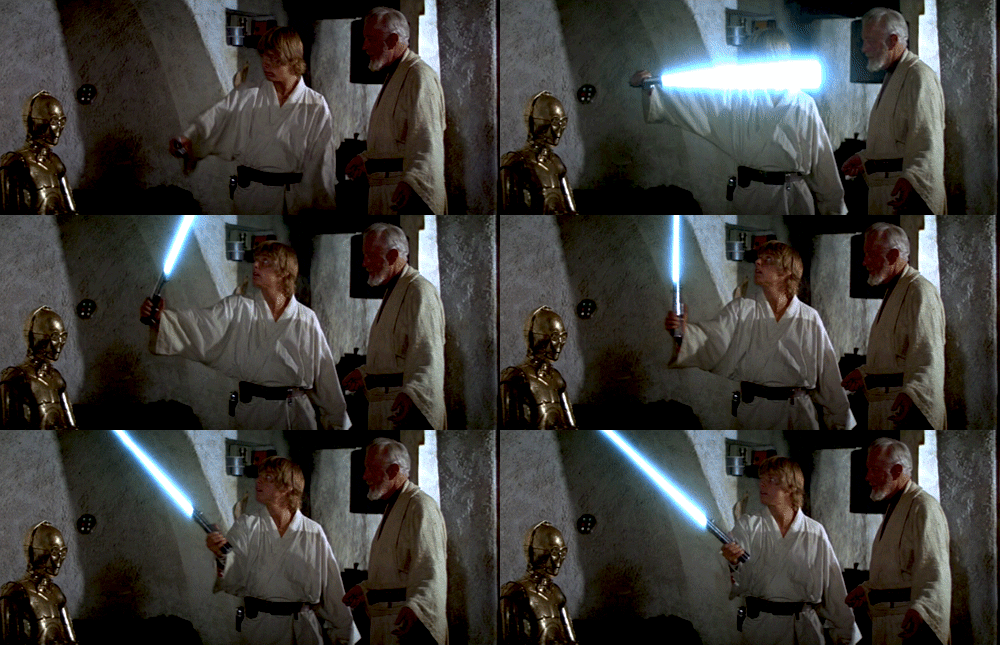
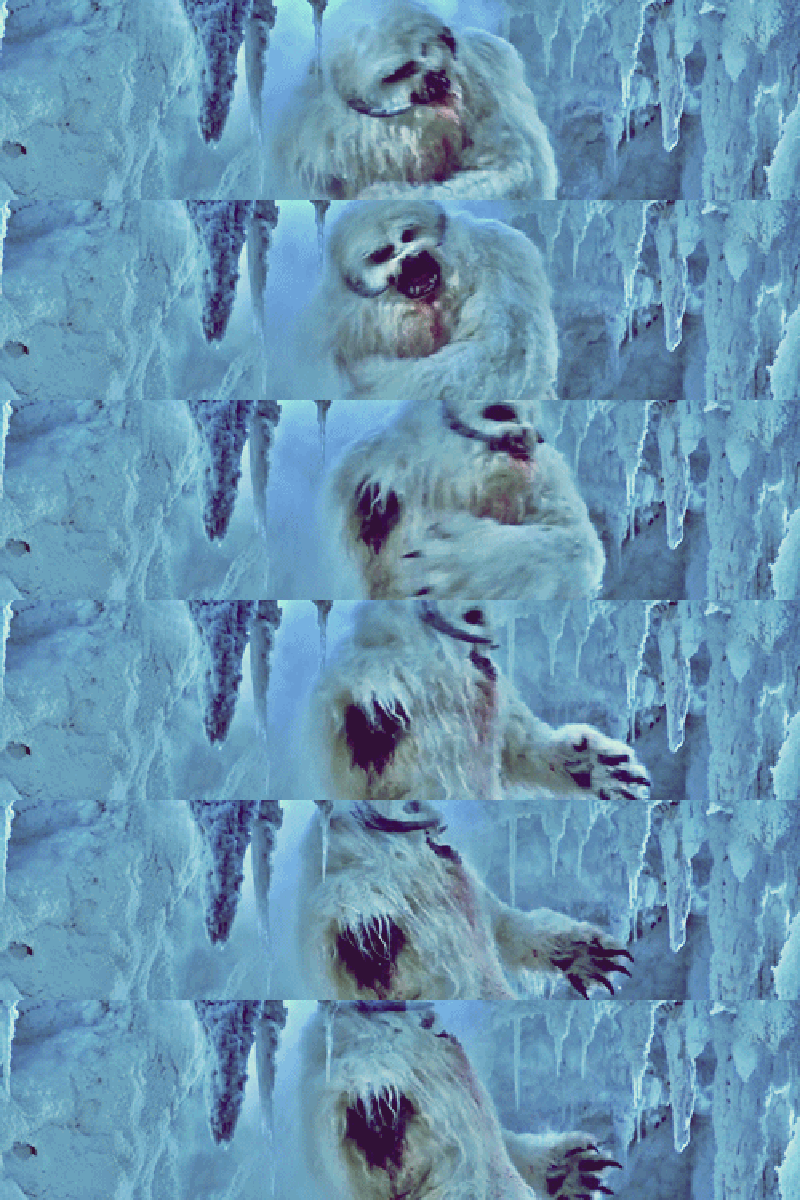
There are smaller touches of myth throughout the Star Wars hexalogy. Luke receives his father’s lightsaber like King Arthur drawing his father’s sword from the stone. The escape from the imperial garbage masher has hints of Jonah and the whale. Luke in the Wampa’s cave has shades of Beowulf.

151022wampa

Like most of the rest of geeky internet, I’ve been watching the trailers for The Force Awakens with excitement. I’ve been struck by something, especially in the latest trailer. The mythology that this latest iteration of Star Wars is working hardest to evoke is… Star Wars.

Star Wars: The Force Awakens Trailer (Official) via Star Wars

Star Wars has transcended being a movie franchise or even an expanded universe. It has reached the point where we can speak of it in terms of mythology.

One of the definitions of myth is that it is a story you know even if you can’t recall ever being told it. Star Wars has that. It is part of our cultural consciousness to the point that even people who haven’t seen the movies (yes, they exist) recognize the sound of a lightsaber and the cadences of the imperial march. Star Wars was all over my childhood, and even though I didn’t get around to seeing the movies until I was a teen (I was a Star Trek fan and young and dumb enough to think that I had to pick one over the other), I recognized Darth Vader, Princess Leia and Yoda on my friends’ lunchboxes.

Another characteristic of myth is that all myths are versions. There is no original, no canon. Though some may disagree on whether this is a good thing, Star Wars has always been an evolving story, getting new versions from small tweaks to big changes. (Yes, I see you in the back in the “Han Shot First” shirt, you can put your hand down.) The new wave of Star Wars movies leaves the old hexalogy alone but reboots the post-Return-of-the-Jedi expanded universe.

For those of us who grew up in the world of Star Wars, it is hard to imagine a time when these stories were not a part of the popular culture, yet there was a time when no one had heard Darth Vader’s breathing or Yoda’s grammar, when no one knew what a lightsaber or a Death Star was. By connecting to the ancient stories we already knew, Star Wars made itself feel timeless. Now it has become a part of that universal memory to be played upon and invoked in its own right.

Images: “This is the weapon of a Jedi knight” via The Film Fatale; wampa via giphy.com

Post edited for style.

In the Seen on Screen occasional feature, we discuss movies and television shows of interest.

Theodor Kittelsen’s Naturalistic Fantastical Art

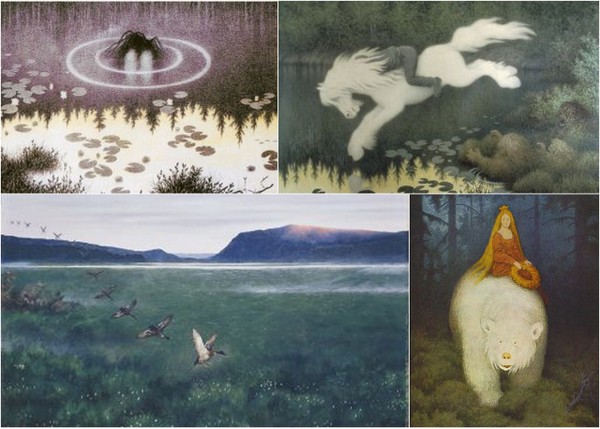
Norwegian Theodor Kittelsen (1857-1914) developed into one of Scandinavia’s most popular artists. He’s especially well known for his nature paintings and illustrations of fairy tales, legends, and trolls.

Trollet_som_grunner_pa_hvor_gammelt_det_er
Theodor Kittelsen: Trollet som grunner på hvor gammelt det er [troll wonders how old it is], 1911. Via Wikimedia Commons.
His art clearly shows how strongly the Norwegian nature inspired him. Kittelsen’s style is said to include aspects naturalism, mysticism, and Art Nouveau.

Kittelsen Collage
Theodor Kittelsen, clockwise from top left: Nøkken [water spirit], 1887–92; Gutt på hvit hest [boy on white horse]; Kvitebjørn Kong Valemon [white bear King Valemon], 1912; 12 villender [12 wild ducks], 1897. Via emmeffe6 on Flickr (one, two, three, four).
The element of a boy on a white horse is connected with water spirit tales. Apparently some näkki water spirits (to use my native Finnish term) can turn into horses to capture humans to pull underwater. I don’t remember that aspect of the näkki stories from my childhood; perhaps there’s a difference between the Scandinavian and Finnish tales.

The landscapes in Kittelsen’s paintings remind me of the Finnish wildernesses a lot. There’s also something solemn and contemplative in the mood of his imagery that makes me connect it with Tolkien’s art and writing, on one hand, and, on the other, with the illustrations of Tove Jansson (see examples of her work on Alice in Wonderland and The Hobbit provided by The Official Moomin site).

Out There is an occasional feature highlighting intriguing art, spaces, places, phenomena, flora, and fauna.

In a World Without Alfalfa…

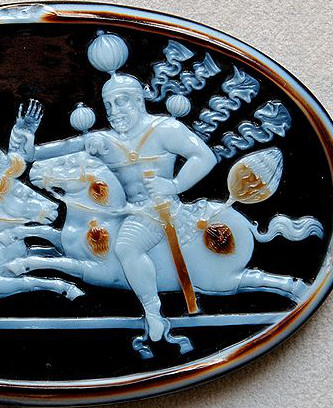
151019Shapur… Marcus Licinius Crassus would have been the first emperor of Rome instead of Julius Caesar.

Stick with me here.

Alfalfa is a plant in the pea family that resembles clover. It originally comes from south central Asia and was cultivated in the northern parts of the Iranian plateau as animal fodder. Compared with other fodder plants, alfalfa is very high in protein, so it is mostly fed to cattle. It can be given in small amounts to most horse breeds, but in large amounts it causes bloating as horses cannot use the excess protein.

The exception is Nisaean horses, a breed of horse that was developed in northern Persia and bred to feed on alfalfa. These horses were able to absorb the extra protein of alfalfa into their bones, giving them denser, stronger bones than other horses. These dense bones enabled the Nisaean horses to make sudden turns while galloping at high speed that would have broken other horses’ legs and to carry heavier weights than other horses of the ancient world could manage.

Continue reading

Digital Painting Inspired by The Martian

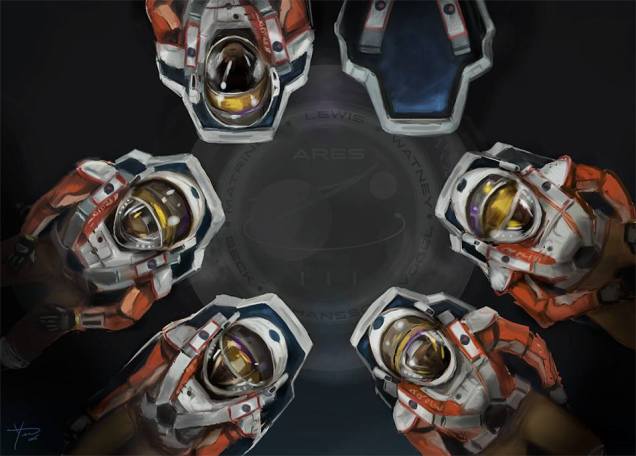
Painter and photographer d. yee was inspired to re-interpret a scene from The Martian as a digital painting:

d. yee.
d. yee.

Says artist:

“Was thinking to use this as a reference for a large format painting (in acrylic). After working on this digital painting over a couple of days I’m starting to rethink the feat. My right hand is not happy.”

Beautiful. Reminds me stylistically of some SF book covers I like. I hope a large format acrylic is coming (and published on their website)!

Out There is an occasional feature highlighting intriguing art, spaces, places, phenomena, flora, and fauna.