It’s a good time to be a Sherlock Holmes fan. There are now plenty of adaptations to choose from. There’s the BBC’s Sherlock if you like visual inventiveness and whip-crack dialogue. For a more traditional procedural that does interesting things with characters, there’s CBS’s Elementary. For Hollywood thrills you can go back a few years to the films starring Robert Downey Jr. as the great detective. For series in the Holmesian spirit without the same characters there’s the medical drama House or the mystery/comedy Psych.
However the setting may change, there are some key elements of Sherlock Holmes’s character that remain the same: the keen powers of observation and deduction, the cycles of intense focus on a problem and lethargic dissipation, the antisocial habits that make him near impossible to live with.
Oh, and Sherlock Holmes is a total jerk-ass.
The standard interpretation of Holmes in modern media is that he is an asshole with no patience for anyone else, either because he’s not neurotypical in some fashion or because he just can’t be bothered to care about anything so pedestrian as decent manners. He gets away with it because he’s just so brilliant.
Well, lately I’ve been rereading the original Sherlock Holmes stories by Conan Doyle, something I’ve been meaning to do for years. I’ve gotten very used to the modern Holmes, so I was surprised to rediscover that the original Holmes wasn’t like that at all. In fact, Conan Doyle’s Holmes is compassionate and generous.
My latest reading project rolls on with The Left Hand of Darknessby Ursula Le Guin (first published in 1969).
Genly Ai is sent to planet Gethen (also known as Winter due to its extremely cold climate) as an envoy for the Ekumen of Known Worlds, an interstellar conglomeration for trade and cultural exchange. His mission is to convince the planet to join the Ekumen, easier said than done on a world where the conditions are semi-arctic even at the warmest time of the year and where cultures and technologies change at a glacial pace. (Pardon the pun!)
I knew a little of Left Hand before reading it. I knew that it’s highly regarded, that the inhabitants of the world are androgynous (or something) and that there’s an arduous trek across a glacier (or snowy steppes or somesuch) that’s somehow significant.
I also knew that some people describe the book as being about gender. Gethenians are all of the same sex – or, rather, of no sex until their monthly reproductive cycle known as kemmer comes around. At that point, depending on who else is in kemmer nearby, a person may turn either into a Gethenian male or female, and it’s quite usual for someone to be both a mother and a father.
I’m not entirely sure yet what Left Hand is about for me. The Gethenian biology does get a lot of attention, but I suspect it’s because it’s so unfathomable to Ai. The importance of hospitality and cooperation in the cold climate is also significant, as are the balancing of opposite forces (like you-me or individual-society), the complex Gethenian honor system shifgrethor and their aversion to war. Karhide’s neighboring country Orgoreyn sounds like a communist regime, with its people described as units instead of citizens and its communal resources or endless bureaucracy; Orgoreyn may, in an unprecedented step, be moving towards starting a war with Karhide, and we might have a Cold War echo there.
Structurally, Left Hand avoids infodump by alternating the present-day narrative chapters with short chapters on Gethenian mythology. I was a little bothered by how much longer the primary narrative chapters were, for it made reading the novel choppy; I may well change my mind about that if I read Left Hand again.
I’ve seen Le Guin’s writing described as zen-like. The descriptor fits her style in Left Hand well, especially when she’s describing traveling across the icy landscape. A fascinating read, and one I may well like to get back to after mulling it over. Considering that I very much enjoy and have read Le Guin’s Earthsea stories several times in two languages, I can’t believe I haven’t read The Left Hand of Darkness before!
Image by Eppu Jensen
This post has been edited.
ICBIHRTB—pronounced ICK-bert-bee—is short for ‘I Can’t Believe I Haven’t Read This Before’. It’s an occasional feature for book classics that have for some reason escaped our notice thus far.
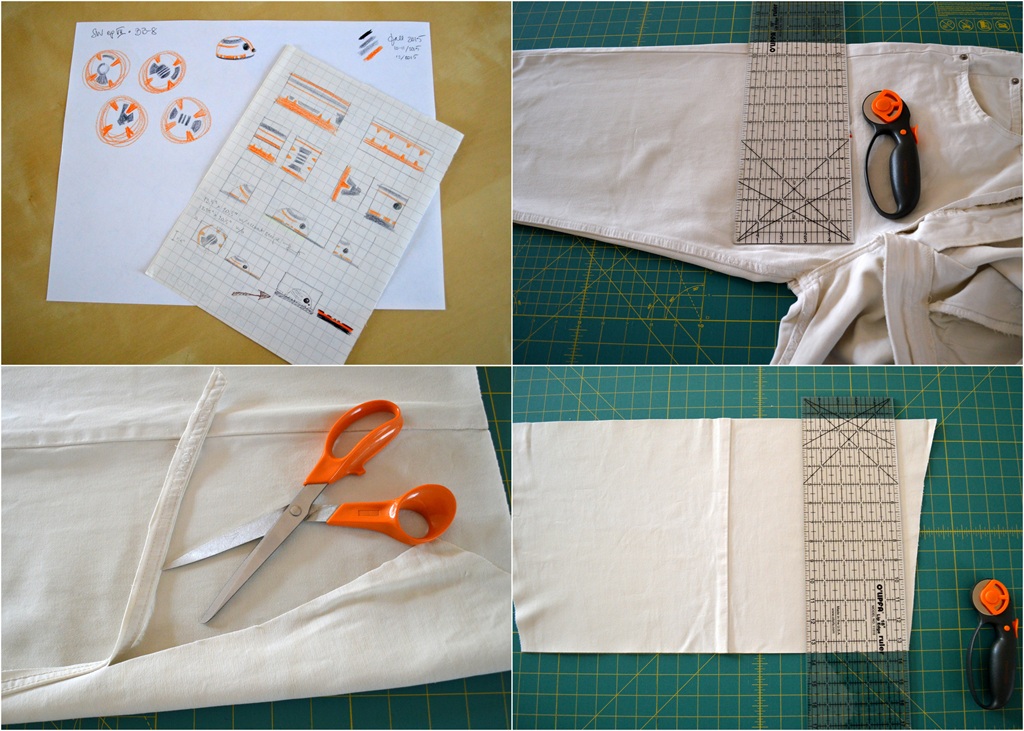
At the end of last year, I wanted to make myself something fun. Since the new Star Wars release date was coming up, that something turned out to be a BB-8 bag.
I used an old pair of pants and various fabric scraps to make it, so the materials were completely free. The bag took me a few nights to make – combining all of those little pieces adds up surprisingly fast. The most time-consuming part for me, though, was deciding on the droid design.
Here’s a quick how-to in pictures:
1 of 4: Deciding on the droid design and cutting as large piece as possible from one pant leg. 2 of 4: Adding stripes and pieces of fabric to the outside to suggest pieces of the droid. 3 of 4: Making box corners, adding an edge binding strip to the top, and adding an inner pocket. 4 of 4: Finished bag.
Not bad for a little fur ball zero dollars! 🙂 If I were to make another, though, I’d probably try a different droid design and fiddle with the inner pocket so that it has more compartments.
Images by Eppu Jensen
This post has been edited.
In Making Stuff occasional feature, we share fun arts and crafts done by us and our fellow geeks and nerds.
You ever leave a comment on someone’s blog, or at least try to, logged in your WordPress account already, happily press the “Post Comment” button, having already confirmed that your little Gravatar icon shows up correctly, only to have the &$%#&%* platform turn on you to ask “Are you [username]? You are being asked to login because [your email address] is used by an account you are not logged into now”?
WHY YES I AM ME, THAT’S WHY I’M FRACKING LOGGED IN ALREADY DID YOU NOT FRACKING SEE MY LOGIN!!!
Sure, there might be a solution to the problem, but it requires research that you don’t presently have the time for. As if you need another item on your to-do list, anyway, so you just put up with the stupidity. And besides, shouldn’t the point of saving your settings be that once you save ’em, they’re available for future use. RAAAAHHH!
Aerial view of part of the Great Zimbabwe complex, photograph by Janice Bell via Wikimedia
Great Zimbabwe is a ruined city in Zimbabwe (and in fact has given the modern country its name). Built over centuries beginning in the 9th century, the site was a center of power for the medieval Shona (or Kalanga) kingdom and part of the trade networks that spanned the Indian Ocean. It was abandoned in the 15th century and stands in ruins today, but even in its ruined state it is impressive.
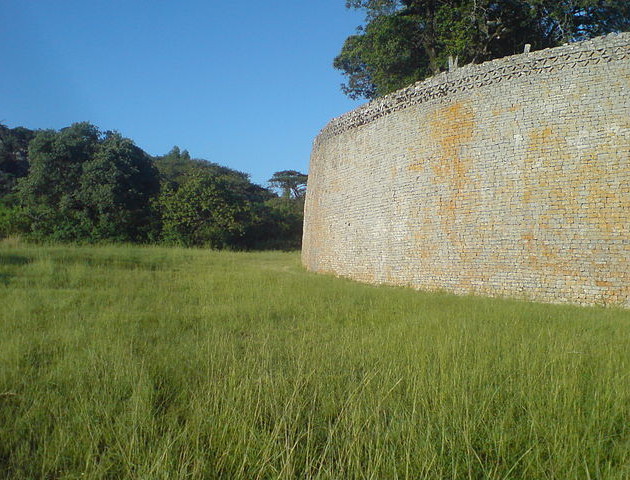
Wall of the great enclosure, photograph by Jens Klinzing via Wikimedia
The remains of numerous stone enclosures spread over hundreds of hectares. At its height, Great Zimbabwe may have housed between 15,000 and 20,000 people. The surviving walls reach heights of five meters and are built of stone blocks assembled without mortar. Several different complexes occupy different positions ranging from hills to near the river. The significance of these different complexes remains unclear, but it may indicate that the center of settlement gradually moved over time, away from the more defensible hill sites to the more accessible valley sites, perhaps to better engage with the oceanic trade networks. Ivory and gold were Great Zimbabwe’s major international exports and trade goods from the Arabian peninsula and China have been found at the site.
Interior walkway showing the quality of the stonework via Wikimedia
One noteworthy feature of the enclosures is their shape: neither rectangular nor circular but irregular curved shapes adapted to the forms of the landscape on which they sit.
In the colonial period, popular theories held that the site must have been built by ancient European or Asian colonizers. The biblical Queen of Sheba was often mentioned in connection with the site. Although archaeologists realized as early as the early twentieth century that Great Zimbabwe had been built by Africans, the colonial administration in what was then Rhodesia suppressed any such claim. The assertion that Africans were incapable of building such a complex site and needed European guidance to achieve any level of civilization was key to the justification of imperial domination. Colonial authorities could not tolerate any evidence that Africans were capable of creating sophisticated works of art and architecture on their own.
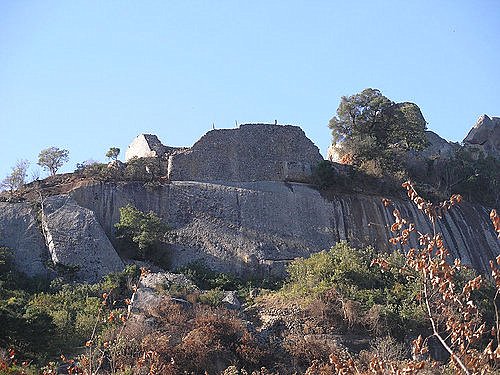
Part of the hill complex seen from the valley below, photograph by Macvivo via Wikimedia
Thoughts for writers
I have two reasons for sharing a little bit of Great Zimbabwe.
First, it is another example of architecture that does not depend on European examples. When doing our worldbuilding as writers, it is easy to fall back on the things that are familiar: European castles, Egyptian pyramids, Greek temples, and the other things we’ve seen before. Let yourself be inspired by the other amazing things people have built. I’d love to see a city inspired by Great Zimbabwe at its height turn up in a fantasy story, even one not set in an explicitly African-inspired world.
Second, this is another example of how politics can screw up good historical scholarship and so why you need to read broadly and get outside familiar frames of reference. Even today, while the Queen of Sheba is generally left out of it, claims that Great Zimbabwe was built by Arabs or Phoenicians still occasionally creep into popular histories.
History for Writers is a weekly feature which looks at how history can be a fiction writer’s most useful tool. From worldbuilding to dialogue, history helps you write. Check out the introduction to History for Writershere.
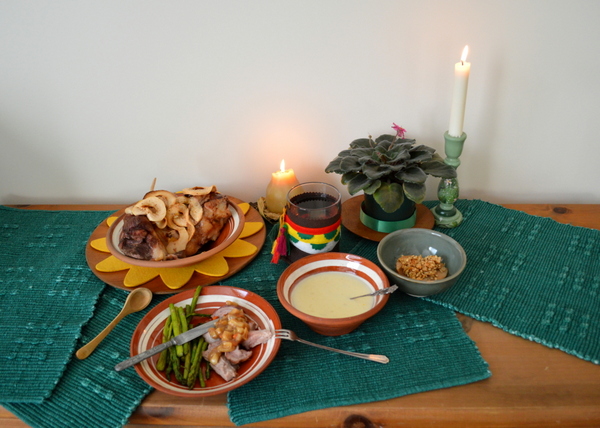
Roast pork with apples, root vegetables, and ginger gravy
Roasted asparagus
Stuffed pears
Red wine
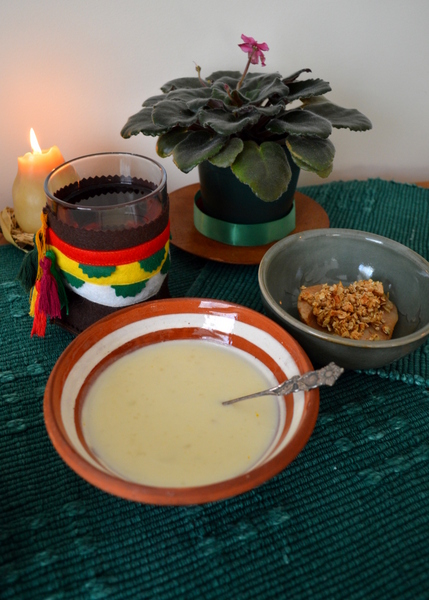
As Elves love song and Dwarves love the gems of the earth, so Hobbits love their food. We know more about Hobbit food than about the cuisine of any other culture on Middle Earth, so it is a surprise to find that in the description of the festivities for Bilbo Baggins’s 111th birthday, we learn nothing about what was actually on the table. (Though clearly there was plenty of it, whatever it was.) That means that for our very first Middle Earth dinner, we have to use a little imagination. Fortunately, there’s a lot to go on.
Since this is a party of special magnificence (with supplies brought in all the way from Dale), I’ve tried to make a combination of typical Hobbit fare with a few special or exotic twists.
“When every guest had been welcomed and was finally inside the gate, there were songs, dances, music, games, and, of course, food and drink. There were three official meals: lunch, tea, and dinner (or supper). But lunch and tea were marked chiefly by the fact that at those times all the guests were sitting down and eating together. At other times there were merely lots of people eating and drinking – continuously from elevenses until six-thirty, when the fireworks started.”
Our version of Bilbo Baggins’s party of special magnificence begins with an appetizer of potato and cream soup, followed by roast pork and root vegetables served with ginger gravy and asparagus on the side. It ends in dessert, with baked stuffed pears. (Of course, in proper Hobbit fashion, you may start and end with whatever you like.) A glass of red wine washes it all down.
Our imagined table comes with a variety of kitchenware styles. Glass and green glazed crockery complement basic redware pottery. There are wood and metal utensils, including a fork and silver soup spoon. The colors green and yellow were pulled from the general description of Hobbits’ preferences. A potted plant and candles finish off the table setting.
Sometimes writing fiction means not just moving a few characters around the map but planning entire campaigns for massive armies. In previous entries in the travel series we looked at some basic issues and how small groups travel on foot. For large groups on foot, much of what we discussed in those entries is relevant, but large groups of people, like armies or mass migrations, bring with them their own set of problems. Today we’ll look at some basic questions in the movement of large groups: How large is “large?” What did it take to make the journey successfully? How far could they travel? And how fast?
This post is written with a particular focus on armies, since they are the best-studied large groups that traveled in the pre-industrial world, but any sufficiently large group of people traveling by foot would face the same basic problems.
Actor Alan Rickman has passed. Apart from a fantastic Professor Severus Snape, Rickman brought to life both on stage and screen numerous other characters, including my favorite Colonel Brandon in the 1995 adaptation of Jane Austen’s Sense & Sensibility.
I also have fond memories of his performance as Alexander Dane / Dr. Lazarus in Galaxy Quest and the sheriff of Nottingham in Robin Hood: Prince of Thieves (with the unforgettable delivery of “Because it is dull, you twit, it’ll hurt more!”, on the desirability of a spoon as a torture device).