Hannibal’s Route Identified?

160407didrachm In 218 BCE, the Carthaginian general Hannibal led an army across the Alps into Italy, touching off the Second Punic War. On the question of exactly where Hannibal crossed the Alps, there’s always been a lot of, for lack of a better term, horse pucky. The ancient sources are vague and of dubious reliability. In the absence of solid evidence, numerous distinct schools of thought on the question have emerged. There are the military professionals who argue that Hannibal must have taken the easiest, most straightforward route open to him. There are the romantics who insist that Hannibal’s army must have taken a difficult and dangerous route befitting such a momentous expedition. The folklorists are persuaded by local legends in the Alps while the textualists wrangle over which of the literary sources is more reliable. Now some literal horse pucky may be getting us closer to an answer.

The whole route hangs on the identification of two specific points. One is an area called the “island” somewhere in the valley of the Rhone river. The other is the pass by which Hannibal’s army crossed the Alps. While the “island” is still uncertain, recent archaeological work may have identified the Alpine pass. As reported in Archaeometry in March, 2016, a large deposit of horse manure and disturbed soil near the Col de la Traversette indicates the passage of a large number of horses dated to the period of the Second Punic War. If this finding stands up to further scrutiny, it may allow us to pin down Hannibal’s Alpine crossing.

Identifying the Traversette as the pass Hannibal’s army took would have some interesting implications for our interpretation of the war as a whole. Although favored by some scholars (notably Sir Gavin de Beer), the Traversette has usually been dismissed as too high, narrow, and difficult for Hannibal’s army, especially when several lower, wider, easier passes were available within a few days’ march. The military-history school in particular has argued that Hannibal would not have set out on his march without good advance intelligence about the Alpine passes and that intelligence would have persuaded him never to attempt the Traversette. If Hannibal did indeed take his army by the Traversette, it suggests that his advance intelligence was not as good as modern historians imagine (whether because Hannibal didn’t know enough about the available passes or because he allowed his army to get into such desperate straits that he had to take a pass he knew was a bad choice).

If Hannibal’s intelligence-gathering was less than optimal, that would also help to explain the major strategic failure of his campaign: overestimating the central Italian cities’ readiness to cast off Roman hegemony. Hannibal’s strategy against Rome depended on stripping Rome of its allies and conquests. While he found ready support in the areas of northern and southern Italy that had only recently been conquered by Rome, very few cities in Rome’s core central Italian territory were willing to join him.

It’s always important to take new findings with caution. Further research may cast doubt on this new evidence. For now though, the poop looks promising.

Post edited for clarity

Image: Tarentine didrachm struck during the Second Punic War, photograph by Classical Numismatic Group via Wikimedia (c. 212-209 BCE; silver)
Space Archaeologist Discovers Potential Viking Site in Southern Newfoundland

A team of archaeologists has unearthed a potential new Viking site in Newfoundland, Canada with the help of satellites. Dr. Sarah H. Parcak, an archaeologist, space archaeologist, and Egyptologist, lead the effort to take infrared images from space to find new archaeological sites.

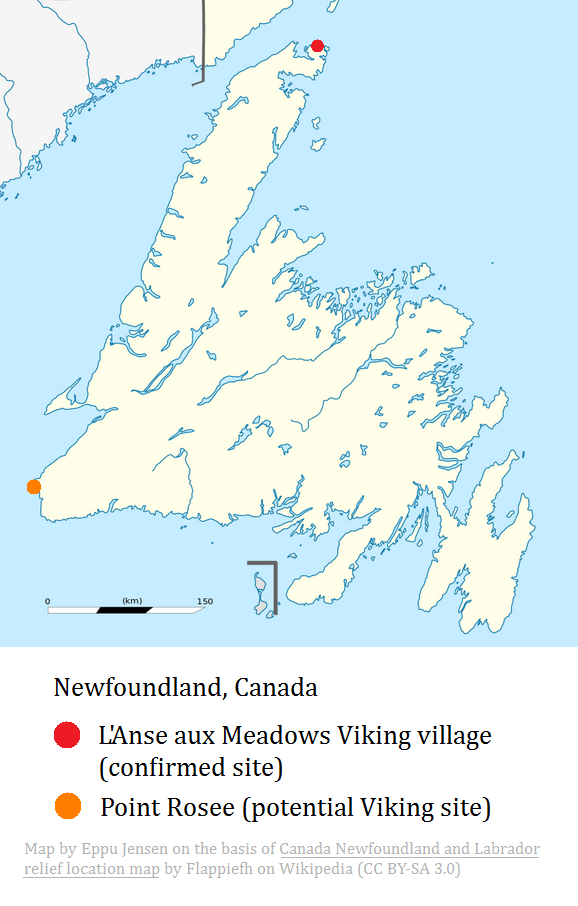
Newfoundland with Viking Activity
Newfoundland with Viking activity. Map by Eppu Jensen on the basis of Canada Newfoundland and Labrador relief location map by Flappiefh on Wikipedia (CC BY-SA 3.0)

According to The New York Times, while searching the coastlines from Baffin Island (in the Canadian territory of Nunavut, west of Greenland) to Massachusetts, she found

“hundreds of potential ‘hot spots’ that high-resolution aerial photography narrowed to a handful and then one particularly promising candidate — ‘a dark stain’ with buried rectilinear features.

“Magnetometer readings later taken at the remote site […] showed elevated iron readings. And trenches that were then dug exposed Viking-style turf walls along with ash residue, roasted ore called bog iron and a fire-cracked boulder — signs of metallurgy not associated with native people of the region.

“In addition, radiocarbon tests dating the materials to the Norse era, and the absence of historical objects pointing to any other cultures, helped persuade scientists involved in the project and outside experts of the site’s promise.”

Point Rosee is approximately 700 km (approximately 400 miles) away from L’Anse aux Meadows, the only currently confirmed Viking site in North America. The Norsemen staying at L’Anse must have traveled further south, though, because butternuts and worked pieces of butternut wood – which are not native to Newfoundland – were found among the Norse objects at the settlement.

CBC News reports that evidence of a Norse-like hearth and 8 kilograms (approx. 16 pounds) of bog iron was found at Point Rosee during a dig in 2015. It isn’t yet known for sure whether the site was a temporary base camp or a settlement, or whether it even was associated with Vikings. If confirmed, Point Rosee would be the second known Viking site in North America.

The evidence is still clearly on the scant side. Digging at Point Rosee is to resume this summer, so maybe they’ll find more.

As a sidenote, isn’t it so cool that we now have space archaeologists?!

Quotes: Shooting People Was Such a Stupid Activity

“Shooting people was such a stupid activity, why should everybody–anybody!–be so impressed? Silver wondered irritably. You would think she had done something truly great, like discover a new treatment for black-stem rot.”

– Lois McMaster Bujold: Falling Free

Silver, one of the genetically engineered, learning-oriented people known as quaddies, expresses her deep dislike of violence.

Bujold, Lois McMaster: Falling Free. Riverdale, NY: Baen, 1988, p. 266.

(This quote comes from my 21 new-to-me SFF authors reading project.)

Serving exactly what it sounds like, the Quotes feature excerpts other people’s thoughts.

Hadrian’s Wall… In Legos!

Brick to the Past is a British Lego-building group that bases their creations on historical landscapes and architecture. One of their builds from last year was inspired by Hadrian’s Wall. The layout combines a stretch of wall, a Roman fortress and town, a milecastle (one of the fortified gateways placed at one-mile intervals), and a native village.

Hadrian's Wall by Brick to the Past
Hadrian’s Wall by Brick to the Past

The buildings are full of delightful details and clever Legosmithing, like the use of a cogwheel over the main door of the bathhouse to represent the wild-haired head that was often associated with springs and baths in Roman Britain, like this fine example from Aquae Sulis (present-day Bath).

The bathhouse by Brick to the Past
Pediment from Aquae Sulis
Pediment from Aquae Sulis, detail of photograph by Velvet via Wikimedia (Bath; 1st c. CE; stone)

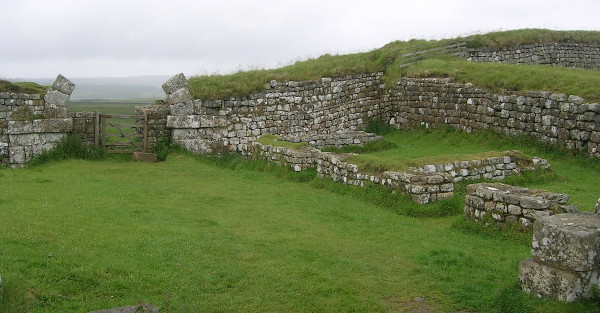
Hadrian would be proud. Here’s a picture of the original, from Milecastle 37. They do kind of look like Legos, don’t they?

Milecastle 37, photograph by Erik Jensen

Hey, look! We found a thing on the internet! We thought it was cool, and wanted to share it with you.

I’ll Have Elevensies with My Elevensies, Thanks!

Beer brewers Night Shift Brewing in Massachusetts made a Baltic porter aged in apple brandy barrels. They call it Elevensies, and describe it as dark and of high gravity.

Night Shift Brewing elevensies_square-01
Elevensies beer by Night Shift Brewing
Night Shift Brewing Elevensies
Elevensies beer. Screenshot from Night Shift Brewing

Sounds like it would’ve made a perfect partner for our Prancing Pony dinner. Maybe we can still find some…!

Found via File 770.

Geeks eat, too! Second Breakfast is an occasional feature in which we talk about food with geeky connections and maybe make some of our own. Yum!


“The Celts” and the Victorian Hangover

160328WandsworthNo, this is not a post about how ladies and gentlemen of the nineteenth century recovered after too many pints of Guinness. Rather, it is about how nineteenth-century ideas about culture and identity have held on so tenaciously in popular history that even now, over a century later, we still have to struggle against them when trying to talk about peoples of the past. One of the subjects that often brings up these outdated ideas is “the Celts.”

Searching for the Celts

Here’s how the Victorian version of history goes. Between 500 and 400 BCE, a new group of people known as the Keltoi to the Greeks or the Gauls to the Romans, whom we call the Celts, emerged in the area of southern Germany, Austria, and Switzerland. From this homeland, they expanded explosively outwards in all directions led by aggressive warrior princes who fought from two-wheeled chariots with long iron swords. They raided Italy and Greece but were prevented from conquering those regions by the armies of the Greeks and Romans. In the west and north, however, the native peoples were far less sophisticated and could not resist the invaders. The Celts conquered France and Belgium, northern Spain, and the British Isles until at the western shores of Ireland their expansion was finally halted by the Atlantic Ocean.

Continue reading →

Love & Friendship Trailer

A movie version of Jane Austen’s never-before-adapted epistolary novel Lady Susan is coming out in a few weeks (released on May 13), and the trailer is finally here.

Love & Friendship TRAILER 1 (2016) – Chloë Sevigny, Xavier Samuel Movie HD via Movieclips Coming Soon

I’ve been waiting for it for a long time without any real idea of what it’ll be like, as I’ve never even heard of the writer / director Whit Stillman before. It looks absolutely hilarious! Kate Beckinsale as Lady Susan seems perfect in every way; I’m also looking forward to seeing more of Jemma Redgrave, James Fleet, and Stephen Fry. Can’t wait! Fansquee!

Hey, look! We found a thing on the internet! We thought it was cool, and wanted to share it with you.

Native American Style Mainstream Genre Icons

Jeffrey Veregge, an artist and member of the Port Gamble S’Klallam Tribe in Washington state, makes positively fantastic versions of mainstream genre icons like superheroes, movie characters, Transformers, aliens, and the like.

Jeffrey Veregge Early-Bird
Early Bird by Jeffrey Veregge

Veregge himself says of his work:

“This site, the work that is seen on it is a reflection of a lifetime love affair with comic books, toys, TV and film. Taking my passions and blending them with my Native perspective, artistic background and the desire to simply be me. Basically I am just trying to have fun and get back to that kid that went to art school to begin with, wanting to create artwork that I want to see and make just for the hell of it.”

Jeffrey Veregge Shield-Logo
Shield by Jeffrey Veregge

Several of his designs would make fantastic fabric prints, like this Flash-inspired one, for example:

Jeffrey Veregge scarlet-blurr
Scarlet Blurr by Jeffrey Veregge (2012)

If there was a fabric Flash version, I’d use it for pencil cases, zipper travel pouches, or a table cloth. Or maybe tall, tall shades with a wide border on the bottom; that would look really striking.

Visit Veregge’s home page for more!

Hey, look! We found a thing on the internet! We thought it was cool, and wanted to share it with you.

Race and Culture in Hannibal’s Army

160322elephantTor.com published an article online today about diversity in Hannibal’s army written from the point of view of historical wargaming. It is a interesting article and well worth a read, but unfortunately it misses the opportunity to really address questions of racial and cultural diversity in ancient warfare. Here is a quick attempt to address some of the things that were lacking.

Race and culture

Race is a term with a lot of baggage, as we are all painfully aware, but it means different things in different contexts. In modern parlance, it describes a socially-constructed division of human beings into more or less arbitrary categories, largely on the basis of skin color and other physical features. In a fantasy context, it refers to distinct species of intelligent creatures like Elves, Orcs, Dwarves, and so on.

The unaddressed problem in the Tor.com article is the conflation of race and culture. In the nineteenth and early twentieth century, overtly racist theories of history posited that people of different genetic backgrounds naturally had different qualities. Many of these stereotypes still linger in our popular culture: the stoic Indian, the mischievous Irishman, the passionate Italian, etc. This belief in racial character was encoded in early classic works of fantasy like Tolkien’s Lord of the Rings, which gave us the stubborn Dwarf, the ethereal Elf, the vicious Orc, etc.

Even as we struggle to root out this conflation of race and culture from our modern life, it lingers on in works of fantasy and science fiction: the logical Vulcan, the boisterous Klingon, the decadent Centauri, the proud Dothraki. As we look back at history, we have to think of the people of the past not in terms of racial qualities but in terms of cultural contexts. People of different origins often do behave differently, but those differences are explained by the cultures they lived in, not the races they represent.

Continue reading →