Travel: Animals

160222reindeerFrom the grand howdah-backed elephant to the plodding pack pony, from the solitary stallion to the caravan of a thousand camels, animals are often a part of how our characters get around. In previous entries to the travel series we’ve considered small and large groups traveling on foot. This time we bring animals into the mix.

Animals can be useful for travel, but they also bring their own challenges with them. The first thing we need to consider is what kinds of animals are useful for long-distance travel. Then we’ll look at the three main ways of using animals for travel: riding, pack, and draft. Finally, a word on the care and feeding of transport animals. As usual in this series, we are looking at real-world history: no griffins or dragon-drawn chariots. Take the information here and adjust as necessary for whatever setting you happen to be writing.

Continue reading

Quotes: She Was Born a Thing

“She was born a thing and as such would be condemned if she failed to pass the encephalograph test required of all newborn babies. There was always the possibility that though the limbs were twisted, the mind was not, that though the ears would hear only dimly, the eyes see vaguely, the mind behind them was receptive and alert.”

– Anne McCaffrey: The Ship Who Sang

The opening sentence of the titular, first story in the collection.

McCaffrey, Anne: The Ship Who Sang. New York, NY: Del Rey, 1969 [stories originally published between 1961 and 1969], p. 1.

(This quote comes from my 21 new-to-me SFF authors reading project.)

Serving exactly what it sounds like, the Quotes feature excerpts other people’s thoughts.

Making A Farewell Feast in Bag End

Here’s a look at how we made yesterday’s Farewell Feast in Bag End.

The menu

  • Fish and chips
  • Boiled cabbage wedges with rosemary mint sauce
  • Blueberry soup

erikchef1As with last month’s party, we have very little to go on in the text for an actual menu. Once again, this requires some imagination, but this time I’m trying to imagine a small, intimate dinner for friends, not a grand party.

Continue reading

Dining in Middle Earth: A Farewell Feast in Bag End

“In the evening Frodo gave his farewell feast: it was quite small, just a dinner for himself and his four helpers… The dining-room was bare except for a table and chairs, but the food was good, and there was good wine: Frodo’s wine had not been included in the sale to the Sackville-Bagginses.”

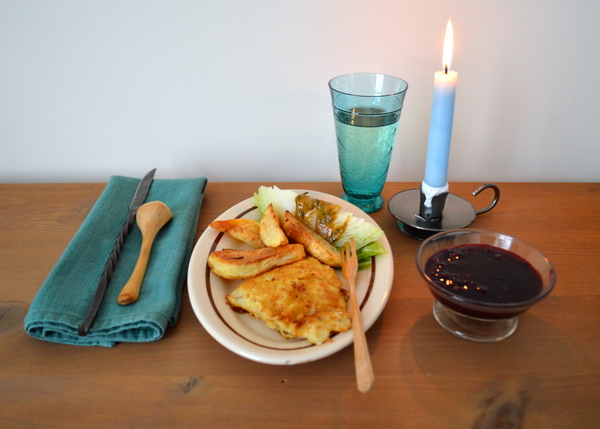
LotR Dinner2Our take on Frodo’s last dinner in Bag End has Sam Gamgee’s fish and chips at the center, accompanied by boiled cabbage wedges with rosemary mint sauce. For dessert there is a simple blueberry soup. And with it all, a glass of wine for toasting the good old hole farewell.

LotR Dinner2 Simple

Since this is quite a small, pre-long-distance-move dinner, the props are mostly simple, too: plain ceramics, plain glass, and wooden utensils on a bare table. Since the “good wine” was explicitly not included in the sale, we went with the spirit of indulgence and picked a fancier glass for it.

LotR Dinner2 Drink

Check out what’s it about in the introduction, or read the how-to!

Images by Eppu Jensen

Geeks eat, too! Second Breakfast is an occasional feature in which we talk about food with geeky connections and maybe make some of our own. Yum!

Fantasy Religions: Religious Sites

So, you’re creating a fantasy religion for a story or game. When your characters need to interact with their gods, where do they go—if anywhere at all? Down the street to the local temple? To the top of a windswept mountain? To a corner of their kitchen? Today we look at religious sites in historical cultures to inspire our imaginations.

We can start by looking at religion in today’s world. Look at the religious life of a modern western community and you will find some people attending their local church, synagogue, or mosque, some people praying quietly in their own homes, some feeling inspired by solitary walks in the woods, some debating points of theology over the internet, some participating in celebrations of religious holidays, and some not involved at all. Many people will do more than one of the above. No culture or religious tradition is monolithic, and this is just as true in the past as the present. The history of religious expression is one of incredible variety both across and within cultures.

In this variety, though, there are some patterns that recur in varying forms. People use different kinds of religious sites for different  needs. Many different traditions have used similar kinds of religious sites, and within any given tradition different sites are used for different purposes. Today we will look at four common types of religious site out of the wide variety of possibilities: assemblies, temples, household shrines, and natural spaces.

Assembly

The “assembly” type of religious space will be recognizable to anyone familiar with major variants of the modern monotheistic religions. It is a space where a community of believers gathers to perform collective rituals such as praying, singing hymns, hearing sermons, feasting, and witnessing or participating in ritual enactments.

Grand Mosque, Djenne, photograph by BluesyPete via Wikimedia

Continue reading

Proud and Prejudiced Zombies

160212ppzI’m really the wrong person to say anything about Pride and Prejudice and Zombies, since I am not a fan of zombie stories to begin with, but having a fondness for Jane Austen I went to the movie hoping for something entertaining. I was not entirely disappointed, but something about the movie bothers me.

It’s not just that it feels like a joke that has gone on too long without getting to a punchline. It is Pride and Prejudice with zombies added, exactly as advertised. The confined and unvarying quality of the movie is a feature, not a bug, and I can live with that. What bothers me about it is what it does to Austen’s characters and in particular the female characters.

Continue reading

Two Historically-Inspired Recipes to Accompany PPZ

Having seen Pride and Prejudice and Zombies last weekend, Regency England is trying to take over my brain. (Braaaain!) Here are two historically-inspired recipes if brains aren’t your favorite dish.

A Charlotte Riley Flickr Yellow pea soup

Pea soup

Maria Popova at Brain Pickings shares a recipe for pease soup (pea soup) by Jane Austen’s longtime friend Martha Lloyd. It comes from Dinner with Mr. Darcy by Pen Vogler. Inspired by the food featured in her novels and letters, the cookbook takes recipes from Austen’s period and adapts them for contemporary cooks.

Ingredients and directions

Take two quarts of pease. Boil them to a pulp. Strain them. Put 1/2 lb of butter into a saucepan. Celery, half an onion, and stew them til tender. Then put two anchovies, powdered pepper, salt, mint and parsley (each a small handful) and spinach, and heat of each a small quantity. Half a spoonful of sugar. The soup be boiled as thick as you like it and the whole be ground together, boiled up and dished.

The mint sounds interesting, but anchovies…?! Visit Brain Pickings for Pen’s modern version of Martha Lloyd’s pea soup and two other recipes. Or take a peak at Amazon’s preview, which includes a few photos from the book, among them four recipes.

Cherries

Cherry bounce

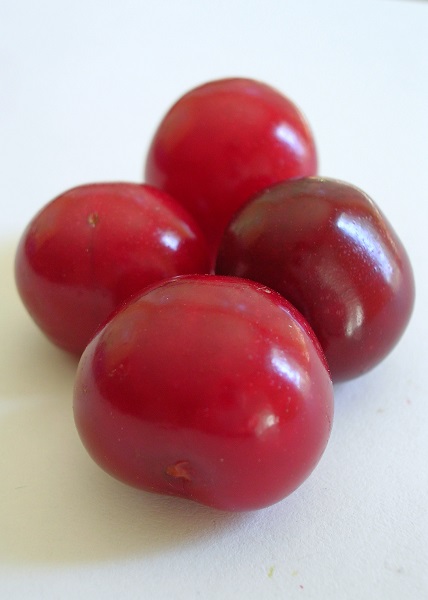
The exact origins of this cherry-infused drink are not known, but it definitely existed towards the end of 18th century, since Martha Washington (1731-1802) had a recipe for it. According to Wikipedia, the village of Frithsden in Hertfordshire claims to have originated it. Since Austen’s Pride and Prejudice is mostly set in Hertfordshire, cherry bounce would make quite a plausible companion to P&P or PPZ.

This recipe is Emily Han’s version, via Design*Sponge:

Ingredients
1 1/2 pounds (680 g) sweet cherries, pitted
4 whole allspice berries
2 whole cloves
1/4 teaspoon ground mace or nutmeg
3/4 cup (144 g) turbinado sugar
1 bottle (750 ml, or 3 1/4 cups) bourbon

Directions

Combine the cherries, allspice, cloves, mace, and sugar in a quart (1 L) jar. Pour the bourbon into the jar, making sure the cherries are submerged. Cap the jar tightly. Store it in a cool, dark place for at least 2 months, shaking occasionally. The longer it infuses, the better it will be. Strain the mixture through a fine-mesh strainer lined with a coffee filter or flour sack cloth, gently pressing on the cherries with the back of a spoon to squeeze out all the liquid. Discard the cherries, or reserve them for another use. Bottle and store in a cool, dark place for up to 1 year. Yields about 3 1/2 cups (823 ml).

A commenter in the Design*Sponge post suggested trying the discarded cherries on ice cream. That does sound yummy! Visit Design*Sponge for another historically-inspired drink recipe by Emily.

Images: Yellow pea soup by A. Charlotte Riley (CC BY-NC-ND 2.0). Cherries by Eppu Jensen

Geeks eat, too! Second Breakfast is an occasional feature in which we talk about food with geeky connections and maybe make some of our own. Yum!

Travel Destination Video: Dwarf Planet Ceres

There’s a new animation of the dwarf planet Ceres. It was made on the basis of images sent by NASA’s spacecraft Dawn, and resembles a travel destination video.

Flight Over Dwarf Planet Ceres by NASA Jet Propulsion Laboratory

More photos, info, and spiffy infographics on Ceres at NASA’s Solar System Exploration site. I’d definitely go visit! How about you?

Out There is an occasional feature highlighting intriguing art, spaces, places, phenomena, flora, and fauna.

Captain America: Civil War Trailer #2

The second trailer big TV spot for Captain America: Civil War dropped during Superbowl this past weekend:

Marvel’s Captain America: Civil War – Big Game Spot by Marvel Entertainment

(Of course, as anyone who can read is be able to tell, this isn’t the second trailer, but a preview. It was aired during Superbowl; hence, “big game spot.” D’oh. Aaanyhow.)

Not much to go on there – it’s only 30 seconds – but we do at least have a clear idea now who’s against who (Captain, Bucky, Falcon, Hawkeye, Scarlet Witch, and Ant-Man versus Iron Man, War Machine, Black Widow, Vision, and Black Panther).

Aaaaand the actual second trailer is below:

Marvel’s Captain America: Civil War – Trailer 2 by Marvel Entertainment

This post has been edited.

Hey, look! We found a thing on the internet! We thought it was cool, and wanted to share it with you.

The Misuses of Myth

160208sphinxMyths, legends, fairy tales, and other stories passed down through the generations are at the root of our storytelling tradition. They are the earliest stories in our literature and some of the first stories we learn as children. It is no wonder that we keep going back to mythology looking for deeper meanings. The drive to find hidden meaning in myth leads to some misguided interpretations. Two common mistakes are Freudian theory and the “forgotten history” theory.

Freudian slips

Freudian theory holds that myths are expressions of universal human drives which we have suppressed in the name of civilization. As the things that we cannot talk about openly come out in our stories, we can hold up mythology as a mirror to our own subconscious in order to see our hidden impulses better. Sigmund Freud’s attempts to explain the human psyche by reference to dreams, myths, and other supposed insights into the unconscious are at the root of this approach, but there are other classic exemplars, such as Bruno Bettelheim’s The Uses of Enchantment, which applies the theory to the Grimms’ fairy tales. (Note that I am speaking of Freudian theory as a way of interpreting myth; I am not in any position to judge Freudianism as a psychological theory.)

Continue reading