Making Food in the Wild

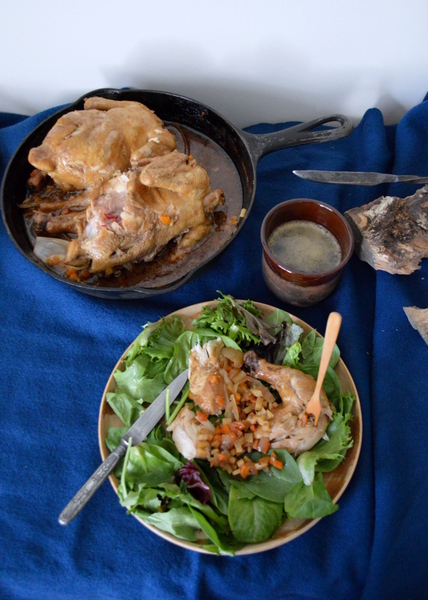
Here’s a look at how we made yesterday’s Food in the Wild.

The menu

  • Pan-braised game hens with root vegetables
  • Leaf and herb salad
  • Blackberries with mint leaves

erikchef1Our heroes were in too much of a hurry to do any good eating in the wild between Bree and Rivendell, but we’ve tried to imagine what a ranger might have been able to cook up in better times. Strider mentions four different kinds of wild food: berries, roots, herbs, and game, and we’ve used a little of each in this meal. (1.11)

Dinner4 Main

The main course is pan-braised game hens. It is the only dish that needs cooking and can be cooked in a shallow pan over a campfire. We used commercially raised game hens and farmed roots for our version, but wild-caught birds and carefully dug wild root vegetables would also do. We also used farmed greens and blackberries, but there are many wild-growing plants whose young leaves can be eaten (the full-grown leaves of most edible wild plants, in contrast to their cultivated cousins, are too tough or bitter to be eaten raw, but may still be useful for cooking). Wild blackberries are common in many forested areas—and they seem to be especially common in Middle Earth, as Bilbo frequently wishes for blackberries while traveling and the Prancing Pony offers a blackberry tart (H4, H6, 1.9)

Continue reading

Dining in Middle Earth: Food in the Wild

“‘There is food in the wild,’ said Strider; ‘berry, root, and herb; and I have some skill as a hunter at need.’”

LotR Dinner4

For this month’s dinner, we take up Strider on his offer and imagine what sort of a meal a ranger could have created in the wild at the best of times. This is what Strider might have cooked up for a party of hungry Hobbits if they hadn’t been running for their lives from ringwraiths: pan-braised game hens with root vegetables on a bed of green leaf and herb salad with fresh blackberries for dessert.

LotR Dinner4 Drink

Cooking would’ve been done with a cast iron spider, and light-weight wooden plates and small utensils wouldn’t add too much to the burden. Small pieces of fabric and sacks provide storage, and a rough piece of firewood functions as a makeshift stool or table. Everything is laid on rich, deep blue wool blend that nods towards Aragorn’s high status as the heir of Elendil.

Check out what’s it about in the introduction, or read the how-to!

Images by Eppu Jensen

Geeks eat, too! Second Breakfast is an occasional feature in which we talk about food with geeky connections and maybe make some of our own. Yum!

Quotes: Shrug off the Condescension that People Have toward ‘Lower’ Genres

“On the verge of débuting his late, lamented sci-fi series ‘Firefly,’ which was cancelled after less than one season of Fox mismanagement, Joss Whedon remarked that his goal was not to create ‘grownup’ TV but to ‘invade people’s dreams’ – to create mythologies, which last so much longer than the mortal form of a TV series. Cult shows, such as ‘Doctor Who’ and ‘Community,’ often have this quality: they shrug off the condescension that people have toward their ‘lower’ genres, using their constraints to find a greater freedom. When you look at a show like that from a distance, it might seem too narrow to contain much of interest. But it’s so much larger when you’re on the inside.”

– Emily Nussbaum

Two thoughts. One: Ha, Joss Whedon wants to do a George Lucas. Two: Just like, say, fly fishing might look narrow on the outside, there are hidden depths and intricacies in just about any hobby or interest. Not sure why it’s still such a surprise to those condescending types.

Nussbaum, Emily. “Fantastic voyage: ‘Doctor Who,’ ‘Community,’ and the passionate fan,” The New Yorker (June 4 & 11, 2012) 127.

Serving exactly what it sounds like, the Quotes feature excerpts other people’s thoughts.

Recommended Reading: Medea

160407MedeaOne of the hallmarks of modern storytelling is toying with the conventions of a genre. Familiar stories get retold with surprising twists and the tropes that everyone can see coming are turned upside-down and inside-out. It’s not just a modern game, though. Older stories can be just as cunning with their twists. When I’m trying to think about how to do something different with a familiar tale, one of the examples I look back to is Euripides’ tragedy Medea.

Medea is one of the classics of ancient Greek theatre. There are plenty of good translations available and it’s not hard to get your hands on one. If you’re looking for an online edition, here are a few. I discussed the play before in comparison to Star Wars, so I won’t bore you with summarizing the whole plot again (check the link if you want a quick reminder). Rather, I want to talk about two interesting things Euripides does with the story.

Continue reading

Rogue One Trailer

The first trailer for Rogue One: A Star Wars Story is out!

ROGUE ONE: A STAR WARS STORY Official Teaser Trailer by Star Wars

I’m delighted to see Felicity Jones cast as a protagonist. I enjoyed her performances as The Unicorn in Doctor Who (season 4, episode 7, “The Unicorn and the Wasp”) and as Catherine Morland in the 2007 adaptation of Jane Austen’s Northanger Abbey. According to IMDB, also Alan Tudyk, Forest Whitaker, and Mads Mikkelsen are among the cast. Mikkelsen seems to have been busy with genre roles lately – first Doctor Strange and now Rogue One.

Rogue One is the first in a series of spinoffs outside the episodic Star Wars core collectively known as the Star Wars Anthology Series. If this trailer is anything to go by, the series should be a lot of fun.

At this writing, the release date is set to December 16, 2016. Can’t wait!

Hey, look! We found a thing on the internet! We thought it was cool, and wanted to share it with you.

Hannibal’s Route Identified?

160407didrachm In 218 BCE, the Carthaginian general Hannibal led an army across the Alps into Italy, touching off the Second Punic War. On the question of exactly where Hannibal crossed the Alps, there’s always been a lot of, for lack of a better term, horse pucky. The ancient sources are vague and of dubious reliability. In the absence of solid evidence, numerous distinct schools of thought on the question have emerged. There are the military professionals who argue that Hannibal must have taken the easiest, most straightforward route open to him. There are the romantics who insist that Hannibal’s army must have taken a difficult and dangerous route befitting such a momentous expedition. The folklorists are persuaded by local legends in the Alps while the textualists wrangle over which of the literary sources is more reliable. Now some literal horse pucky may be getting us closer to an answer.

The whole route hangs on the identification of two specific points. One is an area called the “island” somewhere in the valley of the Rhone river. The other is the pass by which Hannibal’s army crossed the Alps. While the “island” is still uncertain, recent archaeological work may have identified the Alpine pass. As reported in Archaeometry in March, 2016, a large deposit of horse manure and disturbed soil near the Col de la Traversette indicates the passage of a large number of horses dated to the period of the Second Punic War. If this finding stands up to further scrutiny, it may allow us to pin down Hannibal’s Alpine crossing.

Identifying the Traversette as the pass Hannibal’s army took would have some interesting implications for our interpretation of the war as a whole. Although favored by some scholars (notably Sir Gavin de Beer), the Traversette has usually been dismissed as too high, narrow, and difficult for Hannibal’s army, especially when several lower, wider, easier passes were available within a few days’ march. The military-history school in particular has argued that Hannibal would not have set out on his march without good advance intelligence about the Alpine passes and that intelligence would have persuaded him never to attempt the Traversette. If Hannibal did indeed take his army by the Traversette, it suggests that his advance intelligence was not as good as modern historians imagine (whether because Hannibal didn’t know enough about the available passes or because he allowed his army to get into such desperate straits that he had to take a pass he knew was a bad choice).

If Hannibal’s intelligence-gathering was less than optimal, that would also help to explain the major strategic failure of his campaign: overestimating the central Italian cities’ readiness to cast off Roman hegemony. Hannibal’s strategy against Rome depended on stripping Rome of its allies and conquests. While he found ready support in the areas of northern and southern Italy that had only recently been conquered by Rome, very few cities in Rome’s core central Italian territory were willing to join him.

It’s always important to take new findings with caution. Further research may cast doubt on this new evidence. For now though, the poop looks promising.

Post edited for clarity

Image: Tarentine didrachm struck during the Second Punic War, photograph by Classical Numismatic Group via Wikimedia (c. 212-209 BCE; silver)

Space Archaeologist Discovers Potential Viking Site in Southern Newfoundland

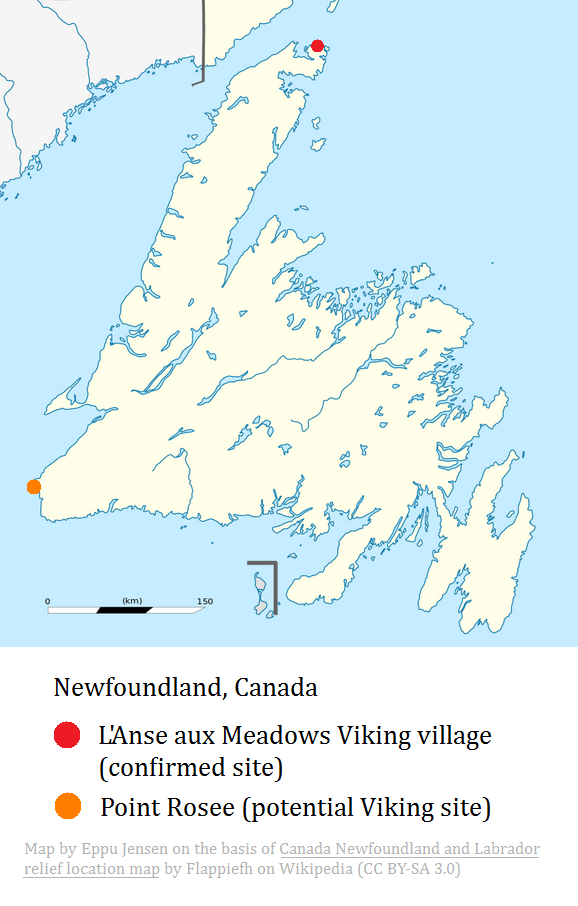
A team of archaeologists has unearthed a potential new Viking site in Newfoundland, Canada with the help of satellites. Dr. Sarah H. Parcak, an archaeologist, space archaeologist, and Egyptologist, lead the effort to take infrared images from space to find new archaeological sites.

Newfoundland with Viking Activity
Newfoundland with Viking activity. Map by Eppu Jensen on the basis of Canada Newfoundland and Labrador relief location map by Flappiefh on Wikipedia (CC BY-SA 3.0)

According to The New York Times, while searching the coastlines from Baffin Island (in the Canadian territory of Nunavut, west of Greenland) to Massachusetts, she found

“hundreds of potential ‘hot spots’ that high-resolution aerial photography narrowed to a handful and then one particularly promising candidate — ‘a dark stain’ with buried rectilinear features.

“Magnetometer readings later taken at the remote site […] showed elevated iron readings. And trenches that were then dug exposed Viking-style turf walls along with ash residue, roasted ore called bog iron and a fire-cracked boulder — signs of metallurgy not associated with native people of the region.

“In addition, radiocarbon tests dating the materials to the Norse era, and the absence of historical objects pointing to any other cultures, helped persuade scientists involved in the project and outside experts of the site’s promise.”

Point Rosee is approximately 700 km (approximately 400 miles) away from L’Anse aux Meadows, the only currently confirmed Viking site in North America. The Norsemen staying at L’Anse must have traveled further south, though, because butternuts and worked pieces of butternut wood – which are not native to Newfoundland – were found among the Norse objects at the settlement.

CBC News reports that evidence of a Norse-like hearth and 8 kilograms (approx. 16 pounds) of bog iron was found at Point Rosee during a dig in 2015. It isn’t yet known for sure whether the site was a temporary base camp or a settlement, or whether it even was associated with Vikings. If confirmed, Point Rosee would be the second known Viking site in North America.

The evidence is still clearly on the scant side. Digging at Point Rosee is to resume this summer, so maybe they’ll find more.

As a sidenote, isn’t it so cool that we now have space archaeologists?!

Quotes: Shooting People Was Such a Stupid Activity

“Shooting people was such a stupid activity, why should everybody–anybody!–be so impressed? Silver wondered irritably. You would think she had done something truly great, like discover a new treatment for black-stem rot.”

– Lois McMaster Bujold: Falling Free

Silver, one of the genetically engineered, learning-oriented people known as quaddies, expresses her deep dislike of violence.

Bujold, Lois McMaster: Falling Free. Riverdale, NY: Baen, 1988, p. 266.

(This quote comes from my 21 new-to-me SFF authors reading project.)

Serving exactly what it sounds like, the Quotes feature excerpts other people’s thoughts.

Hadrian’s Wall… In Legos!

Brick to the Past is a British Lego-building group that bases their creations on historical landscapes and architecture. One of their builds from last year was inspired by Hadrian’s Wall. The layout combines a stretch of wall, a Roman fortress and town, a milecastle (one of the fortified gateways placed at one-mile intervals), and a native village.

Hadrian's Wall by Brick to the Past
Hadrian’s Wall by Brick to the Past

The buildings are full of delightful details and clever Legosmithing, like the use of a cogwheel over the main door of the bathhouse to represent the wild-haired head that was often associated with springs and baths in Roman Britain, like this fine example from Aquae Sulis (present-day Bath).

The bathhouse by Brick to the Past
Pediment from Aquae Sulis
Pediment from Aquae Sulis, detail of photograph by Velvet via Wikimedia (Bath; 1st c. CE; stone)

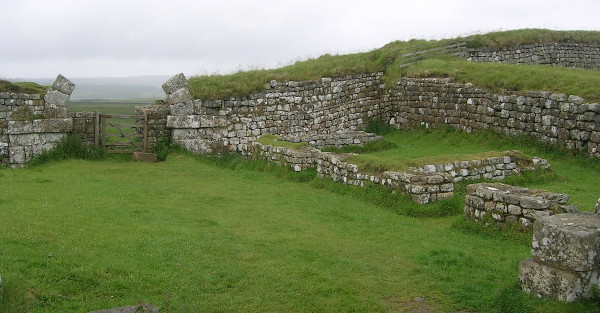
Hadrian would be proud. Here’s a picture of the original, from Milecastle 37. They do kind of look like Legos, don’t they?

Milecastle 37, photograph by Erik Jensen

Hey, look! We found a thing on the internet! We thought it was cool, and wanted to share it with you.

I’ll Have Elevensies with My Elevensies, Thanks!

Beer brewers Night Shift Brewing in Massachusetts made a Baltic porter aged in apple brandy barrels. They call it Elevensies, and describe it as dark and of high gravity.

Night Shift Brewing elevensies_square-01
Elevensies beer by Night Shift Brewing
Night Shift Brewing Elevensies
Elevensies beer. Screenshot from Night Shift Brewing

Sounds like it would’ve made a perfect partner for our Prancing Pony dinner. Maybe we can still find some…!

Found via File 770.

Geeks eat, too! Second Breakfast is an occasional feature in which we talk about food with geeky connections and maybe make some of our own. Yum!