Um… It’s a ukulele playing Batman…
Ukulele Batman vs Bagpipe Superman – Theme Song Battle by The Unipiper
…with a flaming bagpiper Superman riding a unicycle in a kilt!
Some things are just too silly not to share!
Um… It’s a ukulele playing Batman…
Ukulele Batman vs Bagpipe Superman – Theme Song Battle by The Unipiper
…with a flaming bagpiper Superman riding a unicycle in a kilt!
Some things are just too silly not to share!
A movie version of Jane Austen’s never-before-adapted epistolary novel Lady Susan is coming out in a few weeks (released on May 13), and the trailer is finally here.
Love & Friendship TRAILER 1 (2016) – Chloë Sevigny, Xavier Samuel Movie HD via Movieclips Coming Soon
I’ve been waiting for it for a long time without any real idea of what it’ll be like, as I’ve never even heard of the writer / director Whit Stillman before. It looks absolutely hilarious! Kate Beckinsale as Lady Susan seems perfect in every way; I’m also looking forward to seeing more of Jemma Redgrave, James Fleet, and Stephen Fry. Can’t wait! Fansquee!
Hey, look! We found a thing on the internet! We thought it was cool, and wanted to share it with you.
Jeffrey Veregge, an artist and member of the Port Gamble S’Klallam Tribe in Washington state, makes positively fantastic versions of mainstream genre icons like superheroes, movie characters, Transformers, aliens, and the like.

Veregge himself says of his work:
“This site, the work that is seen on it is a reflection of a lifetime love affair with comic books, toys, TV and film. Taking my passions and blending them with my Native perspective, artistic background and the desire to simply be me. Basically I am just trying to have fun and get back to that kid that went to art school to begin with, wanting to create artwork that I want to see and make just for the hell of it.”

Several of his designs would make fantastic fabric prints, like this Flash-inspired one, for example:

If there was a fabric Flash version, I’d use it for pencil cases, zipper travel pouches, or a table cloth. Or maybe tall, tall shades with a wide border on the bottom; that would look really striking.
Visit Veregge’s home page for more!
Hey, look! We found a thing on the internet! We thought it was cool, and wanted to share it with you.
 Tor.com published an article online today about diversity in Hannibal’s army written from the point of view of historical wargaming. It is a interesting article and well worth a read, but unfortunately it misses the opportunity to really address questions of racial and cultural diversity in ancient warfare. Here is a quick attempt to address some of the things that were lacking.
Race and culture
Race is a term with a lot of baggage, as we are all painfully aware, but it means different things in different contexts. In modern parlance, it describes a socially-constructed division of human beings into more or less arbitrary categories, largely on the basis of skin color and other physical features. In a fantasy context, it refers to distinct species of intelligent creatures like Elves, Orcs, Dwarves, and so on.
The unaddressed problem in the Tor.com article is the conflation of race and culture. In the nineteenth and early twentieth century, overtly racist theories of history posited that people of different genetic backgrounds naturally had different qualities. Many of these stereotypes still linger in our popular culture: the stoic Indian, the mischievous Irishman, the passionate Italian, etc. This belief in racial character was encoded in early classic works of fantasy like Tolkien’s Lord of the Rings, which gave us the stubborn Dwarf, the ethereal Elf, the vicious Orc, etc.
Even as we struggle to root out this conflation of race and culture from our modern life, it lingers on in works of fantasy and science fiction: the logical Vulcan, the boisterous Klingon, the decadent Centauri, the proud Dothraki. As we look back at history, we have to think of the people of the past not in terms of racial qualities but in terms of cultural contexts. People of different origins often do behave differently, but those differences are explained by the cultures they lived in, not the races they represent.
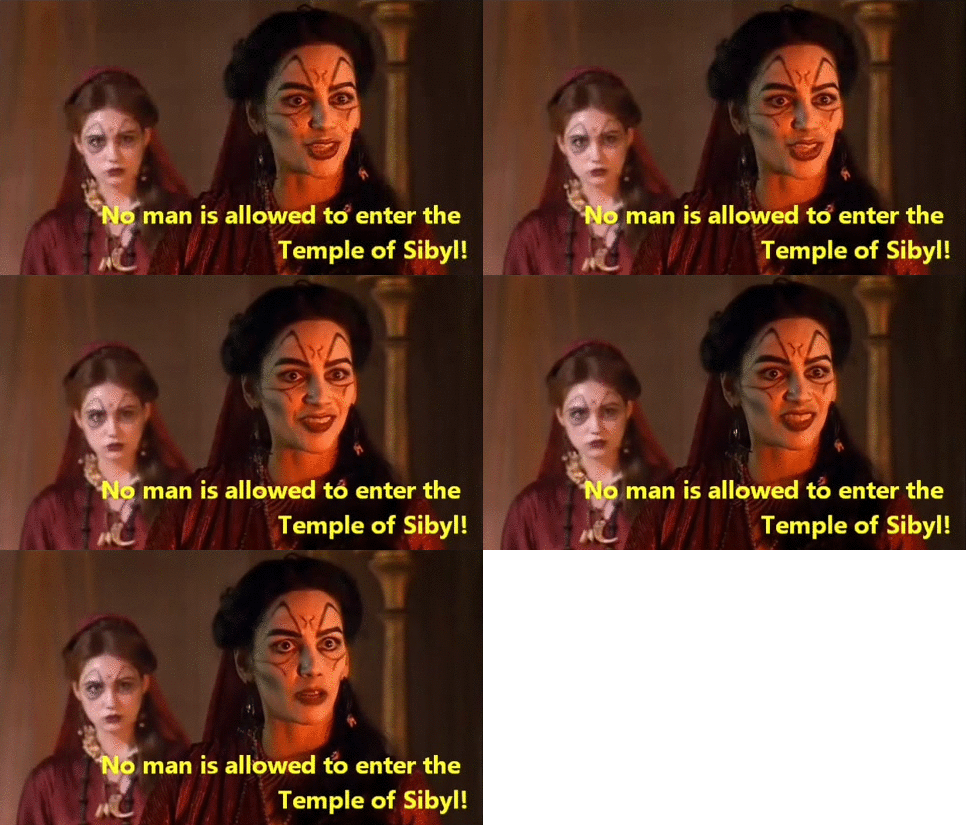 When creating religions for our stories, one of the things to think about is how the people who follow that tradition respond to offenses against its rules and principles. Is your character running the risk of torture and death if they question the accuracy of the sacred texts, or are they just going to get a stern glare from their grandmother for using the wrong hand to swirl the incense at the family altar?
Just as there are lots of different religious traditions that people practice in many different ways, there are lots of different ways of disrespecting religious ideas and offending the people who hold them. I’m going to talk about three kinds of religious transgression today that are often confused with one another. The differences between them are important, though. Which of these kinds of transgression a society recognizes and how it responds to them reflect important things about its history and religious traditions. These three are: sacrilege, blasphemy, and heresy.
(Or, as we call it my house, Saturday night.)
Here’s a look at how we made yesterday’s Supper at the Prancing Pony.
The menu
 No meal in The Lord of the Rings is more clearly described than the supper laid on by Butterbur of Bree at the Prancing Pony, and we have stuck to the letter of the description: a hearty vegetable soup and cold chicken and ham served up with bread, butter, and cheese, with home-brewed stout to drink and a blackberry tart for dessert. (1.9)
“In a twinkling the table was laid. There was hot soup, cold meats, a blackberry tart, new loaves, slabs of butter, and half a ripe cheese: good plain food, as good as the Shire could show, and homelike enough to dispel the last of Sam’s misgivings (already much relieved by the excellence of the beer).”

Barliman Butterbur serves up a filling supper of good home cooking at the Prancing Pony and we’ve done our best to do his fare justice. We have a soup of roasted root vegetables, cold chicken and ham, and bread with butter and cheese. A simple blackberry tart makes a satisfying dessert and a home-brewed blackberry stout goes with it all.

We imagined a material culture in Bree-land that combines Hobbit and Bree Human features, possibly with some Dwarven-made touches. The color white is pulled from Mr. Butterbur’s white apron and the white tablecloth on the four Hobbits’ dinner table. Expanding on that, we used mostly white dishes, white candles, and clear glass. The soup bowl with leaf imprints on its inner surface is similar to the green one in the Long-Expected Party. A fabric-lined basket holds a variety of bread, and half a wheel of cheese invites nibbling.

And there’s pie!

Check out what’s it about in the introduction, or read the how-to!
Images by Eppu Jensen
Geeks eat, too! Second Breakfast is an occasional feature in which we talk about food with geeky connections and maybe make some of our own. Yum!
 From the city of Rome to the Arctic circle is a distance of about 2,750 km. At its greatest extent, the northernmost tip of the Roman empire was more than 1,000 km from the Arctic. Even across such a distance, however, there were connections. A couple of little pieces of evidence show us how knowledge of Rome could reach the far north, and how knowledge of the far north could reach Rome.
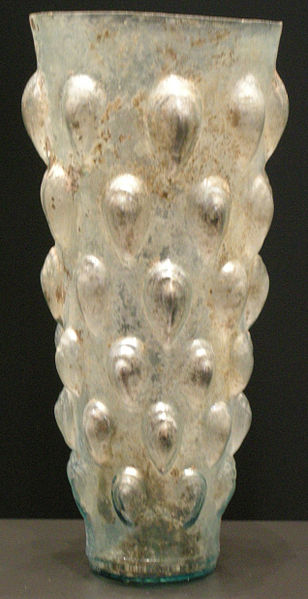
In Føre, Nordland, on an island in far northern Norway, is an ancient burial site. Over several centuries in the late iron age around 10 mound burials were raised of earth and stone. (The number is uncertain because some of the mounds have been destroyed by erosion and farming.) Not all have been excavated, but those that have have yielded the evidence of extraordinary wealth by local standards, including a Roman drinking glass buried in the only female grave so far known at the site. (The glass pictured is of a similar type, but not from the same site.)
It is very unlikely that Føre had any direct connection to the Roman world. Rather it was at the northern extreme of a network of trade and alliances that spanned Scandinavia and the Baltic Sea region which used Roman imports as high-status trade goods and diplomatic gifts. The people of Føre may have had very little idea of what the Roman empire was, but they had some access to Roman goods and valued them as precious objects.
What if there was a fantasy world where moose were tamed and selectively bred for cavalry? I spent some time pondering it after a couple of things found online collided in my head.
First, there’s this animated gif of a moose rushing through a deep snow-filled field:

Their size, speed, and ability to gallop through deep snowbanks make moose fearsome and pretty near unstoppable. Imagine a line of ginormous moose thundering at full tilt towards you across a field – that’s a truly frightening thought! Also bogs don’t slow them down by much, I believe, which might conceivably tip the scales in the right kind of a campaign.
Then, I saw this photo of an albino moose:

Natural snow camouflage. Hmmm.
It’s not that far-fetched an idea, apparently. The Soviet Union attempted to build a moose cavalry in the first half of the 20th century, but they were unsuccessful. In our world, the solitary habits of moose seem to be standing in the way of domestication. If we’re talking about a fantasy world, however, I don’t see why not.
Images: Rushing moose gif via Crazy Hyena. White moose by Antti Terävä via Yle
The Visual Inspiration occasional feature pulls the unusual from our world to inspire design, story-telling, and worldbuilding. If stuff like this already exists, what else could we imagine?
In 2011’s Thor, Idris Elba, despite not looking typically Norse, plays the Norse god Heimdall. In 2016’s Gods of Egypt, Nikolaj Coster-Waldau, despite not looking typically Egyptian, plays the Egyptian god Horus. The casting of Elba as Heimdall surprised me the first time I saw the movie, but it has never bothered me as a fan or as a historian. Coster-Waldau as Horus really bothers me and I think it’s worth taking a minute to explain why.
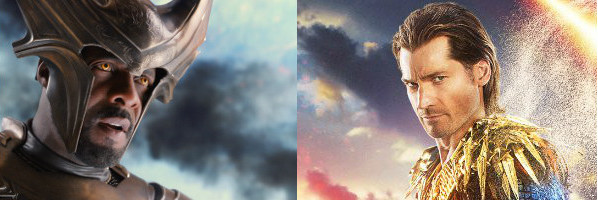
I have nothing against Coster-Waldau as an actor. I haven’t seen Gods of Egypt and don’t plan to, so I have nothing to say about his performance in this particular role, but he’s not the problem here. The problem is in the casting of the movie as a whole.
 Co-Geeking

You must be logged in to post a comment.