Hoplites, the Chigi Vase, and the Problems of Artistic Sources

Art can be a priceless source of evidence for early history, especially for areas and periods with limited surviving written sources, but, just like texts, artistic sources can be tricky to interpret.

Chigi Vase, reconstructed frieze via Wikimedia (7th c. BCE; painted pottery)

Take, for example, this scene from an archaic Greek vase (commonly known as the Chigi Vase, named for one of its modern owners). It provides us with some of our earliest evidence for Greek hoplites and the phalanx formation. Although we understand a lot about the essentials of how hoplite warfare worked, many questions remain unanswered about the precise details of both how a hoplite battle was fought and how the hoplite style of warfare developed over time. Arguments about these topics often depend in part on interpretations of the Chigi vase.

The vase depicts warriors arming themselves and marching into battle as hoplites. Many of the characteristic features of hoplite armament and warfare are on display: heavily armored fighters with large round shields and spears confronting one another in a head-on clash. We can date the creation of this vase to the seventh century BCE, around the same time that the hoplite style of warfare first appeared, so this artwork offers us crucial evidence about what the earliest phase of hoplite warfare looked like and how early some of its defining features emerged.

We can be fairly confident that the artist who painted the decorations on this vase was familiar with the realities of hoplite warfare. The ranks of the phalanx were filled by small farmers and prosperous crafters, including potters and artists. If the painter of this vase was not well-off enough to have fought as a hoplite themselves, they would certainly have known people who had. At the same time, the images are also artistically stylized in ways that make it hard to be sure how much we can rely on them as evidence.

For example, all the warriors shown on this vase are similarly equipped: they have the helmets, breastplates, greaves, and round shields that we think of as the standard parts of the hoplite panoply. Is this vase evidence that hoplite equipment was standardized from an early period, or did the artist depict a standard set of armor to create a pleasing image at a time when real hoplite gear was more of a hodge-podge with individuals equipping themselves as best they could? This question goes to more than matters of artistic taste: one of the most vexed questions in the history of the hoplite phalanx is whether it developed gradually out of older, less rigorously organized styles of warfare or it was created as a fully-realized concept in some particular place and time. Because hoplite warfare was connected with the rise and subsequent fall of early Greek tyrants, understanding the origins of the hoplite phalanx better would have implications for our understanding of major developments in political and social history. Knowing what the Chigi vase painter had in mind would tell us some important things about the early history of ancient Greece.

Out There is an occasional feature highlighting intriguing art, spaces, places, phenomena, flora, and fauna.

Macramé Inspiration Photos for Speculative Writers

There are times when my expertise and interests affect my response to the stories I consume. (I’m pretty sure I’m not the only one.) Lately I’ve been noticing the presence or absence of textiles in my media, and how those textiles came to be.

I’m using macramé as an example of a technique that’s not getting much attention—in fact, I’m not sure I’ve ever seen a story using macramé even as a background element—despite its versatility.

For example, in a fantasy world, you don’t always have to have woven or embroidered wall hangings decorating the lord’s hall. You could also have a ginormous macramé room divider like “Ocean”, below, by Bali-based fiber artist Agnes Hansella:

Colossal Agnes Hansella Ocean

Apart from being refreshingly non-Eurocentric (if we consider the earliest records of macramé-style knots coming from Babylonian and Assyrian carvings), large-scale macramé works obviously require a high level of skill to complete, which makes them a perfect option for displaying a character’s wealth and social capital.

And even in smaller sizes, macramé can come in intricate shapes that in no way resemble the 1970s handiwork that may stereotypically come to mind (plant hangers, wall hangings, or cute but perhaps not entirely flawless friendship bracelets).

Etsy TBiaDesign Macrame Wall Shelf

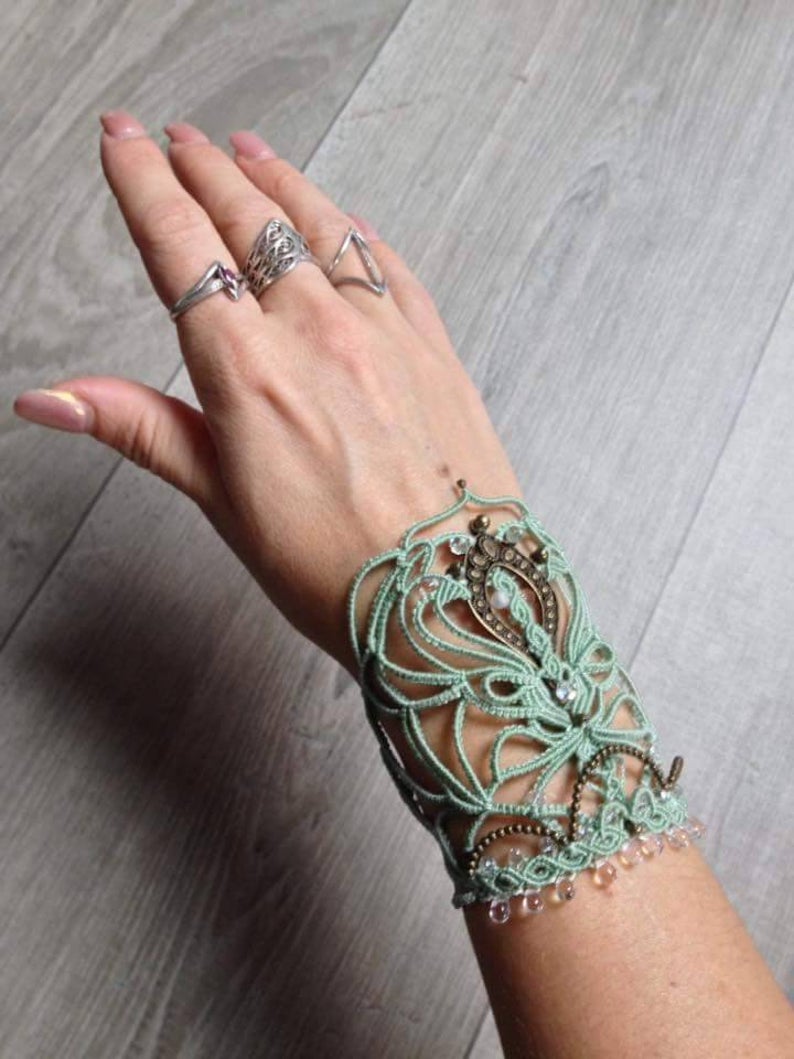
Speaking of small, when writing this blog post I leared that some people make micro macramé, where the working yarn or cord is quite thin. The result is almost lace-like:

Etsy AmeEtTiss Macrame Fillory Cuff

You can make an almost endless range of items with macramé. If you can make cording (like bracelets), you can make anything used for supporting, holding, or edging, for instance like belts, suspenders, bands, animal harnesses (think of ceremonial processions etc.), pulls, straps, or decorative edges.

Macramé also does not need to be made from only unbleached or single color cord; on the contrary, colorful combinations can be quite eye-catching:

Etsy Toni Lasee kitdesignsbykith Green Macrame Belt

If you can make flat surfaces (like wall hangings), you can create items that could also be made from fabric, like table runners, curtains, cushion covers, pouches, or bags.

Pinterest Blue Macrame Bag

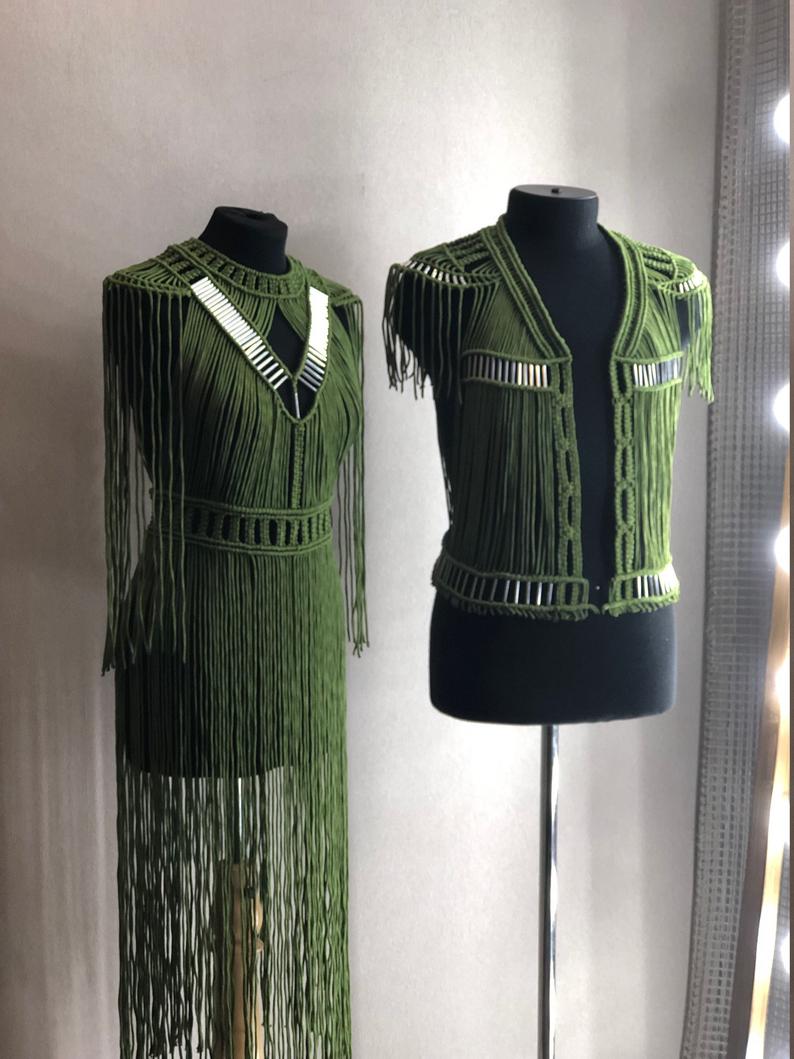
I could also imagine a macramé-style outer garment worn over fabric clothes looking fantastic. Indeed, someone else has had that very thought—check out these outfits promoted as Coachella or Burning Man costumes:

Etsy SeyanaStyle Macrame Vest and Dress

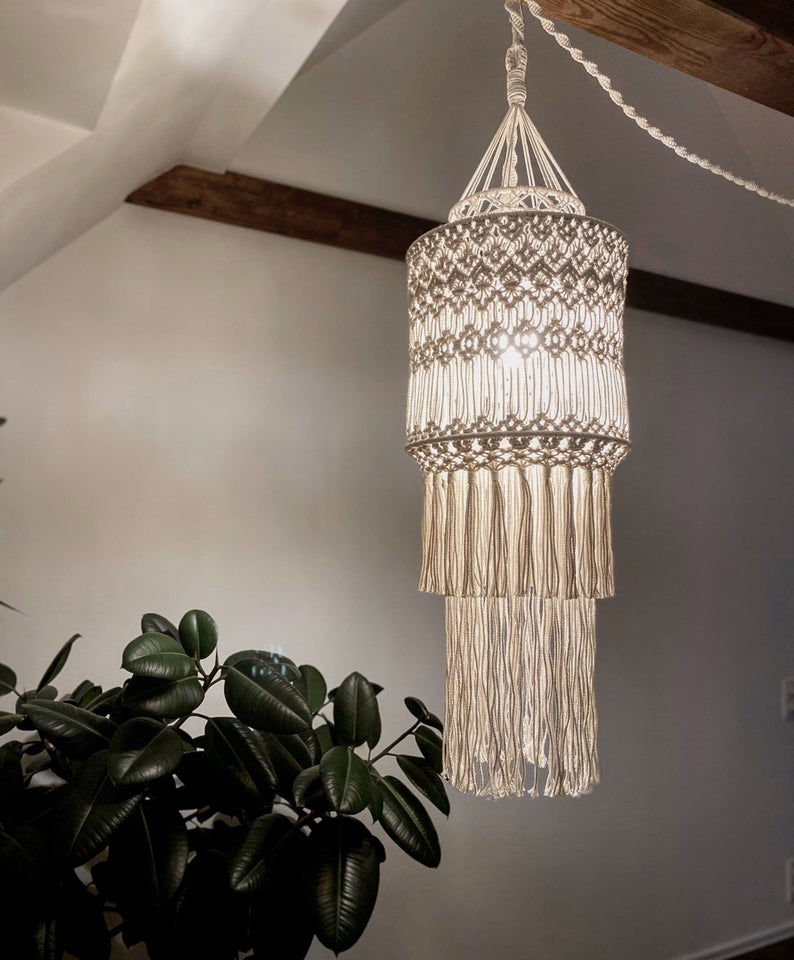
Depending on the type of cord, you could even make more utilitarian household items like chair seats, hammocks, lampshades, or baskets.

Etsy CraftingMode Big Macrame Basket Birch Green
Etsy Irina Kharebava Macrame Lamp Shade

As with all creative work, the maker’s skill and imagination are the limit.

Images: Agnes Hansella via Colossal. Wall shelf by TBiaDesign on Etsy. Lacy cuff by AmeEtTiss on Etsy. Green belt by Toni Lasee at kitdesignsbykith on Etsy. Blue bag with macramé strap via Pinterest. Macrame vests by SeyanaStyle on Etsy. Rectangular basket by Phing Chutima at CraftingMode on Etsy. Lamp shade by Irina Kharebava on Etsy.

Out There is an occasional feature highlighting intriguing art, spaces, places, phenomena, flora, and fauna.
Beautiful Reconstructions of Mesoamerican Cities

Here are some beautiful computer reconstructions of important archaeological sites in Mesoamerica.

Tenochtitlán, Mexico, by Advestudios

Pueblo Bonito, Chaco Canyon, US, by Advestudios


Advestudios, which produced these images, also creates videos and 360 vistas. Their work is wonderful for helping to picture these sites as living, functioning cities and settlements.

Hey, look! We found a thing on the internet! We thought it was cool, and wanted to share it with you.


Living Vicariously Through Social Media: Dracula Parrots

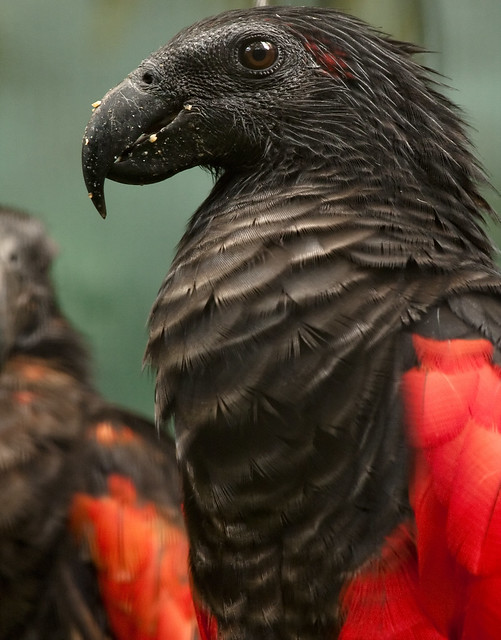
Hey there, handsome—what an amazing coloring these Dracula parrots (Psittrichas fulgidus) have!

Flickr Peter Tan Pesquets Parrot Head Shot

Endemic to New Guinea, they are also known as Pesquet’s parrots, and can be quite sizeable: 46 cm / 18” total length and 700-800 g (24-28 oz) in weight.

Flickr Meen Zhafri Pesquets Parrot Silhouette

Apparently, habitat loss and overhunting have pushed the species into a vulnerable status, and, according to BirdLife International, the population in decreasing.

Flickr Charles Davies Pesquets Parrot in Flight

*sigh* Why can’t we as a species take better care of our nice things? It’s not like we lack the brain power.

Found via Nature & Animals on Twitter. (NB. Seems to require a login in order to see post.)

Images: Head shot by Peter Tan via Flickr (CC BY-SA 2.0). Silhouette by Meen & Zhafri via Flickr (CC BY-NC 2.0) / KL Bird Park, May 2010. In flight by Charles Davies via Flickr (CC BY-NC 2.0).

Out There is an occasional feature highlighting intriguing art, spaces, places, phenomena, flora, and fauna.

An Ancient Minoan Saffron Gatherer

Here’s a beautiful ancient Minoan fresco of a woman gathering saffron on a rocky hillside.

Saffron is a spice derived from the crocus flower, and since each flower produces only a tiny amount of the spice, gathering it on any scale is a labor-intensive process. With her large earrings and the many colorful, decorated layers of her clothing, this lady seems a little overdressed for such hard work. There may be various explanations. Perhaps this fresco represents a ceremonial harvest, not unlike the use of a golden shovel to dig the first scoop of dirt on a building project, or possibly a small harvest for religious use. It might also be simply an artistic depiction suitable for an elite home and not intended to represent the actual attire of an agrarian worker.

Whatever the case, it’s a beautiful work of art.

Image: Detail of saffron-gathering fresco, photograph by Yann Forget via Wikimedia (Akrotiri; c. 1700 BCE; fresco)

Out There is an occasional feature highlighting intriguing art, spaces, places, phenomena, flora, and fauna.

Living Vicariously Through Social Media: Swans in a Winter Wonderland

Reportedly, the Swan Spring wetland park in Ili, Xinjiang, China, has some amazing winter settings. This scene definitely qualifies:

Tumblr F Yeah Chinese Garden Swan Spring Screenshot

I don’t like cold very much, but I do like the look of clean, white snow, and I love blue. This shot is astoundingly beautiful. I’m so sorry I don’t know who filmed the clip this is from.

Here in Massachusetts we have way too much snow for pandemic comfort at the moment. Some of it is pretty, yes, but instead of the graceful swans we have chunky wild turkeys, LOL! Ohwell; at least we’ll get plenty of physical activity by shoveling.

Found via Fuck Yeah Chinese Garden on Tumblr. (Follow the link for a short video.)

Out There is an occasional feature highlighting intriguing art, spaces, places, phenomena, flora, and fauna.
Living Vicariously Through Social Media: An Undersea Roundabout in the Faroe Islands

The Faroe Islands—an autonomous region of Denmark—has built bridges and tunnels before to connect the numerous islands or islets and its 50,000-some residents. Never before, however, have they dug an undersea tunnel as deep or as long as the brand-new Eysturoyartunnilin, nor built an undersea roundabout.

Eysturoyartunnil Interior Green

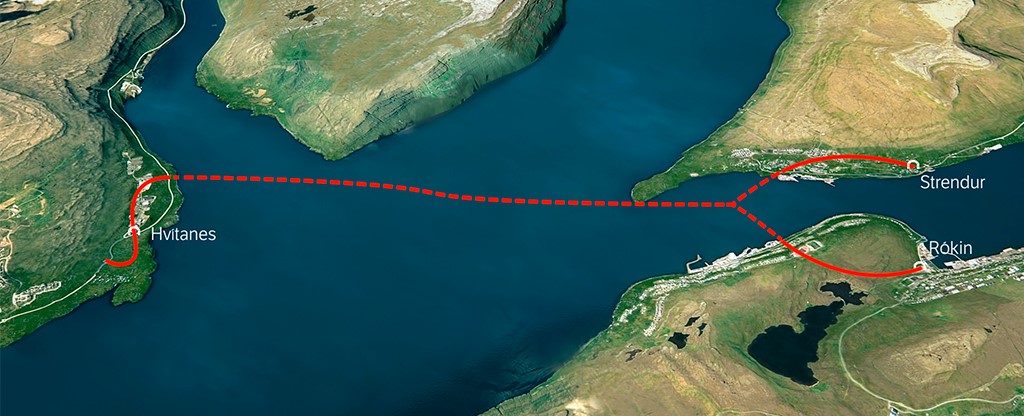
The roundabout is part of a tunnel measuring about 11 km (6.8 miles), the third sub-sea tunnel in the islands. It connects the islands of Streymoy and Eysturoy, and reaches at its deepest 187 meters (roughly 200 yards) below sea level. At this writing the tunnel’s been in use for about a month.

Eysturoyartunnil Map

The roundabout comes with art—sculptures and light effects—designed by the Faroese artist Tróndur Patursson. You can read more about the tunnel at BBC or the P/F Eysturoyar- og Sandoyartunnil project website.

Eysturoyartunnil Interior Blue

Oh, my goodness. It’s obviously not a solution that suits every location, and I assume the cost plus know-how involved can also be a deterrent, but what a feat of engineering and vision it is. This is yet another reason why it’s (pandemic aside) exciting to be living now!

Found via Kristina Háfoss on Twitter.

Images: Map by P/F Eysturoyar- og Sandoyartunnil. Interior images by Estunlar.fo via BBC.

Out There is an occasional feature highlighting intriguing art, spaces, places, phenomena, flora, and fauna.

Cephalopodic Human Figures Drawn by Bored Children in 13th-Century Novgorod

Erik Kwakkel, Professor of Book History & Director, School of Information, UBC, Vancouver, Canada, shares all sorts of interesting tidbits online. Among the older ones—posted over seven years ago now and dating from the Middle Ages—are some wonderful children’s drawings made on birch bark.

This piece of bark is from among a large find made near the city of Novgorod, Russia, from the 13th century.

Tumblr Erik Kwakkel C13th Novgorod Birch Bark Drawing

Isn’t it interesting? Look at the eyebrows and the noses! And the torsos! Incredibly cephalopodic, in a charming way. And the hands look like rakes. The figures are clearly identifiable as humans, but the customary ways of drawing some of the details seems to have changed over the centuries quite a bit.

Check out Kwakkel’s Tumblr or Twitter for more book history particulars.

Image via Erik Kwakkel on Tumblr

Out There is an occasional feature highlighting intriguing art, spaces, places, phenomena, flora, and fauna.
Living Vicariously Through Social Media: Inspiration for Moria Doors

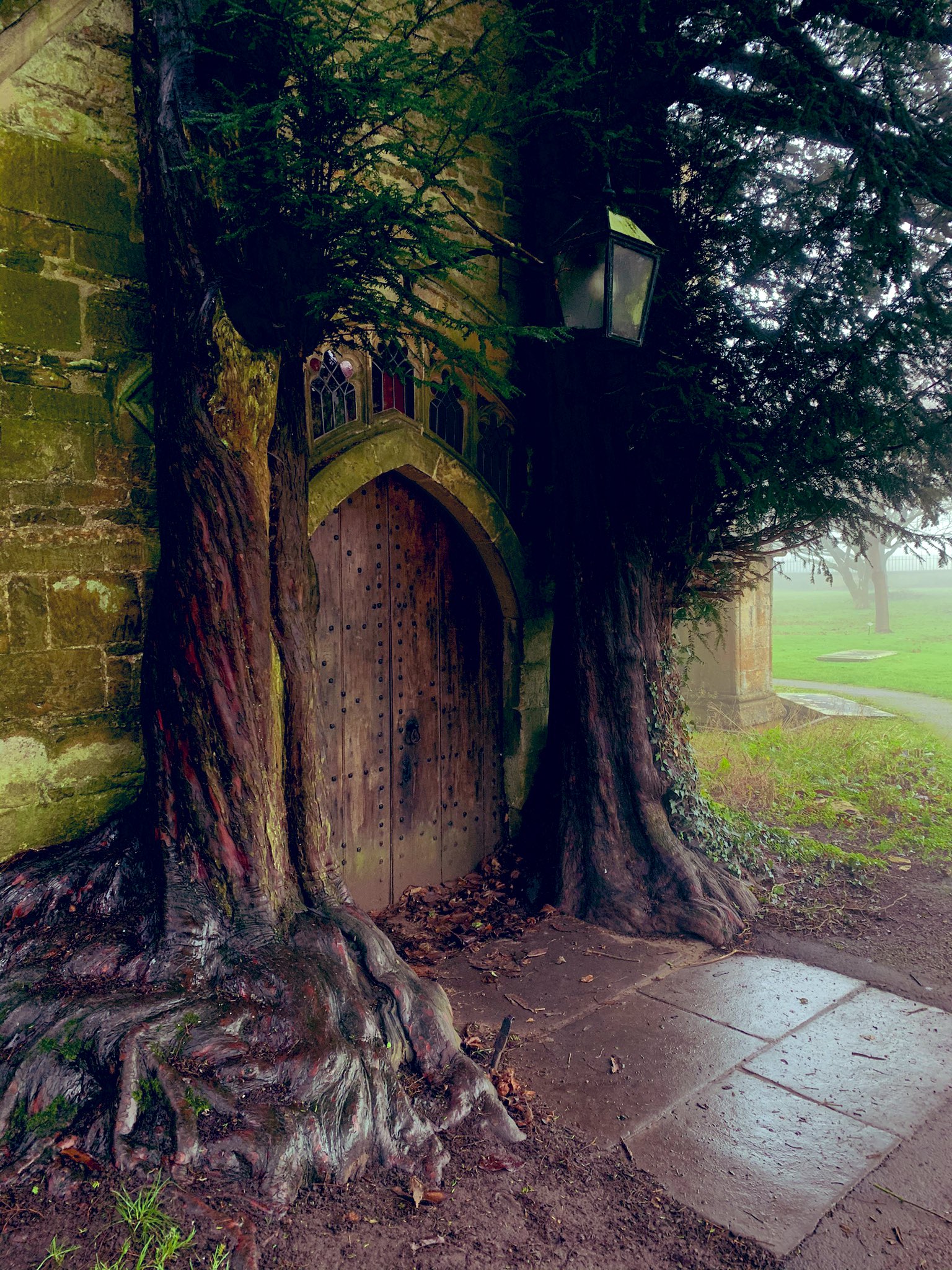
Sophie Berry on Twitter shared this amazing photo of a church door flanked by two trees that have basically grown into the wall:

Twitter Sophie Berry St Edwards Stow-in-the-Wold Back Door

Apparently it’s thought to be the inspiration for the doors of Moria in Tolkien’s Lord of the Rings. No surprise there. How incredible!

Image via Sophie Berry on Twitter.

Out There is an occasional feature highlighting intriguing art, spaces, places, phenomena, flora, and fauna.

Good Health with Telesphorus

With Covid-19 still largely unchecked and the winter flu season closing in on us (in the northern part of the world at least), health and illness are on a lot of our minds. So here’s a votive statuette of an ancient Greek god of health, Telesphorus.

Telesphorus represents an interesting combination of influences from several different cultures. Mythology describes him as a son of the Greek healing god Asclepius specifically concerned with recovery from disease or injury. In art he was often shown as a short, squat man similar to some earth-related deities from Phrygia in inland Anatolia wearing a type of hooded cloak typically associated with Gauls. This version, found in France and carved at some time when the Roman Empire ruled the region, has heavily outlined eyes, a triangular nose, and straight bands of hair, all of which are characteristic of Gaulish and British art. Somehow, this seems an appropriate image for a season in which we face a worldwide pandemic.

We wish you all good health in the times ahead.

Image: Telesphorus statuette, photograph by Millevahce via Wikimedia (found Moulézan, currently Musée Archéologique de Nîmes; Roman period; limestone)

Out There is an occasional feature highlighting intriguing art, spaces, places, phenomena, flora, and fauna.