Living Vicariously Through Social Media: Dracula Parrots

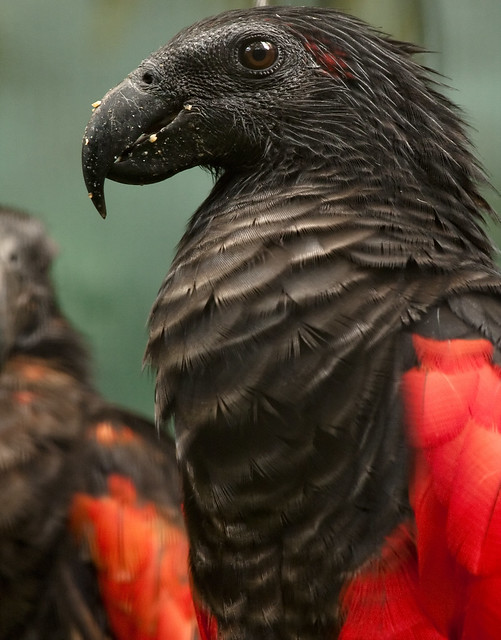
Hey there, handsome—what an amazing coloring these Dracula parrots (Psittrichas fulgidus) have!

Flickr Peter Tan Pesquets Parrot Head Shot

Endemic to New Guinea, they are also known as Pesquet’s parrots, and can be quite sizeable: 46 cm / 18” total length and 700-800 g (24-28 oz) in weight.

Flickr Meen Zhafri Pesquets Parrot Silhouette

Apparently, habitat loss and overhunting have pushed the species into a vulnerable status, and, according to BirdLife International, the population in decreasing.

Flickr Charles Davies Pesquets Parrot in Flight

*sigh* Why can’t we as a species take better care of our nice things? It’s not like we lack the brain power.

Found via Nature & Animals on Twitter. (NB. Seems to require a login in order to see post.)

Images: Head shot by Peter Tan via Flickr (CC BY-SA 2.0). Silhouette by Meen & Zhafri via Flickr (CC BY-NC 2.0) / KL Bird Park, May 2010. In flight by Charles Davies via Flickr (CC BY-NC 2.0).

Out There is an occasional feature highlighting intriguing art, spaces, places, phenomena, flora, and fauna.

An Ancient Minoan Saffron Gatherer

Here’s a beautiful ancient Minoan fresco of a woman gathering saffron on a rocky hillside.

Saffron is a spice derived from the crocus flower, and since each flower produces only a tiny amount of the spice, gathering it on any scale is a labor-intensive process. With her large earrings and the many colorful, decorated layers of her clothing, this lady seems a little overdressed for such hard work. There may be various explanations. Perhaps this fresco represents a ceremonial harvest, not unlike the use of a golden shovel to dig the first scoop of dirt on a building project, or possibly a small harvest for religious use. It might also be simply an artistic depiction suitable for an elite home and not intended to represent the actual attire of an agrarian worker.

Whatever the case, it’s a beautiful work of art.

Image: Detail of saffron-gathering fresco, photograph by Yann Forget via Wikimedia (Akrotiri; c. 1700 BCE; fresco)

Out There is an occasional feature highlighting intriguing art, spaces, places, phenomena, flora, and fauna.

Living Vicariously Through Social Media: Swans in a Winter Wonderland

Reportedly, the Swan Spring wetland park in Ili, Xinjiang, China, has some amazing winter settings. This scene definitely qualifies:

Tumblr F Yeah Chinese Garden Swan Spring Screenshot

I don’t like cold very much, but I do like the look of clean, white snow, and I love blue. This shot is astoundingly beautiful. I’m so sorry I don’t know who filmed the clip this is from.

Here in Massachusetts we have way too much snow for pandemic comfort at the moment. Some of it is pretty, yes, but instead of the graceful swans we have chunky wild turkeys, LOL! Ohwell; at least we’ll get plenty of physical activity by shoveling.

Found via Fuck Yeah Chinese Garden on Tumblr. (Follow the link for a short video.)

Out There is an occasional feature highlighting intriguing art, spaces, places, phenomena, flora, and fauna.

Living Vicariously Through Social Media: An Undersea Roundabout in the Faroe Islands

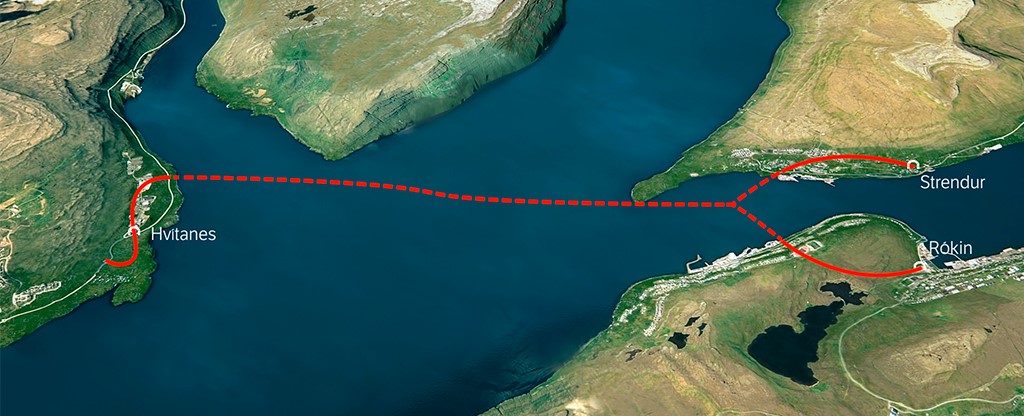
The Faroe Islands—an autonomous region of Denmark—has built bridges and tunnels before to connect the numerous islands or islets and its 50,000-some residents. Never before, however, have they dug an undersea tunnel as deep or as long as the brand-new Eysturoyartunnilin, nor built an undersea roundabout.

Eysturoyartunnil Interior Green

The roundabout is part of a tunnel measuring about 11 km (6.8 miles), the third sub-sea tunnel in the islands. It connects the islands of Streymoy and Eysturoy, and reaches at its deepest 187 meters (roughly 200 yards) below sea level. At this writing the tunnel’s been in use for about a month.

Eysturoyartunnil Map

The roundabout comes with art—sculptures and light effects—designed by the Faroese artist Tróndur Patursson. You can read more about the tunnel at BBC or the P/F Eysturoyar- og Sandoyartunnil project website.

Eysturoyartunnil Interior Blue

Oh, my goodness. It’s obviously not a solution that suits every location, and I assume the cost plus know-how involved can also be a deterrent, but what a feat of engineering and vision it is. This is yet another reason why it’s (pandemic aside) exciting to be living now!

Found via Kristina Háfoss on Twitter.

Images: Map by P/F Eysturoyar- og Sandoyartunnil. Interior images by Estunlar.fo via BBC.

Out There is an occasional feature highlighting intriguing art, spaces, places, phenomena, flora, and fauna.

Cephalopodic Human Figures Drawn by Bored Children in 13th-Century Novgorod

Erik Kwakkel, Professor of Book History & Director, School of Information, UBC, Vancouver, Canada, shares all sorts of interesting tidbits online. Among the older ones—posted over seven years ago now and dating from the Middle Ages—are some wonderful children’s drawings made on birch bark.

This piece of bark is from among a large find made near the city of Novgorod, Russia, from the 13th century.

Tumblr Erik Kwakkel C13th Novgorod Birch Bark Drawing

Isn’t it interesting? Look at the eyebrows and the noses! And the torsos! Incredibly cephalopodic, in a charming way. And the hands look like rakes. The figures are clearly identifiable as humans, but the customary ways of drawing some of the details seems to have changed over the centuries quite a bit.

Check out Kwakkel’s Tumblr or Twitter for more book history particulars.

Image via Erik Kwakkel on Tumblr

Out There is an occasional feature highlighting intriguing art, spaces, places, phenomena, flora, and fauna.

Living Vicariously Through Social Media: Inspiration for Moria Doors

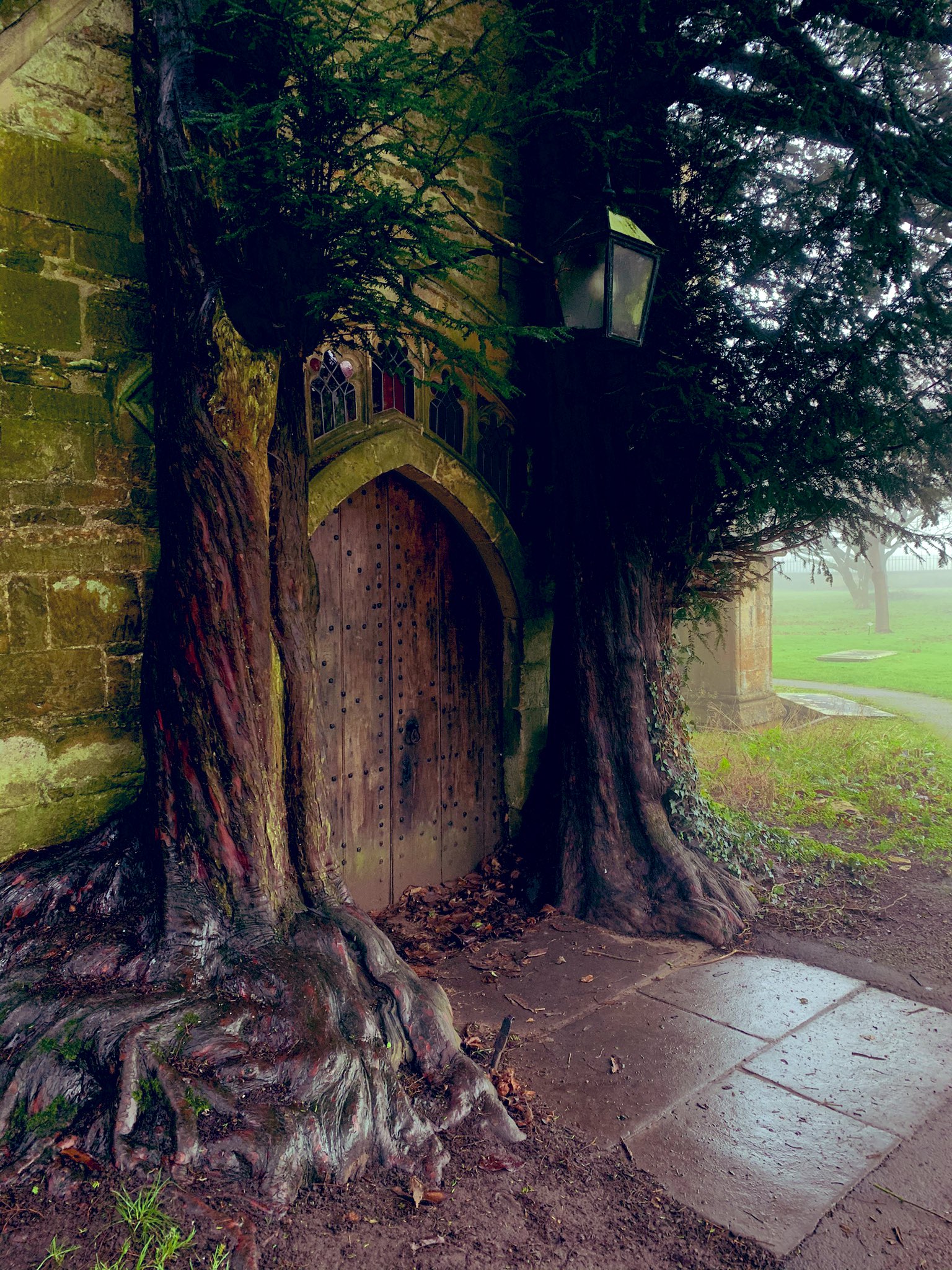
Sophie Berry on Twitter shared this amazing photo of a church door flanked by two trees that have basically grown into the wall:

Twitter Sophie Berry St Edwards Stow-in-the-Wold Back Door

Apparently it’s thought to be the inspiration for the doors of Moria in Tolkien’s Lord of the Rings. No surprise there. How incredible!

Image via Sophie Berry on Twitter.

Out There is an occasional feature highlighting intriguing art, spaces, places, phenomena, flora, and fauna.

Good Health with Telesphorus

With Covid-19 still largely unchecked and the winter flu season closing in on us (in the northern part of the world at least), health and illness are on a lot of our minds. So here’s a votive statuette of an ancient Greek god of health, Telesphorus.

Telesphorus represents an interesting combination of influences from several different cultures. Mythology describes him as a son of the Greek healing god Asclepius specifically concerned with recovery from disease or injury. In art he was often shown as a short, squat man similar to some earth-related deities from Phrygia in inland Anatolia wearing a type of hooded cloak typically associated with Gauls. This version, found in France and carved at some time when the Roman Empire ruled the region, has heavily outlined eyes, a triangular nose, and straight bands of hair, all of which are characteristic of Gaulish and British art. Somehow, this seems an appropriate image for a season in which we face a worldwide pandemic.

We wish you all good health in the times ahead.

Image: Telesphorus statuette, photograph by Millevahce via Wikimedia (found Moulézan, currently Musée Archéologique de Nîmes; Roman period; limestone)

Out There is an occasional feature highlighting intriguing art, spaces, places, phenomena, flora, and fauna.

A Striking Greek Gods Photoshoot

Here’s a beautiful new imagining of the Greek gods, “20 Dioses y Diosas para 2020,” photographed by Ana Martinez and styled by Mario Ville. This photoshoot combines ancient ideas, modern fashion, and imaginative graphics with Black models taking the roles of the gods. You can see the full set of photos at N20.

A few of my favorites:

Juana Mum as Hera

Lewis Amarante as Poseidon

Ruben Baika as Apollo
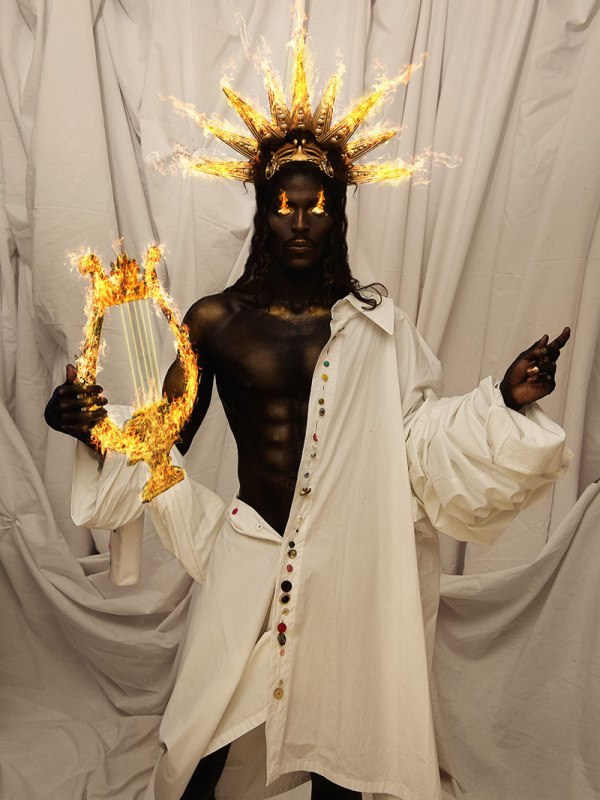
I appreciate how these images combine classic symbols such as Apollo’s lyre and Poseidon’s trident with modern dress and accents. I wish the artists had chosen to use color for the clothing rather than just white, since ancient images of the gods were brightly colored, not the plain white marble we are used to seeing now, but there’s no denying how strikingly the white garb sets of the models’ dark skin. I also enjoy seeing versions of some of the less well-known gods like Hestia, goddess of the hearth, and Eris, goddess of discord.

This photoshoot is another example of how effectively the ancient Greeks crafted their mythology and its visual language in ways to be flexible enough to allow for many new interpretations and to be accessible to a broad and diverse audience.

Images by Ana Martinez via Neo2

Post edited to remove a miscopied link

Out There is an occasional feature highlighting intriguing art, spaces, places, phenomena, flora, and fauna.

Video of 14th-Century Techniques of Bridge Building

Here is an interesting animation of how the Charles Bridge in Prague, Czech Republic, was built with 14th century techniques:

Karlův most – Stavba pilíře a klenebního pole ve 14. století by praha-archeologicka.cz on YouTube

3D graphics and postproduction is by Tomáš Musílek, with assists from Ondřej Šefců and Zdeněk Mazač. More information about Charles Bridge can be found at the portal Prague – the City of Archaeology. (Note: most of the site’s content and functionality seems to be in Polish, or link from the English summary to the equivalent full page in Polish.)

I love it how we’re now able to not just model but animate many old or even ancient building projects. It really reveals how far we’ve come and the skills and persistence we have as a species.

Found via File 770.

Out There is an occasional feature highlighting intriguing art, spaces, places, phenomena, flora, and fauna.
A Huron/Wyandot Glengarry Cap

This decorated hat was created by an indigenous North American Huron/Wyandot artisan around 1840. It is made of wool, silk, and moosehair, worked using traditional techniques, but patterned after the Glengarry-style cap of the Scottish highlands and decorated with a Victorian floral motif.

Hats and other decorated objects like this one represent a complex interplay of cultural, artistic, and economic influences. Indigenous artisans from Iroquoian, Wabenaki, and other native nations had long created trade goods intended for exchange with European settlers and adapted to European tastes. In the nineteenth century, indigenous creators took advantage of the growth of a tourist industry around the Great Lakes region to market a broader range of wares combining forms that white customers would recognize and find useful, like this Glengarry cap, with decorative schemes that appealed to Victorian sensibilities while preserving traditional techniques. Such objects were created in a combination of traditional and modern materials, such as moosehair and leather combined with wool, silk, and glass beads.

The creation and sale of these goods—often produced by female artisans—provided both a means of preserving traditional artistic methods and a valuable economic resource to indigenous and First Nations peoples at a time when other opportunities in white-dominated American and Canadian society were hard to find, and indigenous cultures were often suppressed, sometimes violently.

Image: Glengarry-style cap via Metropolitan Museum (Metropolitan Museum, New York; c. 1840; wool, silk, and moosehair; unknown Huron/Wyandot artist)

Out There is an occasional feature highlighting intriguing art, spaces, places, phenomena, flora, and fauna.