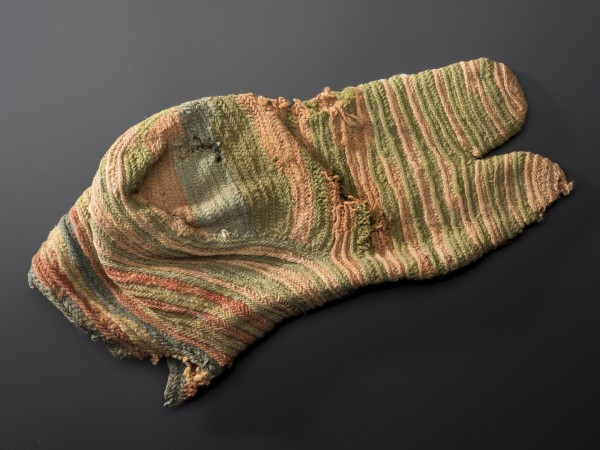
This amazingly preserved sock comes from the late Roman period of ancient Egypt. The colors of the stripes give us some idea of how bright and cheerful this sock must have been when it was new.
The notch at the end separated the big toe for wearing thong sandals. The question of whether this means “wearing socks with sandals has an ancient and honorable pedigree” or “ancient Egyptians could be huge dorks, too” is left as an exercise for the reader.
This terra cotta Etruscan sarcophagus depicts a couple reclining on a dining couch together. Etruscans adopted a great deal of cultural influences from the Greek world (including, for instance, the style of dining while lying on a couch), but one sharp difference from the Greeks was while in the Greek world dinner parties were exclusively male affairs, Etruscan women and men dined together.
This couple looks particularly happy and loving, smiling and holding one another affectionately. Of course, art is not always a reflection of life; just because a couple wanted to be depicted as a happy family in their funeral portrait doesn’t necessarily mean they were happy together in life, but it’s certainly nice to imagine that they were, and the very fact that they wanted to be perceived as a loving, intimate couple tells us something about the values of their culture.
Image: Sarcophagus of the spouses, photograph by Sailko via Wikimedia (CC BY-SA 4.0) (found Caere, currently National Etruscan Museum at Villa Giulia, Rome; c. 530-520 BCE; terra cotta)
Out There is an occasional feature highlighting intriguing art, spaces, places, phenomena, flora, and fauna.
In Lima, Peru, artist Xomatoc and local residents painted a number of stairs with colors and combinations more typically associated with traditional South American blankets and other textiles.
This project was a part of the Pinta Lima Bicentenario. Xomatoc’s project was only one of public art installations painted around the municipality to celebrate each participating neighborhood’s history and cultural memory.
The length of the stairs, the vibrant colors, and the large enough scale of these patterns make them really eyecatching. And, good grief, the degree of the slopes! (I grew up essentially on a flood plain, which is why mountains look so drastic to me.) The stairs definitely will be visible a long way.
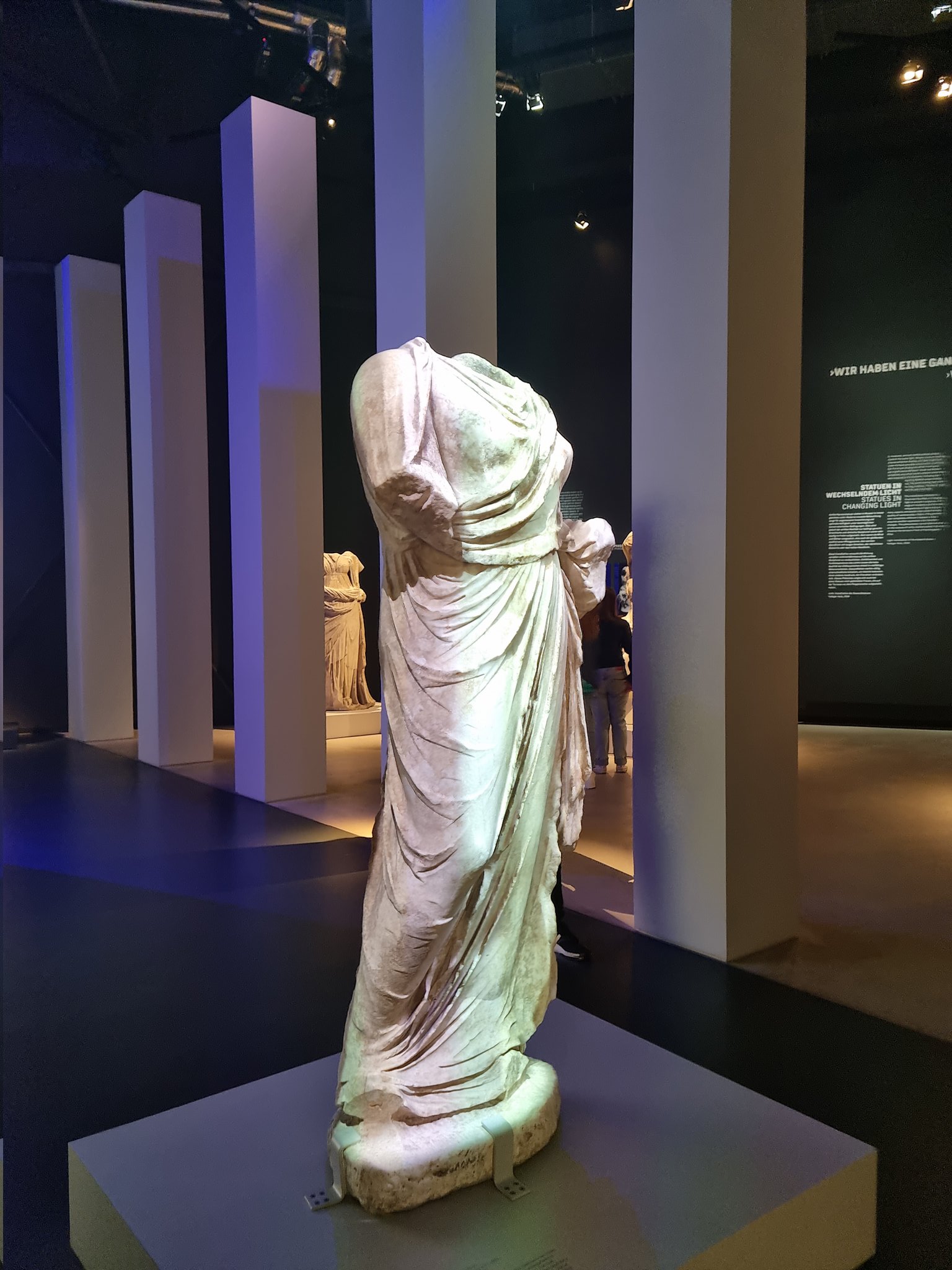
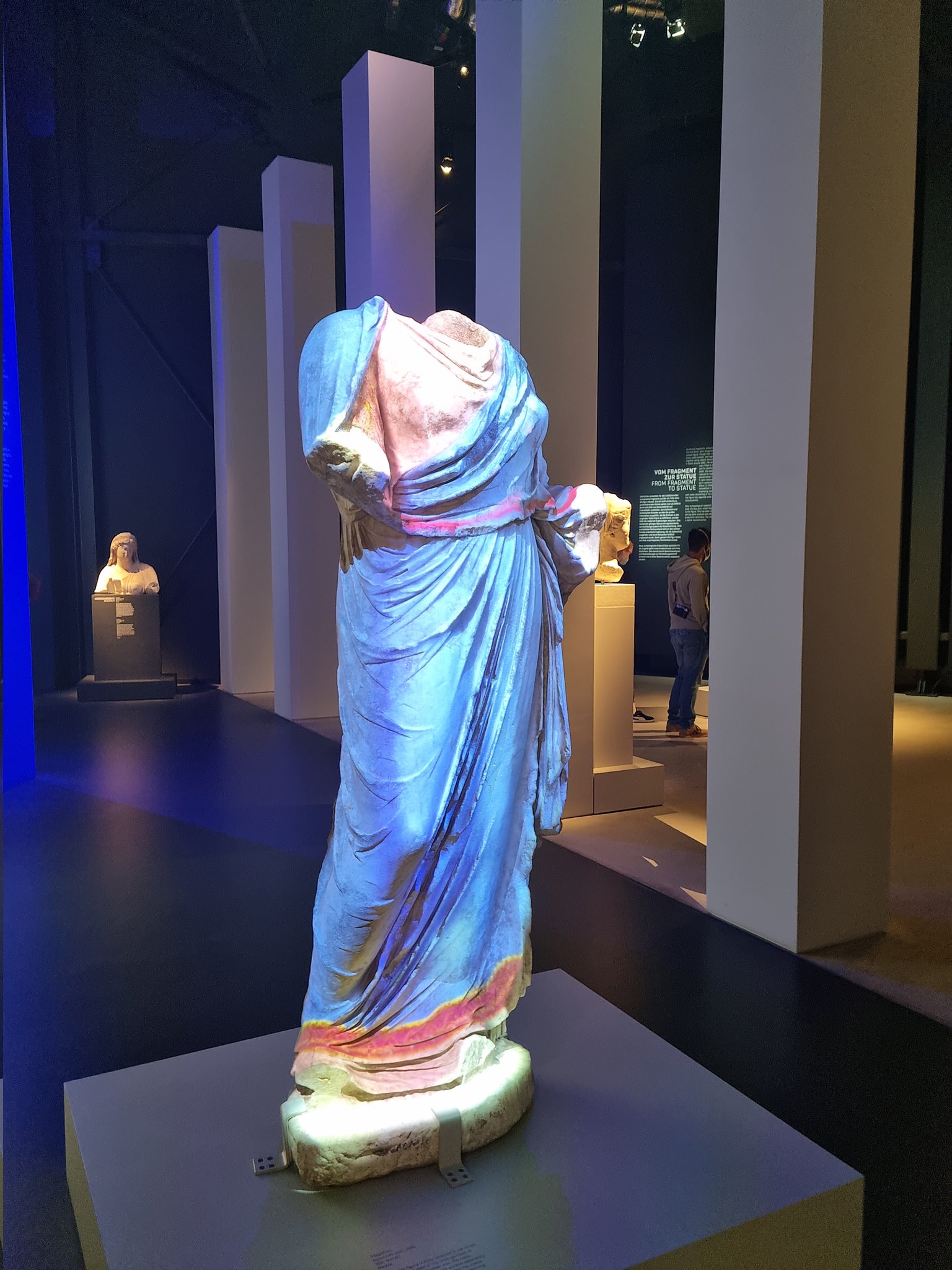
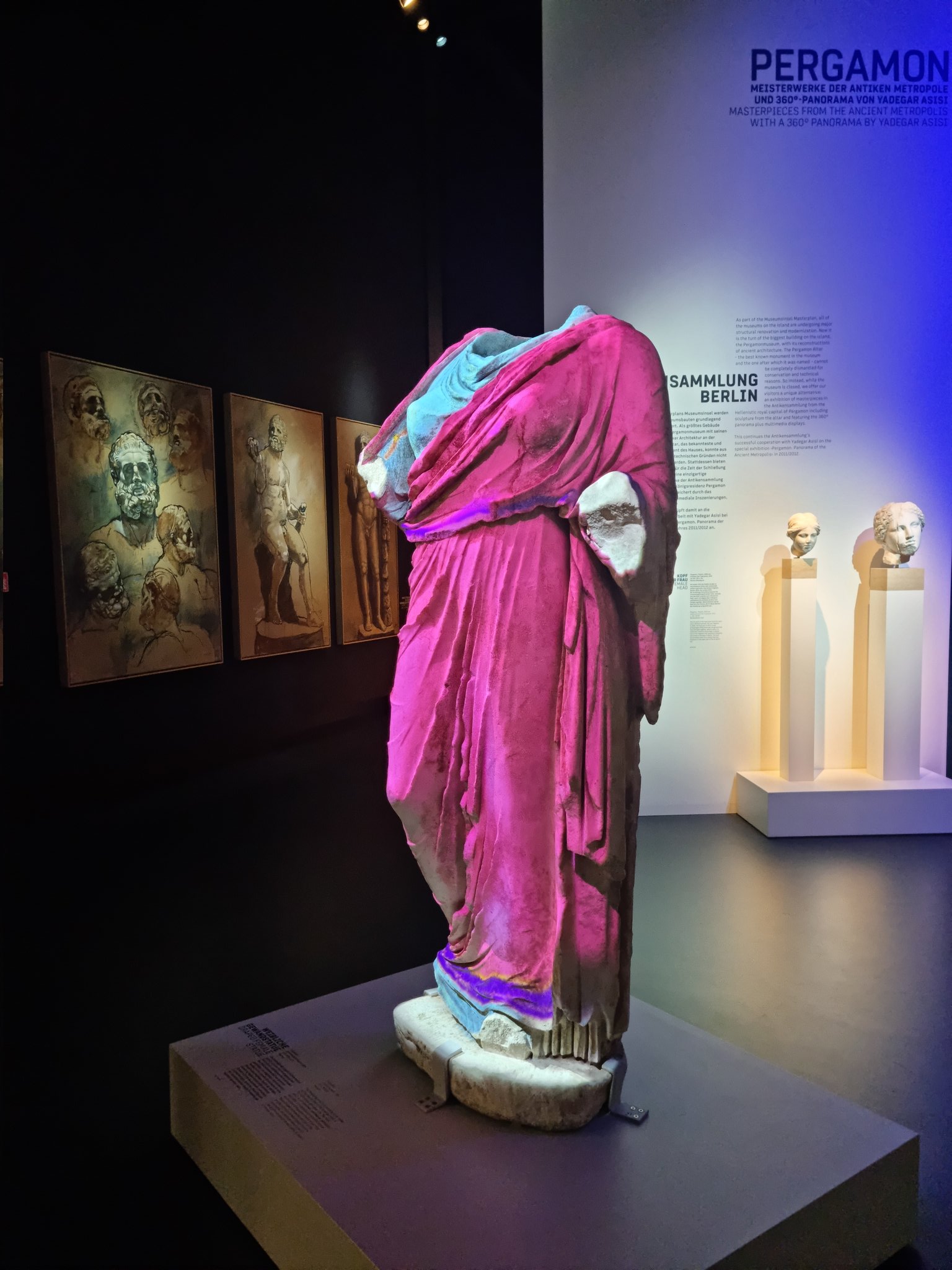
Here are a few interesting pictures from the Pergamon Panorama in Berlin where colored lights are used to show a few different variations on what marble ancient statues might have looked like in their original colors. A very neat idea and some great photography from Twitterer @BelovedOfOizys!
Images: Statuary from Pergamon with colored lights, photographs by @BelovedOfOizys via Twitter
Out There is an occasional feature highlighting intriguing art, spaces, places, phenomena, flora, and fauna.
Would you ever have thought large birds could live in cities? I would’ve found it a stretch on the basis of my experience, but apparently in Amsterdam in the Netherlands there is a large urban population of herons. Photographer Julie Hrudová has been documenting them, and the photos are very arresting.
Some of the birds seem to be getting quite bold:
Fascinating, isn’t it? Also, the pictures gives me all sorts of ideas for secondary worldbuilding. I could easily imagine semi-domesticated herons in a story, rather like the reindeer in Lapland.
The Visual Inspiration occasional feature pulls the unusual from our world to inspire design, story-telling, and worldbuilding. If stuff like this already exists, what else could we imagine?
Recent images taken by the Hope spacecraft launched by the United Arab Emirates show an improved view of auroras on Mars.
The auroras on Mars don’t just appear over the poles, however, but all around the planet. The Emirates Mars Mission didn’t discover these discrete auroras, but Hope’s images are, apparently, the most impressive captured so far.
Modern minakari bowl, photograph by Interesting009 via Wikimedia
This gorgeous bowl is an example of a style of enamel work known as minakari (also spelled meenakari or mina-kari), which literally means “to place heaven into an object.”
The style was developed in Persia under the Safavid kingdom in the sixteenth and seventeenth centuries CE. Artists of that time took enameling techniques from Europe and China and used them to create works whose intricate designs and vivid colors drew on the rich legacy of Persian and Islamic art.
Minakari works are still being produced today, especially in and around the city of Isfahan. “Placing heaven in an object” seems like a good enough description to me.
Out There is an occasional feature highlighting intriguing art, spaces, places, phenomena, flora, and fauna.
Heroes don’t spend all their time being heroic. They need time off, too. That was the idea behind this beautiful vase by the ancient Athenian painter Exekias.
On one side, we see Achilles and Ajax, two of the great Greek warriors of the Trojan War, putting aside most of their armor for a while and playing a board game. Achilles is winning, as Exekias lets us know because he has given us the score: beneath Achilles’ head is the word “four,” beneath Ajax’s, “three.” According to literary tradition, Achilles’ tent was at one end of the Greek line, Ajax’s at the other, so this was not just a casual pick-up game; one or the other of the heroes must have crossed the entire Greek camp so they could play.
Amphora, Achilles and Ajax playing a game, photograph by Daderot via Wikimedia (Athens, currently Vatican Museums; c. 540-530 BCE; black-figure pottery; by Exekias)
On the other side of the vase, the twin heroes Castor and Pollux return home. They are welcomed by their parents, Tyndareus and Leda. On the left, Pollux leans down to greet a dog who jumps up, excited to see him.
Amphora, Castor and Pollux return home, photograph by M. Tiveros via Classical Art Research Centre (Athens, currently Vatican Museums; c. 540-530 BCE; black-figure pottery; by Exekias)
Exekias was an innovative artist. He was one of the first vase painters to show mythic heroes not in the midst of action but at ease, among the familiar surroundings of everyday life.
If you’ve been feeling the weight of the past year, take some inspiration from heroes: play a game, say hello to family, play with a pet. If it’s good enough for Achilles, Ajax, Castor and Pollux, it’s good enough for you, too.
Out There is an occasional feature highlighting intriguing art, spaces, places, phenomena, flora, and fauna.
Here are some ladies enjoying a good stag hunt, from an illumination in a copy of “The Letter of Othea to Hector” by Christine de Pizan. The image represents the mythical huntresses of the goddess Diana, as imagined by a medieval artist. We see one lady driving game by beating the bushes and another taking aim with her bow while two more blow the hunting horn and manage the dogs.
Hunting scene from the “Letter of Othea to Hector” via Wikimedia (Bibliothèque nationale de France, Paris; 1407-1409; paint on parchment; by the Master of the Letter of Othea)
Out There is an occasional feature highlighting intriguing art, spaces, places, phenomena, flora, and fauna.
I can’t say I’m a night owl, but I nevertheless am definitely not a morning person. That makes me a little wistful sometimes, since mornings can be beautiful.
Case in point: nature photographer David Chambon’s dew-laden insect photos. They are. Just. Stunning!