Covering canals with something to slow water evaporation is a no-brainer, right? (Or should be.) How about making those covers be solar panels for a two-fer—as apparently is already happening in India—now, that’s outright ingenious.
(Incidently, I can recommend Paolo Bacigalupi’s novel The Water Knife from 2015, in which water rights and covered canals feature strongly. In case you’re interested in that sort of fiction.)
Carved gravestones with images and short poems celebrating the deceased were common in the ancient world, but it wasn’t just people who got them. This one commemorates a pig who apparently died in some kind of traffic accident. Like other Greek epitaphs, this one is phrased in the first person, as if the pig were narrating its own story.
A little pig, everyone’s friend, a young quadruped, I lie here, after leaving behind the land of Dalmatia to be offered as a gift. I walked through Dyrrachium and Apollonia in my longing, and passed through the whole earth alone untouched. Now, by the violence of wheels, I have left the sunlight behind. I longed to see Emathia and the phallic chariot, but now I lie here, and my debt to death is cleared.
Supplementum Epigraphicum Graecarum 25:711
(My own translation)
The story seems to be that a pig was bought somewhere in Dalmatia (the Balkans) and driven overland toward the plain of Emathia in Macedonia (west of modern-day Thessaloniki), to be offered as a sacrifice in a festival for Dionysus (which often involved a large decorated phallus carried in a procession). The stone was found in Edessa, a city right at the edge of Emathia, and it seems that here the poor pig got run over by a cart.
It’s certainly unusual for an animal to have a gravestone like this. There was a custom of writing joke epitaphs for animals, but few people went to the expense of actually getting them carved in stone. Perhaps this pig was special, or perhaps the gravestone represents a kind of substitute for the religious act of sacrifice that was no longer possible once the pig was killed on the road.
Whatever the case may be, that was clearly some pig.
Image: Copy of pig stela, photograph by Philipp Pilhofer via Wikimedia (Edessa; 2-3 c. CE; carved stone)
Out There is an occasional feature highlighting intriguing art, spaces, places, phenomena, flora, and fauna.
One of the astounding things about living right now is the sheer amount of scientific knowledge and technical skills humanity has gained in the past 100 years or so alone.
These days it’s trivial, for example, to get high-quality photos from a neighboring planet brought to your personal device.
(Ok, it’s not truly trivial in the strictest sense since so many steps and technologies are involved, but at the same time: Photos. From another planet. Automatically delivered. Via the Internet. Which many (if not most) of us in the West have casual access to. Pretty much daily! So yes. Trivial.)
Specifically, I’m talking about the Persevererance Imgage Bot on Twitter. It’s a project by computer engineer Niraj Sanghvi. He has automated image tweeting mostly from NASA/JPL-Caltech sources for an impressive, ever-growing collection.
The photos are purely functional, of course, helping the rover to operate, but some are also quite interesting as photographs. Below are some recent favorite shots.
(Click on the image source links below to find more about each photo.)
In September 2021, Photographer Dmitry Kokh visited the currently unoccupied Kolyuchin Island in the Chukchi Sea between Russia and Alaska, and documented some of the wildlife there. A bunch of polar bears seem to have settled in the abandoned buildings of a former Russian weather station.
You can see the bears casually stroll in between the houses, and apparently even spend time inside the buildings, often peeking out of the glassless windows. Astounding!
This floor mosaic comes from the dining room of a Roman house. The central parts of the floor have been lost, but the edges of the room were decorated to look like the untidy remains of a banquet. We can identify leaves, fish and poultry bones, nut shells, bits of fruit, and the shells of a wide variety of shellfish. This may seem like an odd choice for home decoration, but mosaics in this style were popular in well-to-do Greek and Roman households. To contemporary guests, mosaics like this sent a number of messages about the people who dined on them.
On one level, this mosaic simply reflected the reality of the room it was in. Diners at an ancient banquet could toss their refuse on the floor with abandon because they were not the ones who had to clean it up. The widespread use of enslaved labor for domestic service meant that the rich could lob greasy chicken bones and half-eaten olives around the place without caring about the time and effort involved in cleaning up afterward. In that sense, this mosaic identified the owners of this house as the sorts of people who had other people to do the cleaning up after them.
On the other hand, the evident abandon with which the detritus is strewn around the room is deceptive. The individual pieces are precisely placed so that there the space between them is relatively even. Larger items are spread out with smaller ones between them. They are positioned in loose diagonal lines with a subtle aesthetic regularity; similar objects repeat to help unify the image, but are spaced out and given different orientations to avoid any sense of pattern. This mosaic is an extremely fine one made of very small tesserae in many different shades that must have taken a substantial amount of work by a skilled mosaic artist and a team of workers. The details of this Roman mosaic also imitate a famous Greek predecessor created by the mosaic artist Sosos of Pergamum. The effect was meant to project wealth and power: only the very rich could afford to put so much care into looking so careless.
The choice of food to show in this mosaic is also significant. Meat had a religious, even moral, significance in Greek and Roman culture. Large land animals like cattle, sheep, and pigs were typically eaten as part of a communal religious sacrifice, and religious custom dictated how they could be cooked and served as well as who should partake in the feast. Fish, shellfish, and poultry were not constrained by similar rules and could be eaten when, how, and in any company one liked. As such, this sort of food was associated with indulgence, even decadence. To say that a fellow Greek or Roman dined on fish had a sting of moral judgment akin to declaring that someone today enjoys champagne and caviar. The variety of fish bones, chicken claws, and shells in this mosaic makes a statement that this room is not one for solemn sacrificial meals but a place where the diners can indulge in their favorite delicacies free of any religious scruples or moral condemnation.
A great deal of meaning is packed into a mosaic of an untidy floor. These were messages that the original guests in this dining room would have implicitly understood in same way that we today grasp the status-signaling meaning of a four-car garage or a water view.
Image: Detail of unswept floor mosaic, photograph by Yann Forget via Wikimedia (currently Gregorian Profano Museum, Vatican; early 2nd c. CE; glass tessera mosaic; by Heraclitus, copied from work by Sosos of Pergamum)
History for Writers looks at how history can be a fiction writer’s most useful tool. From worldbuilding to dialogue, history helps you write.
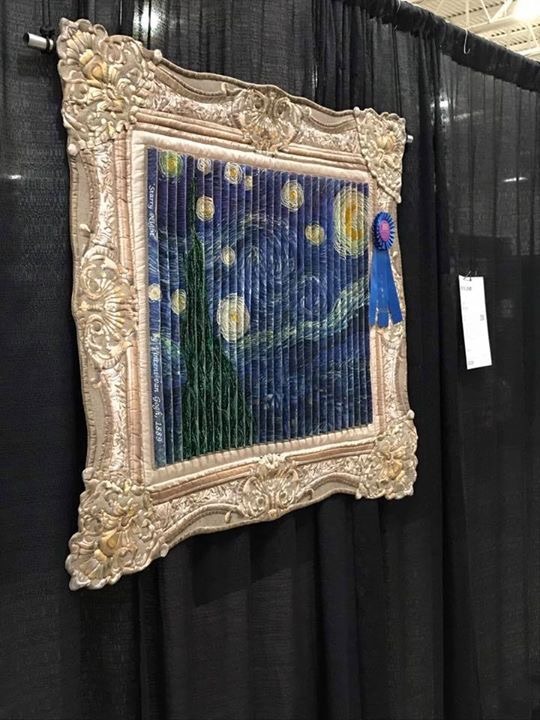
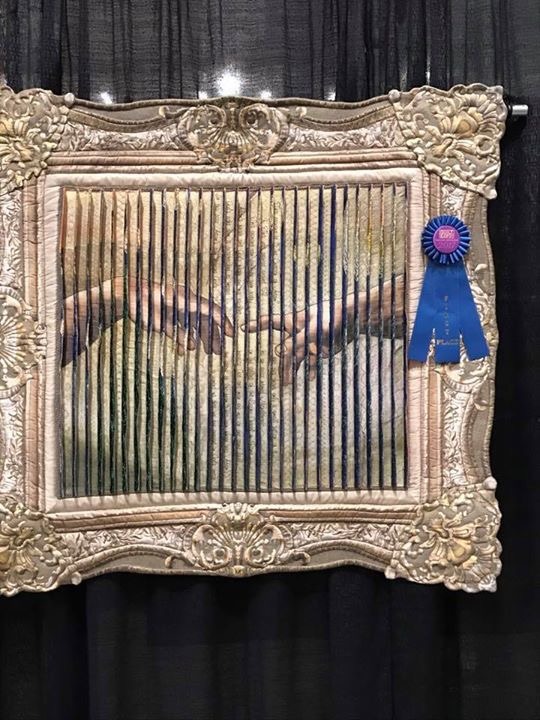
Check out this mind-blowing quilt simultaneously copying three fine arts pieces, namely Vincent van Gogh’s Starry Night, Michelangelo’s The Creation of Adam, and Edvard Munch’s The Scream:
Even the intricate gold frame is sewn!
This astounding piece is called “Sleep, Play, Scream” and it was made by Flora Joy. She was deservedly awarded for her innovative trispective technique.
Any time I come across someone, typically an older white man (seriously, dudes, you’ve got to do better), sneering at sewing or other textile work, I can’t but shake my head. Poor twits, showing what they emphatically don’t know jack shit about.
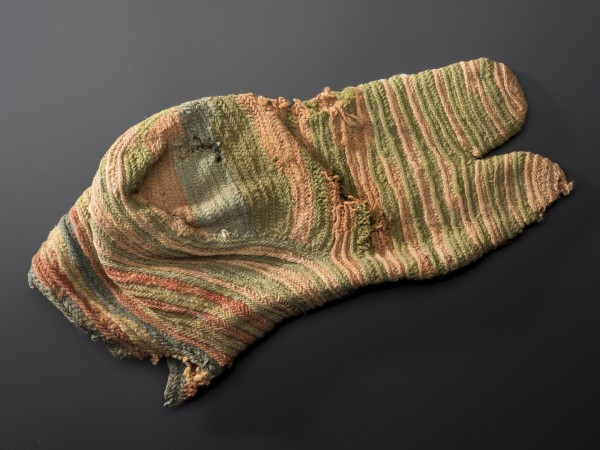
This amazingly preserved sock comes from the late Roman period of ancient Egypt. The colors of the stripes give us some idea of how bright and cheerful this sock must have been when it was new.
The notch at the end separated the big toe for wearing thong sandals. The question of whether this means “wearing socks with sandals has an ancient and honorable pedigree” or “ancient Egyptians could be huge dorks, too” is left as an exercise for the reader.
This terra cotta Etruscan sarcophagus depicts a couple reclining on a dining couch together. Etruscans adopted a great deal of cultural influences from the Greek world (including, for instance, the style of dining while lying on a couch), but one sharp difference from the Greeks was while in the Greek world dinner parties were exclusively male affairs, Etruscan women and men dined together.
This couple looks particularly happy and loving, smiling and holding one another affectionately. Of course, art is not always a reflection of life; just because a couple wanted to be depicted as a happy family in their funeral portrait doesn’t necessarily mean they were happy together in life, but it’s certainly nice to imagine that they were, and the very fact that they wanted to be perceived as a loving, intimate couple tells us something about the values of their culture.
Image: Sarcophagus of the spouses, photograph by Sailko via Wikimedia (CC BY-SA 4.0) (found Caere, currently National Etruscan Museum at Villa Giulia, Rome; c. 530-520 BCE; terra cotta)
Out There is an occasional feature highlighting intriguing art, spaces, places, phenomena, flora, and fauna.
In Lima, Peru, artist Xomatoc and local residents painted a number of stairs with colors and combinations more typically associated with traditional South American blankets and other textiles.
This project was a part of the Pinta Lima Bicentenario. Xomatoc’s project was only one of public art installations painted around the municipality to celebrate each participating neighborhood’s history and cultural memory.
The length of the stairs, the vibrant colors, and the large enough scale of these patterns make them really eyecatching. And, good grief, the degree of the slopes! (I grew up essentially on a flood plain, which is why mountains look so drastic to me.) The stairs definitely will be visible a long way.
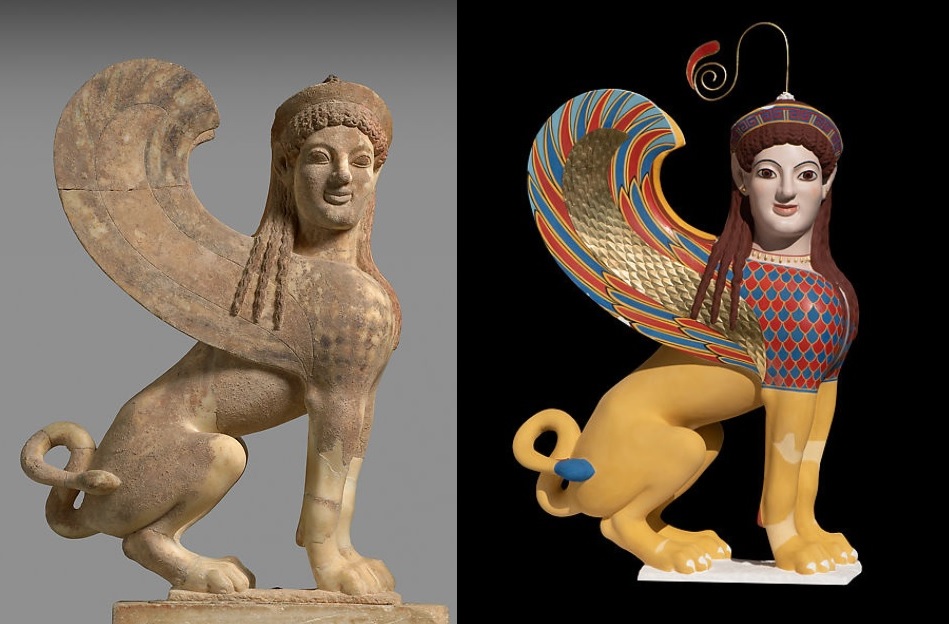
Here are a few interesting pictures from the Pergamon Panorama in Berlin where colored lights are used to show a few different variations on what marble ancient statues might have looked like in their original colors. A very neat idea and some great photography from Twitterer @BelovedOfOizys!
Images: Statuary from Pergamon with colored lights, photographs by @BelovedOfOizys via Twitter
Out There is an occasional feature highlighting intriguing art, spaces, places, phenomena, flora, and fauna.
You must be logged in to post a comment.