Visual Inspiration: Greater Blue-Eared Starling

The greater blue-eared glossy-starling (Lamprotornis chalybaeus) is a common bird in parts of Africa. It’s as handsome as handsome gets—absolutely gorgeous!

iNaturalist petermcintyre Greater Blue-eared Starling

This stunning starling breeds in a band of land stretching from Senegal in the west coast all the way east to Ethiopia, and south again through eastern Africa to northeastern South Africa, northern Botswana, southern Namibia, and northern Angola. They live in subtropical forests, savanna, and shrublands.

I’ve always found the English name starling lovely—certainly lovelier than the Finnish one (kottarainen)—but the looks of the common starling haven’t, sadly, quite lived up to the name in my mind. Now, the greater blue-eared starling is quite something else! It would be so remarkable to see a turquoise-blue murmuration in a fantasy production, wouldn’t it?

Found via Herps and Birds on Tumblr.

Image by petermcintyre via iNaturalist (CC BY-NC 4.0)

Winter Count

As a historian, its always fascinating to me to encounter the historiographic practices of another culture. Every culture has reasons to remember the past, and finds its own solutions to the problems posed by the limitations and fallibility of human memory. While written narrative histories have been privileged in the Western world, they are not the only way of preserving the past.

The winter count is a tradition of the Lakota, Kiowa, and several other indigenous nations of the North American plains. Customarily painted on buffalo hide, the winter count records years with one or two pictographic symbols representing major events of the year. These documents served as an aid to memory so that important past events could be recalled and put in relation to one another. In more recent times, some were also created on fabric or paper.

Copy of a Kiowa winter count for 1889-1892 via Wikimedia (previously Smithsonian Museum, now lost; 1890s; ink on buckskin; copy by Ankopaaingyadete of his original work on paper)

We know of winter counts dating from as early as the late seventeenth century and some still being kept in the early twentieth century. Not many have survived intact to today. Like many cultural objects created by indigenous North Americans, winter counts were sometimes destroyed by white settlers and at other times taken by collectors as anthropological curiosities. Some of those that no longer survive were photographed or copied, and in some cases, while the images have been lost, written descriptions survive.

There’s more than one way to preserve historical knowledge. Here’s one idea to keep in mind when thinking about how we know about the past and how people in a culture different from our own might relate to historical memory.

Living Vicariously Through Social Media: Rainbow Eucalyptus Trees

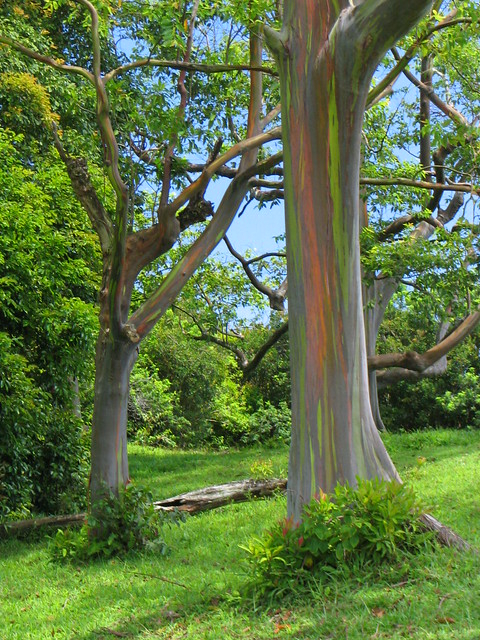
Rainbow eucalyptus trees (Eucalyptus deglupta) shed their bark at a strip at a time, and the tree trunks look stripy as a result. That’s not all, however—the stripe colors can vary surprisingly much. A freshly revealed area will look bright pale green, which then darkens and changes to orange, red, brown, and grey or blue.

Flickr spencer9 Rainbow Eucalyptus
Flickr Jean-Francois Schmitz Rainbow Eucalyptus

Rainbow eucalyptuses are native to the Philippines, Indonesia, and Papua New Guinea, but have been planted elsewhere in suitable climates.

Amazing, aren’t they? I wonder whether the Weta artists looked at rainbow eucalyptus trees as an inspiration for their saturated, weird Mirkwood trees for the Hobbit movies. (They talked about the design in the behind-the-scenes documentaries; the movies as released are too dark to see the colors properly, if memory serves.)

Images: Two eucalyptuses by spencer9 via Flickr (CC BY-NC 2.0). Closeup by Jean-François Schmitz via Flickr (CC BY-NC-ND 2.0).

Out There is an occasional feature highlighting intriguing art, spaces, places, phenomena, flora, and fauna.

A Dragon Crawls Down from the Ceiling to Make a Fireplace

A dragon fireplace. A DRAGON. Fireplace!

Twitter Into the Forest Dark Dragon Fireplace

Ok, thinking about it a little longer than half a second, it’s not surprising that there are a number of dragon designs for fireplaces and stoves for both indoors and out, in addition to firepits, fireplace screens, and andirons.

This particular one must be custom work and as such, it cannot be inexpensive. But, dang, is it handsome or what?

By unknown. Found and image via Into the Forest Dark on Twitter.

Out There highlights intriguing art, places, phenomena, flora, and fauna.

A Greco-Scythian Gorytos

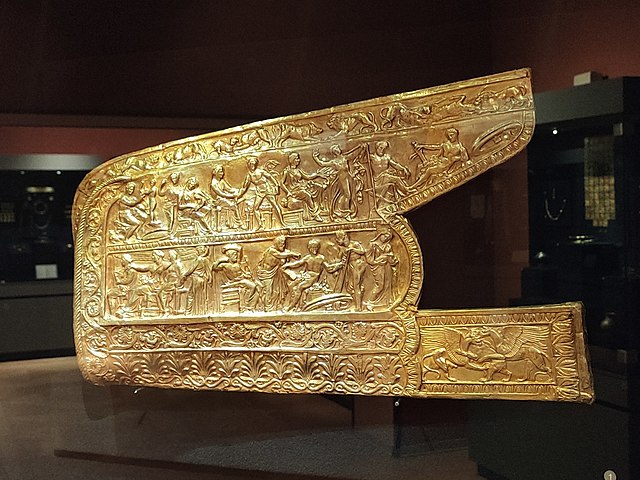
Here’s a beautiful work of art. This is a golden decorative panel from a gorytos, a combination quiver and bowcase that was used widely among ancient peoples of the steppes and the Iranian plateau. This example was found in Melitopol in southeastern Ukraine.

Gorytos, photograph by VoidWanderer via Wikimedia (found Melitopol, currently Kyiv; 4th c. BCE; gold)

Scythian artisans were expert metalworkers, and the Scythian elite valued high-quality metalwork, especially in gold, as emblems of status. This panel was made by Greek crafters serving the Scythian market. The central panel shows scenes from the life of Achilles, a Greek hero whose legends were sometimes associated with Scythia and whose warrior prowess was appealing to Scythian tastes. The outer panels feature decorative scenes of animals hunting, a popular motif in Scythian metalwork.

This piece is not just a beautiful work of art, it’s also an example of how art and artisans in antiquity crossed boundaries and bridged cultures.

Out There highlights intriguing art, places, phenomena, flora, and fauna.

Visual Inspiration: Whiskered Treeswifts

Whiskered treeswifts (Hemiprocne comata) live in various subtropical or tropical forests in Southeast Asia.

Macaulay Library David Cathy Cook Whiskered Treeswift

They remind me of swallows, but are more colorful. Especially the combination of grey plus blue in the wings and back appeals to me.

Setting personal color preferences aside, wouldn’t it be so much more interesting to read a secondary world fantasy story with, say, messenger birds that look like whiskered treeswifts rather than the uninspired and unoriginal corvids?

Yes, corvids are AMAZING birds, but they’re used EVERYWHERE. Could they not be replaced by something else in a fantasy story? Or at least made vibrantly colored?

Image by David and Cathy Cook via The Cornell Lab of Ornithology, Macaulay Library

The Visual Inspiration occasional feature pulls the unusual from our world to inspire design, story-telling, and worldbuilding. If stuff like this already exists, what else could we imagine?

James Webb Telescope’s Breathtaking Protostar Image

The James Webb Space Telescope has taken near-infrared images of the protostar within the dark cloud L1527, providing insight into the beginnings of a new star. Below is the most spectacular of the images that NASA released.

NASA James Webb Protostar L1527


Here’s NASA’s description of the image:

“The protostar itself is hidden from view within the ‘neck’ of this hourglass shape. An edge-on protoplanetary disk is seen as a dark line across the middle of the neck. Light from the protostar leaks above and below this disk, illuminating cavities within the surrounding gas and dust.
“The region’s most prevalent features, the clouds colored blue and orange in this representative-color infrared image, outline cavities created as material shoots away from the protostar and collides with surrounding matter. The colors themselves are due to layers of dust between Webb and the clouds. The blue areas are where the dust is thinnest. The thicker the layer of dust, the less blue light is able to escape, creating pockets of orange.”

Wow. It’s really stunning, isn’t it?

Considering how much incredible data the James Webb has already gotten in its first year (and I’m not even properly following its work), I cannot conceive how much more it’ll provide in its decade-long planned mission.

Image by NASA and the Space Telescope Science Institute

Out There highlights intriguing art, places, phenomena, flora, and fauna.

A Writing Rabbit

There’s an interesting character in this scene from a Classic Maya vase. In the main scene, an aged underworld god is enjoying the company of a bevy of young women, but below him a rabbit scribe is keeping its eyes out and its ears perked while taking notes.

Scene from the “Princeton Vase” via Princeton University Art Museum (found Nakbe, Guatemala, currently Princeton Art Museum; 670-705 CE; ceramic with painted stucco)

None of the rabbits I’ve ever known in my life have been so practical!

Out There highlights intriguing art, places, phenomena, flora, and fauna.

Visual Inspiration: Bohemian Waxwing in White

Leucism or pigmentation loss results in partial coloring in individuals, like this amazing Bohemian waxwing:

Tumblr Make Rantala Leucistic Bohemian Waxwing

Very striking, isn’t it! A white waxwing would catch your eye anyway, but the red and yellow wing and tail tips are the truly arresting parts. Wow.

I just can’t but wonder how well one would do in nature. In northern Fennoscandia it would be okay in the winter, because even with the climate change the northern Nordic areas get snow, but summer might be tough.

Image by Make Rantala on Instagram, found via Beauty in All Things on Tumblr.

Out There highlights intriguing art, places, phenomena, flora, and fauna.

Living Vicariously Through Social Media: Eagle-Winged Northern Lights

The Astronomy Photographer of the Year contest is hosted by National Maritime Museum, part of the Royal Museums Greenwich in Britain. In 2022, the competition was run for the 14th time. This shortlisted photo by Alexander Stepanenko didn’t win the award for auroae, as astounding as it is:

Colossal Alexander Stepanenko Winged Aurora orig Sm

Stepanenko’s shot was taken in Murmansk, Murmansk Oblast, Russia, and was highly commended by the jury.

Spectacular, isn’t it? As a Finn who grew up two hours south of the Arctic Circle, I’ve seen my share of northern lights, but never this, hm, I guess curvy is the right word. I know they undulate and can therefore make fancier shapes; I’ve only managed to see them fairly linear, though, or curving over quite a large swath of the sky, just like I haven’t seen any purple or yellow ones myself.

Come to think of it, there is a thin lining of white and purple at the right edge of this aurora. Wow! Is it any wonder that natural scenes like these have lead the earlier hominids and humans to think of magic and gods?

Image by Alexander Stepanenko, found via Colossal.

Out There highlights intriguing art, places, phenomena, flora, and fauna.