No, this is not a post about how ladies and gentlemen of the nineteenth century recovered after too many pints of Guinness. Rather, it is about how nineteenth-century ideas about culture and identity have held on so tenaciously in popular history that even now, over a century later, we still have to struggle against them when trying to talk about peoples of the past. One of the subjects that often brings up these outdated ideas is “the Celts.”
Searching for the Celts
Here’s how the Victorian version of history goes. Between 500 and 400 BCE, a new group of people known as the Keltoi to the Greeks or the Gauls to the Romans, whom we call the Celts, emerged in the area of southern Germany, Austria, and Switzerland. From this homeland, they expanded explosively outwards in all directions led by aggressive warrior princes who fought from two-wheeled chariots with long iron swords. They raided Italy and Greece but were prevented from conquering those regions by the armies of the Greeks and Romans. In the west and north, however, the native peoples were far less sophisticated and could not resist the invaders. The Celts conquered France and Belgium, northern Spain, and the British Isles until at the western shores of Ireland their expansion was finally halted by the Atlantic Ocean.
Tor.com published an article online today about diversity in Hannibal’s army written from the point of view of historical wargaming. It is a interesting article and well worth a read, but unfortunately it misses the opportunity to really address questions of racial and cultural diversity in ancient warfare. Here is a quick attempt to address some of the things that were lacking.
Race and culture
Race is a term with a lot of baggage, as we are all painfully aware, but it means different things in different contexts. In modern parlance, it describes a socially-constructed division of human beings into more or less arbitrary categories, largely on the basis of skin color and other physical features. In a fantasy context, it refers to distinct species of intelligent creatures like Elves, Orcs, Dwarves, and so on.
The unaddressed problem in the Tor.com article is the conflation of race and culture. In the nineteenth and early twentieth century, overtly racist theories of history posited that people of different genetic backgrounds naturally had different qualities. Many of these stereotypes still linger in our popular culture: the stoic Indian, the mischievous Irishman, the passionate Italian, etc. This belief in racial character was encoded in early classic works of fantasy like Tolkien’s Lord of the Rings, which gave us the stubborn Dwarf, the ethereal Elf, the vicious Orc, etc.
Even as we struggle to root out this conflation of race and culture from our modern life, it lingers on in works of fantasy and science fiction: the logical Vulcan, the boisterous Klingon, the decadent Centauri, the proud Dothraki. As we look back at history, we have to think of the people of the past not in terms of racial qualities but in terms of cultural contexts. People of different origins often do behave differently, but those differences are explained by the cultures they lived in, not the races they represent.
When creating religions for our stories, one of the things to think about is how the people who follow that tradition respond to offenses against its rules and principles. Is your character running the risk of torture and death if they question the accuracy of the sacred texts, or are they just going to get a stern glare from their grandmother for using the wrong hand to swirl the incense at the family altar?
Just as there are lots of different religious traditions that people practice in many different ways, there are lots of different ways of disrespecting religious ideas and offending the people who hold them. I’m going to talk about three kinds of religious transgression today that are often confused with one another. The differences between them are important, though. Which of these kinds of transgression a society recognizes and how it responds to them reflect important things about its history and religious traditions. These three are: sacrilege, blasphemy, and heresy.
From the city of Rome to the Arctic circle is a distance of about 2,750 km. At its greatest extent, the northernmost tip of the Roman empire was more than 1,000 km from the Arctic. Even across such a distance, however, there were connections. A couple of little pieces of evidence show us how knowledge of Rome could reach the far north, and how knowledge of the far north could reach Rome.
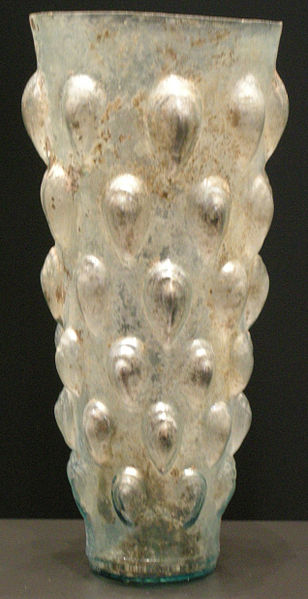
In Føre, Nordland, on an island in far northern Norway, is an ancient burial site. Over several centuries in the late iron age around 10 mound burials were raised of earth and stone. (The number is uncertain because some of the mounds have been destroyed by erosion and farming.) Not all have been excavated, but those that have have yielded the evidence of extraordinary wealth by local standards, including a Roman drinking glass buried in the only female grave so far known at the site. (The glass pictured is of a similar type, but not from the same site.)
It is very unlikely that Føre had any direct connection to the Roman world. Rather it was at the northern extreme of a network of trade and alliances that spanned Scandinavia and the Baltic Sea region which used Roman imports as high-status trade goods and diplomatic gifts. The people of Føre may have had very little idea of what the Roman empire was, but they had some access to Roman goods and valued them as precious objects.
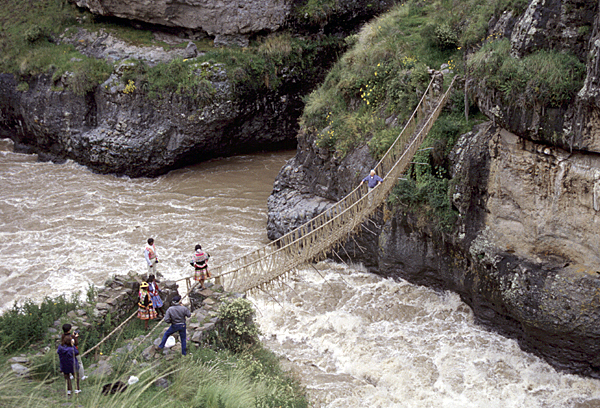
The Inca empire of South America was connected by a network of roads used by chasqui runners and pack llamas carrying messages and supplies around the empire. The Inca, creating their empire in the Andes mountains, faced challenges unlike those of flat-land and river-valley empires, among which was the problem of crossing numerous steep mountain valleys and rivers that ran dangerously swift in the flood season. Their solution to this problem was: rope bridges.
Suspension rope bridges spanned rivers and valleys, the longest reaching a length of 45 meters. They were made with ropes twisted out of grass and had to be rebuilt every year or two. The rebuilding was dangerous work that was assigned to local villagers as part of their obligation to the empire. Most Inca bridges have long since been replaced with modern structures, but one, the Q’iswa Chaka over the Apurimac River in Peru, is still rebuilt every year by local people as a way of preserving their heritage.
From the grand howdah-backed elephant to the plodding pack pony, from the solitary stallion to the caravan of a thousand camels, animals are often a part of how our characters get around. In previous entries to the travel series we’ve considered small and large groups traveling on foot. This time we bring animals into the mix.
Animals can be useful for travel, but they also bring their own challenges with them. The first thing we need to consider is what kinds of animals are useful for long-distance travel. Then we’ll look at the three main ways of using animals for travel: riding, pack, and draft. Finally, a word on the care and feeding of transport animals. As usual in this series, we are looking at real-world history: no griffins or dragon-drawn chariots. Take the information here and adjust as necessary for whatever setting you happen to be writing.
So, you’re creating a fantasy religion for a story or game. When your characters need to interact with their gods, where do they go—if anywhere at all? Down the street to the local temple? To the top of a windswept mountain? To a corner of their kitchen? Today we look at religious sites in historical cultures to inspire our imaginations.
We can start by looking at religion in today’s world. Look at the religious life of a modern western community and you will find some people attending their local church, synagogue, or mosque, some people praying quietly in their own homes, some feeling inspired by solitary walks in the woods, some debating points of theology over the internet, some participating in celebrations of religious holidays, and some not involved at all. Many people will do more than one of the above. No culture or religious tradition is monolithic, and this is just as true in the past as the present. The history of religious expression is one of incredible variety both across and within cultures.
In this variety, though, there are some patterns that recur in varying forms. People use different kinds of religious sites for different needs. Many different traditions have used similar kinds of religious sites, and within any given tradition different sites are used for different purposes. Today we will look at four common types of religious site out of the wide variety of possibilities: assemblies, temples, household shrines, and natural spaces.
Assembly
The “assembly” type of religious space will be recognizable to anyone familiar with major variants of the modern monotheistic religions. It is a space where a community of believers gathers to perform collective rituals such as praying, singing hymns, hearing sermons, feasting, and witnessing or participating in ritual enactments.
Grand Mosque, Djenne, photograph by BluesyPete via Wikimedia
Myths, legends, fairy tales, and other stories passed down through the generations are at the root of our storytelling tradition. They are the earliest stories in our literature and some of the first stories we learn as children. It is no wonder that we keep going back to mythology looking for deeper meanings. The drive to find hidden meaning in myth leads to some misguided interpretations. Two common mistakes are Freudian theory and the “forgotten history” theory.
Freudian slips
Freudian theory holds that myths are expressions of universal human drives which we have suppressed in the name of civilization. As the things that we cannot talk about openly come out in our stories, we can hold up mythology as a mirror to our own subconscious in order to see our hidden impulses better. Sigmund Freud’s attempts to explain the human psyche by reference to dreams, myths, and other supposed insights into the unconscious are at the root of this approach, but there are other classic exemplars, such as Bruno Bettelheim’s The Uses of Enchantment, which applies the theory to the Grimms’ fairy tales. (Note that I am speaking of Freudian theory as a way of interpreting myth; I am not in any position to judge Freudianism as a psychological theory.)
Aerial view of part of the Great Zimbabwe complex, photograph by Janice Bell via Wikimedia
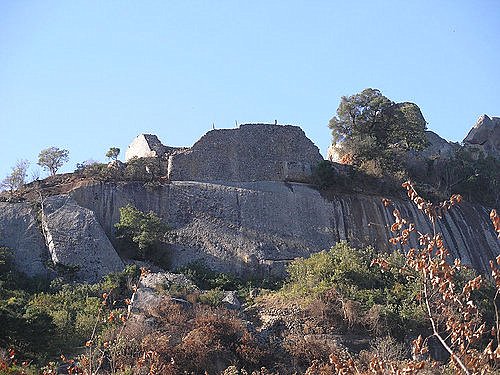
Great Zimbabwe is a ruined city in Zimbabwe (and in fact has given the modern country its name). Built over centuries beginning in the 9th century, the site was a center of power for the medieval Shona (or Kalanga) kingdom and part of the trade networks that spanned the Indian Ocean. It was abandoned in the 15th century and stands in ruins today, but even in its ruined state it is impressive.
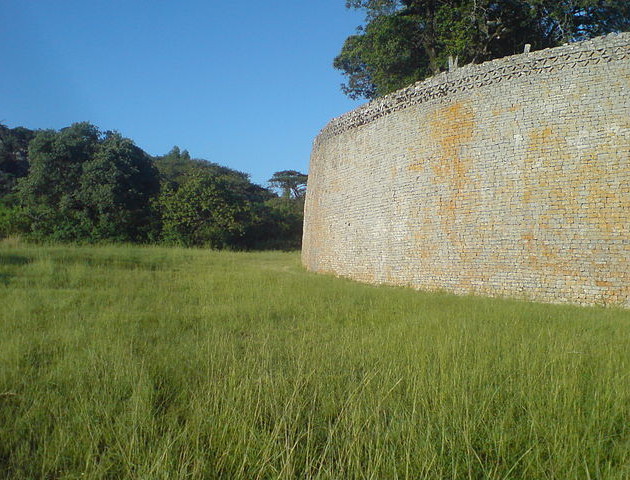
Wall of the great enclosure, photograph by Jens Klinzing via Wikimedia
The remains of numerous stone enclosures spread over hundreds of hectares. At its height, Great Zimbabwe may have housed between 15,000 and 20,000 people. The surviving walls reach heights of five meters and are built of stone blocks assembled without mortar. Several different complexes occupy different positions ranging from hills to near the river. The significance of these different complexes remains unclear, but it may indicate that the center of settlement gradually moved over time, away from the more defensible hill sites to the more accessible valley sites, perhaps to better engage with the oceanic trade networks. Ivory and gold were Great Zimbabwe’s major international exports and trade goods from the Arabian peninsula and China have been found at the site.
Interior walkway showing the quality of the stonework via Wikimedia
One noteworthy feature of the enclosures is their shape: neither rectangular nor circular but irregular curved shapes adapted to the forms of the landscape on which they sit.
In the colonial period, popular theories held that the site must have been built by ancient European or Asian colonizers. The biblical Queen of Sheba was often mentioned in connection with the site. Although archaeologists realized as early as the early twentieth century that Great Zimbabwe had been built by Africans, the colonial administration in what was then Rhodesia suppressed any such claim. The assertion that Africans were incapable of building such a complex site and needed European guidance to achieve any level of civilization was key to the justification of imperial domination. Colonial authorities could not tolerate any evidence that Africans were capable of creating sophisticated works of art and architecture on their own.
Part of the hill complex seen from the valley below, photograph by Macvivo via Wikimedia
Thoughts for writers
I have two reasons for sharing a little bit of Great Zimbabwe.
First, it is another example of architecture that does not depend on European examples. When doing our worldbuilding as writers, it is easy to fall back on the things that are familiar: European castles, Egyptian pyramids, Greek temples, and the other things we’ve seen before. Let yourself be inspired by the other amazing things people have built. I’d love to see a city inspired by Great Zimbabwe at its height turn up in a fantasy story, even one not set in an explicitly African-inspired world.
Second, this is another example of how politics can screw up good historical scholarship and so why you need to read broadly and get outside familiar frames of reference. Even today, while the Queen of Sheba is generally left out of it, claims that Great Zimbabwe was built by Arabs or Phoenicians still occasionally creep into popular histories.
History for Writers is a weekly feature which looks at how history can be a fiction writer’s most useful tool. From worldbuilding to dialogue, history helps you write. Check out the introduction to History for Writershere.
Sometimes writing fiction means not just moving a few characters around the map but planning entire campaigns for massive armies. In previous entries in the travel series we looked at some basic issues and how small groups travel on foot. For large groups on foot, much of what we discussed in those entries is relevant, but large groups of people, like armies or mass migrations, bring with them their own set of problems. Today we’ll look at some basic questions in the movement of large groups: How large is “large?” What did it take to make the journey successfully? How far could they travel? And how fast?
This post is written with a particular focus on armies, since they are the best-studied large groups that traveled in the pre-industrial world, but any sufficiently large group of people traveling by foot would face the same basic problems.
 No, this is not a post about how ladies and gentlemen of the nineteenth century recovered after too many pints of Guinness. Rather, it is about how nineteenth-century ideas about culture and identity have held on so tenaciously in popular history that even now, over a century later, we still have to struggle against them when trying to talk about peoples of the past. One of the subjects that often brings up these outdated ideas is “the Celts.”




 Co-Geeking
#/media/File:A_classical_dictionary_of_Greek_and_Roman_biography...revised.._(1894)_(14779978921).jpg)


