The Shannara Chronicles: The Delight of Bad Television

We’ve been watching The Shannara Chronicles. (We only watch series on DVD, so we’re still working our way through season 1). It’s some of the worst television I’ve seen in a while, and I can’t wait to see more.

161010shannara
One trailer park elf, one spoiled princess, and one edgy ex-bandit, coming right up. Image via IMDb.

Make no mistake, The Shannara Chronicles is terrible. The plot is a meandering soap opera mashed together from two parts Tolkien (a band of hobbits teenagers, occasionally aided by a grumpy wizard druid, must carry the magical ring seed to a distant place through a strange wilderness in order to save the world from a dark lord warlock who mostly just chills out in his tower henge being all evil and stuff) and one part Hunger Games (a tedious teenage love triangle between one girl half-elf boy and two boys girls—one rugged, the other sophisticated—in a vaguely-defined post-apocalyptic North America). Episode scripts are written Mad-Lib style: Dire warning about [peril] goes unheeded, recurring bandit guy threatens to [do something awful], someone explains [plot point] to the confused half-elf dude, princess has to be saved from [unheeded peril].

Yet despite its flaws, Shannara Chronicles manages the trick that most bad television doesn’t: to be both bad and enjoyable. More remarkably, it has managed this feat while remaining convinced of its own seriousness, instead of embracing its camp absurdity like most other beloved bad SFF shows, from Batman to Xena.

The scenery, the design, there are beautiful things under the layers of bad storytelling. Image via IMDb.
There are beautiful things under the layers of bad storytelling. Image via IMDb.

It’s hard to explain why I enjoy Shannara. Taste, of course, is subjective: one viewer’s guilty pleasure is another’s eye-roll marathon. I think there are three things about it that work for me:

  1. The diamonds among the dross. Shannara is a kiwi production and I watch it in much the same spirit that I watch Peter Jackson’s Hobbit movies: for the moments of beauty buried in the failings of concept and writing. The visual design is inventive and sometimes startling. Among the actors there are some shining stars like John Rhys Davies, Jed Brophy, and Manu Bennett improving the lackluster scripts with their performances. Plus New Zealand scenery is always worth seeing.
  2. We’re starved for good fantasy. I like classic fantasy. I like it better when it’s done well, but in the absence of that (or when showrunners think that doing fantasy well means adding as much torture, rape, and pointless death as possible), I’ll take it done badly. Plus, it’s refreshing to see a post-apocalyptic story in which the post-apocalypse is a quaint side note to the plot rather than a weight around its neck.
  3. The straight line is funnier than the joke. Comedy is well and good, but sometimes the best laughs come from people who don’t know they’re funny, and if the creators of Shannara know how funny they’re being, they aren’t letting on. I enjoy groaning at the teenage drama, the princess who has to be saved from something once an episode, the elite Elven soldiers who get themselves clobbered by bandits in under ten seconds, and the rest of the show even more when there isn’t a wisecracking sidekick poking me in the ribs and saying Hey, didja see what we did there? Huh? Huh?
Because this is totally how you dress to save the world. Image via IMDb.

In 2016, this terrible year in which some disasters hit with the shock of a thunderbolt and others drag on like a cold you can’t shake, the small-scale disaster of a wonderfully bad tv show is just what I need to take my mind off the rest of the world for a few hours.

In the Seen on Screen occasional feature, we discuss movies and television shows of interest.

Artifacts and Transmogrification: Guardian Druid and Holy Priest

Legion, the latest World of Warcraft expansion, has a new feature: artifacts. Instead of replacing your weapons with more powerful weapons as you level up, you get an artifact weapon that increases in power as you play. Artifacts put a new wrinkle in the transmogrification game.

(Quick primer for those of you not playing World of Warcraft: as you play the game, your character acquires new gear—weapons and armor—which make your character more effective. They also appear on your character’s model in the game. Transmogrification is a system that lets you change the appearance of your character’s gear so you can make your character look how you want.)

The artifacts all have brand-new, unique models and its clear that a lot of time and design effort went into them. In some cases, the results are beautiful. In other cases, not so much. Some are real works of art, but they may not fit your character’s aesthetic. I find I react very differently to artifacts on different characters.

My guardian druid, for example, doesn’t like her new fist weapons, not one little bit. On the left below is what her gear looks like in its natural state. Her artifacts are now transmogrified to a pair of colorful, jewel-like weapons and I’ve built the rest of her set around their colors.

160929druigua

My holy priest, on the other hand, loves his new staff. His previous set, on the left, was based on dusty reds and bronzes. With his new artifact staff on the right, he’s totally getting his blue on.

160929prihol

I’ve got lots more characters in different specs with different styles still to level up and get transmogged. I’ll drop some more pictures when I get there. Are you using the artifacts? Transmogging over them? Transmogging in response to them? Share your thoughts.

Of Dice and Dragons is an occasional feature about games and gaming.

Becoming Egyptian

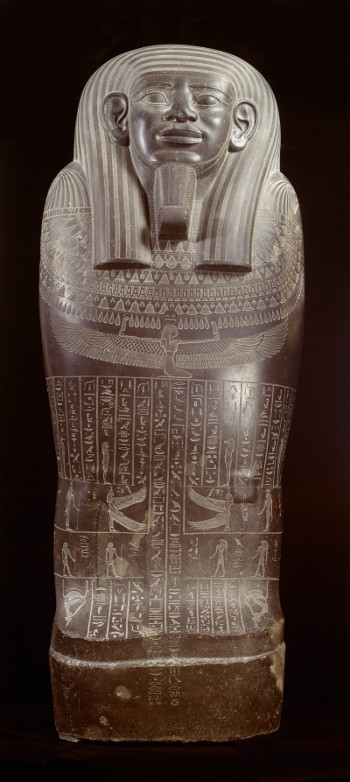
Sarcophagus of Wahibre-em-akhet, via Rijksmuseum van Oudheden (Egypt, possibly Giza, currently Rijksmuseum van Oudheden; basalt; 664-525 BCE)
Sarcophagus of Wahibre-em-akhet via Rijksmuseum van Oudheden (Egypt, possibly Giza, currently Rijksmuseum van Oudheden; basalt; 664-525 BCE)

The sarcophagus of Wahibre-em-akhet, from Egypt in the seventh or sixth centuries BCE, is a typical Egyptian sarcophagus, not for a king but for a man of wealth and status in Egypt’s Twenty-Sixth Dynasty. The Egyptian iconography is easily recognized: the long beard and braided wig of the portrait; the conventional Egyptian ways of depicting eyes, ears, and other features; the winged protective goddesses; the hieroglyphic text. There is nothing about this sarcophagus to suggest its owner was anything other than a native Egyptian, born and bred, from a people who had lived in the Nile valley since time immemorial. Nothing, that is, until you read the hieroglyphic text and find out that Wahibre-em-akhet’s parents were named Alexicles and Zenodote; both are Greek names.

We know nothing else about Wahibre-em-aket or his parents. We can’t say definitively where they came from, where they grew up, what language or languages they spoke, or how they identified themselves in daily life. It seems very likely, though, that we are looking at someone who was born to Greek parents but lived as an Egyptian.

Wahbire-em-akhet’s family probably had connections to Naukratis, a Greek city founded in Egypt with royal permission. The original settlers of Naukratis were Greek mercenaries who had served the Egyptian pharaohs in their war for freedom from the Assyrian empire. Alexicles may have been one of those mercenaries or the descendant of one. The mercenaries and their descendants continued to serve the kings of Egypt and seem to have gradually assimilated into Egyptian culture. One gang of soldiers left graffiti on the temple of Abu Simbel in upper Egypt while on campaign, including a soldier who identified himself as Psammatichus, son of Teocles, another Egyptian-named son of a man with a Greek name.

Whatever role he played, Wahibre-em-akhet must have done well for himself to afford such a fine sarcophagus. Like many other later-generation immigrant communities, the Greeks in Egypt probably found that assimilating to local customs, names, and languages was useful for getting ahead. They were not the first people to do so. We tend to think of Egypt as isolated, even xenophobic, but Egypt was also a powerful and wealthy kingdom that needed foreign trade connections and could afford to supplement its army with mercenaries from abroad. Greeks, Carians, Jews, Nubians, and Libyans are all well documented as traders and soldiers in Egypt. Many other peoples certainly found their way to the Nile valley as well. As they assimilated into the local culture, adopting Egyptian names and presenting themselves according to Egyptian traditions, these peoples become hard to discern in the archaeological record, but the occasional find like Wahibre-em-akhet’s sarcophagus reminds us that they were still there.

Thoughts for writers

Traditional histories have conditioned us to think of ancient cultures as discrete units: this is Greek, that is Egyptian, that over there is Persian, and the other thing in the corner is Etruscan. It’s useful to be reminded that the lived experience has always been more complicated. Wahbire-em-akhet was, in some ways, both Egyptian and Greek. Most likely his parents were, too. They must have faced many of the same challenges and intersections that immigrant families still face today.

People like Wahbire-em-aket and his parents existed in history. They belong in our stories, too. There is nothing new about multiculturalism.

History for Writers looks at how history can be a fiction writer’s most useful tool. From worldbuilding to dialogue, history helps you write. Check out the introduction to History for Writers here.

Putting Trigger Warnings on my Syllabi

160303booksThe question of whether we, as professors, should include trigger warnings on our course syllabi has been bubbling in academia for a few years now. I’ve been uncertain what to do and my university’s administration has not taken a public position. After wide reading and long thought, I’ve decided to add a content note to my syllabi. Here is how it goes:

This course involves topics that may evoke strong reactions. These topics include war, violence, slave-holding societies, non-consensual sexual activity, and various forms of social inequality, but other topics may come up in the course of class discussion. I will do my best to inform you about what upcoming readings will cover, but it will not always be possible to predict what topics will arise in discussion or what associations may arise for you as you read.

It is your responsibility as a student to complete all assigned coursework and readings and to participate in class discussions. It is my responsibility as your professor to help you overcome any obstacles to doing so.

If you anticipate that some topic may be difficult for you, or if you discover that an assignment provokes a reaction that prevents you from continuing your work as a student, please come see me to discuss it. If a topic arises in class discussion that makes you too uncomfortable to remain in class, you are welcome to leave the room until you feel ready to return. If you need to leave the room during class discussion, please come and see me afterwards when you feel ready to do so. In either case, we will work together to find alternative ways for you to do the coursework.

You are also welcome to seek support and guidance outside of class. Student Counseling Services is at your disposal, as is Campus Spiritual Life. You do not have to discuss difficult emotional subjects with me if you do not wish to, but if I don’t know that something is creating an obstacle to your coursework, I can’t help you find a way around it.

Continue reading

Making The Courtesy of the Golden Hall

Here’s a look at how we made yesterdays The Courtesy of the Golden Hall.

The menu

  • Rye porridge
  • Braised beef
  • Roasted vegetables
  • Saffron and cream pancake
  • Apple compote

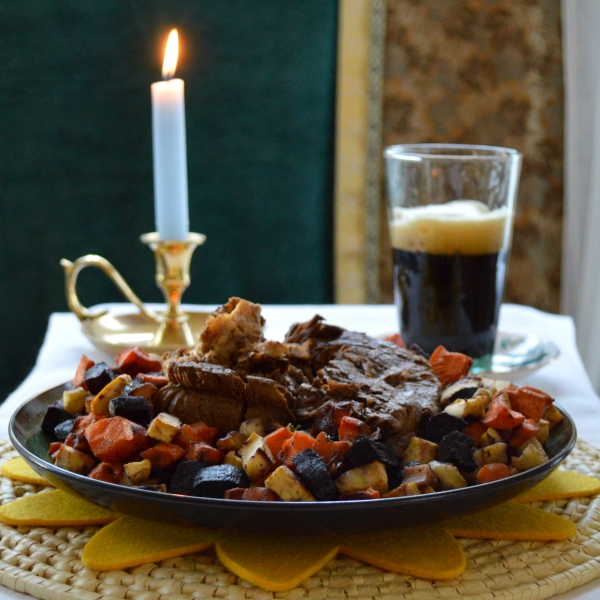
erikchef1Tolkien gives us only a few hints about the food of Rohan, but they are enough for us to flesh out the picture.

Dinner9 Main2

There are several references to meal, in the sense of coarsely ground flour. Éomer mocks Wormtongue by questioning whether anyone would trust him with a sack of meal (3.6) and Théoden warns the herald of Minas Tirith to have supplies ready for the Rohirrim when they ride to Gondor’s aid, for to travel light and fast they can carry only meal and water enough to last until they reach the battlefield. (5.3) Coarse flour makes poor bread and, significantly, bread is never mentioned in Rohan. Every other people in Middle Earth, from Hobbits to Orcs, has some kind of bread, but not the Rohirrim, which suggests they are making something else with their grain: porridge. Porridge is a staple of many northern European cultures like those that inspired the Rohirrim. The deep, earthy flavors of rye make for a very satisfying porridge to start our dinner.

The herds of Rohan are prominently mentioned, although what exactly they are herds of is never specified. (2.9, 3.2) Since cattle were highly prized across ancient northern Europe, beef seems like the right meat to serve at the royal table. Braising is an excellent way to cook large joints of meat and could be done in a cauldron over a low fire in a mead hall. Root vegetables are also a staple of northern European cuisines and make an good accompaniment to braised beef.

The saffron and cream pancake recipe comes from a Viking source and shows the extent of the trading networks the Vikings were engaged in, connecting them with the distant shores of the Mediterranean where saffron was harvested. It seems an appropriate way to honor the friendship between Rohan and Gondor to suggest that the Rohirrim had access to a few southern luxuries as well. The apple compote we serve with it is based on Anglo-Saxon recipes.

Continue reading

Shadows of Star Wars

A puppetry troupe in Malaysia has been working to revive interest in the local traditional shadow puppet theatre, called wayang kulit, by performing a version of Star Wars using classical techniques of puppet-building, storytelling, and presentation. The performance, called Perperangan Bintang, retells the beginning of A New Hope, fusing elements from the movie with elements from the wayang kulit repertoire, which also revolves around tales of a young hero who must free a princess from an evil warlord. Here Sangkala Vedah confronts Puteri Leia.

Sangkala Vedah and Puteri Leia, via The Star

And here are two more characters you might know.

Si P-long and Ah Tuh, via Pinterest
Si P-long and Ah Tuh via Pinterest

Here’s a video about the performance. Skip to 3:45 to see a familiar character make an entrance in style.

PBWK (Peperangan Bintang Wayang Kulit) preview- 18th Oct 2013 via ActionTintoy-Tintoy Chuo

It’s great to see how a modern story can be interpreted through traditional arts.

Hey, look! We found a thing on the internet! We thought it was cool, and wanted to share it with you.

No Time for Conditioner When You’ve Got Rebels to Fight

The Greek military writer Polyaenus recounts this story about the Parthian princess Rhodogune:160901Shirin

Rhodogune was bathing and beginning to wash her hair. A messenger came to report that a subject nation was in revolt. Without washing out her hair but just tying it up as it was, she mounted her horse, led out the army, and swore an oath that she would not wash her hair until she had put down the rebellion, and indeed, after long fighting, she triumphed. After her victory, she bathed and washed out her hair.

– Polyaenus, Stratgems 8.27

So, the next time you’re having a bad hair day or just can’t be bothered to do anything but tie it back, you can tell the world you’ve got rebels to fight and the hair can wait.

Image: Shirin bathing (not Rhodogune, sorry) via Wikimedia (c 1480; ink on parchment)

Serving exactly what it sounds like, the Quotes feature excerpts other people’s thoughts.

Catch!

War can be a nasty business. It’s no wonder soldiers sometimes enjoy a bit of cheeky humor. This ancient Greek sling bullet was cast with the word DEXAI on it, meaning “Catch!” or “Take that!”

Sling bullet, photograph © Trustees of the British Museum via The British Museum (Athens; 4th c. BCE; lead)

It’s in much the same spirit as these American soldiers in World War II offering “Easter eggs” for Adolf Hitler.

Easter eggs for Hitler, US National Archives via Wikimedia

Some things just don’t change.

History for Writers is a weekly feature which looks at how history can be a fiction writer’s most useful tool. From worldbuilding to dialogue, history helps you write. Check out the introduction to History for Writers here.

History, Disability, Inclusion

160822CaludiusThe Roman emperor Claudius walked with a limp, spoke a with a stutter, and sometimes experienced sudden and uncontrollable movements of his body. These effects were moderate when he was calm but became more pronounced when he was agitated. Claudius’ symptoms are well documented and modern scholars have suggested various diagnoses. Polio was at one time the preferred explanation but has fallen out of favor. More recent suggestions are cerebral palsy and Tourette syndrome.

If he lived today, Claudius could be diagnosed and receive appropriate treatment or accommodation. The systems we have now to describe various disabilities helps us to recognize an individual’s particular set of symptoms as part of an identifiable condition or disease. Knowing what to call things, where they come from, and how to treat or accommodate them makes a difference to how we handle individual cases. In antiquity, all anyone knew was that Claudius behaved strangely in ways that no one could explain.

Lack of labels and explanations does not mean that people did not live with all the same things we live with today. Some are obvious. Romans may not have been able to explain why Claudius’ distant relative, the censor Appius Claudius Caecus, went blind, but there was no doubt about the state of his vision. Other conditions are less obvious, but no less real.

We have only very recently learned to recognize the chronic traumatic encephalopathy experienced by sports players who receive repeated trauma to the head, for example, but brains are not more vulnerable now than they were in past centuries. For most of the past several thousand years, war has meant large numbers of people repeatedly hitting each other in the head, with or without helmets. CTE and the changes in behavior that go with it must have been part of the experience of pre-modern warriors, whether they knew how to identify it or not.

Post-traumatic stress disorder is also a modern diagnosis, but people have always experienced traumatic stresses, not just in warfare but from violence within families and between individuals, sexual assault, and life-threatening accidents. In any population that has experienced such stress, some individuals will experience aftereffects, whether they have a name for them or not.

Similarly, we have only recently (in historical terms) learned to diagnose autism and related conditions, but people have lived with them throughout human history. The same can be said of Alzheimer’s disease. Many people who are described in historical sources as “simple-minded,” “senile,” etc. may have been living with one of these conditions.

Even when people couldn’t name or explain the disabilities and conditions they lived with, their experiences of life could be profoundly shaped by them. Claudius’ family considered him an embarrassment and kept him out of public view. He himself reportedly exaggerated his symptoms and avoided the public sphere when he was a young man to keep himself from seeming like a threat to the rest of the dynasty, which may have helped him survive the murderous palace intrigues of the early empire. When he unexpectedly became emperor after the assassination of Caligula, though, his lack of experience in public business made his claim to the title precarious. To improve his reputation, he initiated the Roman conquest of Britain. Claudius’ condition, whatever it was, ended up affecting the lives of thousands of people.

Thoughts for writers

Historians and writers of speculative fiction are in a similar position: we spend our time thinking about a world in terms that the people living in it would not, perhaps even could not, think of themselves. No historian can suppose that Romans simply didn’t experience post-traumatic stress disorder because they didn’t have a word for it. Writers have a similar responsibility.

Of course, in speculative fiction, anything is possible. We can imagine worlds with magic, or warp drive, or both. We can imagine worlds without gender, without water, without music. All of these are valid artistic choices, but we have to recognize them as choices and take seriously the causes and consequences of those choices.

It’s entirely plausible to construct a fictional world in which people don’t have a word for autism or don’t recognize cerebral palsy as a physical condition, but those conditions exist and affect people whether their culture acknowledges them or not. An ancient Roman could not have explained the laws of gravity, but things still fell down. To create a fictional world in which such conditions simply do not exist is a choice. If we make that choice as writers, we owe it as much serious thought as if we created a world without gravity. Creating a world in which people do not understand disabilities is no excuse for creating a world in which no one experiences a disability.

(Author’s note: I have tried, to the best of my understanding, to use the current accepted terminology to refer to the various symptoms, conditions, and disabilities I have mentioned in this post, but if I have made any mistakes, I welcome corrections in the comments and will update the post accordingly.)

Image: Portrait head of Claudius, photograph by Cnyborg via Wikimedia (currently Ny Carlsberg Glyptotek, Copenhagen; 1st c. CE; marble)

History for Writers is a weekly feature which looks at how history can be a fiction writer’s most useful tool. From worldbuilding to dialogue, history helps you write. Check out the introduction to History for Writers here.

Making Rangers’ Rations

Here’s a look at how we made yesterday’s Rangers’ Rations.

The menu

  • Ham
  • Fruit sauce
  • Cucumber salad
  • Bread
  • Butter
  • Cheese
  • White wine

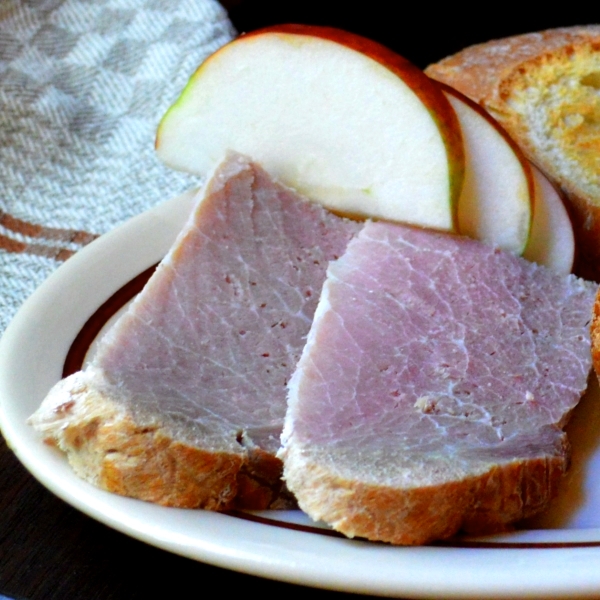
erikchef1Like the Hobbits’ dinner at the Prancing Pony in Bree, we get a pretty clear description of what the rangers of Gondor eat at their camp in Ithilien and it all makes a lot of sense for people who are stuck out in the wild away from supply lines living off rations. Ham, dried fruit, butter, and cheese are all preserved foods that keep well long-term. (4.5) Not all breads keep well, but there are many kinds that do. I’ve stuck to this description with a couple of adjustments.

First, I added a cucumber salad for the sake of some more vegetables. This particular salad uses vinegar and salt, not unlike a pickling brine. While this salad wouldn’t last as long as a proper pickle, the brine does help it keep a little longer.

Second, I made a softer bread rather than the hardtack Faramir’s troops would probably have had for their regular rations. Since Ithilien has olive trees and other characteristically Mediterranean vegetation, I’ve used a basic Mediterranean-style dough that can be baked in many different ways. (4.4)

Dinner8 Ithilien Pared Down

The thinking behind these adjustments (other than I wanted a vegetable and didn’t feel like making hardtack again) is that Faramir broke out the good stuff for his honored guests. (Remember we’re going by the novel here, not the Peter Jackson movies—which were mostly great but turned Faramir into a total jerk.) Cucumbers and soft fresh bread may not be much of a luxury to most of us, but for weary travelers they could be a welcome change from waybread and forage.

Continue reading