bearing his bright cheeks and walking by the right hand of Isis.
…
You boast how you provide for the people,
how day and night and all the seasons revere you
and call you kin, Breith and Mandulis,
stars, emblems of the gods rising in heaven.
– Paccius Maximus
(My own translation)
These lines come from a poem written by a Roman soldier named Paccius Maximus and painted on the wall of the temple to Mandulis at Kalabsha, in modern Sudan. We know very little about Paccius besides what he tells us in this and one other poem, but based on some clues he is believed to have been a local African officer in the late Roman army.
Mandulis, often associated with his twin brother Breith, was a Nubian sun god. It’s interesting to note how Paccius readily connected Mandulis with both the Olympian gods and the Egyptian goddess Isis, easily harmonizing Greco-Roman, Egyptian, and Nubian religious traditions. His poem gives us a glimpse at how culturally complex and interconnected the world of the Roman empire was.
But, as fascinating as Paccius’ poem is, it’s on my mind today for a different reason.
It snowed here last night. Again. That’s the fifth snowstorm we’ve had this March.
You see this stuff? You see it? I’m sick of it. I like winter just fine, but it’s time for this winter to be over.
Mandulis, wherever you are, we could really use you and your bright cheeks right now. Any time you want to come start providing for us people here, buddy. Any time. I’ll be waiting.
It sounds like a simple question that ought to have a straightforward answer, but both the question and its answer are far more complicated than they appear. In these posts, I dig into the topic to explore what we know, what we don’t know, and what we mean by race in the ancient Mediterranean world.
Part 4: Skin Color in Art
In the previous post, we looked at how Greeks and Romans wrote about skin color. Today we look at how they represented it in art.
In looking at how ancient artists handled skin color, we have to begin by recognizing that not all ancient artworks have come down to us intact or preserving their original colors. We must especially shake off the association of ancient art with gleaming white marble. Marble was favored for sculpture in the ancient Mediterranean because the stone is slightly translucent and it reacts to light in a way similar to human skin, but marble statues were not usually left white. They were painted, often in bright colors which have faded or disappeared entirely after thousands of years of exposure. To get a more accurate sense of how ancient artists represented skin color, we have to choose our sources carefully and look for types of artwork that hold color better over time or that have been protected from exposure.
Although people of the ancient Mediterranean were aware that human skin tones could vary widely, they did not attach the same meaning to this variation that we tend to today. Since skin color was not a primary way of marking ethnic identity, artists could use it to convey other meanings, or simply for decorative effect.
It was a widespread custom in the ancient Mediterranean to use skin color as an indicator of gender. Men were often portrayed with dark reddish-brown skin, women with pale yellow-white skin. This artistic convention reflects a conventional ideology in which the socially acceptable activities for men were agriculture and war, outdoor occupations which exposed them to the sun. Women were similarly expected to stay indoors, working in the home and preserving their pale skin. For a man to be pale suggested that he worked indoors at trades that, though necessary for society, were less prestigious. Similarly, for a woman to appear dark-skinned suggested that she had to work outside the home, implying that her household was not rich enough to be self-sustaining. When patrons directed artists to depict them with conventional skin colors, they were responding to the social pressure to look their best. We cannot assume that artworks like these represent the actual appearance of their subjects.
Funerary statues of Rahotep and Nofret via Wikimedia (Egyptian Museum, Cairo; c. 2500 BCE; painted limestone)Portrait of a couple from Pompeii via Wikimedia (Pompeii, currently Museo Archeologico Nazionale di Napoli; 1st c. CE; fresco)
Skin color could also be used to indicate other features of identity. Darker skin, for instance, was associated with age, lighter skin with youth. Children were often depicted with light-colored skin, regardless of gender. In this portrait of the family of the Roman Emperor Septimius Severus, Septimius’ skin is distinctly darker than his wife Julia Domna’s, but their son Caracalla’s skin is even a little paler than his mother’s. (Their other son Geta’s face was obliterated in antiquity after Caracalla became emperor and assassinated his brother).
Portrait of Septimius Severus and family, photograph by José Luiz Bernardes Ribeiro via Wikimedia (currently Altes Museum, Berlin; c. 200 CE; painted panel)
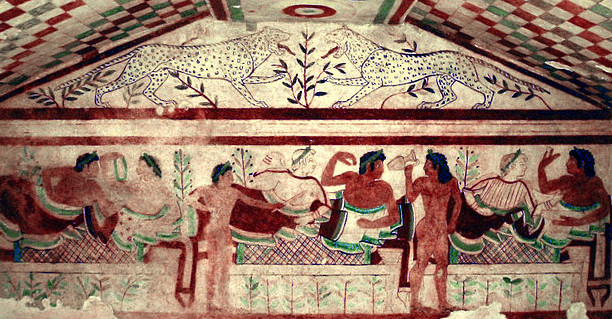
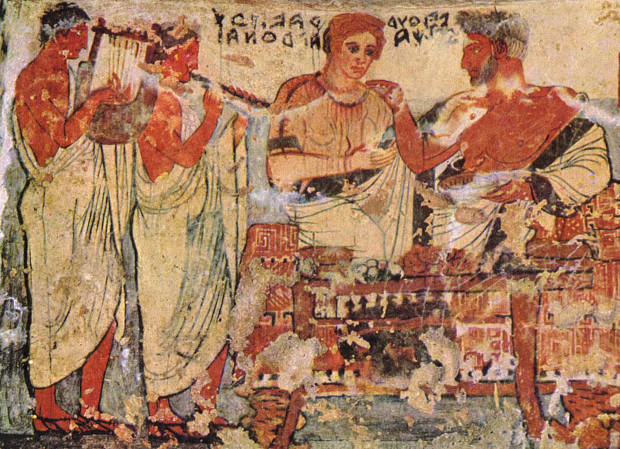
The degree to which skin color was emphasized as a feature in art also varied between cultures and across time. These two examples of Etruscan tomb art from Tarquinia show how much variation there could be even within the same community. While both follow the dark men / light women pattern (gender is also marked by differences in clothing, hair style, and activity) one makes the distinction very stark and schematic while the other is much more subtle.
Banquet scene from the Tomb of the Leopards, photograph by AlMare via Wikimedia (Tarquinia; 480-450 BCE; fresco)Banquet scene from the Tomb of the Shields via classconnection (Tarquinia; c. 340 BCE; fresco)
In many cases, the skin color of human figures in ancient art is dictated by the choice of medium more than by a desire to convey any message. The two sides of this vase, for instance, present similar scenes, the hero Heracles at a feast, in opposite color schemes.
“Bilingual” vase, composite of photographs viaWikimedia (Vulci, currently Staatliche Antikensammlung, Berlin; 520-510 BCE; pottery; believed to be by Andokides Painter)
This statue of the Tetrarchs, four emperors who governed the Roman Empire in a short-lived experiment in joint rule, is carved out of porphyry, a very hard stone with a dark purple hue. This stone was chosen for several reasons, partly because of the traditional association of purple with imperial power and partly because the dense, hard stone suggested the strength of the institution the joint rulers were trying to create. A realistic depiction of skin tone was not a priority.
Tetrarchs statue, photograph by Nino Barbieri via Wikimedia (currently St. Mark’s Square, Venice; early 4th c. CE; porphyry)
When depicting beings beyond the human realm, skin color could carry many other meanings. The Egyptian god of the dead, Osiris, was traditionally depicted with green skin, symbolic of regrowth and new life. In these wall paintings, the green-skinned Osiris appears in two different scenes in the company of other gods.
Wall paintings from the tomb of Horemheb, photograph be Jean-Pierre Dalbéra via Wikimedia (Valley of the Kings; c. 1292 BCE; fresco)
Similarly, the Etruscan god Charu, who was responsible for guiding the souls of the dead into the afterlife, was typically shown with blue skin, representing decaying flesh.
Charu from the François Tomb, detail of photograph via Wikimedia (Vulci; c. 330 BCE; fresco)
Sometimes ancient artists used skin color to indicate ethnicity in ways that are easy for us to recognize, such as this vase representing two women’s faces. The light-skinned woman’s features, such as her pointed nose, thin lips, and wavy hair, suggest that she is meant to be of European descent while the black-skinned woman has features characteristic of a sub-Saharan African origin, such as a flat nose, fuller lips, and tightly coiled hair.
Janiform aryballos, photograph by Jastrow via Wikimedia (from Greece, currently Louvre; 520-510 BCE; pottery)
In other cases, we cannot be entirely sure what the skin color in ancient art is meant to convey. This fresco from Minoan Knossos depicts bull leapers in distinctly different skin tones, but it is difficult to be sure what significance, if any, that difference has. It may be meant to show differences in gender, although the figures’ similar proportions, clothing, and hair do not confirm it. It might be intended to indicate people of different ethnic origins. Alternatively, it could be simply for aesthetic variation. We do not know enough about Minoan culture and its conventions for representing ethnicity, gender, and other identities in art to be certain.
Bull leaping fresco (restored), photograph by Nikater via Wikimedia (Knossos; 1550-1450 BCE; fresco)
As with literary descriptions of skin color, we have to approach ancient artistic representations with a cautious awareness of how far removed we are from the cultures that created them. The artists who made these images and the patrons who commissioned them did not share many of our basic assumptions about what skin color means and how it should be represented. Their cultural context was unlike ours and they created their works to communicate with other people of their place and time, not to send time capsules to us millennia later. It is not enough for us to stroll through museums or flip through the pages of art books looking for faces that look the way we think people of different ethnic origins ought to look.
Ancient art is not a representative snapshot of ancient demographics. Art represents what people consider important, not necessarily the reality of the world they live in. In a world in which privilege, power, and identity were not wrapped up with race in the same way they are today, the representation of race in art was much less of a priority. Just because ancient artists, like ancient writers, often chose not to depict skin color as a defining mark of ethnic identity does not mean that they did not live surrounded by people of all different hues with ancestries spanning the globe. As with how we read literature, we have to learn to read ancient art in new ways if we are to make sense of it as evidence for the diversity of ancient Mediterranean societies.
History for Writers is a weekly feature which looks at how history can be a fiction writer’s most useful tool. From worldbuilding to dialogue, history helps you write. Check out the introduction to History for Writershere.
In between seasons 4 and 5 of new-series Doctor Who there is a series of specials starring David Tennant, but our copy of the discs turned out to be defective, so while we wait for a good opportunity to replace them, our rewatching and rating project carries on to season 5.
“The Eleventh Hour” – 3
“The Beast Below” – 3
“Victory of the Daleks” – 4
“The Time of the Angels” – 6
“Flesh and Stone” – 1.5
“The Vampires of Venice” – 2
“Amy’s Choice” – 2
“The Hungry Earth” – 5
“Cold Blood” – 2
“Vincent and the Doctor” – 5
“The Lodger” – 4
“The Pandorica Opens” – 5
“The Big Bang” – 6
The average rating for this season is a rather dismal 3.7, a big come-down from season 4’s 6.9. Nothing rises above a ho-hum 6, and almost half the episodes this season rate less than a 4, which is pretty much our minimal cut-off for ever wanting to see an episode again.
This season of Doctor Who poses one big question, and that question is: what on Earth happened to Stephen Moffat?? Many of our favorite episodes of previous season were written by Moffat: “The Empty Child” / “The Doctor Dances” in season 1, “The Girl in the Fireplace” in season 2, “Blink” in season 3, “Silence in the Library” / “The Forest of the Dead” in season 4. All these episodes were intricately-constructed masterpieces in which every piece fit, every tantalizing question had a satisfying answer, and the gee-whizery of the sci-fi was balanced with sensitive emotional stories. We had great expectations for Moffat’s first season a showrunner, and instead we got… this? The writing is clunky, the plots are full of janky bits that don’t fit, the characters are unpleasant, and the whimsy feels forced. We wonder whether the demands of production didn’t leave him time to develop his scripts more fully, or if perhaps the quality of his earlier scripts depended in part on good editing by the previous production team.
The new cast doesn’t improve matters. We don’t care for Matt Smith’s interpretation of the Doctor, which relies too much on surface wackiness and feels emotionally hollow. But even worse is the new companion, Amy Pond, played by Karen Gillan. All credit to Ms. Gillan for her acting, but the character is written as a whiny, self-centered bully. Both of these characters reflect an unappealing turn in Moffat’s writing, also visible in his series Sherlock: the belief that if a person is very clever or otherwise special, they get a pass on basic human decency. That’s a position we can’t get behind.
The lowest-rated episode of this season is “Flesh and Stone,” at 1.5. It’s the second part after the rather decent “The Time of the Angels,” following the Doctor’s adventures with a band of futuristic warrior priests in an underground labyrinth filled with Weeping Angels. The first episode give us a reasonably good set-up which the second just fails to pay off. The momentum built up in the first part sputters out as the second part pays its dues to the season-long “crack in the universe” arc. The Weeping Angels were one of Moffat’s most interesting creations in “Blink,” but they would have been better left alone than recycled for this episode.
The best episodes, both at 6, are “The Time of the Angels” and “The Big Bang.” “The Big Bang” does a better job of delivering the old Moffat magic with a complicated time-woven story about the Doctor and his friends racing to stop the end of the universe that was set off in the previous episode. It has some good moments and finally gives Amy’s Stockholm Syndrome victim boyfriend Rory something to do, but it never quite rises to its potential.
All in all, a real let-down of a season for us, but we know there are other folks out there who feel differently, including fans of Amy Pond and Matt Smith’s Doctor. What episodes this season did you love (or not)? Let us know in the comments!
An official from a Western superpower arrives in a rich and powerful African kingdom and offers his respect and support to a royal woman. It may sound like Everett Ross from Black Panther, but it’s actually two millennia older:
Good fortune to the Lady Queen, may she live happily for many years. Acutus came from the city and [saw the place (?)] on the 15th of April.
(My own translation)
This inscription, the southernmost Latin inscription yet discovered, comes from Musawwarat es-Suffra in modern-day Sudan, which in antiquity was part of the kingdom of Kush. Kush, often called Meroë by Greek and Roman authors after its capital city, was a powerful state on the central Nile river. After the Roman conquest of Egypt in 30 BCE, the Roman Empire and Kush fought a brief border war, but the Kushan Queen Amanirenas soon made a peace treaty with Rome that was respected by both sides for centuries to come. (Greco-Roman authors mistakenly call Amanirenas “Candance,” which is not a name but a Kushan title for a royal woman.)
This inscription, which is in rather poor condition and cannot be read fully, probably dates to sometime in the third century CE. The Acutus who dedicated it was most likely a Roman envoy (“the city” being Rome) who had come to Kush on diplomatic business. His effusive good wishes to another (unnamed) ruling queen were in keeping with how Roman ambassadors demonstrated respect for foreign rulers. This inscription shows that Rome regarded its relationship with Meroë as worth maintaining with proper diplomatic dignity. Kush profited handsomely from facilitating trade between the Roman Mediterranean and both sub-Saharan Africa and the Indian Ocean, and had every reason to encourage ongoing good relations.
The history of interactions between Europeans and Africans is filled with bloodshed and inhumanity. It is understandable how appealing Black Panther‘s fantasy of an isolated African state untouched by European invasion or interference is to many fans. But it is also worth remembering that isolation is not the only option, and history also contains examples of European-African contacts that were peaceful and respectful.
Image: CIL III 83 via Adam Łajtar and Jacques van der Vliet, “Rome-Meroe-Berlin. The Southernmost Latin Inscription Rediscovered (“CIL” III 83),” Zeitschrift für Papyrologie und Epigraphik, 157 (2006), 193-198.
Serving exactly what it sounds like, the Quotes feature excerpts other people’s thoughts.
In no particular order. Spoiler warnings in effect.
Erik’s random thoughts:
This is the movie that Thor was trying to be: a Shakespearean family drama about an exiled hero coming to terms with the destiny of his people and his father’s failures in the midst of a gorgeous futuristic city-state. (On a side note: does anyone actually remember the original Thor movie or have we collectively agreed that the franchise starts with number 3?)
I love the architecture of Wakanda. It looks like the product of thousands of years of African tradition with the highest of modern technology, just as it should.
Even for a fantasy of African exceptionalism, the story does not shy away from the bitter real history of imperialism, exploitation, slavery, and its modern-day consequences, and the movie is richer and stronger for it.
Shuri is awesome. Her combination of flippancy in the face of tradition, passion for technological tinkering, and powerful love for her family and home make her a delight to watch. I think she’s my favorite character in the whole movie, and that’s not an easy pick in this one.
Could we have T’Challa and Shuri take over the Tony Stark role in the Marvel Universe, please? I appreciate what Iron Man did to kickstart the MCU and hold the early installments together, but I’ve had enough of him now. I honestly don’t think I can handle onemoremovieaboutTony Stark’semotional issues. T’Challa can be the guy in the super suit who cracks wise while leading the fight and Shuri can be the tinkerer who keeps upgrading everybody’s gear.
Even in a franchise that includes a movie about waking up one morning to discover that literal Nazis have taken over the US government, Black Panther feels like the movie we most need in 2018: a meditation on the temptations of division, resentment, and revenge and the hard choice of embracing a flawed and fractured world with hope. As crucially as Black Panther contributes to the representation of black people in genre media—and by Bast it does—it has a lot to say outside the dialogue of race as well.
For the record: as a white man, I have no problem whatsoever identifying with the characters of this movie. I’m not talking about Martin Freeman’s Everett Ross, either—Zuri is my guy.
Eppu’s random thoughts:
Note: These thoughts are based on one viewing. I’m fully aware that some of them are just scratching the surface and that I need to see the move (at least!) a second time and mull things over properly.
If I had to use one word to describe Black Panther, on a meta level it would be confelicity: I am so, so, SO glad for those black people who are exited, overjoyed, and exhilarated over seeing a full cast of people that look like them acting with grace and agency, not minimized but celebrated! On a story level, I’d use equality.
I knew from reading non-spoiler reviews beforehand that the movie passes the Bechdel test, so I didn’t even bother tracking it. It was very nice not to have to care.
If it was nice not to have to care about whether the Bechdel test passes or not, it was outright GLORIOUS to see that WOMEN ARE PEOPLE in their own right, with their own interior lives, not just breasts and posteriors for men to ogle. And such a spread of different women, too, each doing their thing according to their interests and skills. Because that’s who we are, and what we do, and have done for millenia, and it’s damn time that the self-absorbed, able-bodied, white cis hetero men in Hollywood respected that. (Yes, I know that the Black Panther team behind the camera included many, many people of color, including women, but that’s not the default, is it.)
And of course it’s not just that women are people in their own right, but that there are so many diverse black women. Have you any idea what a disservice (to put it mildly) your typical Anglo-American fiction does to women of color, especially black women? I didn’t until I started paying attention. It’s atrocious and shameful.
Black Panther was visually beautiful. Beautiful! It was so beautiful my brain experienced a moment of “this looks wrong” when stepping out of the movie theater into the dim and snowless February evening in Massachusetts.
Also, the sets and costumes were breathtaking just like I thought. Everything looked like it was produced by a living culture, with layers of history and development alike.
OMG, the tech. Those dragonfly helicopters! Attack rhinos! I kinda want those 3d phone calls! No—scratch that. The maglev trains and über-advanced health care. Like now.
The opening sequence (T’Chaka voiceover telling a story to young T’Challa) and the end credit visuals I thought nodded back to the superhero fight statue end credits for Avengers: Age of Ultron. Yet neither ever lost sight of the fact that they were for and about Black Panther.
A superhero movie with a male lead confident and mature enough to listen to others ROCKS! (Hat tip to Justina Ireland for pointing out T’Challa’s ability to listen as a core personality trait.)
I liked Martin Freeman’s character Everett Ross in this movie. He started with “I know what I’m doing, piss off little people” claptrap. In Wakanda, however, he quickly—and without too much whining—realized how out of his depth he was and spent a good while looking and listening and learning. In the final battle, he redeemed himself to some extent in my eyes when he hopped back into the fighter jet holo-interface to destoy the final cargo plane after he’d discovered that the base he was sitting in was under attack and that there was less than a minute before the gunfire broke through. And never, ever was he written or played as a Mighty Whitey.
It was also good to see a thoroughly accomplished man (T’Challa) grapple with impostor syndrome (not ready to be King). We don’t see or hear much of that; mostly it’s women who are saddled with it in the public discussion.
I liked T’Challa’s relationship with the rest of his family members, but I LOVED every moment between him and Princess Shuri. They so clearly love and respect each other as equals—with different skill sets, sure, but equals nevertheless—plus jostle around like real-life siblings.
Finally, all of the acting was so good. I won’t miss Andy Serkis’s character. At. All! Props to Serkis, his incredible performance made the dude truly terrifying and disgusting, but I’d rather watch the competent and kind Africans, thank you.
Imagining the mundane details of daily life in past cultures can be difficult. Everyday things like houses, clothing, and daily routines tend not to be well-represented in textual or archaeological sources because they were so ordinary that no one thought to write about them or take care to preserve them. Yet these are exactly the sorts of everyday details that can be most useful when looking to the past for inspiration for worldbuilding. To try to understand what daily life looked like in the past, we often rely on chance finds and careful reading of sources that weren’t intended as guides to the mundane.
For example, we have only a limited idea of what an ancient Minoan house may have looked like. The Minoan civilization flourished on Crete and some of the southern islands of the Aegean Sea in the first half of the second millennium BCE, at its height between roughly 2100 and 1400 BCE. Minoan palaces have been thoroughly excavated at sites such as Knossos and Phaistos, but what about the homes of ordinary people?
We have a few valuable sources of evidence. One is this pottery house model found at Archanes, on Crete. This model shows many features that must have been part of everyday Minoan architecture: solid lower-story walls and a breezy columned upper story, windows barred with slats, a projecting balcony, and perhaps a small walled garden. (The entry door is on the other side of the model; the upper story is modern reconstruction.)
House model, photograph by Zde via Wikimedia (Archanes, currently Archaeological Museum, Heraklion; c. 1700 BCE; pottery)
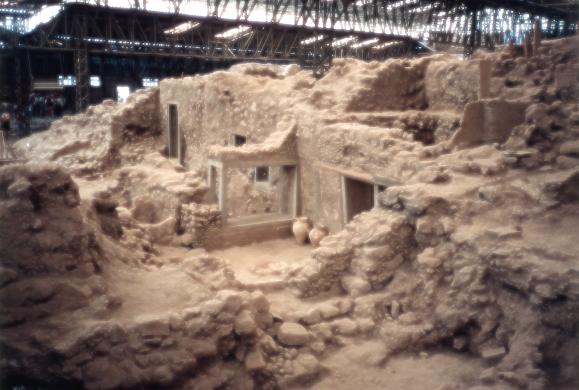
To get a sense of how houses like this fit together to make up a village, we can look to the site of Akrotiri, a Minoan settlement on the island of Thera (now called Santorini) that was buried in a volcanic eruption sometime around the late 1600s BCE. Despite the destructive effects of the eruption, excavation at the site has found a tightly-built settlement of multi-story houses connected by streets and drainage channels.
Photograph of Akrotiri excavation by F. Eveleens via Wikimedia
More evidence comes from a fresco that was preserved on the wall of a house at Akrotiri, depicting a panoramic view of the island. This segment shows the town. While the image is a little hard to interpret, we can clearly see a densely-built settlement with houses made of regularly cut stone sitting on many levels. These houses display many of the same features as the Archanes house: low doorways, porticoed porches, windows covered by slats, and people looking out from balconies or rooftops.
Akrotiri fresco, photograph by Dirk Herdemerten via Wikimedia (Akrotiri; c. 1700 BCE; fresco)
When we put all these different sources together, we can begin to imagine everyday life in a Minoan house: the shady lower floor and the breezy upper floor, the slivers of sunlight coming in through the window grilles, the gurgle of water running by in the drain channel right outside, and the endless chatter of the neighbors on their overhanging balcony. For creating any sort of pre-modern culture in a warm, dry setting like the Mediterranean, it’s not a bad start.
History for Writers is a weekly feature which looks at how history can be a fiction writer’s most useful tool. From worldbuilding to dialogue, history helps you write. Check out the introduction to History for Writershere.
There are some things that we can all pretty much agree are part of a good story, whether on the page or on the screen: compelling characters, an interesting setting, a well-crafted plot. These things are basic to most great stories. But then we have our own individual tastes, the particular things we hunger for and that make us excited about one story more than another.
The two of us have spent some time thinking about exactly what we most want out of stories. Here’s what we came up with.
Erik here. What I most want out of a story can be summed up as: Problem-Solving. I want to watch characters go through the process of confronting a problem, considering how to deal with it, and figuring out the best solution. I want to see not just the successful results but all the steps it took to get there. I want to know what the characters did, how it worked, and why it worked.
The obvious sort of story for me to go to is a mystery in the Sir Arthur Conan Doyle / Agatha Christie tradition, where the narrative centers around a problem that needs to be solved and the climax comes with the detective meticulously explaining how they worked out that the vicar’s charwoman is actually the long-lost sister of Lady Dudsworthy and the poison was hidden in Colonel Flusterton’s peppermint lozenges.
But I also enjoy other kinds of stories that explore other kinds of problem-solving. Tolkien’s Lord of the Rings is full of problem-solving and process, from Gandalf working out the magic word to open the doors of Khazad-dum to Frodo and Sam donning orc armor to sneak across Mordor. My favorite part of the novel is the Council of Elrond, when our heroes sit down and spend a chapter just talking about the problem, possible solutions, and the limits of their options, rather than rushing off into heroic battle. Jane Austen’s novels also offer a kind of problem-solving, especially my favorites Emma and Pride and Prejudice. Even though the problems are about relationships and social interactions, Austen’s characters approach them with the same attention to what is possible, what is not, and how to best go about achieving their goals.
On tv, I love shows like Leverage and Burn Notice that focus on the practical details of how their characters pull of heists or get out of scrapes. I also enjoy shows that focus on the processes of problem-solving in more human, less technical terms, like Call the Midwife and Downton Abbey. Some of the movies I enjoy the most combine solving practical problems with working out conflicts between people, like TheAvengers and Pacific Rim.
Eppu here. My favorite story moments involve a bunch of characters learning to work together. I haven’t yet found a good existing name to describe the device with. The closest ones I’ve found are We Work Well Together (a trope) and team building, but both have a slightly different focus. For the lack of a better term I’m calling mine Learning to Work Together.
Specifically, what I like is the hard-to-capture process of the characters realising (usually after a struggle or struggles) how to fit into a working whole all the separate strengths that each person brings. Optimally, of course, it will be a well-working whole at least from the point of view of plot. It’s nice if the characters will end up at least appreciating if not outright liking each other, too, even if there might be tense moments. At the very least they will have to deal with each other well enough to fulfill their goal(s).
Many ensemble stories tack on a sequence of Learning to Work Together to explain how the characters become a unit after they find each other. Some devote more time and effort into it, but for others the process of getting to know your teammates is more or less handwaved aside to make space for the all-important plot. While plot is necessary, I don’t think it should override everything else: I’m looking for a balanced story—preferably with a good heaping of Learning to Work Together.
Some favorite screen examples include Rogue One: A Star Wars Story, Hunger Games, Marvel’s TheAvengers, and the series Leverage (although arguably the latter might better fit under We Work Well Together). One of the reasons I ended up liking Pacific Rim much more than I expected was the attention that was given to the formation of team Raleigh and Mako, with Pentecost hovering at the rim. (Badum-CHING! [Sorry!])
Satisfyingly protracted versions are shown in the series Star Trek: Deep Space Nine and Elementary. While Murdoch Mysteries concentrates more on the problem-solving aspect, now and then recurring side characters or one-off visitors get wonderful sequences of Learning to Work Together. And, come to think of it, several of my favorite Doctor Who episodes involve the characters figuring out who the others are and how to interact with them effectively (“42”, “Blink”, “Silence in the Library”, and “Midnight” to mention a few).
Examples in novels and novellas that I’ve read recently include A Closed and Common Orbit by Becky Chambers, Six Wakes by Mur Lafferty, and Ninefox Gambit by Yoon Ha Lee. Nnedi Okorafor’s Binti trilogy, Malka Older’s Centenal Cycle, and Kate Elliott’s Crossroads series also sprinkle in many instances of Learning to Work Together whenever characters make new connections.
The best stories for the two of us to co-geek over as a couple are stories about groups of people learning to work together in order to solve problems. When we sit down to rewatch a favorite tv series or reminisce about our favorite books together, we go back to the stories about how different people can come together, learn to respect and trust one another, and use their own individual talents to work through a problem that none of them could solve on their own.
Made into a sound bite, Erik’s favorite stories are about “How do we do this?” and Eppu’s favorites are about “As a team.”
Image: screenshot from the 2012 Marvel movie The Avengers
Creative Differences is an occasional feature in which we discuss a topic or question that we both find interesting. Hear from both of us about whatever’s on our minds.
It’s been said that one of the measures of skill in a language is the ability to tell a dirty joke. It looks like some women in central Gaul were up to snuff in their Latin.
The evidence comes from a set of loom weights with Gaulish and Gaulish/Latin inscriptions. Loom weights are small weights, often made from stone, pottery, or metal, used to keep tension on the fibers in certain types of loom. They are a very common find in archaeological sites because they were simple everyday objects that lots of people used, people needed a lot of them, and they were easy to replace if they got damaged or broken. (So many loom weights turn up in archaeological digs that there’s a joke among archaeologists that if you find something you can’t identify it’s probably a loom weight.) Most loom weights are quite simple objects, like the Saxon examples in the illustration here, but a collection of loom weights with inscribed texts have been found in France, dating from some time during the Roman period.
The texts on these weights are short sayings, often with a good rolling rhythm like these:
Nata imi daga uimpi
Gaulish for: ‘I am a good and pretty girl.’
Nata uimpi curmi da
Gaulish for: ‘Pretty girl, bring me beer.’
But then there are some like this one:
Nata uimpi uim pota
Now, nata uimpi is Gaulish for ‘pretty girl,’ like in the previous examples, but uim pota is Latin. Pota means ‘drink,’ which is clear enough, but uim is a little trickier. Uim is abbreviated from a longer word, and there are two possibilities. If it is shortened from uinum (more typically written as vinum), then the inscription says: ‘Pretty girl, drink wine.’ On the other hand, uim could be short for uirum (or virum), in which case the meaning gets a bit naughtier: ‘Pretty girl, drink the man.’ (Which probably means exactly what your dirty mind thinks it means.)
Early researchers concluded that this naughty loom weight must have been made by a man and given to a woman who didn’t understand the double meaning, because women are delicate flowers who would never say such a thing. More recent scholarship has pointed out that those earlier researchers clearly haven’t spent enough time around women.
These and other (even naughtier) loom weights suggest that there was a community of Gaulish-speaking women who were also sufficiently familiar with Latin to make dirty jokes. Textile work was traditionally a women’s activity and would have taken up a significant part of their time. It could also be a social activity. We should imagine these Gaulish women gathered together weaving, sewing, and chatting, not unlike a modern craft circle. In that context, these loom weights with their rhythmic sayings and naughty suggestions would have been a playful accent to enliven the working day.
Image: Saxon loom weights, photography by Simon Speed via Wikimedia (currently Bedford Museum; stone)
Season 4 is a brilliant one studded with fantastic episodes. The overall average for the season is an impressive 6.9, and even the lowest-rating episodes of the season are a couple of 4s—no real stinkers this time around. Part of what makes this season so great is the Doctor’s new companion, Donna. After pseudo-girlfriends Rose and Martha (who both had their moments—especially Martha), Donna and the Doctor are just chums traveling time and space, which makes for a fresh dynamic. Catherine Tate puts in a wonderful performance as Donna, letting us see the vulnerability and warmth of heart under her brassy exterior. She and David Tennant also play wonderfully off of one another in their comic scenes. There are also some ingenious episodes this season, making drama and terror out of things as mundane as shadows and repeated words.
The least successful episodes for us were “The Doctor’s Daughter” and “The Stolen Earth,” both coming in at 4. In “The Doctor’s Daughter,” the Doctor gets insta-sorta-cloned to produce a soldier daughter in a bog-standard sci-fi story about two warring races who have forgotten what they were fighting over in the first place. “The Stolen Earth” is the set-up to a two-parter about the Earth (and other planets, including, bafflingly, Clom) disappearing from space as part of a nefarious plot. Most of the episode is spent watching various familiar characters fail to do anything of any particular use. Both of these episodes have a shaggy-dog-story quality to them with an interesting set-up but not much in the way of payoff. Even the return of our beloved Martha in both of these episodes can’t elevate the limp writing.
But that’s okay, because we are spoiled with not one, not two, but three full 10s at the top of the list. First there’s “The Unicorn and the Wasp,” a delicious romp that brings us Agatha Christie with a giant alien wasp twist. This episode manages the difficult task of snort-guffawing it’s way through all the tropes of the English country house mystery while still creating a powerful emotional story around Christie’s famous disappearance and amnesia. Then there’s “Silence in the Library” and “Forest of the Dead,” a stunning two-parter that poses a complicated mystery with a powerful and satisfying resolution. The Doctor and Donna arrive in a planet-sized library to find it empty of people, but filled with shadows that can kill. After a perilous adventure and the slow unraveling of the library’s secrets, we end with a touching story about the lengths we will go to for the people we love. This episode is also noteworthy for introducing Professor River Song, marvelously played by Alex Kingston. A couple of time-travelers, the Doctor here meets River for the first time, just as she is meeting him for the last time.
Honorable mention goes to “Partners in Crime,” at 9, in which Donna and the Doctor run into each other while investigating the same shady weight-loss company, and “Midnight,” a claustrophobic horror story about a mysterious force copying people’s words.
There are lots of other Doctor Who fans out there, and you may have different takes on this season’s highs and lows. We’d love to hear about it. Feel free to share which episodes of season 4 you loved or didn’t.
You must be logged in to post a comment.