Race in Antiquity: Bad Answers, Part 2

“What race were the ancient Greeks and Romans?”

It sounds like a simple question that ought to have a straightforward answer, but both the question and its answer are far more complicated than they appear. In these posts, I dig into the topic to explore what we know, what we don’t know, and what we mean by race in the ancient Mediterranean world.

Part 8: Bad Answers 2

Hard questions don’t have easy answers. Sometimes, the best way to get a good answer is to start with some bad answers and try to understand why they are bad. Today we look at a few bad answers that people have given about race in antiquity to see what we can learn from them.

When I call these answers “bad,” I don’t mean that there is nothing good in them or that the people who gave them were bad or foolish people. They are “bad” in the sense that they miss important facts or misunderstand the realities of the ancient world, but this is where most answers to most interesting questions start. The process of research, in almost any field, is a process of making our answers less bad through gathering more facts and thinking more carefully about them. We can’t do that effectively if we don’t have a place to start or if we don’t take a close look at our bad answers to understand how to make them better.

If you have spent any time reading about the question of race in the ancient Mediterranean, you have probably come across some version of these answers. I’m not linking to any particular sites because I don’t want anyone to feel called out or personally criticized. What’s important is that we learn from these bad answers in order to come up with better ones. In the last installation, we looked at some simple bad answers that were easy to move past. Today we look at couple of more complicated bad answers. These ideas take more work to explain and understand, but the reward of doing so is a fuller and deeper grasp of the problem.

Hair Color

Skin color is one of the primary markers of race in the modern West, but ancient authors and artists did not describe or depict skin color in ways that match up with modern racial categories. Knowing this, some historians have gone looking for other indicators of racial identity such as hair.

There are various descriptions of individuals and groups of people, both mythic and historical, in classical literature that mention hair color. The legendary hero Achilles, son of Peleus, for instance, is typically described as having fair hair.

[Athena] stood behind him and grasped the son of Peleus by his yellow hair,

visible to him alone

– Homer, Iliad 1.197-8

All translations my own

Although Ancient Greek words for colors do not always match up with our own, the word used to describe Achilles’ hair here, xanthos, generally refers to a yellowish color tending towards orange or red. It can be used to describe not just hair but gold, wine, even fried fish. However we might interpret this description of Achilles, it seems clear that the epics imagine him somewhere on the spectrum between blond and redhead.

The Roman emperor Commodus was described in a similar way, even with an explicit reference to gold:

He was a young man then, fine to look at, with a strong body and a face that was handsome without being boyishly pretty. His eyes were powerful and seemed to flash with lightning. His hair, reddish blond and naturally curled, seemed to gleam as if on fire when the sun struck it. Some were of the opinion that he scattered gold dust in his hair before going out, while others believed that he was bathed in a holy light.

Herodian, Roman History 1.7.5

Some people point to descriptions like these, as well as other references to people in the ancient Mediterranean having blond or red hair (or blue or green eyes), as evidence that the people of ancient Greece and Rome must therefore have been, in modern terms, white. That argument, though, will not stand.

We might first point out that some of these people never actually existed (like Achilles), and that for those who did (like Commodus), we have no independent way of verifying whether the accounts are accurate or not, but this is not the real problem. Achilles may not have been a living person, but it seems clear that the oral tradition about him intended the audience to understand him as being fair haired. Herodian’s description of Commodus may be exaggerated (with the lightning eyes and the holy light in the hair), but he was clearly writing to an audience that was prepared to accept the idea of a blond Roman.

We can also point out that hair color is not a perfect proxy for race. Yellow-red hair and pale skin do often go together, but it is entirely possible to have either one without the other. Still, statistically speaking, any human population with a significant number of blonds in it is almost certain to also have a significant number of people in it we would call white. The problems with the hair argument are deeper.

Imagine, if you will, that some future student asks some future historian: “What race were the people of the United States in the twentieth century?”

And the future historian answers: “Well, Marilyn Monroe was blonde, and the Marvel character Natasha Romanoff was a redhead, so that means Americans were white.”

We can all recognize what’s wrong with that answer. Knowing the racial identities of a few real and/or made up people tells us almost nothing about the racial makeup of the larger societies they existed within. The number of people from antiquity whose hair color (or other physical features) we know about is vanishingly small, and the individuals in question are far from a representative sample.

The contention that a few blonds here and there in classical literature tells us anything meaningful about race in the Greek and Roman world assumes that there can only be one answer, that Greeks and Romans had a single, coherent racial identity which allowed for no change or variation. We don’t have to scour ancient sources for references to hair color to know that this was far from true.

Cleopatra

You knew we’d get here eventually, didn’t you? Of all individual people in antiquity, no one’s racial identity has been more fiercely debated than that of Cleopatra VII, the last Ptolemaic queen of Egypt.

Some people argue that Cleopatra should be identified as black. Sometimes this argument is made on very thin premises. (Cleopatra was queen of Egypt, which is on the continent of Africa, but that is not the same as being ethnically Egyptian, nor is being Egyptian necessarily the same as being black. Shakespeare’s play Anthony and Cleopatra refers to her skin as dark, but Shakespeare lived a millennium and a half after Cleopatra and had no first-hand knowledge of her appearance.) But there are more serious arguments about Cleopatra’s race that require more serious engagement.

Cleopatra was a member of the Ptolemaic dynasty, descendants of the Macedonian general Ptolemy, who ruled Egypt for three centuries after the empire of Alexander the Great broke up on his death. The Ptolemies prized the purity of their bloodline and frequently intermarried among different branches of the family line, sometimes even between brother and sister. As a royal dynasty whose claim to power depended on descent, the Ptolemy family preserved lots of information about their ancestral line. We know more about Cleopatra’s family tree than almost anyone else in the ancient Mediterranean, but the fact is that this information only covers about three fourths of her ancestry. Despite the careful record-keeping of the Ptolemies in general, Cleopatra’s mother is poorly documented, and we know nothing at all about her maternal grandmother.

Some have argued that the lack of information about Cleopatra’s grandmother is itself significant, that it reflects the family’s attempt to bury evidence of a marriage (or non-marital relationship) that was outside the norm for Ptolemaic kings, who resided among a mostly Greco-Macedonian court in Alexandria. They argue that the mystery woman must therefore have been an Egyptian. Advocates of this position further argue that Greek, Roman, and other European authors whitewashed Cleopatra, removing any reference to her African heritage in order to claim such a symbol of beauty and power for white Europe.

This argument is a nuanced one that draws on real and substantial knowledge not only of the Ptolemies but of the sordid history of modern Western scholarship, which has often embraced racist and white supremacist interpretations of history, erasing or ignoring the lives of non-white peoples and individuals. It is an argument that some people of color today understandably find empowering and satisfying: it must feel good to “reclaim” one of the most widely-recognized names in history. Still, it is an argument that ultimately rests on the same faulty premises and flawed reasoning as the other bad answers we have looked at.

To begin with, we cannot assume that Cleopatra’s grandmother was Egyptian. “Unknown” simply means “unknown.” Most of the women at or in the orbit of the Ptolemaic court were ethnically Greek or Macedonian. Few Egyptians even lived in Alexandria, which was considered separate from Egypt, not a part of it. There were, however, substantial Jewish, Persian, and Syrian populations in the city, whose elite members had a better chance at finding their way into the royal court than most Egyptians did. It is not impossible that a member of the royal family could have had a relationship with an Egyptian woman, but the odds of any given unidentified woman in the Ptolemaic court being Egyptian are very long.

Even if Cleopatra’s grandmother was Egyptian, Egyptian is not the same as black. Certainly no ancient Egyptian would have described themselves that way, but even if we approach ancient Egypt in the terms of modern racial categories—what would we call them if we saw them passing by on the street today?—this simple equation will not stand. The ancient population of Egypt was complex. Genetic evidence reveals a core population most closely tied to other North African peoples of the Mediterranean coastal zone, but also with traces of long-term immigration from both southwestern Asia and sub-Saharan Africa. Artworks and literary sources suggest that Egyptian skin tones could range from very dark brown to very light tan. Certainly there were some ancient Egyptians who, if they appeared before us today, we would describe as black, but there were many more we would not.

It is not impossible that Cleopatra’s grandmother was Egyptian. If she was, it is also not impossible that she had sub-Saharan ancestry and dark skin. Literary evidence suggests that one early Ptolemaic king had taken an Egyptian woman as a mistress, known as Didyme, who may have been dark-skinned, so there would be historical precedent for such a relationship. (Athenaeus, Deipnosophists 13.37 = 576e-f; Asclepiades, in the Palatine Anthology 5.210) It may be more significant, however, to note that although the Ptolemaic family ruled Egypt for some three hundred years, Didyme is the only Egyptian woman we know of who was involved with a member of the family. All of this is very tenuous grounds for making claims about Cleopatra’s race.

Was Cleopatra whitewashed by Greek and Roman authors who wanted to claim her for “their” people? Quite the opposite. Cleopatra was embroiled in the last stage of the long-running Roman civil war as a supporter of Mark Anthony against Octavian, the future emperor Augustus. Octavian’s propaganda strategy depended on convincing the Roman people that the civil war was over. He therefore portrayed his struggle against Antonius not as the last gasp of that conflict but as the glorious Roman conquest of Egypt. Anything that made Cleopatra appear as an exotic foreign potentate was perfectly suited to his needs. Although the Roman sources do their best to exoticize Cleopatra, none of them makes any remarks on her skin color or ancestry.

Here is how the Roman poet Vergil pictured Cleopatra leading her ships in the naval battle of Actium:

In the midst, the queen shakes her native sistrum and calls her people to fight,

not seeing the twin snakes coming behind her.

Her monstrous, feral god, the barking Anubis,

shakes his spear against Neptune, Venus,

and Minerva

– Vergil, Aeneid 8.696-701

And here is the poet Horace on the same theme:

… the insane queen schemed

to bring death and ruin

to the Capitol and our state

with her foul throng of thugs,

drunk with vain hopes

of sweet victory.

– Horace, Odes 1.37.6-12

The images invoked against Cleopatra were of drunkenness, luxury, and the (from a Roman point of view) strangeness of Egyptian religion, but not her appearance or ancestry. Roman political invective could make hay out of even the most trivial personal quirks; if the smear campaign against Cleopatra said nothing about her ethnicity, that must mean there was nothing about it that a Roman audience would have found unusual.

Assumed whiteness

As different as the arguments are, both the attempt to classify Greeks and Romans by their hair color and the assertion of a “black” Cleopatra fall victim to the same problem: they both accept the fundamental assumption of an all-white ancient Mediterranean. The hair argument assumes that the ancient Greeks and Romans were racially uniform, and that if we identify a few of them, the same answer must apply to the rest. The case for Cleopatra’s black grandmother similarly assumes that the ancient Mediterranean was so blindingly white that our only way of finding any possible exceptions is to clutch at scraps and plead that “it’s not entirely impossible” can be turned into “it must be so.”

Both of these approaches, intentionally or not, buy into racist claims about a pure white ancient Mediterranean. They only make sense within the parameters set by that assumption. Achilles’ blond hair only seems useful as a measure of ethnic identity if we already assume that the ancient Greeks were uniformly white. The gaps in Cleopatra’s family tree only appear tantalizing if we buy into the notion that people of color in the ancient Mediterranean were a rare and scandalous secret to be covered up. Without the assumption of whiteness, neither of these cases is particularly interesting or useful at all.

The mistakes of the past can be hard to overcome, even when we are actively trying to challenge them. Sometimes that hardest thing to do when looking for new answers to old questions is to see the weaknesses in the questions themselves.

Other posts on Race in Antiquity:

Image: Mosaic of Achilles having his first bath, photograph by Wolfgang Sauber via Wikimedia (“House of Theseus”, Paphos; 2nd c. CE; mosaic)

Post edited for spelling

History for Writers is a weekly feature which looks at how history can be a fiction writer’s most useful tool. From worldbuilding to dialogue, history helps you write. Check out the introduction to History for Writers here.


Rating: Murdoch Mysteries, Season 1

Our next series up for rewatching and rating is Murdoch Mysteries, a Canadian show about a scientifically-minded detective at the turn of the twentieth century. This show combines the spirit of Sherlock Holmes with a touch of steampunk as Detective Murdoch loves to tinker and invents everything from the lie detector to internet catfishing in the service of Victorian crimefighting. Here’s our take on the first season:

  1. “Power” – 6
  2. “The Glass Ceiling” – 4
  3. “The Knockdown” – 6
  4. “Elementary, My Dear Murdoch” – 4
  5. “Till Death Do Us Part” – 5.5
  6. “Let Loose the Dogs” – 4.5
  7. “Body Double” – 5.5
  8. “Still Waters” – 6
  9. “Belly Speaker” – 2
  10. “Child’s Play” – 5.5
  11. “Bad Medicine” – 5.5
  12. “The Rebel and the Prince” – 4.5
  13. “The Annoying Red Planet” – 10

Murdoch Mysteries gets off to a good start with an average rating of 5.3, modest but respectable. It takes the series a while to warm up as the actors find their roles, but by the end of the season our favorites are all on the screen: the thoughtful, soft-spoken Detective Murdoch; the erudite, self-assured medical examiner Dr. Ogden; the pugnacious Inspector Brackenreid; and the whimsical but good-hearted Constable Crabtree. This season mostly plays as a fairly standard police show, just set a century ago, but by the end of the season you can see the team starting to have fun with the series’ trademark of transposing modern ideas into a Victorian setting, suitably adapted to the society and technology of the time.

Most of this season’s episodes are solidly in the middle range from 4 to 6, competent but not always inspired, but there are two outliers, one in each direction. The lowest-rated episode is “Belly Speaker,” a 2, about a mentally disturbed ventriloquist who seems to be confessing to murder through his dummy. This episode was probably meant to be a tense psychological thriller that keeps the audience guessing, but it’s just a one-trick pony. One-trick ponies can be entertaining if the trick is good enough, but this one’s trick is a puppet with a bad attitude and a super annoying voice. It’s not enough.

On the other hand, the season goes out with a bang in “The Annoying Red Planet,” at a full 10, in which a dead body mysteriously lodged in a tree leads to fears of alien visitation and an international conspiracy. This episode deftly weaves together contemporary speculations about life on Mars and phantom airships with the tropes of modern political thrillers and UFO narratives. It also introduces one the series’ most delightful recurring characters in the mysterious man in (a) black (top hat), Terrence Myers.

It’s a good start to Murdoch Mysteries, showing the series’ potential while also leaving room to grow.

Are you a Murdoch fan? Got a take of your own on season 1? Let us know!

Image: Murdoch Mysteries main cast via IMDb

In the Seen on Screen occasional feature, we discuss movies and television shows of interest.

Ancient Women as Generals

It has come to my attention that some folks online have been making a fuss about the fact that the strategy game Rome: Total War II allows players to recruit women as generals to lead their armies in fighting around the ancient Mediterranean. They decry this addition to the game as modern politics intruding anachronistically on the purely masculine history of war. Well, that’s a load of hogwash.

As your friendly neighborhood ancient historian, I’m happy to present a brief, selective, far-from-comprehensive list of women who led military forces in antiquity. Enjoy.

(All translations my own)

Amage

A Sarmatian queen, 2nd century BCE, who led her people against foreign invaders.

Amage, wife of Medosaccus, a Sarmatian king… seeing that her husband was diverted by luxury, took matters in hand, giving many judgments, organizing the defense of the realm, and fighting off foreign attacks.

– Polyaenus, Strategms 8.56


Amanirenas

A Kushite queen, 1st century BCE, who led forces against Roman armies encroaching on her territory from southern Egypt. (Strabo mistakes her title, Candace, for her name)

Queen Candace, in my day the ruler of the Ethiopians, a masculine woman who was blind in one eye… led an army many thousands strong against the [Roman] garrison

– Strabo, Geography 17.54

Continue reading

Tamias

Let me tell you about the word tamias.

Tamias is a word in Ancient Greek. It was the title of the official in charge of the Athenian state treasury. It is related to the verb temnō, which means to cut something up into pieces, especially used of carving meat.

Now, meat was not always easy to come by in ancient Greece. Most people would not have eaten meat on a regular basis, at least not from land animals—bird and fish meat was probably a little easier to come by, but meat from animals like cattle, sheep, goats, and pigs was a rarity. In fact, meat from these animals was almost always consumed as part of a sacrifice. When the ancient Greeks offered an animal to the gods in sacrifice, only a small representative portion of the animal was usually burned for the gods. The rest of the meat was cooked and consumed by the community.

Since sacrifice was a religious act, there were important rules about the procedure. One was that the portions of meat shared out among the participants had to be of equal size. To do otherwise would be to suggest that the blessings of the gods invoked by the ritual should come down unequally. The carver who prepared the meat for cooking therefore had a job that required both expertise and a solemn devotion to the good of the whole community.

When the Athenians were organizing their state and assigning one official to responsible for managing the state finances, it makes sense that they would invoke the image of the old sacrificial carver for an official who would take on a post of such weighty responsibility, but this is not where the saga of tamias ends.

A treasurer’s job is not just to share out funds equitably but also to store and guard valuable goods so they will be available in the future when needed. This is the idea invoked by the scientific name Tamias striatus (literally ‘stripey treasurer’) for this fellow. The chipmunk carries food in its big cheek pouches and stores it for the winter in its burrow.

From food to gold and back to food again: that’s the history of tamias.

Image: Eastern chipmunk, photograph by Cephas via Wikimedia

On, of, and about languages.

A Pumpkin Primer

I grew up with pumpkins. As a child I picked them myself from our neighborhood farm or from my mother’s garden. We carved jack-o’-lanterns for Halloween and had pumpkin pie for Thanksgiving dessert. While pumpkins are native to North America and are widely grown here, the popularity of “pumpkin spice” products (which typically contain no actual pumpkin) and the spread of Halloween traditions from the United States have led to pumpkins becoming more available elsewhere in the world. So, for those of you who may have encountered pumpkins for the first time in recent years and been somewhat at loss for what to do with them, here’s a short introduction from someone who grew up with them.

About pumpkins

Pumpkins are a variety of winter squash. In American English, “pumpkin” typically refers to large, orange or yellow squashes with vertical ribs. In other regions, the word applies to winter squashes more widely. Pumpkins tend to be sweeter than other varieties of winter squash, but for most cooking purposes, you can substitute one kind of winter squash for any other.

Pumpkins grow on sprawling vines on the ground. Some varieties are bred to grow larger than others, but you will usually find pumpkins sold in four sizes for three different purposes: decorative (large), carving, sugar, and decorative (small).

Decorative

Either small enough to fit in your palm or gigantic monsters, these pumpkins are just meant for autumnal decoration around the house or on your front steps. The small ones are too small to carve, while the big ones are often irregularly shaped, having slumped under their own weight while growing. Neither is particularly good for cooking, but you’re welcome to try and see what you come up with.

Carving

Early migrants from the British Isles brought their traditions of carving lanterns out of various root vegetables to their colonies on the coast of North America, where they learned to grow the native squashes from the indigenous peoples. Pumpkins soon became the favored vegetable for the fall custom.

The classic jack-o’-lantern pumpkins are about the size of your head or larger. Their flesh tends to be stringy, watery, and not very good for cooking.

To carve a jack-o’-lantern, start by setting the pumpkin on a flat surface and deciding which side will make the best face. (Pumpkins are often a little lopsided with one half larger or more rounded the other, because of how they lie on the ground while growing.) Next sketch out a face you like with a pencil, marker, or just by making shallow cuts with the tip of a knife.

When you are satisfied with the face, cut the top off in a circle large enough to get your hand in comfortably. It’s a good idea to cut a small diamond-shaped notch half into the top and half into the body of the pumpkin to help you line up the top correctly when putting it back on. Scoop out the seeds and strings from the interior with a large spoon. (Save the seeds if you want to roast them; there’s not much use for the stringy bits.) Scrape away a bit of the flesh on the bottom to make a stable base for the candle.

Carve out the face with a small, sharp knife. In accordance with the principle of “measure twice, cut once,” it’s a good idea to start cutting out the holes a little smaller than you marked them, since you can make them bigger as you go, but not smaller. Once you have all your holes cut through the wall of the pumpkin, cut back the flesh from the inside to widen the holes and allow more light through. It can also help to scrape away at the flesh on the inner surface to make it thinner. (Basically, wherever you have cut through the pumpkin should be wider on the inside than on the outside.)

Take the carved jack-o’-lantern into a darkened room and shine flashlight down through the open top to see how the light comes through and whether there are any places where you need to cut away more of the flesh to get the effect you want. When ready to display, light a tea light or other small candle and put it inside the pumpkin (on a small dish, if you want easier cleanup or worry about the candle burning down), put the top back on, and enjoy!

Once carved, a jack-o’-lantern will only be at its best for a few days, a week at most. Then, as the flesh dries, it will start to shrivel and crumple in on itself. If you want yours to look its best, carve no more than a week before Halloween (or whenever you want to display it).

Sugar

Sugar pumpkins are roughly the size of your head or a little smaller. They are grown to have the best flavor and consistency.

You can peel a raw pumpkin with a sturdy paring knife and cut the flesh into chunks to boil or steam, but I find the best way to prepare pumpkin for cooking is to roast it in halves.

Snap or cut off the stem and split a pumpkin vertically with a small sharp knife. Scoop out the seeds and strings. Save the seeds if you want to roast them. Lay the pumpkin halves cut side up in a shallow baking pan lined with foil or baking parchment. Roast at 400 F / 200 C for 30-45 minutes or until the flesh is soft and the halves no longer hold their shape. (You can also steam pumpkin by setting the halves cut side down in a baking dish with a little water in the bottom.) Let the pumpkin cool until safe to handle. The skin will peel easily away from the flesh, though you may need to cut around the split edges with the tip of a knife. Puree the flesh.

Roasting pumpkin seeds is easy. Separate the seeds from the strings, toss the seeds with a little vegetable oil and salt, spread them out in a pan, and roast them at 400 F / 200 C for about 15 minutes or until they are a nice golden brown. They make a good crunchy snack.

Once you have your roasted pumpkin, here are a couple of my favorite recipes for using it.

New England pumpkin pie

One pumpkin will yield about two pies with this recipe

Ingredients

  • 1 unbaked pie shell
  • 3 eggs
  • ½ teaspoon salt
  • 1/2 cup / 1 dl brown sugar
  • 1 cup / 2 dl milk (soy and almond substitutes work fine)
  • 1 ½ cups / 3 ½ dl roasted pumpkin
  • 2 teaspoons cinnamon
  • 1 teaspoon ginger
  • ½ teaspoon nutmeg

Directions

  1. Preheat oven to 475 F / 250 C.
  2. Prepare the pie shell.
  3. Beat the eggs lightly.
  4. Add the salt, brown sugar and milk and mix well.
  5. Add the pumpkin and spices and mix well.
  6. Pour the mixture into the pie shell.
  7. Bake at 475 F / 250 C for 15 minutes.
  8. Reduce heat to 325 F / 150 C and continue to bake for another 45 minutes or until the filling is well set.
  9. Let cool and serve with whipped cream, or serve warm with vanilla ice cream.

Pumpkin apple beef stew

Ingredients

  • 2 tablespoons flour
  • A pinch of salt
  • A pinch of pepper
  • 1 tablespoon butter
  • 1 pound / ½ kilo stew beef
  • 1 onion
  • 2 potatoes
  • 4 carrots
  • 2 large apples
  • Pureed flesh of one pumpkin
  • 2 cups / 5 dl beef stock
  • 1 cup / 2 dl dark beer

Directions

  1. Blend the flour, salt and pepper in a bowl.
  2. Cut the beef into cubes and roll them in the flour mixture.
  3. Melt the butter in the bottom of a large, heavy pot and brown the beef cubes.
  4. Roughly chop the onion. Peel and roughly chop the carrots and potatoes. Core, peel, and roughly chop the apples. Add them all to the pot.
  5. Add the pumpkin, stock, and beer to the pot.
  6. Let simmer over low heat for two hours or until the beef is soft and the root vegetables thoroughly cooked through.

Happy fall!

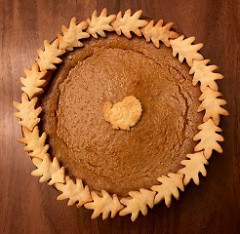
Images: Pumpkins, photography by Infrogmation via Wikimedia. Winking Halloween pumpkin inside – 2014-10-31, photograph by Tim Evans via Flickr. Pumpkin pie, photograph by distopiandreamgirl via Flickr.

How It Happens is an occasional feature looking at the inner workings of various creative efforts.

Representation Chart: Marvel Cinematic Universe, Phase 2

We all know that the representation of people of different genders and races is imbalanced in popular media, but sometimes putting it into visual form can help make the imbalance clear. Here’s a chart of the Phase 2 movies of Marvel’s Cinematic Universe (Iron Man 3; Thor: The Dark World; Captain America: The Winter Soldier; Guardians of the Galaxy; Avengers: Age of Ultron; Ant-Man).

Characters included

  • Iron Man 3: Tony Stark / Iron Man, Aldrich Kilian, Happy Hogan, Trevor Slattery, President Ellis, Savin, Harley Keener, Vice President Rodriguez, Maya Hansen, Pepper Potts, Brandt, Colonel Rhodes / War Machine, Yinsen
  • Thor: The Dark World: Thor, Loki, Odin, Malekith, Fandral, Volstagg, Erik Selvig, Ian, Jane Foster, Sif, Frigga, Darcy Lewis, Heimdall, Korath, Algrim, Hogun
  • Captain America: The Winter Soldier: Steve Rogers / Captain America, Alexander Pierce, Bucky Barnes / Winter Soldier, Rumlow, Agent Sitwell, Arnim Zola, Rollins, American World Security Councilor, Senator Stern, Batroc, Natasha Romanoff / Black Widow, Maria Hill, Sharon Carter / Agent 13, Peggy Carter, British World Security Councilor, Nick Fury, Sam Wilson / Falcon, Indian World Security Councilor, Chinese World Security Councilor
  • Guardians of the Galaxy: Peter Quill / Star-Lord, Ronan, Yondu Udonta, Dey, The Collector, Kraglin, Saal, Nebula, Nova Prime, Bereet, Carina, Gamora, Drax
  • Avengers: Age of Ultron (new characters): Bruce Banner / Hulk, Clint Barton / Hawkeye, Pietro Maximoff / Quicksliver, Baron Strucker, Dr. List, Ulysses Klaue, Vision, Wanda Maximoff / Scarlet Witch, Laura Barton, Dr. Helen Cho
  • Ant-Man: Scott Lang / Ant-Man, Hank Pym, Darren Cross / Yellowjacket, Paxton, Luis, Kurt, Mitchell Carson, Hope van Dyne, Cassie Lang, Maggie Lang, Dave, Gale

Rules

In the interests of clarity, here’s the rules I’m following for who to include and where to place them:

  • I only count characters portrayed by an actor who appears in person on screen in more or less recognizable form (i.e. performances that are entirely CG, prosthetic, puppet, or voice do not count).
  • The judgment of which characters are significant enough to include is unavoidably subjective, but I generally include characters who have on-screen dialogue, who appear in more than one scene, and who are named on-screen (including nicknames, code names, etc.)
  • For human characters that can be reasonably clearly identified, I use the race and gender of the character.
  • For non-human characters or characters whose identity cannot be clearly determined, I use the race and gender of the actor.
  • I use four simplified categories for race and two for gender. Because human variety is much more complicated and diverse than this, there will inevitably be examples that don’t fit. I put such cases where they seem least inappropriate, or, if no existing option is adequate, give them their own separate categories.
  • “White” and “Black” are as conventionally defined in modern Western society. “Asian” means East, Central, or South Asian. “Indigenous” encompasses Native Americans, Polynesians, Indigenous Australians, and other indigenous peoples from around the world.
  • There are many ethnic and gender categories that are relevant to questions of representation that are not covered here. There are also other kinds of diversity, including sexuality, language, disability, etc. that are equally important for representation that are not covered here. A schematic view like this can never be perfect, but it is a place to start.

Corrections and suggestions welcome.

In the Seen on Screen occasional feature, we discuss movies and television shows of interest.

“At Least It Made You Feel Something”

I have a rant.

There is one phrase I hate to hear more than any other from authors, scriptwriters, game designers, and other creative people: “At least it made you feel something.” It is a phrase that is sometimes trotted out when audiences voice hurt, anger, or annoyance over how a story that they were emotionally invested in turned out, and it is a load of crap.

We all understand that no story is going to satisfy all audiences. Good stories move us, and sometimes they move us to tears or to rage. Some people want stories to leave them angry or sad, and that’s as legitimate as wanting a story to leave you smiling. But a good story should not leave you hurt or annoyed.

There are good ways for creators to respond to upset audiences (which, I note, is not the same as responding to trolls—that’s a different game altogether). They can say: “I’m sorry, I’ll try to learn from this experience and do a better job in the future.” They can say: “This was the story I wanted to tell, but clearly it wasn’t the story you wanted to hear, so you should find a different story.” They can say: “I think this story matters and I don’t care that you didn’t like it.” All of these are appropriate responses. They are honest and respect the validity of peoples’ feelings, even the ones we don’t share. Even no response at all is perfectly acceptable; no creator owes their audience any engagement they don’t feel like giving.

But if a creator does choose to respond to criticism, “At least it made you feel something” is no kind of response at all. What’s wrong with it?

It sets the bar absurdly low

Good stories make us feel things, but that doesn’t mean that it doesn’t matter what a story makes us feel as long as it makes us feel something. To put it another way: if I kicked you in the shins, it would definitely make you feel something, but you would be perfectly justified in saying that that wasn’t the feeling you wanted.

It dismisses criticism

Criticism is legitimate. People have a right to have opinions about your story, whether you agree with them or not. Simply dismissing all criticism with “It made you feel something” denies that what your audience feels is just as relevant as how strongly they feel it.

It is self-congratulatory at best, selfish at worst

Reacting to an audience’s complaints with “It made you feel something” is a reach-around self-compliment. Even worse is if you actually take satisfaction in your ability to make others feel bad.

It betrays a lack of belief in the merits of the story

“It made you feel something” is close kin to “There’s no such thing as bad publicity.” In a social media world, creators may think that making their audience angry enough post online tirades about their work is the cheapest advertising they can get, but it is also a signal to the audience that the creators don’t care enough about their work or don’t have enough confidence in it to sell it on its own merits.

Stories often make us feel things. That is a huge part of why we read, watch, and play them. To open a book, watch a movie, or play a game is to entrust your feelings to another person for a time, and we have every right to speak up when we feel that our trust has been abused.

If what I feel about your story is hurt that you killed my favorite character, frustrated by the direction of the plot, or annoyed that you railroaded me into playing a villain, you don’t have to agree with me. You don’t have to take any account of my feelings at all if you don’t want to. But don’t waste my time with: “At least it made you feel something.”

Here endeth the rant.

Here there be opinions!

Queen Teuta, Piracy, and War

Let’s talk about pirates. (No, not talk like pirates—that comes later this week.) In popular culture, we typically think of pirates in the waters of the Caribbean in the 17th and 18th centuries, but the practice of cruising the seaways and taking plunder by force is an ancient and worldwide custom. For some people, raiding passing ships was an accepted and ordinary way of life. Among those people were the ancient Illyrians.

The Illyrians lived along the mountainous western coast of the Balkan peninsula, in the vicinity of modern-day Albania, Montenegro, Croatia, and Bosnia-Herzegovina. Much like the Greeks who lived to their south, they shared a common culture and language, but were not politically unified. Small-scale warfare and raiding between Illyrian tribes was a normal part of life, but Illyrians also frequently went beyond their borders, raiding nearby cities and sailing out into the sea in small, fast boats to attack passing ships.

The Illyrians were well placed to make a profit on plundering shipping. From their position along the Adriatic coast, they could easily strike at trade routes through the Adriatic, and more organized raiding parties could hit the major routes that between Greece and Italy, connecting the eastern and western Mediterranean.

For much of the ancient period, Illyrian piracy was a present but manageable danger in the Mediterranean, more an occasional nuisance than a real threat to trade, but in times of turmoil, when the more organized states of the region were less able to deter attacks, Illyrian tribes could become more ambitious. One tribe that took advantage of such chaotic circumstances was the Ardiaei, who aggressively pursued not only raiding at sea but conquests on land as well under their queen Teuta (ruled 231-227 BCE).

At this time, the major powers of the both the eastern and western Mediterranean were busy with their own problems. The Greek world was consumed with wars between the kingdom of Macedonia and several alliances of Greek cities. Tensions were rising between Rome and Carthage as the two major powers in the west slid towards a second war. Teuta’s husband and predecessor as ruler, Agron, had gotten his people involved in Macedonia’s wars and expanded his tribe’s control over large areas of Illyria. Teuta carried on with an aggressive policy that combined piratical raids on nearby shipping lanes with territorial expansion along the Adriatic coast.

As Teuta’s people began to threaten Roman merchants, the Romans decided to intervene and sent a pair of ambassadors to demand reparations and an end to the attacks. Teuta dismissed the ambassadors’ complaints saying:

…that she would try to take care that no injustice should be done to the Romans by the Illyrian nation, but that it was not the custom for Illyrian monarchs to prevent their people from making their living on the sea.

– Polybius, History 2.8.8

(My own translation)

Teuta’s response was somewhat disingenuous, given that she had directed and made use of seaborne raids for her own purposes, but it also shows how the Illyrians thought about their piratical activities.

Teuta was making a distinction between piracy and war. War, from her point of view, was a collective effort by a whole nation, directed by its leaders against a defined enemy. Illyria was not at war with Rome, and she promised the Roman emissaries that she and her forces had no intention of attacking Roman territory. Her wars were in Greece.

Piracy was something different. It was not a way of making war but a way of making a living, something done by private individuals. She, even as queen, had no right to interfere in her people’s piracy, any more than she could tell farmers not to farm or hunters not to hunt. The Illyrians regarded passing ships as a kind of natural resource. Plundering those ships was just a way of harvesting that resource, like pulling fish from the sea in nets. It was not an attack upon a particular people or nation. Anyone who sailed the seas was accepting the risk of being plundered and had little right to complain about it.

As far as Teuta was concerned, the Romans had no business complaining to her: she wasn’t at war with them, and her people had a natural right to plunder any ship that passed by.

Of course, the Romans didn’t see it like that. From the point of view of Roman merchants, it didn’t much matter whether the people raiding their ships and stealing their goods were agents of a monarch or private entrepreneurs. In response to Teuta’s seemingly dismissive answer, Rome launched an attack on Illyria. After brief fighting, Teuta’s forces were beaten and she, though allowed to remain in power, was stripped of most of her territory and forced to pay tribute to Rome.

Queen Teuta’s response to the Romans offers us an alternative view to the dominant Greco-Roman narrative of Mediterranean history. Even though her answer comes to us filtered through the perspective of a Greek historian who casts the Romans as the heroes of the story, we can still understand the logic of her point of view. To her, the difference between war and piracy mattered; as queen, she had the right to control one activity, but not the other.

Image: Modern Albanian coin with an artist’s depiction of Teuta, photograph by Numista via Wikimedia

History for Writers is a weekly feature which looks at how history can be a fiction writer’s most useful tool. From worldbuilding to dialogue, history helps you write. Check out the introduction to History for Writers here.