Superheroes and Fascism

There’s an idea that sometimes raises its head in pop culture discussions that superheroes are fundamentally fascist. (Here’s a version of the argument from a few years back, some pushback from the time, and some more recent reflections on the same idea.) The essential argument is that superheroes are a version of the might-makes-right ideology of fascism, grounded in the idea that the only way to solve problem is to look to a single, nearly (or actually) superhuman individual who reshapes the world, often with violence. Superhero stories portray a world incapable of coping with injustice without the intervention of such a superior individual, which is the same claim made by fascist movements, whether past or present. Others have objected to this idea, pointing out that while fascists seek power, superheroes traditionally reject it, many of them even hiding behind secret identities to avoid even taking credit for the good they do.

As with many challenging ideas, there may be some merit in both sides of the argument, but I think it helps us make sense of the debate to look at it from a greater distance and think about both superheroes and fascism in the deeper context they both draw on: heroes. I’ll speak specifically about the heroes of Greek mythology—in part because they are the ones I know best, and in part because they were particular points of reference both for the fascist movements of the twentieth century and for the creators of early superheroes—but similar patterns can be found in cultures throughout the world.

Heroes in ancient Greece were not just figures of myth and story; they were surrounded with religious, cultural, and political significance. Their significance varied, though, with time and context.

Some of the earliest signs of the veneration of heroes is archaeological. In the 800s and 700s BCE, there is evidence for religious rituals at tombs dating from the Mycenaean period hundreds of years earlier. The people of the ninth and eight centuries had very little understanding of the realities of the Mycenaean kingdoms, but they seem to have associated those tombs with heroic figures from their mythic past. These characters first appear to us in literary form in the Homeric epics as warrior kings like Achilles, Agamemnon, and Odysseus, but their legends must have been circulating in oral tradition for generations before.

In the eighth century, these heroes were claimed as literal, direct ancestors by aristocratic families around Greece. These families maintained the ceremonies at the Mycenaean tombs and sponsored the poets who performed epics like the Iliad and Odyssey. The claims they made to descent from such famous heroes were political, part of how they competed for power against rival families. The epics reflect the way in which heroes were perceived as the exclusive property of the aristocrats—when the rank-and-file soldier Thersites dares speak up against Agamemnon in the Iliad, the hero Odysseus gives him a dressing down for daring to challenge his betters and threatens to strip him naked and beat him with Agamemnon’s scepter. When Odysseus returns home to Ithaca, he comes home not as a leader of the whole community but as an avenging warlord defending his own property against rivals. (Homer, Iliad 2.212-277; Homer, Odyssey 22)

But heroes did not remain the sole property of the aristocrats. In the volatile politics of the seventh and sixth centuries, those who agitated to wrest power from the entrenched aristocrats and create more inclusive democratic governments also laid claim to the heroes. Figures of myth were reinterpreted not as the literal ancestors of specific families but as part of the shared heritage of whole communities. Some heroes were claimed by cities in the regions they were historically connected to, such as Theseus in Athens or Orestes in Sparta. Other heroes, like Heracles, were more wide-ranging, and could be invoked by the Greeks who traveled and settled throughout the Mediterranean.

The process of making these heroes the collective heritage of a community rather than the exclusive property of aristocratic families had many aspects. Unlike the private tomb cults of the ninth and eighth centuries, heroes and their worship became part of communal religious practices, including public shrines and festivals. The stories of heroes were reimagined; unlike the Homeric heroes, who behaved as larger-than-life aristocrats defending their own private interests, heroes of the later archaic and classical periods were defenders of their homelands and peoples who stood for justice. Theseus, for instance, is portrayed unifying the people of Athens by journeying through Attica and around nearby coastlands slaying dangerous monsters and subduing bandits and murderers—a long way from Odysseus slaughtering his wife’s suitors to defend his own home and property. Heroes were often physically incorporated into the life of the community through the practice of collecting and preserving what were believed to be their bones. Herodotus recounts how the Spartans brought the bones of Orestes back to Sparta from neighboring Tegea to give them victory in war and how Greek preparations for the naval battle against the invading Persians at Salamis included sending a ship to the island of Aegina to retrieve sacred images of the hero Aeacus and his equally heroic sons. These relics belonged to whole communities, not to single families. By these means, the exclusive, aristocratic heroes of early Greece became the collective, democratic heroes of the classical age. (Herodotus, Histories 1.67-68, 8.64, 8.84; Plutarch, Parallel Lives, “Life of Theseus”)

The tension between these two kinds of heroes—the exclusive ones who justify the power of a narrow elite and the inclusive ones who stand for the best qualities of a whole community—is not unique to ancient Greece. We can see it repeated in cultures throughout history up to the present day. The “heroes” involved need not be figures of myth and legend, either; historical figures, celebrities, and political leaders can receive the same treatment as well.

Fascism and superheroes both draw on this history, but they apply different aspects of it. Fascism looks back to the exclusive, aristocratic kind of heroism that claimed a connection with great figures of myth and history to justify the power of a limited group, whether defined by class, ethnicity, family, or political affiliation. Fascist leaders of the twentieth century claimed the heritage of a semi-historical, semi-mythical past as an exclusive property of their followers. Modern quasi-fascistic movements have a similar obsession with jealously gatekeeping their own chosen semi-historical models, from the inhabitants of medieval Europe to the Founders of the United States.

Superheroes, by contrast, represent the inclusive, democratic response that makes heroes represent not the interests of a self-defined elite but the aspirations of a broad community. Superman is the immigrant experience in the US writ large. Captain America stands for the courage and integrity of Americans at their best, while Iron Man represents Americans rising to do the right thing despite the arrogance and materialism that defines them at their worst. The “friendly neighborhood Spider-Man” is the neighborhood Spider-Man for a reason.

So my answer, in the end, is: no, superheroes aren’t fascist, even if they draw on some of the same roots. Fascism is the modern world’s darkest kind of heroism; superheroes are our answer.

Image: A version of Captain America’s shield, photograph by ze_bear via Flickr (CC BY-SA 2.0)

History for Writers looks at how history can be a fiction writer’s most useful tool. From worldbuilding to dialogue, history helps you write.

Ancient Egyptians Knew How to Party

Here’s how the ancient Greek traveler and historian Herodotus describes the festivities surrounding a great festival held every year in honor of the goddess Bast, popular with both native Egyptians and foreign residents like Greek mercenaries and traders:

When they celebrate the festival in Bubastis, they do these things. Men and women sail there together, huge numbers of them in every boat. Some of the women shake rattles and some play flutes the whole way there; the rest sing and clap their hands. Whenever they sail by a city, they put in to shore and do the following: some of the women keep doing what I described, some call out tauntingly at the women in the city, some dance, and some stand up and hoist up their dresses. They do this at every city along the river.

– Herodotus, Histories 2.60

(My own translation)

Now, Herodotus was an outsider describing customs he didn’t entirely understand, and he certainly got some of his facts wrong. Still, many of the details he recounts of daily life in Egypt seem to have come from his own observations, and more than a few hold up on comparison with Egyptian literature and art. In any case it sure sounds like the ancient Egyptians knew how to have a good time!

Serving exactly what it sounds like, the Quotes feature excerpts other people’s thoughts.

The Valley of the Whales

In the western desert of Egypt is a valley known as Wadi al-Hitan. Like some of the other famous valleys in Egypt, such as the Valley of the Kings and the Valley of the Queens, this valley is a kind of graveyard, but this one is for whales. Not that people buried whales here; rather, the desert preserves the fossils of a wide variety of sea life from millions of years ago, when this region was under a shallow sea. Among the most striking and important fossils at the site are the remains of several different species showing different stages of the evolution of ancient land mammals into the whales we know today.

Wadi al-Hitan is today preserved as a UNESCO site in recognition of both its stark natural beauty and its paleontological significance.

Images: An excavated fossil skeleton of a prehistoric whale, photograph by AhmedMosaad via Wikimedia. Spine and skull of a Dorudon atrox, photograph by Christoph Rohner via Wikimedia. Vertebrae on the desert sands, photograph by Jolybook via Wikimedia.

Out There is an occasional feature highlighting intriguing art, spaces, places, phenomena, flora, and fauna.

Hoplites, the Chigi Vase, and the Problems of Artistic Sources

Art can be a priceless source of evidence for early history, especially for areas and periods with limited surviving written sources, but, just like texts, artistic sources can be tricky to interpret.

Chigi Vase, reconstructed frieze via Wikimedia (7th c. BCE; painted pottery)

Take, for example, this scene from an archaic Greek vase (commonly known as the Chigi Vase, named for one of its modern owners). It provides us with some of our earliest evidence for Greek hoplites and the phalanx formation. Although we understand a lot about the essentials of how hoplite warfare worked, many questions remain unanswered about the precise details of both how a hoplite battle was fought and how the hoplite style of warfare developed over time. Arguments about these topics often depend in part on interpretations of the Chigi vase.

The vase depicts warriors arming themselves and marching into battle as hoplites. Many of the characteristic features of hoplite armament and warfare are on display: heavily armored fighters with large round shields and spears confronting one another in a head-on clash. We can date the creation of this vase to the seventh century BCE, around the same time that the hoplite style of warfare first appeared, so this artwork offers us crucial evidence about what the earliest phase of hoplite warfare looked like and how early some of its defining features emerged.

We can be fairly confident that the artist who painted the decorations on this vase was familiar with the realities of hoplite warfare. The ranks of the phalanx were filled by small farmers and prosperous crafters, including potters and artists. If the painter of this vase was not well-off enough to have fought as a hoplite themselves, they would certainly have known people who had. At the same time, the images are also artistically stylized in ways that make it hard to be sure how much we can rely on them as evidence.

For example, all the warriors shown on this vase are similarly equipped: they have the helmets, breastplates, greaves, and round shields that we think of as the standard parts of the hoplite panoply. Is this vase evidence that hoplite equipment was standardized from an early period, or did the artist depict a standard set of armor to create a pleasing image at a time when real hoplite gear was more of a hodge-podge with individuals equipping themselves as best they could? This question goes to more than matters of artistic taste: one of the most vexed questions in the history of the hoplite phalanx is whether it developed gradually out of older, less rigorously organized styles of warfare or it was created as a fully-realized concept in some particular place and time. Because hoplite warfare was connected with the rise and subsequent fall of early Greek tyrants, understanding the origins of the hoplite phalanx better would have implications for our understanding of major developments in political and social history. Knowing what the Chigi vase painter had in mind would tell us some important things about the early history of ancient Greece.

Out There is an occasional feature highlighting intriguing art, spaces, places, phenomena, flora, and fauna.

Beautiful Reconstructions of Mesoamerican Cities

Here are some beautiful computer reconstructions of important archaeological sites in Mesoamerica.

Tenochtitlán, Mexico, by Advestudios
Pueblo Bonito, Chaco Canyon, US, by Advestudios


Advestudios, which produced these images, also creates videos and 360 vistas. Their work is wonderful for helping to picture these sites as living, functioning cities and settlements.

Hey, look! We found a thing on the internet! We thought it was cool, and wanted to share it with you.


Rating: Deep Space Nine, Season 6

The Dominion war heats up, taking the characters of Star Trek: Deep Space Nine in lots of new directions, some more interesting than others. Here’s our take on what season 6 has to offer.

  1. “A Time to Stand” – 6
  2. “Rocks and Shoals” – 7
  3. “Sons and Daughters” – 0
  4. “Behind the Lines” – 3.5
  5. “Favor the Bold” – 5
  6. “Sacrifice of Angels” – 6
  7. “You Are Cordially Invited” – 8.5
  8. “Resurrection” – 2
  9. “Statistical Probabilities” – 4
  10. “The Magnificent Ferengi” – 8.5
  11. “Waltz” – 3
  12. “Who Mourns for Morn?” – 7.5
  13. “Far Beyond the Stars” – 8
  14. “One Little Ship” – 9
  15. “Honor Among Thieves” – 0
  16. “Change of Heart” – 4
  17. “Wrongs Darker than Death or Night” – 0
  18. “Inquisition” – 2
  19. “In the Pale Moonlight” – 7
  20. “His Way” – 1
  21. “The Reckoning” – 4
  22. “Valiant” – 2
  23. “Profit and Lace” – 2
  24. “Time’s Orphan” – 6
  25. “The Sound of Her Voice” – 4
  26. “Tears of the Prophets” – 5.5

This season’s ratings are all over the place. There are a number of strong episodes in the 7-9 range, but also multiple 0s. The average comes to 4.4, in line with season 5 and a bit less than seasons 3 and 4. It seems a bit unfair to average out this season’s episodes, though, because there are so many different things going on. The Dominion war storyline runs through the season and provides a lot of solid episodes. There are also big moments of character development, some good—Worf and Dax getting married in “You are Coridally Invited”, everyone’s favorite barfly getting a backstory in “Who Mourns for Morn?”—some less good—Kira doing a reverse Back to the Future on her mother and Gul Dukat in “Wrongs Darker than Death or Night,” Quark learning what it’s like to be a feeeemale in “Profit and Lace”. Then there are some episodes that just come out of nowhere, like Sisko having a vision of twentieth century science fiction and racism in “Far Beyond the Stars.”

At the bottom end of the scale, we have a trifecta of absolute 0s. There’s “Sons and Daughters,” in which Worf’s son Alexander and Dukat’s daughter Ziyal both get to have strained relationships with their respective fathers. There’s “Honor Among Thieves,” in which O’Brien inexplicably has an undercover mission infiltrating a seedy crime syndicate, an episode with no good reason to exist, let alone be in this series. And there’s the aforementioned “Wrongs Darker than Death or Night,” a limp episode for such a pretentious title that is both overly contrived and weightless at the same time. I’ve mentioned before that it sometimes feels like there was a frustrated noir writer in the writers’ room, and they have their fingerprints on this season as well. “Honor Among Thieves” is straight-up noir, and “Wrongs Darker than Death or Night” leans hard in the same direction. It’s as uninterseting now as it was before.

But this season also has some great episodes at the other end of the scale. The best of the season is “One Little Ship,” at 9, in which a miniaturized Dax, Bashir, and O’Brien in a miniaturized runabout help rescue the Defiant from being captured by the Jem’Hadar. It’s a fun episode that gives all the characters something to do and nicely balances the silliness of its main conceit with the seriousness of the ongoing war plot. Two more episodes that also strike a good balance between goofiness and gravity are “You Are Cordially Invited” and “The Magnificent Ferengi,” both at 8.5. In “You Are Cordially Invited,” the weighty question of whether Worf and Dax can make it as a couple despite their differences is interwoven with Klingon wedding rituals that are as gloriously over the top as you would imagine. “The Magnificent Ferengi” finds Quark, Rom, Nog, and some of our other favorite Ferengi mounting a rescue operation when their Moogie is captured by the Dominion, and it goes both hopelessly wrong and delightfully right.

For all that Deep Space Nine is remembered as the dark, gritty version of Star Trek, filled with tension and war, it has also given us some of the goofiest, most wonderfully weird episodes of the franchise.

Image: Little O’Brien and Little Dax contemplate big problems on the Defiant, from “One Little Ship” via IMDb

In the Seen on Screen occasional feature, we discuss movies and television shows of interest.

A Preview of The Greco-Persian Wars

I am pleased to announce that my second book, The Greco-Persian Wars: A Short History with Documents, is coming out in just a few days. This book tells the story of the wars between Greeks and the Persian Empire in the early fifth century BCE through translations of ancient documents.

While the wars of the early fifth century in Greece dominate modern histories of Greco-Persian interaction, they were only part of a larger history in which the main actors were not Greeks but Persians, and whose events played out not simply in Greece but across the eastern Mediterranean. Looking at a broader history allows us to put the Greco-Persian Wars into a more meaningful context. The story of Persia’s engagement in Greece is not one of East-West cultural clashes or Greek ascendancy, but of Persia’s success in adapting to the challenges of an unstable, frequently violent frontier region, and that is the history my book explores.

This book features over eighty-five separate selections translated from Greek, Old Persian, Elamite, Akkadian, Hebrew, Aramaic, Egyptian, and Lycian, each with contextual notes. They are accompanied by a short historical introduction, a glossary, a chronology, maps, and a select bibliography.

Here is a selection from one of the documents. In this text, set some hundred years after the famous battles of Marathon, Thermopylae, Salamis, and Plataea, we see how complicated relations between Greeks and Persians remained. This text is a useful reminder that we have to think not of relations between Greece and Persia but between Greeks and Persians. On both sides, individuals had their own motivations and interests that could lead to unexpected alliances and tricky rivalries.

* * *

Friendship and its complications

Xenophon, Hellenica 4.1.31-39

Relationships of xenia, or guest-friendship were a traditional way in which Greek aristocrats formed personal relationships across the boundaries of the polis. Similar relationships were also extended to Persians who dealt with the Greek frontier. While these relationships could be channels for diplomacy and political negotiation, they could also create conflicting loyalties. The exchange between the Spartan king Agesilaus—at that time ravaging the Persian-held territories in Ionia—and the satrap Pharnabazus in 395 or 394 BCE shows both the potentials of xenia and its dangers.

First they greeted each other and Pharnabazus held out his right hand. Agesilaus clasped it. Then Pharnabazus spoke first, since he was the elder.

“Aegsilaus, and you other Spartans here,” he said, “I became your friend and ally when you were fighting the Athenians. Not only did I support your fleet with money, but I myself fought alongside you on horseback and we drove your enemies into the sea together. You cannot accuse me of ever having played you false, like Tissaphernes. Yet despite this, you have now left my land in such a state that I cannot even feed myself, unless I gather up the scraps you leave behind like an animal. All the beautiful houses and woods full of trees and beasts that my father left me, which I used to enjoy so much, I now see either cut down or burned up. Well, if I don’t know what is righteous and just, you tell me how these are the acts of men who know how to repay favors.”

The thirty Spartans were ashamed and said nothing, but then after a time Agesilaus spoke up.

“Pharanbazus,” he said, “I think you understand that in the Greek cities, people also become guest-friends to one another. But when their cities go to war, such people fight on behalf of their homelands against their friends, and even kill them, if it should so happen. In the same way, since we are now at war with your king, we are compelled to treat everything of his as enemy territory. However, we would think it the best thing in the world to become your friends. Now, if it were a matter of throwing off the king to be ruled by us instead, I certainly would not advise it, but if you side with us now you will have the chance to flourish without having any master or humbling yourself to anyone. I think freedom is, after all, worth any amount of money. Even so, we are not urging that you should be free and poor. Rather, by taking us as your allies, you will increase your own power, not the king’s, and by subduing those who are now your fellow slaves you will make them your own subjects. You will become both free and rich—what else could you need to have perfect happiness?”

“In that case,” said Pharnabazus, “shall I tell you plainly what I will do?”

“That would be a good idea,” said Agesilaus.

“Well then,” he said, “if the king sends another general here and makes me subordinate to him, I will gladly become your friend and ally. On the other hand, if he gives the command to me, ambition is such a powerful force that I will fight you to the best of my ability.”

When he heard these words, Agesilaus grasped Pharnabazus’ hand and said:

“My dear friend, I hope you will be our ally! But know this: I will leave your territory now as quickly as I can, and in the future, even if the war continues, we will leave you and your land alone as long as we have other foes to fight.”

That was the end of the meeting, and Pharnabazus mounted up and rode away, but his son Parapita, a fine young man, stayed behind. He ran up to Agesilaus and said:

“Agesilaus, I make you my guest-friend.”

“For my part, I accept,” Agesilaus replied.

“Remember it,” said Parapita. He at once gave the beautiful javelin he was carrying to Agesilaus. In return, Agesilaus took a splendid decoration from the horse his secretary Idaeus was riding and gave it to Parapita. Then the young man leapt upon his horse and followed after his father.

* * *

If you’ve found some of my previous posts about Persians, life in the Persian Empire, and the complicated relationships between Persians and Greeks interesting, you may enjoy The Greco-Persian Wars.

The Greco-Persian Wars: A Short History with Documents comes out February 24th from Hackett Publishing.

Hardcover: $49 / Paperback: $18 / e-book versions available

You can pre-order directly from Hackett or on Amazon or Barnes and Noble, or from your local bookseller.

Image: Greco-Persian Wars paperback cover by Hackett Publishing

Announcements from your hosts.


An Ancient Minoan Saffron Gatherer

Here’s a beautiful ancient Minoan fresco of a woman gathering saffron on a rocky hillside.

Saffron is a spice derived from the crocus flower, and since each flower produces only a tiny amount of the spice, gathering it on any scale is a labor-intensive process. With her large earrings and the many colorful, decorated layers of her clothing, this lady seems a little overdressed for such hard work. There may be various explanations. Perhaps this fresco represents a ceremonial harvest, not unlike the use of a golden shovel to dig the first scoop of dirt on a building project, or possibly a small harvest for religious use. It might also be simply an artistic depiction suitable for an elite home and not intended to represent the actual attire of an agrarian worker.

Whatever the case, it’s a beautiful work of art.

Image: Detail of saffron-gathering fresco, photograph by Yann Forget via Wikimedia (Akrotiri; c. 1700 BCE; fresco)

Out There is an occasional feature highlighting intriguing art, spaces, places, phenomena, flora, and fauna.

Two-Question Worldbuilding

There are lots of different ways to imagine new secondary worlds and the cultures within them. You can start from the ground up—literally—by drawing a map and thinking about how the landscape shapes the cultures within it. You can start with a big concept and work your way down into the details from that, or go the other way and start with a single detail that serves your narrative, then build the rest of the world around it.

But sometimes you don’t want to mess with all that. Sometimes you’re writing a story or mapping out a game and you need your characters to have a little bit of interaction with a far-off foreign land, but not enough to make it worth developing in every detail.

Here are two quick questions you can ask to lay the basis for simple worldbuilding for side cultures in pre-industrial worlds that still gives them some substance:

  • How many people have control over their own source of food?
  • How much do those people have to compete with others for food sources?

We’re not talking actual numbers or anything quantifiable here, just a general sense: a little bit, a fair amount, or a lot?

(Food sources come in many forms. We most often think of farms and herds of animals, but consider also fishing and hunting, trading with food-producing regions abroad, or raiding richer neighbors.)

The first question tells you about social structure: food is crucial to life, so access to it is one of the most powerful ways people can assert control over others or claim their own independence.

Where only a few people control the available food sources and most other people are in some way dependent on them, there is strong social stratification. It could take many forms: tenant farming, slave plantations, highly-regulated trade markets, or organized piracy of trade routes. Whatever the case, the society will have a small elite marked out by their wealth, way of life, or social privileges.

When most people control their own food sources, you have a much less stratified society. It could be small farms, independent merchant families, or bands of friends who hunt and fish together. The society need not be perfectly egalitarian—some farmers or trading partnerships may be wealthier than others—but when most people are self-sufficient, the rich have less leverage to get the poor to go along with any claims they make to special privileges. Societies where people aren’t dependent on others for survival can also have trouble organizing any kind of large-scale collective action, whether it’s setting up an organized legal system or sending an army on campaign.

In between, you get a range of possibilities: some people manage by fishing and keeping market gardens, others labor on the estates of the rich, while bands of young warriors form up now and then when things get tough to go plunder richer lands, then come home and return to their homesteads. In a society where people live at many different levels of subsistence, social stratification can be complicated, but also fluid. A tenant farmer may be able to save enough over time to buy a plot of their own and join the ranks of independent farmers, while an aristocrat who suffers a run of bad harvests may have to sell their tenanted estates and buy a smaller patch they can farm themselves, but that doesn’t make them social equals.

The second question goes to internal conflict: the more people who have to compete over resources, the more turmoil you are likely to see within a society.

When there is little competition over resources—either because they are abundant enough for everyone or because those who control them have a grip too tight to be challenged—societies are likely to be stable. Some may be inward-looking and peaceful, others may simply export their conflicts abroad: a state full of rich farmers might support a large army to invade and colonize other lands, or a society with no resources available at home might drive the poor and desperate to raid their neighbors or move away as laborers or mercenaries.

By contrast, in a culture where there’s not enough to go around or where those who have resources can’t effectively defend them, expect a high level of internal conflict. This conflict might take violent forms, from ongoing petty raiding between neighbors to civil wars, or it might be channeled into cutthroat negotiations between rival trading houses or a frantic scramble for royal patronage among the highborn families.

In between the extremes, at a moderate level of competition, you are likely to see a society that goes through cycles of stability and fractiousness, where the winners know that they can’t hold onto their gains forever, but the losers can afford to lick their wounds, build new alliances, and hope to come out on top next time.

Below is a rough chart of what a society with a particular combination of resource distribution and competition may look like. Remember that these are patterns and tendencies, not absolute rules. Our own world’s history will furnish plenty of examples of societies that don’t fit these patterns, and you can certainly imagine worlds that don’t. But if you find yourself in need of some quick-and-dirty worldbuilding, this is a good place to start.

Chart by Erik Jensen

History for Writers looks at how history can be a fiction writer’s most useful tool. From worldbuilding to dialogue, history helps you write.

A Farewell to Cards

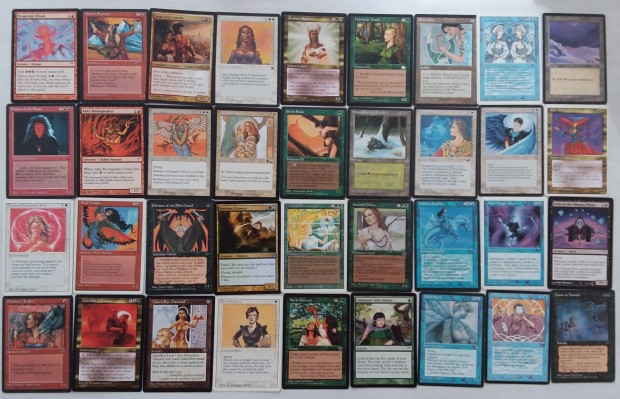
Back in the 1990s, in my high school and college days, I used to be into Magic: The Gathering, the granddaddy of trading card games. I’ve dabbled a little since then, but it’s twenty years since I played the game with any seriousness. I really enjoyed the game, especially the challenge of coming up with interesting decks (I was what they used to call a “Johnny” player), but it isn’t part of my life any more, so I’ve decided its time to get rid of my collection.

After doing a little research on ways of selling Magic cards (and thinking about which ones are viable in the midst of a pandemic), I decided to list my cards on Cardsphere, a website created by and for Magic fans.

So far, I’ve only sold a handful of cards, but I keep my eye on the offers and little by little I’m working the collection down. I was never much into the collecting aspect of the game, so I don’t have many of the high-value cards (although I do have a couple of old dual lands that I’m hoping to sell for a few hundred dollars apiece). Most of what I’ve sold so far has gone for pocket change, and I know I’m losing money on postage on some transactions. Still, it is a pleasure to know that these cards I no longer have any use for are going to make someone else happy.

The process of sorting, organizing, listing, and sending off my cards has meant I’ve spent more time looking at my collection in the past few months than I did in the previous couple of decades, and in a way that has been good for me. It’s nice to be reminded of happy days long ago and to say a proper goodbye to the old dears.

My card inventory is visible here, if anyone wants to check out what I have to offer.

Image by Erik Jensen

Of Dice and Dragons is an occasional feature about games and gaming.