Johanna Sinisalo on the BSFA Awards 2016 Longlist

Finnish author Johanna Sinisalo’s novel The Core of the Sun (Auringon ydin, translated by Lola Rogers) was voted onto the BSFA Awards 2016 longlist for best novel.

Amazon Sinisalo The Core of the Sun

The BSFA Awards are awarded each year to the best Novel, Short Fiction, Artwork and work of Non-Fiction as voted for by the members of the British Science Fiction Association. BSFA members can vote on the longlist to draw up a shortlist between January 01 and January 31. The shortlists for these four awards will normally comprise the five works in each category that receive the most individual nominations by the deadline.

Congratulations! I’m looking forward to hearing whether Sinisalo makes it onto the shortlist.

Incidentally, Sinisalo is one of the guests of honor at Worldcon 75 in Helsinki this coming August.

Found via File 770.

Image via Amazon.

Quotes: She Tried to Take It All in

“She tried to take it all in, to memorize every detail of the amazing historical event she was witnessing: The young woman splashing in the fountain with three officers of the Royal Norfolk Regiment. The stout woman passing out poppies to two rough-looking soldiers, who each kissed her on the cheek. The bobby trying to drag a girl down off the Nelson monument and the girl leaning down and blowing a curled-paper party favor in his face. And the bobby laughing.”

– Connie Willis: All Clear; London, 7 May 1945

Just a part of the World War II Victory in Europe Day celebration in Trafalgar Square, London, according to author Connie Willis. What a delightful image, especially the bit about the bobby and the girl with the party favor!

Willis, Connie: All Clear. New York, NY: Spectra, 2010, p. 14.

(This quote comes from my 21 new-to-me SFF authors reading project.)

Serving exactly what it sounds like, the Quotes feature excerpts other people’s thoughts.

Quotes: More Open to Imagining Better Worlds that Might Be Possible

“Science fiction came into being in response to a new thing in human history: the understanding that not only was the world changing, but also that the rate of change was speeding up. That in a normal lifetime, you could expect to experience multiple episodes of rapid, disorienting change. Science fiction at its best has always been about examining and inhabiting those experiences when the world passes through a one-way door.

“Modern science fiction grew up in the Great Depression and flourished in World War II. It thrived in the strangeness of the 1950s and the different strangeness of the 1960s. It has continued to be an essential set of tools for engaging with our careening world.

[…]

“And I really do believe that science fiction and fantasy storytelling makes us, in some fundamental way, a bit more practiced in the ways of a world caught up in wrenching change—and more open to imagining better worlds that might be possible.”

– Editor Patrick Nielsen Hayden

Like I wrote in my Arrival Recap: I explicitly do not want all of my reading and viewing rehashing the same old stories over and over, because SFF is explicitly about examining other possibilities.

Nielsen Hayden, Patrick. “The prospect before us.” Making Light, November 9, 2016

Serving exactly what it sounds like, the Quotes feature excerpts other people’s thoughts.

Maria Turtschaninoff’s Novel Maresi Optioned

Swedish-speaking Finnish author Maria Turtschaninoff announced last week that her fantasy novel Maresi has been optioned for a movie by the U.K.-based company Film4.

Congrats—grattis! Awesome news!

The historically inspired fantasy was originally published in Finland in 2014 and awarded the prestigious Finlandia Junior Prize in the same year. It’s the first in the Red Abbey Chronicles series.

Turtschaninoff Maresi US 2017 Cover

Film4 has developed and co-financed many of the most successful films from the U.K. in recent years, including Academy Award winners 12 Years a Slave and Slumdog Millionaire. Earlier Film4 productions include K-Pax, Trainspotting, and Four Weddings and a Funeral.

The U.S. edition of Maresi will be released January 03, 2017.

A freestanding sequel called Naondel has just been published in Swedish and Finnish, but at this writing there’s no information about translations. Turtschaninoff is currently working on book three for the series.

Maresi comes highly recommended by a friend of mine, but I haven’t yet been able to get it. I’m eagerly looking forward to January!

Image via Maria Turtschaninoff

Quotes: There Is Something about Talking in the Night

“There is something about talking in the night, with the shreds of sleep around your ears, with the silences between one remark and another, the town dark and dreaming beyond your own walls. It draws the truth out of you, straight from its little dark pool down there, where usually you guard it so careful, and wave your hands over it and hum and haw to protect people’s feelings, to protect your own.”

– Margo Lanagan: Tender Morsels

The magic of night-time works in many ways.

Lanagan, Margo. Tender Morsels. New York, NY: Alfred A. Knopf, 2008, p. 307.

(This quote comes from my 21 new-to-me SFF authors reading project.)

Serving exactly what it sounds like, the Quotes feature excerpts other people’s thoughts.

Arrival—Establishing Common Ground

A new Arrival screen ad is out! (Published today, in fact!) In an atypical move, the trailer (if you can call it that) starts with several completely unrelated clips of people in an experimental situation:

Arrival (2016) – “Common Ground” – Paramount Pictures by Paramount Pictures

…except that, of course, the clips aren’t unrelated. They show two strangers with no shared language trying to figure out what they have in common. It’s quite clever; see for yourself.

Two weeks to go till opening night!

Hey, look! We found a thing on the internet! We thought it was cool, and wanted to share it with you.

Quotes: Discover Not Just the Abstract Thought

“As he watched the TV, he remembered a lecture in his second year of college by a professor of environmental science. The gist had been that institutions, even individual departments in governments, were the concrete embodiments of not just ideas or opinions but also of attitudes and emotions. Like hate or empathy, statements such as ‘immigrants need to learn English or they’re not really citizens’ or ‘all mental patients deserve our respect.’ That in the workings of, for example, an agency, you could, with effort, discover not just the abstract thought behind it but the concrete emotions.”

– Control (John Rodriguez)

That… sounds like sociology or anthropology. Clearly environmental science has more connections with humanities / social sciences than I’ve previously thought!

VanderMeer, Jeff. Authority (Southern Reach Trilogy 2). New York, NY: Farrar, Straus and Giroux, 2014, p. 147.

Quotes: Undercover Work as a Librarian

“Sometimes undercover work as a Librarian involved posing as a rich socialite, and the Librarian in question got to stay at expensive hotels and country houses. All while wearing appropriately high fashion and dining off haute cuisine, probably on gold-edged plates. At other times, it involved spending months building an identity as a hard-working menial, sleeping in attics, wearing plain woollen dress, and eating the same food as the [boarding school] boys.”

– Genevieve Cogman: The Invisible Library

That’s a different kind of library gig all right!

Cogman, Genevieve. The Invisible Library. New York, NY: Roc, 2016, p 2.

Serving exactly what it sounds like, the Quotes feature excerpts other people’s thoughts.

On First Contact Communication in Arrival

The movie summer and early fall have been rather dry, as has the actual weather here. I’m eagerly awaiting November when Doctor Strange (six weeks to go!) and Arrival (seven weeks!) open a hopefully more thirst-quenching end of the year. And the more I hear about Arrival, the more intriguing it sounds.

Mark Liberman at Language Log was asked to provide a linguist’s perspective on first-encounter communication strategies. His post is both lengthy and enlightening.

RA Olea Flickr Sign Language Friend

Specifically, he answers the question “An alien is standing in front of you, apparently peaceably. What is the first thing you try, in an attempt to communicate with it?”

The meatiest bit is this:

“There’s no guarantee that their senses and their modes of action are going to be a good fit to ours. They might communicate via skin color changes like cuttlefish, except maybe theirs are only visible in the ultraviolet. Or maybe they can modulate and sense electric fields, like electric eels. They might use gestural and postural changes in a body that’s very different from ours, or rapid morse-code-like modulations of sound at a dozen different frequencies independently and simultaneously. Maybe pheremone-like chemical signals are a crucial part of the process.

“Whatever the modalities of communication, it’s quite likely that we won’t be able to imitate them without building some specialized apparatus. And it’s quite possible that it would be hard even to recognize the fact that they’re communicating with one another, before we even get to the point of trying to understand and imitate.

“More likely, the process would be:

(1) Persuade them not to kill us, and vice versa;
(2) Persuade (or coerce) them to let us observe their within-species interactions, or vice versa;
(3) Design and build systems for recording, analyzing, and synthesizing their communicative signals (or wait for them to do the same thing for ours);
(4) Use those systems to engage in a sort of “monolingual demonstration”, and hope that we can come to understand them and communicate with them to some extent.”

According to Liberman, Ted Chiang’s short story “Stories of Your Life” (that the movie is based on) also mentions “in a mild way” a few of these issues:

“[Protagonist, linguist Dr. Louise Banks] needs to use a ‘sound spectrograph’ to analyze the aliens’ utterances, which sound to her ears ‘vaguely like […] a wet dog shaking the water out of its fur’, and she needs recording and playback to communicate in the other direction, since they don’t recognize her attempts to imitate their speech.”

Visit Language Log for more.

On the basis of the Arrival trailers released so far it’s hard to say whether the movie will be focusing on linguistics specifically, or whether the intellectual mystery will be rounded up into a more generic academic exercise. It does look like the script at least attempts to stay with Chiang’s story. Like Liberman, I’m very interested to see how much of the linguistics makes it on screen.

Image: sign language : friend via Flickr (2008; colored pencil on charcoal paper; by R.A. Olea) CC BY 2.0

On, of, and about languages.

Ginormous List of Oncoming SFF Screen Adaptations

Natalie Zutter at Tor.com has made a list of SFF adaptations currently in the works either for tv or cinema.

Richard K Morgan altered-carbon_UK_Pb

Such a variety of projects! It really seems like a golden age for genre adaptations, like Zutter says. Head on to Tor.com for the full list.

I’m most interested in Arrival (based on a story by Ted Chiang and out very soon now!), Altered Carbon by Richard K. Morgan, and Lilith’s Brood by Octavia E. Butler. It would also be great to see Ann Leckie’s Ancillary series, Red Mars by Kim Stanley Robinson, and Daniel José Older’s Bone Street books on screen.

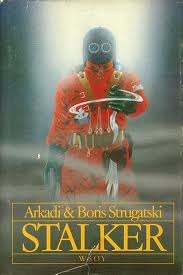
It was also intriguing to see Roadside Picnic by Arkady and Boris Strugatsky on the list, for I’m not used to seeing Eastern bloc SFF authors in the Anglo-American market. According to the all-knowing Internets, Roadside Picnic was turned into a Russian SFF art film Stalker in 1979. I never saw that, but did read the Finnish translation (Stalker: huviretki tienpientarelle) when I was too young to really understand it, so it would be nice to refresh my memory.

Goodreads Strugatski Stalker

Besides works in progress mentioned in Zutter’s list, I’m looking forward to OtherLife. It’s adapted from Kelley Eskridge’s Solitaire (2002), which I read only this year and loved. Unfortunately, OtherLife seems currently to have paused in post-production. We live in hope, though! (I’ve been following the story of its development on Eskridge’s blog; do visit for a glimpse of indie movie projects from a writer’s perspective.)

Anything on your radar that especially tickles your fancy? Do share!

Images: Altered Carbon via Richard K. Morgan. Stalker via Goodreads

Hey, look! We found a thing on the internet! We thought it was cool, and wanted to share it with you.