Art for Early Editions of Dune

Have you read Dune? If so, you might enjoy this early art by John Schoenherr:

Schoenherr Dune Dawn at the Palace of Arrakeen
John Schoenherr: Dawn at the Palace of Arrakeen.
Schoenherr Dune Stilgar and His Men
John Schoenherr: Stilgar and His Men.


Schoenherr Dune Defeating the Sardaukar
John Schoenherr: Defeating the Sardaukar.

Apparently, Frank Herbert said Schoenherr (1935-2010) was “the only man who has ever visited Dune.” Schoenherr’s paintings of Herbert’s Dune were published first in the Analog magazine and later in a fully illustrated version.

For me, along with John Christopher’s The Tripods, Dune is one of the SFF books I read in my (much) younger days and have kept re-reading over the years. Seeing this early art was certainly a treat!

Found via Dangerous Minds – go visit for more info & pics.

Out There is an occasional feature highlighting intriguing art, spaces, places, phenomena, flora, and fauna.

The Myth Is Strong With This One

It’s well known that George Lucas drew inspiration from mythology when writing Star Wars. Luke Skywalker, the young hero from the planet farthest from the bright center of the universe, gets the call to adventure delivered by droid and goes off on a Campbellian journey to rescue a princess, seek out an ancient mentor, and finally confront his fallen father. The prequel trilogy gave us the tragic version in which Anakin, the great warrior, was driven to madness and destroyed the things he loved the most.

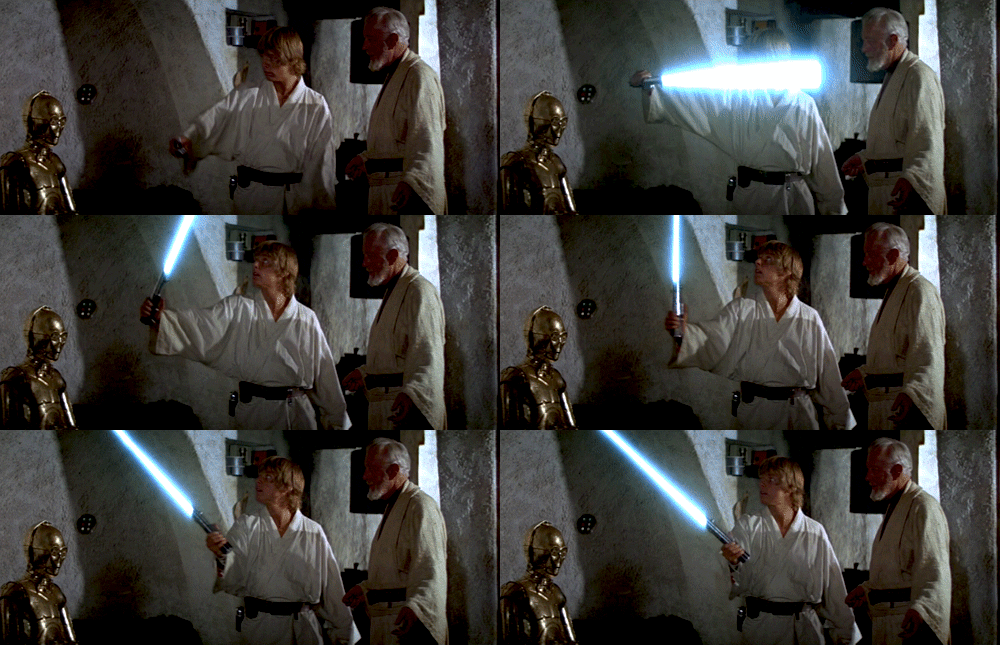
1501022lightsaber

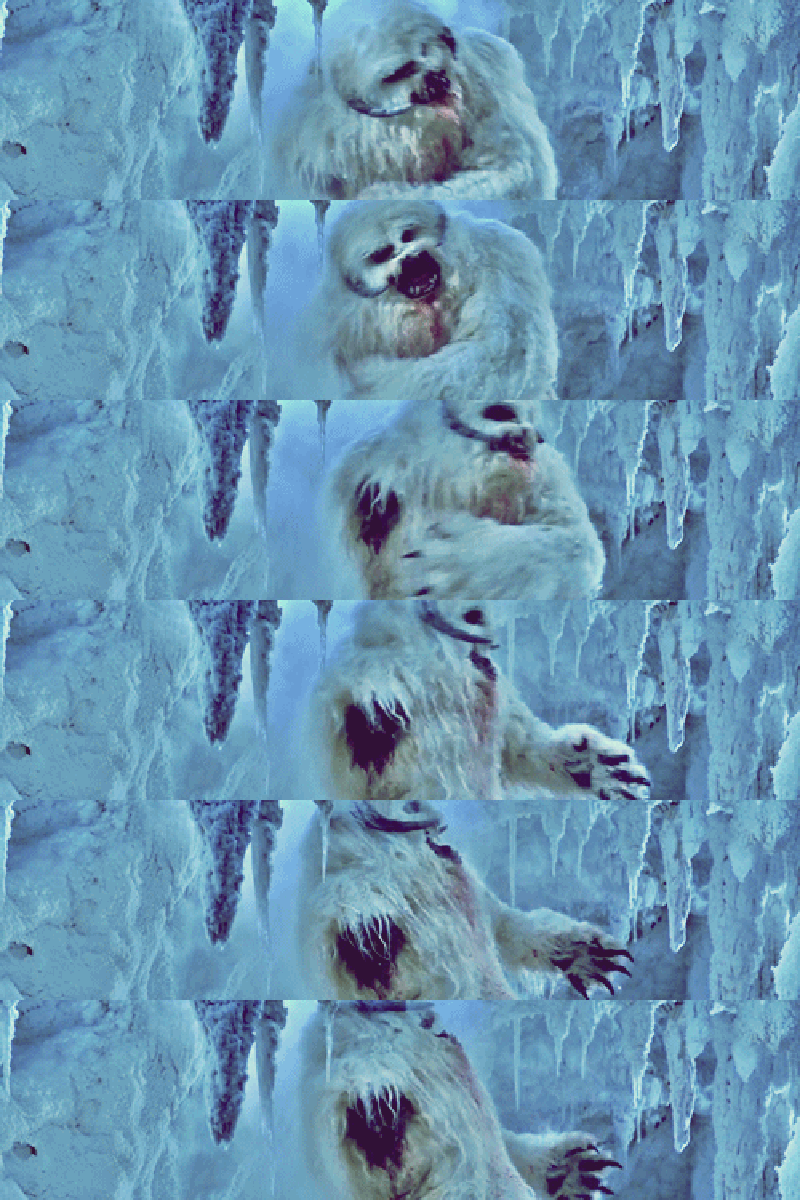
There are smaller touches of myth throughout the Star Wars hexalogy. Luke receives his father’s lightsaber like King Arthur drawing his father’s sword from the stone. The escape from the imperial garbage masher has hints of Jonah and the whale. Luke in the Wampa’s cave has shades of Beowulf.

151022wampa

Like most of the rest of geeky internet, I’ve been watching the trailers for The Force Awakens with excitement. I’ve been struck by something, especially in the latest trailer. The mythology that this latest iteration of Star Wars is working hardest to evoke is… Star Wars.

Star Wars: The Force Awakens Trailer (Official) via Star Wars

Star Wars has transcended being a movie franchise or even an expanded universe. It has reached the point where we can speak of it in terms of mythology.

One of the definitions of myth is that it is a story you know even if you can’t recall ever being told it. Star Wars has that. It is part of our cultural consciousness to the point that even people who haven’t seen the movies (yes, they exist) recognize the sound of a lightsaber and the cadences of the imperial march. Star Wars was all over my childhood, and even though I didn’t get around to seeing the movies until I was a teen (I was a Star Trek fan and young and dumb enough to think that I had to pick one over the other), I recognized Darth Vader, Princess Leia and Yoda on my friends’ lunchboxes.

Another characteristic of myth is that all myths are versions. There is no original, no canon. Though some may disagree on whether this is a good thing, Star Wars has always been an evolving story, getting new versions from small tweaks to big changes. (Yes, I see you in the back in the “Han Shot First” shirt, you can put your hand down.) The new wave of Star Wars movies leaves the old hexalogy alone but reboots the post-Return-of-the-Jedi expanded universe.

For those of us who grew up in the world of Star Wars, it is hard to imagine a time when these stories were not a part of the popular culture, yet there was a time when no one had heard Darth Vader’s breathing or Yoda’s grammar, when no one knew what a lightsaber or a Death Star was. By connecting to the ancient stories we already knew, Star Wars made itself feel timeless. Now it has become a part of that universal memory to be played upon and invoked in its own right.

Images: “This is the weapon of a Jedi knight” via The Film Fatale; wampa via giphy.com

Post edited for style.

In the Seen on Screen occasional feature, we discuss movies and television shows of interest.

Digital Painting Inspired by The Martian

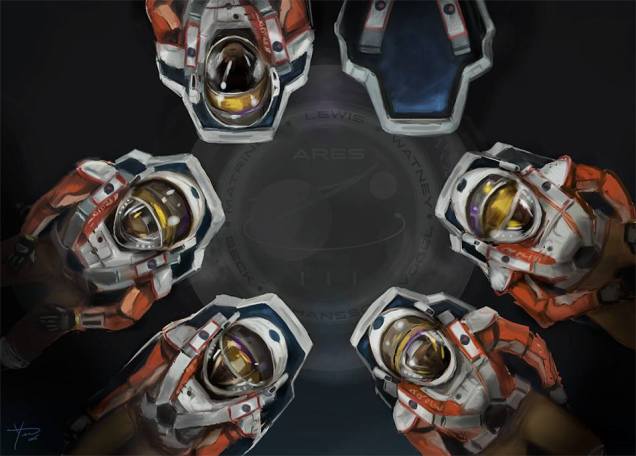
Painter and photographer d. yee was inspired to re-interpret a scene from The Martian as a digital painting:

d. yee.
d. yee.

Says artist:

“Was thinking to use this as a reference for a large format painting (in acrylic). After working on this digital painting over a couple of days I’m starting to rethink the feat. My right hand is not happy.”

Beautiful. Reminds me stylistically of some SF book covers I like. I hope a large format acrylic is coming (and published on their website)!

Out There is an occasional feature highlighting intriguing art, spaces, places, phenomena, flora, and fauna.

The Martian Cast & ISS Crew Chat

File 770 has a nice roundup of ten clips from and about The Martian, ranging from teasers and trailers to interviews and talks. The coolest is perhaps a 20-some minute call between two The Martian actors and two of six members of the International Space Station crew:

Space Station Crew Members Talk to Cast of The Martian

From the ISS, Expedition 45 Commander Scott Kelly and Flight Engineer Kjell Lindgren were on the horn; from the movie cast, Sebastian Stan and Mackenzie Davis during a visit they made to Mission Control at the Johnson Space Center in September.

Hey, look! We found a thing on the internet! We thought it was cool, and wanted to share it with you.

The Martian Final Trailer

The final trailer for The Martian is out!

The Martian Official Final Trailer by CBR Trailers

The more I hear about this adaptation, the more excited I get – and I’m not big on survival flicks! I’m looking forward to seeing more of Donald Glover (whom I only know from Community), Chiwetel Ejiofor, and Sean Bean (who better not die in this one!). I’m also curious about Kate Mara (whose performance I liked in the otherwise deplorable Fantastic Four reboot). I think I also noticed Michael Peña – Luis in Ant-Man – get some space shuttle time.

In any case, it’s going to be especially good after a weak movie August and a disappointing September.

OMG OMG OMG OMG – Worldcon 2017 in Helsinki!

The biiiig thing in the SFF fandom this year has been the Hugo kerfuffle. Erik and I have followed and talked about it, but engaged more with the 2017 Worldcon campaign. Helsinki in 2017 is one of four bids, competing with D.C., Montreal, and Nippon.

I haven’t been involved with Worldcons before, but the prospect of a major international con in Finland, during our centennial of independence to boot, was just too good to pass. As a Finn and a part of the Finnish fandom, I know Finns put together smooth, professional, kick-ass events.

hki2017-logo

Site selection for the 2017 con was decided by voting among this year’s Worldcon members. Voting closed last night. Aaaaaand we won!

Kermit flail!

Kermit Flail

At this writing, the results are still unofficial, but as they are undisputed, it’s pretty much a given that we’ll have a Finnish Worldcon.

I’m so, so happy for my compatriots and co-geeks, and thankful to everyone who voted and spread the word. We did it! Suurkiitos!

Disclaimer: I’m a supporter of the bid, and also sewed a bunch of items bearing the bid logo for the bid to give away. More at my business blog and Flickr.

Kermit flail image: Via Walker—Bait on Tumblr.

Hugo Voting, “Good” Stories, and Politics

I just submitted my Hugo ballot for 2015. We’ll know soon enough who won what. We’ve had months of online arguing about who should win and why, and I’m sure we’ll soon have months of arguing about who won and why, and if you’re at all like me, you’re sick to death of the whole business. So, I’m not going to talk about who I voted for or why I think they should win. Instead, I want to talk about two ideas that have arisen from the conversations that have unfolded around the Hugos this year. Both have to do with how we evaluate stories and both, I think, are founded in misguided ideas about what a story is.

The ideas I’m talking about are:

1. “We should vote for stories that are good, not just the ones we like”

Most of the time, I like things because I think they are good and I think things are good because I like them.

There’s some slippage around the edges. There are some things that I can see are technically well executed, but that I don’t enjoy (The Hunger Games, the rebooted Battlestar Galactica), and there are some things I enjoy despite their technical failings (early-season Star Trek: The Next Generation, The Princess Bride). For the most part, though, the overlap between “stuff I like” and “stuff I think is good” comes pretty close to 100%.

There is no objective standard of what makes a story “good.” You can’t measure and quantify it. There are things that a lot of people agree on about what makes for a good story, but subjectivity in large amounts is not the same as objectivity. Lots of people think that Ender’s Game is a great work of science fiction, but in the end all that means is that lots of people like it.

Calling on people to vote for stories that are “good” is meaningless. If nothing else, the controversy around this year’s Hugo nominees has been an excellent demonstration of the fact that we all have different definitions of what good means. We vote for the stories we like because those are the stories we think are good. The winners will be the stories that the greatest number of people liked, and that’s all there is to it.

2. “We shouldn’t judge a story on whether we agree with its politics or not”

As one of my college writing teachers told us: “A story is an experiment in moral physics.” At the core of a story, any story, is an idea about how the world does, could, or should work. You can call that politics or a message, but all it is in the end is an idea, and an idea that shapes how the world of a story works and how its characters interact with one another is just as integral to that story as any other element.

It is just as legitimate to judge a story on its ideas as on its plot, characters, dialogue, or any other element. A vital part of what make so many of us love, say, The Lord of the Rings is the idea that doing the right thing matters, even when it seems like no one will ever notice or care. Without that guiding idea, the story would not be at all the same. When we are deciding whether we like a story or not, we cannot take the ideas of that story out of the picture and it would be a mistake to try.

And that is all I have to say about the 2015 Hugos. You pay your money and you cast your vote. We’ll see the results soon enough.

Story Time is an occasional feature all about stories and story-telling. Whether it’s on the page or on the screen, this is about how stories work and what makes us love the ones we love.

Q&A: Which Starship Would You Command

Quiz time! We took the Which Starship Would You Command quiz. Here are the results:

1) What do you think is the most important quality or feature for a starship?

Erik: Ability to withstand powerful forces [‘Cause, you know, I bet there’s a lot of those in space.]

Eppu: A good collection of scientific instruments, weapons, and engineering tools. [Be prepared! Things are going to break, and in space you want to be very, very prepared when something breaks.]

2) What kind of crew would you want to have on your starship?

Eppu: I’d like a well-balanced crew on my ship; diplomats, security experts, scientists, doctors, etc. [Again, be prepared!]

Erik: A family of versatile and multi-talented members with a strong purpose. [I figure being versatile with a strong sense of purpose is important if you’re in danger of being stranded millions of light years out in space.]

3) Pick a vehicle.
Green compact carErik: Green compact car. [It’s cute!]

Eppu: Same [A good-enough compromise between looks and utility; also, I don’t need that question answered.]


4) You’re out exploring space, when you come across a ship belonging to a new alien species you’ve never encountered before. What would you do?

Eppu: Stealthily observe them from afar to determine if they’re hostile before opening communications. [I guess one of these days I’ll find myself in a “bath” that’s getting hotter in minute increments… 😉 ]

Erik: Same [I don’t like talking to people to begin with. Even more so if they’re hostile.]

5) You’re out patrolling the stars when you get a distress call from a civilian freighter that has been damaged somehow and drifted into the territory of a hostile, angry alien race. They’re asking for help. What do you do?

Erik: Approach the border cautiously, broadcasting to the hostile alien empire that we come on a mission of mercy. [But if I have to deal with hostile folks I’m going to let them know that I’m not here to cause trouble.]

Eppu: See if there’s any way I can quietly and sneakily cross the border to try and reach the freighter. [Quick, before the hyena come!]

6) Pick which uniform you’d like your crew to wear.

Han Solo's outfitEppu: Han Solo’s outfit [‘Cause pockets! This is a pet peeve of mine. We’ll need pockets in the future, too. So many sci-fi outfits are ridiculously lacking in practical details.]
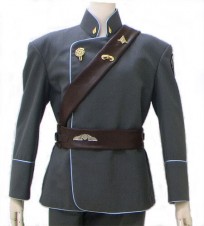


Battlestar Galactica uniformErik: Battlestar Galactica uniform. [Eh. What can I say? I’m a sucker for a nice sash.]


7) What kind of captain would you like to be?

Erik: Wait, lead? I’m in charge? Whose idea was that? [I’m like the guy who sits three chairs down from the navigator in the staff meeting and has one line explaining why the people on this planet are offended by the color orange. Don’t put me in charge of nothin’.]

Eppu: Same [Uhh…]

8) Pick a color scheme for your ship’s hull.

Grey, subtly pixelatedEppu: Grey, subtly pixelated [In space, no-one can hear you complain about hull color.]


Grey with bright stripeErik: Grey with bright stripe [Ooh, it’s so shiny and spacey!]


9) Pick a bridge.

Traditional Far-Eastern bridgeErik: Traditional Chinese bridge. [It’s elegant and tranquil. I go for that.]


Gracefully curved bridgeEppu: Graceful curves and loop at one end [Loop-de-doo!]


10) You receive a communication from an off-world colony, which says they’ve encountered a new life form and would like you to assist. What would you do?

Eppu: I’d bring a science team to investigate the new life form. [No word on danger, so study it is!]

Erik: Same. [Because that’s what I do: I investigate the heck out of things.]

So, apparently we both would command…

USS Enterprise D

USS Enterprise D. “Let’s see what’s out there.”

Q&A is an occasional feature in which we share our responses to quizzes, questions, and quirky ideas for your entertainment.

Fantastic Worlds Exhibit at The Smithsonian

The Smithsonian’s new exhibit Fantastic Worlds: Science and Fiction, 1780-1910 opened on July 01, 2015. In addition to the physical exhibit, the Smithsonian Libraries provide an online version.

The Smithsonian Libraries online exhibit Fantastic Worlds.

From the online exhibit description:

“Travel with us to the surface of the moon, the center of the earth, and the depths of the ocean — to the fantastic worlds of fiction inspired by 19th-century discovery and invention.

“New frontiers of science were emerging. We took to the air, charted remote corners of the earth, and harnessed the power of steam and electricity. We began unlocking the secrets of the natural world. The growing literate middle class gave science a new and avid public audience. Writers explored the farther reaches of the new scientific landscape to craft novels, hoaxes, and satires.”

The online exhibit reveals a new thematic component (or chapter) each Tuesday. So far we’ve seen “Terra Incognita” and The Age of the Aeronaut”. The chapters include images, maps, and videos, plus intriguing curator’s notes. Sounds great for early science fiction and fantasy enthusiasts, as well as people interested in the history of exploration or late 1700s to 1800s.

Found via Smithsonian Libraries on Tumblr.

Out There is an occasional feature highlighting intriguing art, spaces, places, phenomena, flora, and fauna.