“A celebration of pilots, captains, engineers, crew members, and the spacecraft they love to fly. (And race, and crash, and fix, and play in, and fight in, and…)”
It’s a great time to be a geek – not only are more SFFnal stories than before being published and adapted to the screen and stage, but making, remixing, and sharing our own content is incredibly easy.
“She was born a thing and as such would be condemned if she failed to pass the encephalograph test required of all newborn babies. There was always the possibility that though the limbs were twisted, the mind was not, that though the ears would hear only dimly, the eyes see vaguely, the mind behind them was receptive and alert.”
– Anne McCaffrey: The Ship Who Sang
The opening sentence of the titular, first story in the collection.
McCaffrey, Anne: The Ship Who Sang. New York, NY: Del Rey, 1969 [stories originally published between 1961 and 1969], p. 1.
“Secrecy in Karhide is to an extraordinary extent a matter of discretion, of an agreed, understood silence – an omission of questions, yet not an omission of answers.”
– Ursula K. Le Guin: The Left Hand of Darkness
In the country of Karhide on planet Gethen, acceptable modes of behavior and communication—and through them, people’s social standing—depend on what isn’t said as much as what is. In that sense, the world reminds me of Jane Austen’s novels, where discretion and the ability to read other people’s reactions are highly valued. And as a Finn, I certainly know and sympathize with an understood silence. In Finland, silence—even beyond an understood silence—is normal. In the U.S., for me, silence is a way to connect to my home country and therefore a solace.
Le Guin, Ursula K.: The Left Hand of Darkness. New York, NY: Ace Books, 1976 [originally published 1969], p. 287.
My latest reading project rolls on with The Left Hand of Darknessby Ursula Le Guin (first published in 1969).
Genly Ai is sent to planet Gethen (also known as Winter due to its extremely cold climate) as an envoy for the Ekumen of Known Worlds, an interstellar conglomeration for trade and cultural exchange. His mission is to convince the planet to join the Ekumen, easier said than done on a world where the conditions are semi-arctic even at the warmest time of the year and where cultures and technologies change at a glacial pace. (Pardon the pun!)
I knew a little of Left Hand before reading it. I knew that it’s highly regarded, that the inhabitants of the world are androgynous (or something) and that there’s an arduous trek across a glacier (or snowy steppes or somesuch) that’s somehow significant.
I also knew that some people describe the book as being about gender. Gethenians are all of the same sex – or, rather, of no sex until their monthly reproductive cycle known as kemmer comes around. At that point, depending on who else is in kemmer nearby, a person may turn either into a Gethenian male or female, and it’s quite usual for someone to be both a mother and a father.
I’m not entirely sure yet what Left Hand is about for me. The Gethenian biology does get a lot of attention, but I suspect it’s because it’s so unfathomable to Ai. The importance of hospitality and cooperation in the cold climate is also significant, as are the balancing of opposite forces (like you-me or individual-society), the complex Gethenian honor system shifgrethor and their aversion to war. Karhide’s neighboring country Orgoreyn sounds like a communist regime, with its people described as units instead of citizens and its communal resources or endless bureaucracy; Orgoreyn may, in an unprecedented step, be moving towards starting a war with Karhide, and we might have a Cold War echo there.
Structurally, Left Hand avoids infodump by alternating the present-day narrative chapters with short chapters on Gethenian mythology. I was a little bothered by how much longer the primary narrative chapters were, for it made reading the novel choppy; I may well change my mind about that if I read Left Hand again.
I’ve seen Le Guin’s writing described as zen-like. The descriptor fits her style in Left Hand well, especially when she’s describing traveling across the icy landscape. A fascinating read, and one I may well like to get back to after mulling it over. Considering that I very much enjoy and have read Le Guin’s Earthsea stories several times in two languages, I can’t believe I haven’t read The Left Hand of Darkness before!
Image by Eppu Jensen
This post has been edited.
ICBIHRTB—pronounced ICK-bert-bee—is short for ‘I Can’t Believe I Haven’t Read This Before’. It’s an occasional feature for book classics that have for some reason escaped our notice thus far.
Hello, hello; Happy New Year! Over the holidays I had the chance to catch up on my blog reading and found yet another piece of delightful news for Finnish SFF: Hannu Rajaniemi’s Collected Fiction made it onto NPR’s Guide to 2015’s Great Reads.
The guide contains some 260 titles contributed by NPR staff and critics. Other science fictional books on the guide include Shadowshaper by Daniel José Older, The Traitor Baru Cormorant by Seth J. Dickinson, and Sorcerer to the Crown by Zen Cho, for example.
In our area, there were Episode VII showings pretty much continuously starting from 7 p.m. last night. I was ever so briefly tempted to go from viewing to viewing straight through the night. But no.
No, we didn’t go.* Instead, we’re about to head out to a noon showing. It remains to be seen how many others we’ll have to fight for seats decided to wait till daytime on the official release day.
How early did you see The Force Awakens? Do tell!
*) I think we’re both at that stage where, rather than do something right the moment it’s possible, we prefer to take our creature comforts into consideration. (Especially sleep, much like an old cat. Yay for old cats!)
I’ve been avoiding the reviews, for I just don’t want to be spoiled of any book-to-movie changes. Although there’s one big change I hope against hope will be made: I’d like not so many members of the film crew (especially Finnick) to perish trying to push deeper into the Capitol.
Hey, look! We found a thing on the internet! We thought it was cool, and wanted to share it with you.
From time to time, I get sucked into thinking about the pragmatics of fictional worlds. By that I mean all the mundane details of how people lead their everyday lives, starting from the very basic human (or creature) needs like food, clothing, waste management, and social interaction. Not just who takes care of, say, the laundry and when, but where do they go to do it, how do they get there, what kinds of implements are they expected to bring in themselves and what is shared, how long does it take, what physical motions do they go through, is it a solo activity or a joint effort, and the like.
For me as a visual person, often thinking about everyday activities and movement through spaces tumbles into thinking about what exactly do these various spaces look like. It’s a way to add depth and realism into a story – we are physical beings who love tactile experiences and accumulate all sorts of personal possessions, and if a fictional world ignores that, it makes that world fall flat for me. (Hello, Star Trek!)
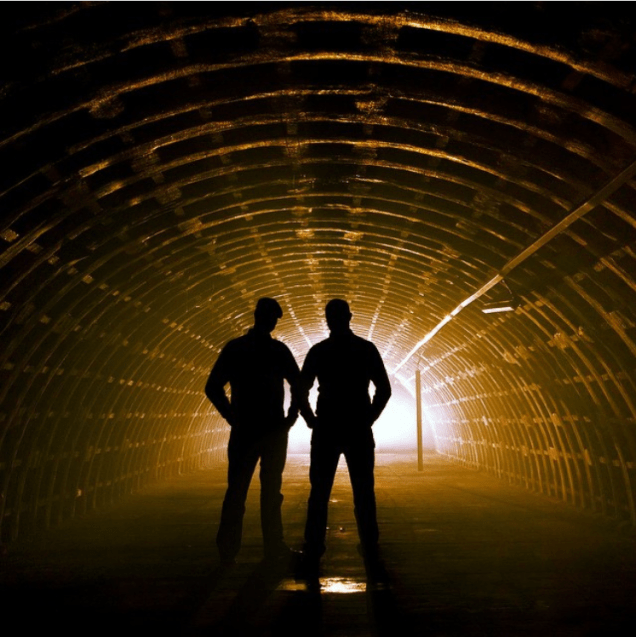
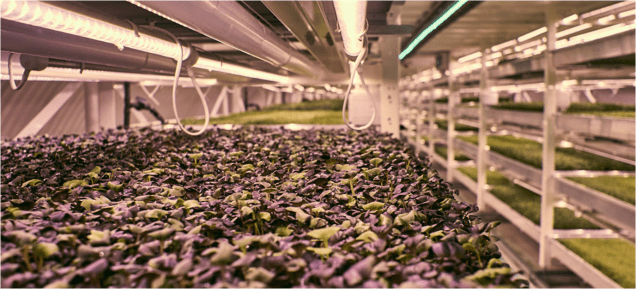
The Hunger Games is one of the current ones in my mind because of the approaching Mockingjay – Part 2 premiere and because of an article on Colossal I saw about a World War II era bomb shelter in London that has been turned into an underground farm.
The company running the operation, Growing Underground, produces leafy greens like watercress, basil, coriander, and radish in hydroponic beds lit by LED lamps.
In the The Hunger Games world, the population of District 13 lives in underground bunkers; the above-ground structures were destroyed by the Capitol. In the Mockingjay novel, Collins mentions various spaces like the armory, the laundry, labs, testing ranges, and farms in passing. She describes these spaces mostly just in very generic terms; e.g., the color of the living compartments is white, and we hear of furniture like dressers and conference tables with individual screens, but that’s about the extent of the detail.
Scenes in the movie Mockingjay – Part 1 show the special weapons lab with a shooting range, the hangar, the bunker, and some hospital and apartment rooms, among others, but I don’t think we’ve seen any underground farms of any kind, nor the poultry farm, for example, that was destroyed in the book version of the bombing of 13 by the Capitol.
Clockwise from top: living quarters, cafeteria, and infirmary at District 13. Images via Jabberjays.net.
The Growing Underground photos of their growing beds fit quite well with Collins’s carefully frugal description and the established Hunger Games visual style. So, in my headcanon, even if we haven’t seen them on screen, District 13’s underground hydroponics now look very much like those of Growing Underground.
Out There is an occasional feature highlighting intriguing art, spaces, places, phenomena, flora, and fauna.





 Co-Geeking
You must be logged in to post a comment.