I’ve been avoiding the reviews, for I just don’t want to be spoiled of any book-to-movie changes. Although there’s one big change I hope against hope will be made: I’d like not so many members of the film crew (especially Finnick) to perish trying to push deeper into the Capitol.
Hey, look! We found a thing on the internet! We thought it was cool, and wanted to share it with you.
From time to time, I get sucked into thinking about the pragmatics of fictional worlds. By that I mean all the mundane details of how people lead their everyday lives, starting from the very basic human (or creature) needs like food, clothing, waste management, and social interaction. Not just who takes care of, say, the laundry and when, but where do they go to do it, how do they get there, what kinds of implements are they expected to bring in themselves and what is shared, how long does it take, what physical motions do they go through, is it a solo activity or a joint effort, and the like.
For me as a visual person, often thinking about everyday activities and movement through spaces tumbles into thinking about what exactly do these various spaces look like. It’s a way to add depth and realism into a story – we are physical beings who love tactile experiences and accumulate all sorts of personal possessions, and if a fictional world ignores that, it makes that world fall flat for me. (Hello, Star Trek!)
The Hunger Games is one of the current ones in my mind because of the approaching Mockingjay – Part 2 premiere and because of an article on Colossal I saw about a World War II era bomb shelter in London that has been turned into an underground farm.
The company running the operation, Growing Underground, produces leafy greens like watercress, basil, coriander, and radish in hydroponic beds lit by LED lamps.
In the The Hunger Games world, the population of District 13 lives in underground bunkers; the above-ground structures were destroyed by the Capitol. In the Mockingjay novel, Collins mentions various spaces like the armory, the laundry, labs, testing ranges, and farms in passing. She describes these spaces mostly just in very generic terms; e.g., the color of the living compartments is white, and we hear of furniture like dressers and conference tables with individual screens, but that’s about the extent of the detail.
Scenes in the movie Mockingjay – Part 1 show the special weapons lab with a shooting range, the hangar, the bunker, and some hospital and apartment rooms, among others, but I don’t think we’ve seen any underground farms of any kind, nor the poultry farm, for example, that was destroyed in the book version of the bombing of 13 by the Capitol.
Clockwise from top: living quarters, cafeteria, and infirmary at District 13. Images via Jabberjays.net.
The Growing Underground photos of their growing beds fit quite well with Collins’s carefully frugal description and the established Hunger Games visual style. So, in my headcanon, even if we haven’t seen them on screen, District 13’s underground hydroponics now look very much like those of Growing Underground.
Out There is an occasional feature highlighting intriguing art, spaces, places, phenomena, flora, and fauna.
Have you read Dune? If so, you might enjoy this early art by John Schoenherr:
John Schoenherr: Dawn at the Palace of Arrakeen.John Schoenherr: Stilgar and His Men.
John Schoenherr: Defeating the Sardaukar.
Apparently, Frank Herbert said Schoenherr (1935-2010) was “the only man who has ever visited Dune.” Schoenherr’s paintings of Herbert’s Dune were published first in the Analog magazine and later in a fully illustrated version.
For me, along with John Christopher’s The Tripods, Dune is one of the SFF books I read in my (much) younger days and have kept re-reading over the years. Seeing this early art was certainly a treat!
It’s well known that George Lucas drew inspiration from mythology when writing Star Wars. Luke Skywalker, the young hero from the planet farthest from the bright center of the universe, gets the call to adventure delivered by droid and goes off on a Campbellian journey to rescue a princess, seek out an ancient mentor, and finally confront his fallen father. The prequel trilogy gave us the tragic version in which Anakin, the great warrior, was driven to madness and destroyed the things he loved the most.
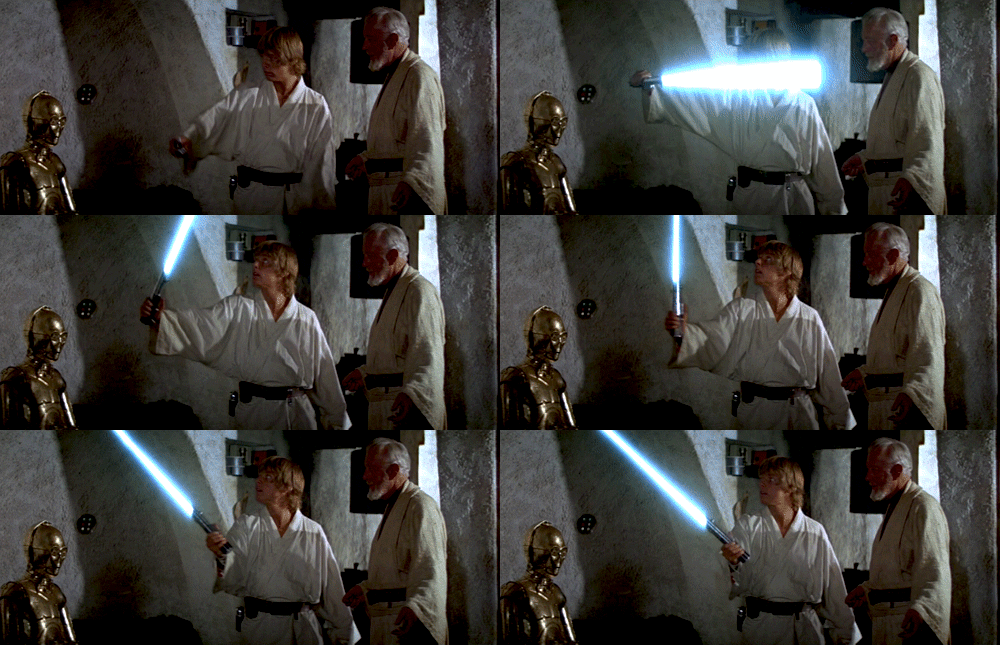
There are smaller touches of myth throughout the Star Wars hexalogy. Luke receives his father’s lightsaber like King Arthur drawing his father’s sword from the stone. The escape from the imperial garbage masher has hints of Jonah and the whale. Luke in the Wampa’s cave has shades of Beowulf.
Like most of the rest of geeky internet, I’ve been watching the trailers for The Force Awakens with excitement. I’ve been struck by something, especially in the latest trailer. The mythology that this latest iteration of Star Wars is working hardest to evoke is… Star Wars.
Star Wars: The Force Awakens Trailer (Official) via Star Wars
Star Wars has transcended being a movie franchise or even an expanded universe. It has reached the point where we can speak of it in terms of mythology.
One of the definitions of myth is that it is a story you know even if you can’t recall ever being told it. Star Wars has that. It is part of our cultural consciousness to the point that even people who haven’t seen the movies (yes, they exist) recognize the sound of a lightsaber and the cadences of the imperial march. Star Wars was all over my childhood, and even though I didn’t get around to seeing the movies until I was a teen (I was a Star Trek fan and young and dumb enough to think that I had to pick one over the other), I recognized Darth Vader, Princess Leia and Yoda on my friends’ lunchboxes.
Another characteristic of myth is that all myths are versions. There is no original, no canon. Though some may disagree on whether this is a good thing, Star Wars has always been an evolving story, getting new versions from small tweaks to big changes. (Yes, I see you in the back in the “Han Shot First” shirt, you can put your hand down.) The new wave of Star Wars movies leaves the old hexalogy alone but reboots the post-Return-of-the-Jedi expandeduniverse.
For those of us who grew up in the world of Star Wars, it is hard to imagine a time when these stories were not a part of the popular culture, yet there was a time when no one had heard Darth Vader’s breathing or Yoda’s grammar, when no one knew what a lightsaber or a Death Star was. By connecting to the ancient stories we already knew, Star Wars made itself feel timeless. Now it has become a part of that universal memory to be played upon and invoked in its own right.
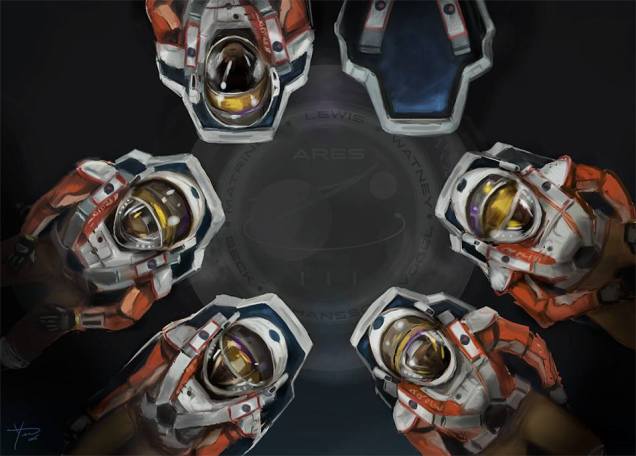
“Was thinking to use this as a reference for a large format painting (in acrylic). After working on this digital painting over a couple of days I’m starting to rethink the feat. My right hand is not happy.”
Beautiful. Reminds me stylistically of some SF book covers I like. I hope a large format acrylic is coming (and published on their website)!
Out There is an occasional feature highlighting intriguing art, spaces, places, phenomena, flora, and fauna.
File 770 has a nice roundup of ten clips from and about The Martian, ranging from teasers and trailers to interviews and talks. The coolest is perhaps a 20-some minute call between two The Martian actors and two of six members of the International Space Station crew:
From the ISS, Expedition 45 Commander Scott Kelly and Flight Engineer Kjell Lindgren were on the horn; from the movie cast, Sebastian Stan and Mackenzie Davis during a visit they made to Mission Control at the Johnson Space Center in September.
Hey, look! We found a thing on the internet! We thought it was cool, and wanted to share it with you.
The more I hear about this adaptation, the more excited I get – and I’m not big on survival flicks! I’m looking forward to seeing more of Donald Glover (whom I only know from Community), Chiwetel Ejiofor, and Sean Bean (who better not die in this one!). I’m also curious about Kate Mara (whose performance I liked in the otherwise deplorable Fantastic Four reboot). I think I also noticed Michael Peña – Luis in Ant-Man – get some space shuttle time.
In any case, it’s going to be especially good after a weak movie August and a disappointing September.