Review of the First Pern Book: Dragonflight by Anne McCaffrey

I’ve long been aware of Anne McCaffrey’s Pern books, if only on a superficial level—fantasy, dragons, getting a bit old but supposed to be good; that sort of an idea. While on the lookout for more cozy fiction in our local library, I randomly ran into Dragonflight, the first Pern novel, and decided to finally give it a go.

And before I get into my review: Spoiler warnings in effect! Also, a heads-up on one f-bomb.

Current Reading Dragonflight

It was interesting. No, truly—not the “interesting” interesting, the faux compliment or empty-nothings-version of polite interesting. Really, truly interesting. And it does feel somewhat old. (Published in 1968, so not as old as The Lord of the Rings, to put it into my own SFFnal context).

Humans settled the third planet in the Rukbat solar system and called it Pern. Contact with Earth was broken, however: after two generations, Rukbat’s stray planet (which follows a wildly erratic orbit) came close enough that deadly spores crossed over to Pern and dropped from the sky with devastating losses, not just among the settlers but native Pernese life as well—only solid rock and metal proved impervious.

To burn these devastating silvery threads from the air before they had a chance to land, men and women with high empathy and rudimentary telepathic ability were trained to work with “dragons” bred from indigenous life forms that resembled their mythical Terran namesakes. The process took generations, and a complex, stratified society with tithing responsibility was created to feed and equip the dragonriders while they focused on defence and training in their unfertile mountaintop abodes known as Weyrs.

Each time the stray planet—also known as the Red Star—passes close enough, the Threads fall for a period of 50 years. Then the wanderer swings far enough away and at least another 200 years (sometimes 400 due to the erratic orbit) go by in peace, which is long enough for the rest of the populace to forget and start resenting the tithes and scorning the dragonmen until the next 50-year Pass comes along.

The two main characters are Lessa of Ruatha Hold and dragonrider F’lar of Benden Weyr. We first encounter Lessa as a ragged kitchen girl who survived by serving those who betrayed her family and took over their lands. F’lar offers her a chance to impress a golden dragon, a future queen dragon, with whom she will share a telepathic bond, and to become a Weyrwoman, a co-leader of a Weyr, possibly with F’lar himself.

Over the couple of years it takes for her queen Ramoth to mature, Lessa learns more about the civilization on Pern, the ballads, the teachings, and what it means to be Weyrwoman. The major problem Benden Weyr faces is that another Pass is impending, but there are not enough dragons to protect all of Pern, for currently only one Weyr out of six remains populated; why dragonriders in the others disappeared hundreds of years ago is not known.

The setting falls into fantasy despite the science-fictional premise, but some details deviate from “pure” medieval-European-based fantasy. For instance, the dragons are able to breathe fire after chewing (fueling up on) a native rock called firestone; dragonriders use this ability to destroy as many Threads as possible while they are still falling. Dragons can also travel instantly from one place to another, or one time to another. Furthermore, all dragons are able to converse telepathically and willing to pass on messages from human to human. Finally, crafters (which I wish were talked about more) end up re-inventing flamethrowers to destroy spores that made it to ground.

The structure differs quite a bit from the typical structure of current fantasy novels. The book is divided into four sections that at times felt like they would’ve worked better as individual short stories. Apparently Dragonflight is actually two novellas squished together to make a novel, so that probably explains this tangle.

There were also confusing things. For example, some events span many Turns (the Pernese year) in a very short span of pages and this isn’t very clearly remarked upon. Somewhat annoying was the s’elling of d’agonrider n’mes w’th an a’ostrophe. There is a story-internal reason, but it’s only vaguely referred to.

Moreover, it was frustrating to me that Lessa kept leaping to conclusions and acting without thought; I would’ve liked to see more character development. The description of the society also remains rather narrow, since the POV characters are almost solely Lessa and F’lar. This feels to me like a deliberate choice by the author, not a flaw due to lack of skill, but your mileage may vary.

Some of the more disgusting details include F’lar’s tendency to call Lessa merely “the girl” and to grab and shake her, and yet he cannot fathom why she at times resents him. Hello, dude, could there possibly be a reason…?!? This might be a character development choice, but it never paid off, IMO. Also, during Ramoth’s first mating flight (with Flair’s dragon Mnementh), Lessa was pressured to stay in telepathic contact with her dragon to take advantage of the surge of sexual desire and to essentially manipulate a pairing of Lessa and F’lar, like their dragons.

Browsing reviews, it’s pretty clear that Dragonflight (and likely the rest of the Pern series) has a particular audience that cares deeply for McCaffrey’s approach and worldbuilding; the rest don’t. I can see why many people liked it, and I can also see why many people disliked it.

I saw one reviewer complain that the main problem was solved “easy peasy because of time travel”. I’d say that’s missing the point; to me the focus isn’t how the lack of dragonriders was solved. Instead, the author concentrates on the attempts to get there. How to find the right people and put them in places where they can be most effective. Convincing others, the necessary political maneuverings, discussing possible strategies, etc., to try and wrangle out a solution to a deadly dilemma given these particular constraints. A kind of council of Elrond, if you like, but as a novel.

I found Dragonflight engaging enough that I started reading the sequel, Dragonquest. However, I soon found I didn’t have the motivation to continue the same kind of people-wrangling, when a lot of the interpersonal relations were antagonistic (I do like my stories with a heaping of Learning to Work Together), and especially because F’lar still fucking cannot stop shaking Lessa. I’ll be better off spending my reading time elsewhere, now that the novelty has worn off.

Image by Eppu Jensen

Review: Blindsight by Peter Watts

Recently I’ve been trying to read more SFFnal classics among my normal selection. I can’t remember why I added Blindsight by Peter Watts (published in 2006) onto my library holds list. When it finally became available and I started to read, I discovered that one of the characters is called Jukka Sarasti (which is a Finnish name), so perhaps that was it.

Content note: spoiler alert!

Current Reading Blindsight

The novel’s events start in the year 2082. A first contact situation arises after thousands of unknown devices burn up in Earth’s atmosphere in a coordinated manner and radio signals are detected near a Kuiper belt object.

Earth sends a ship captained by an AI (called the Captain) to investigate. Theseus is crewed by five augmented humans or transhumans, including their leader, a genetically reincarnated vampire (Sarasti). When the crew wakes from hibernation they discover that Theseus was rerouted mid-flight to a new destination in the Oort cloud. Orbiting a previously undetected rogue gas giant is an enormous, constantly growing object, presumably a vessel, which the crew dub Rorschach.

The Theseus crew begin studying Rorschach with telemetry and excursions despite some very hostile environmental conditions. Additional challenges are posed by psychological effects (hallucinations) and extremely fast, multi-limbed organisms on Rorschach, and on Theseus the crew’s aggravation with the narrator, synthesist Siri Keeton. Eventually relations between Theseus and Rorschach culminate in physical attacks, and only one crew member, Keeton, is sent back to Earth in an escape pod with copies of the information collected before Theseus detonates its payload to destroy Rorschach.

What was especially delightful is that—setting aside Sarasti, who as mission commander and a predator is kind of outside the crew anyway—Theseus’s crew consists of two men and two women, and everyone is described the same way regardless of the configuration of their bodies. Skills and personalities are what matter most. (This is especially enjoyable after reading certain other classic SF novels, which I will leave unnamed to languish in their stifling obsolescence.)

Another interesting detail is that Susan James, the linguist in the crew, actually carries three other personalities or cores in her head, all working and socializing in harmony, and collectively referred to as the Gang by the rest of the crew.

Blindsight turned out to have one suprisingly topical detail. The Gang figure out that despite conversing with the Theseus crew seemingly normally, Rorschach doesn’t really understand the communication. This sounds very much like the recent discussion of Chat-GPT and other AI engines, doesn’t it?

One of the strengths of Blindsight is that it fuses elements from both the so-called hard sciences and the social sciences. Surely SFF (and all storytelling, for that matter) is at its strongest when it’s questioning our perceived realities or possible realities, starting from what makes humans tick. I’m quite tired of SFF that takes bland “and then they went to x and did y” travel narratives and merely cloaks them in fancy wrappings.

Alas, Blindsight has quite a few horror elements and closes with a rather despondent situation. Despite being skillfully written and constructed, it’s therefore not for me.

Blindsight was followed (in 2014) by the novel Echopraxia to make up the Firefall duology.

ICBIHRTB—pronounced ICK-bert-bee—is short for ‘I Can’t Believe I Haven’t Read This Before’. It features book classics that have for some reason escaped our notice thus far.

SFFnal Book Classics: Redemption in Indigo

Redemption in Indigo was Karen Lord’s first published novel. It won a number of awards and nominations, including the 2011 Mythopoeic Fantasy Award for Adult Literature.

Current Reading Redemption in Indigo

The description from Lord’s website reads:

“Paama’s husband is a fool and a glutton. Bad enough that he followed her to her parents’ home in the village of Makendha, now he’s disgraced himself by murdering livestock and stealing corn. When Paama leaves him for good, she attracts the attention of the undying ones—the djombi—who present her with a gift: the Chaos Stick, which allows her to manipulate the subtle forces of the world. Unfortunately, a wrathful djombi with indigo skin believes this power should be his and his alone.”

Redemption in Indigo has been called a contemporary fairy tale, a mix of Caribbean and Senegalese influences (chapters 1-3 are based on the latter), and a story of adventure, magic, and the power of the human spirit, complete with trickster spiders.

I found Redemption in Indigo intriguing and refreshing. Since it pulls from such different traditions than my native northern Finnish ones, I did occasionally have to consciously stop and adjust my expectations (like I did when I was reading Nnedi Okorafor’s Who Fears Death).

Anyway. Paama’s humor was a delight, slightly sarcastic at times, and I’m definitely a fan of well-crafted sarcasm (like Jane Austen’s). Her bit-of-a-dumbo husband Ansige cannot control his appetite, with consequences bordering the ridiculous. Lord also made some interesting structural choices which nod towards oral storytelling traditions.

The most enjoyable feature of the novel, however, was how seemingly small scale beginnings (a wife walking out on her husband) actually turned into life and death siatuations, and, yet, that wasn’t turned into a DRAMATIC OMG IT’S THE END OF THE KINGDOM / EMPIRE / WORLD (again)TM story like so many western fantasy novels tend to be. Lord’s subtle telling just rolls smoothly on, forcing the reader to pay attention. I had more than one “Wait, what?” moment… Which, to be explicit, is a good thing!

Dr. Lord is a Barbadian ownvoices author, editor, and research consultant. Visit Lord’s website for more.

Image by Eppu Jensen

ICBIHRTB—pronounced ICK-bert-bee—is short for ‘I Can’t Believe I Haven’t Read This Before’. It’s an occasional feature for book classics that have for some reason escaped our notice thus far.

Three Favorite Jane Austen Screen Adaptations

July 18, 2017, marked the 200th anniversary of the death of Jane Austen, my favorite (deceased) author.

JASNA Truth Universally Acknowledged Book Always Better

To honor her work, we rewatched all of the screen adaptations that we could easily get our hands on.

Jane Austen Rewatch Owned Adaptations

Here, in short, are three of my absolute favorites. (For links to the complete reviews, visit my post A Jane Austen Rewatch Project for the 200th Anniversary of Her Passing.)

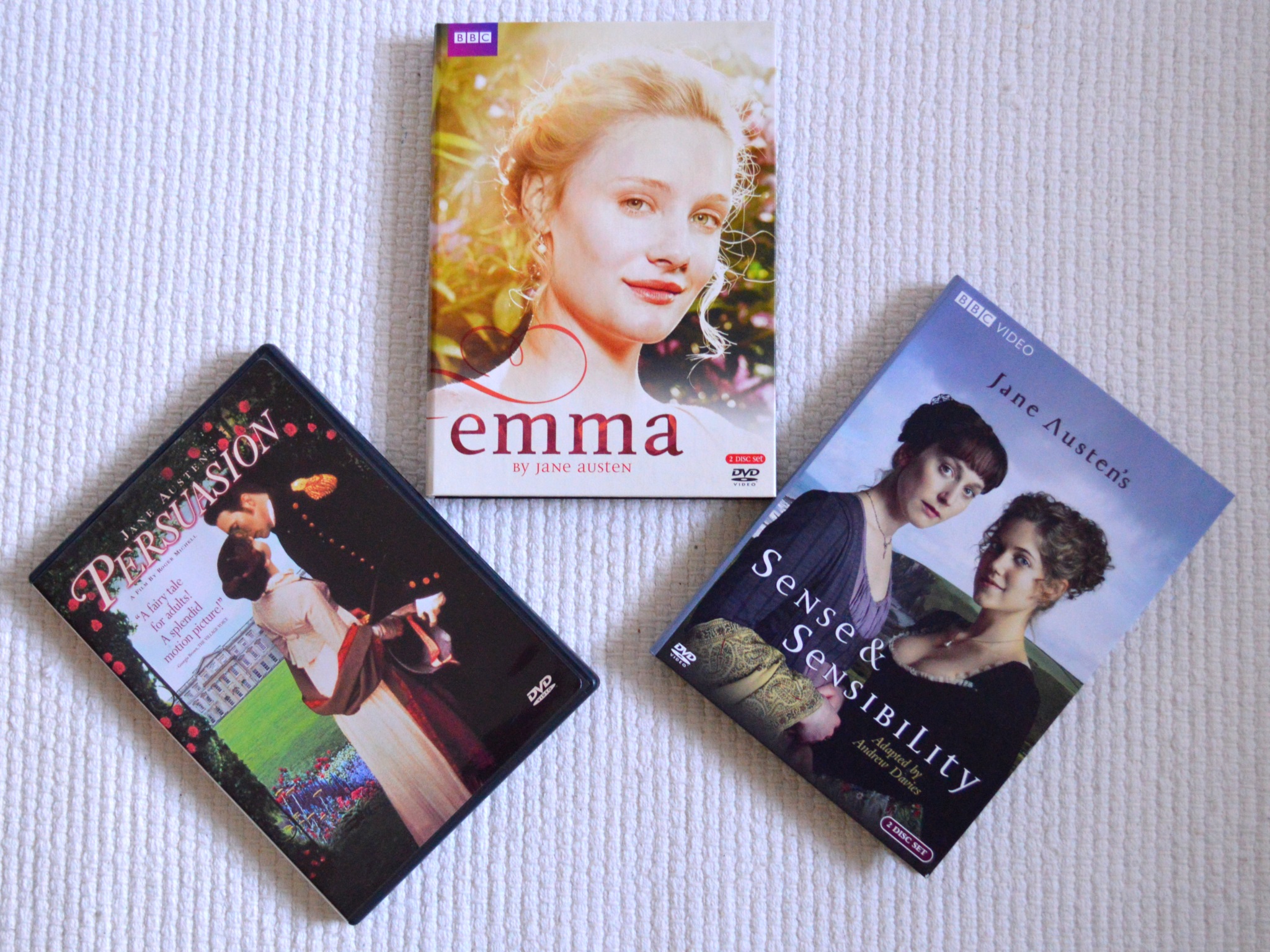
Sense and Sensibility (anonymously published in 1811) is by far my favorite Austen novel, and my favorite adaptation is the Andrew Davies miniseries (directed by John Alexander; 2008). It stars Hattie Morahan and Charity Wakefield as Elinor and Marianne. Both were new to me, but I was familiar with the significant male actors: Dan Stevens (Mr. Edward Ferrars) is in the first few seasons of Downton Abbey, David Morrissey (Colonel Brandon) portrays the confused faux-Doctor in the Doctor Who Christmas special “The Next Doctor”, and Dominic Cooper (Mr. Willoughby) as young Howard Stark scratches science to see if it bleeds in Marvel Cinematic Universe’s Captain America: The First Avenger and Agent Carter (and rules as King Llane Wrynn in the Warcraft movie).

It was a gutsy choice of Davies to begin the series with Willoughby’s explicit seduction of a 15-year-old girl, an event which happens very much off-screen in the novel and most adaptations, but becomes the crux of the plot.

The series does have some issues. For example, the Devonshire “cottage” that the financially strained Dashwood ladies had to accept was turned into a literal cottage instead of a good, solid house from the novel. The events are condensed, sure, but their pace doesn’t feel rushed like in the movie versions. Most of the writing, acting, propping, and costuming are solid to excellent.

Jane Austen Rewatch Three Favorites

Emma (1815) was the fourth and last of Austen’s works to be published during her lifetime, and the Emma miniseries from 2009 (adapted by Sandy Welch, directed by Jim O’Hanlon) outshines the other adaptations. (Unsuprisingly, the miniseries format serves Austen’s nuance much better than the movie length.)

The version has several strengths, starting with excellent casting. Romola Garai stars as Emma Woodhouse, and Jonny Lee Miller (who has more recently – and deservedly – starred as Sherlock Holmes in the series Elementary) as Mr. Knightley. Miller’s is by far the most enjoyable Mr. Knightley performance I’ve seen. Mr. Knightley is often played as rather curt and strict, which I find not just offputting but a mistake.

All major characters are introduced at the beginning of episode 1, which helps people new to Austen. Moreover, this version does the epilogue clearly and succinctly, without massive infodumping. In addition, I immensely enjoy the music, the set dressing, costuming and propping, and other visuals. It’s a thoroughly, thoroughly enjoyable Emma. In fact, if the same team were to make other Austen adaptations, I’d go to great lenghts to see them.

Finally, Persuasion is a novel of pressures, choices, and second chances, posthumously published in 1817. The 1995 movie version of Persuasion is excellent. The screenplay is by Nick Dear, and Roger Mitchell directed Amanda Root as Anne Elliot and Ciarán Hinds as Captain Wentworth. I really like Root’s understated and considerate version of Anne; Hinds works well enough even if a few scenes tend towards hammy.

Although the picture quality is grainy, the soundtrack is nice and there are subtitles (not a given on older DVDs). The props, locations, and costuming are also great. This is my favorite version so far—in an ideal world, of course, we would be due another adaptation.

For links to the complete mini-reviews of these and all of the other adaptations, visit my post A Jane Austen Rewatch Project for the 200th Anniversary of Her Passing.

Images: Book is always better screencap from JASNA website. Both DVD images by Eppu Jensen.

In the Seen on Screen occasional feature, we discuss movies and television shows of interest.

Quotes: A Question that Pretty Much No One Actually Asked to Be Answered

Aaron Pound at Dreaming About Other Worlds reviews the Star Wars movie Rogue One and includes this delicious bit of analysis:

“The obvious slicing and dicing of the intrigue and adventure in the early parts of the movie would be forgivable is [sic] one were able to think that it was done simply to try to cram as much of that as possible into the story, but instead the movie keeps shifting away from Jyn, Cassian, K-2SO and the rest of the intrepid rebels to focus on what can only be described as the deadly dull office politics of the Imperial Officer class. In large part, all these scenes really do is provide a really long-winded answer for the question ‘How did Grand Moff Tarkin become the commander of the Death Star’, which is a question that pretty much no one actually asked to be answered.”

– Aaron Pound

Reader, I LOLed. 🙂

Pound, Aaron. “Review – Rogue One: A Star Wars Story”. Dreaming About Other Worlds, June 01, 2017.

Serving exactly what it sounds like, the Quotes feature excerpts other people’s thoughts.

Arrival Recap

So, here are some initial thoughts on Arrival. Spoiler alert is most definitely in effect!

Twitter Arrival Movie Poster Aug 16 2016

Things I loved:

  • No stealth female protagonists here, but an actual, full-time, proper female lead who isn’t there for her boobs and butt, but brains!
  • Top notch plotting, dialogue, and characters, all in all. Also the directing, sets, music, and effects were impressive.
  • Some of the trailers make it look like the linguistics lecture in the very beginning is in a huge auditorium with only a handful of students attending, which might have meant that the movie university was going to have a neglected linguistics department or lukewarm students. Not so. There was a good reason why students didn’t show up, i.e., the alien landing.
  • Dr. Louise Banks (Amy Adams) was treated as an expert almost universally. Notable exceptions were a CIA bloke at the Montana camp and Dr. Ian Donnelly (Jeremy Renner), the male lead. The latter, upon meeting Dr. Banks for the very first time, quoted something she’d written and said something to the effect of “Too bad it’s wrong.” Tut tut. He got over himself, though.
  • Colonel Weber (Forest Whitaker), the army liaison for the civilian consultants, was an actual ally to Dr. Banks and Dr. Donnelly, not an antagonist. It would’ve been so easy to take the lazy road. (Then again, they did take it with the antagonistic CIA bloke.)
  • The complexities of language and communication were explained with easily understandable comparisons.
  • Languages were treated as the complex systems that they are, i.e., other levels beyond the lexicon got attention.
  • Many of the English translations of the heptapods’ language were messy (e.g., “Abbott is death process” = “Abbot is dying”). As a non-native English speaker who operates with two languages on a daily basis, I found it very realistic. There are times when quick and dirty is what you need, and others when you can spend more time pondering. In a first contact situation where political and military pressures are high, there might not even be a need to polish the English syntax as long as the message is unambiguous.
  • Some of the aliens’ language was subtitled. I’m a visual person; in addition, I can’t always hear everything in noisy environments such as movie theaters or restaurants. ❤ subtitles!
  • The story is very explicit about the need for people work together to solve problems without feeling preachy. YMMV.
  • A male hero doesn’t punch an alien in the face at the end. I’m all for punching the bad guys—now and then. I explicitly do not want all of my reading and viewing rehashing the same old stories over and over, because SFF is explicitly about examining other possibilities. It feels (’cause I haven’t seen any statistics or anything) like lately we’ve mostly gotten the punchy kind of SFF. It was so nice to face a different fare for a change.

Things I didn’t think were quite as successful:

  • Only one prominent female speaking role. For realz. Surely you’re better than that, writing team.
  • The conflation of linguistics and translating. Of course the two disciplines are related, but each comes with its own set of principles and tools.
  • Dr. Banks and Dr. Donnelly each got their own team in Montana, but the teams were hugely underused. They might have been completely omitted for all the difference they made.
  • Dr. Banks’s visions affected her thinking and behavior, but weren’t integrated into the dialogue terribly well. The one time they tried (“Are you dreaming in their language?”), she responded very defensively, and the matter was dropped without further exploration.
  • Non-linear time as part of the plot. It’s a very difficult concept to pull off successfully. I haven’t come across a story yet where I think it works to its full effect. (I might feel differently about “Story of Your Life.” Note to self: Find it & read.) Even so, the execution in Arrival was one of the most elegant I’ve encountered, and the reveals were well-paced.
  • At the end, the aliens indicate that they’re sharing their full language with Dr. Banks because in 3,000 years they will need humanity, but that was it. What a cliffhanger!

I’ll finish with a couple of links:

How the writer of ‘Arrival’ spent a decade getting his sci-fi Oscar contender made. An interview with screenwriter Erik Heisserer that sheds light to the difficulties in getting a movie project greenlit and adapting the inspiration story.

‘Arrival’ Author’s Approach To Science Fiction? Slow, Steady And Successful. An interview with Ted Chiang, whose short story “Story of Your Life” (1998) was the basis for Arrival.

Ted Chiang, the science fiction genius behind Arrival. Another focus piece on Chiang.

Image via Arrival Movie on Twitter

In the Seen on Screen occasional feature, we discuss movies and television shows of interest.

Ursula Le Guin: The Left Hand of Darkness

My latest reading project rolls on with The Left Hand of Darknessby Ursula Le Guin (first published in 1969).

The Left Hand of Darkness

Genly Ai is sent to planet Gethen (also known as Winter due to its extremely cold climate) as an envoy for the Ekumen of Known Worlds, an interstellar conglomeration for trade and cultural exchange. His mission is to convince the planet to join the Ekumen, easier said than done on a world where the conditions are semi-arctic even at the warmest time of the year and where cultures and technologies change at a glacial pace. (Pardon the pun!)

I knew a little of Left Hand before reading it. I knew that it’s highly regarded, that the inhabitants of the world are androgynous (or something) and that there’s an arduous trek across a glacier (or snowy steppes or somesuch) that’s somehow significant.

I also knew that some people describe the book as being about gender. Gethenians are all of the same sex – or, rather, of no sex until their monthly reproductive cycle known as kemmer comes around. At that point, depending on who else is in kemmer nearby, a person may turn either into a Gethenian male or female, and it’s quite usual for someone to be both a mother and a father.

I’m not entirely sure yet what Left Hand is about for me. The Gethenian biology does get a lot of attention, but I suspect it’s because it’s so unfathomable to Ai. The importance of hospitality and cooperation in the cold climate is also significant, as are the balancing of opposite forces (like you-me or individual-society), the complex Gethenian honor system shifgrethor and their aversion to war. Karhide’s neighboring country Orgoreyn sounds like a communist regime, with its people described as units instead of citizens and its communal resources or endless bureaucracy; Orgoreyn may, in an unprecedented step, be moving towards starting a war with Karhide, and we might have a Cold War echo there.

Structurally, Left Hand avoids infodump by alternating the present-day narrative chapters with short chapters on Gethenian mythology. I was a little bothered by how much longer the primary narrative chapters were, for it made reading the novel choppy; I may well change my mind about that if I read Left Hand again.

I’ve seen Le Guin’s writing described as zen-like. The descriptor fits her style in Left Hand well, especially when she’s describing traveling across the icy landscape. A fascinating read, and one I may well like to get back to after mulling it over. Considering that I very much enjoy and have read Le Guin’s Earthsea stories several times in two languages, I can’t believe I haven’t read The Left Hand of Darkness before!

Image by Eppu Jensen

This post has been edited.

ICBIHRTBpronounced ICK-bert-bee—is short for ‘I Can’t Believe I Haven’t Read This Before’. It’s an occasional feature for book classics that have for some reason escaped our notice thus far.